
‘Propaganda Steamers and Trains’ from Soviet Russia (New York). Vol. 4 No. 15. April 16, 1921.
Soon after the proletariat’s victory in November there arose the acute question of contact between Moscow and Petrograd, the centers of the Revolution, and the provinces. It was a question of supplying the provinces with information concerning the policy and activity of the Soviet Government.
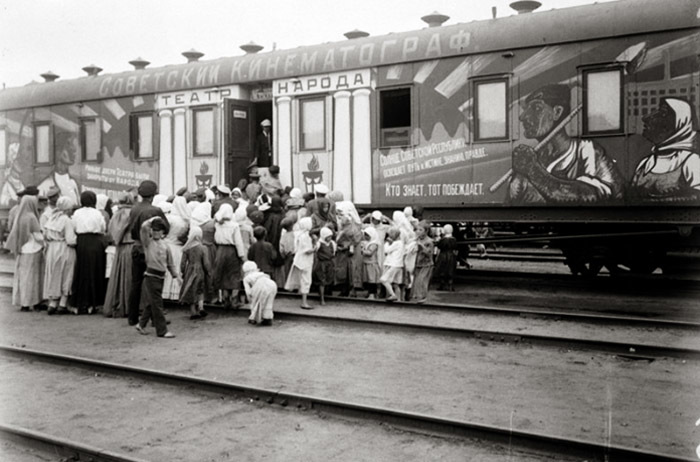
One and a half years ago the foundation was laid of two auxiliary movable networks of propaganda organizations, in the shape of a flying detachment of organizing and propaganda trains, and a flotilla of steamers, for the purpose of rendering swift aid to the provinces, to unite them with the center, to guide and control the local organs of government and organizations, to develop extensive agitation and conduct the supply of literature and decrees.
The propaganda boat or train, in its construction, represents a complete harmonious whole. It is an itinerant general soviet institution. In its general organization it is very similar to the construction of the National Central Executive. It is the “National Executive on the road,” as one comrade called it. The analogy is partly right. This can be seen by a close inspection of the sections of the train (or the boat). The following is a brief outline of these sections:

The Political Section, the chief section of the train. It consists of: (a) instructors sub-section, containing instructors from practically all Commissariats and the Central Committee, and (b) agitation and lecturing collegiate, of agitators and lecturers. This Section carries on the basic work, i.e., it organizes, inspects the local Soviet and Party organizations, and carries on mass agitation amongst the population. At the head is a political commissar.
The Grievance Bureau is also an important section. Here the people hand in all complaints and written statements against the local organs of government and their separate representatives. Usually the chief of this section is a representative of the Russian Communist Party.
The Intelligence Section carries out all the preparatory and auxiliary work for the Political Section; it sees to the execution of the established program at all stopping places; it summarizes the work of the Political Section and other auxiliary sections, and collects material and information. This Section is in direct touch with the Political Section.

The Rosta (Russian Telegraph Agency) Section carries on the publishing, editorial and information work, publishes a newspaper, leaflets, proclamations, etc., and conducts the work of the train’s radio-station. At the head of this Section is a responsible representative of the Russian Telegraph Agency (the editor). It is also his duty to instruct the local press organs and to go into the Political Section as a political worker.
The remaining sections are as follows: the Cinema, Book Stall, Exhibition, Accounting and Control sections, the Commandant, the Economic and the Technical sections.
All the above-named sections are accommodated in sixteen to eighteen freight and passenger cars. The entire train is uniform.
The sections of the train are connected by interior telephones, which can be connected with the Central if necessary. Every train (and boat) has a wireless station which receives messages from Moscow, Lyons, Nauen and other places in the course of its journey. There is direct communication from one car to the other, so that inside the work goes on while the train is moving.
The occupants of the train consist of 15 to 18 political workers, and about 80 to 85 technical collaborators, working for the political section and all the auxiliary sections of the train. (On a boat there are 175 to 200 technical collaborators.)

The outside walls of the trains are painted with pictures and watchwords. Futurism has already done away with, and the paintings are now of a purely realistic character.
The following is some data concerning the work of the propaganda trains of the National Central Executive Committee from December 27, 1918, to December 12, 1920:
The Train “November Revolution” made 12 journeys.
The Train “Lenin” made 3 journeys.
The Train “Red Cossack” made 1 journey.
The Train “Soviet Caucasus” made 1 journey.
The Train “The Red East” made 1 journey.
The Boat “The Red Star” made 2 journeys.
Total, 20 journeys.
Provinces recurrently attended 96.
Stoppages made 775.
At provincial towns 96.
At county towns 189.
Time spent on stoppages (days) 656.
Meetings conducted 1,891.
Attendance at meetings 3,752,000.
Lectures 1,008.
Attendance at lectures 25,200.
Business meetings with local workers 1,334.
Inspection of Soviet and Party organs 3,543.
Moving-picture shows 1,962.
Concerts 106.
Attendance at cinemas and concerts 2,216,000.
Number of grievances received 14,548.
Attendance at agricultural and sanitary exhibitions, and exhibition on Mother and Child Protection on board “The Red Star” 132,500.
Attendance at Medical Exhibition on the train “The Red East” 34,000.
Printed matter, distributed, published in the trains, in Russian and other languages:
(a) Newspapers (copies) 1,641,400.
(b) Leaflets (copies) 1,428,000.
Literature sold to the value of (roubles) 11,657,335.
Soviet Russia began in the summer of 1919, published by the Bureau of Information of Soviet Russia and replaced The Weekly Bulletin of the Bureau of Information of Soviet Russia. In lieu of an Embassy the Russian Soviet Government Bureau was the official voice of the Soviets in the US. Soviet Russia was published as the official organ of the RSGB until February 1922 when Soviet Russia became to the official organ of The Friends of Soviet Russia, becoming Soviet Russia Pictorial in 1923. There is no better US-published source for information on the Soviet state at this time, and includes official statements, articles by prominent Bolsheviks, data on the Soviet economy, weekly reports on the wars for survival the Soviets were engaged in, as well as efforts to in the US to lift the blockade and begin trade with the emerging Soviet Union.
PDF of full issue: (large file): https://www.marxists.org/history/usa/pubs/srp/v4-5-soviet-russia%20Jan-Dec%201921.pdf
 Revolution's Newsstand