
The Ohio State Penitentiary in Columbus, built in 1834 to house 1,500 inmates and notorious for its cruelty, was jammed with 4,200 prisoners in 1930. Then, like now, a disproportionate number of incarcerated were Black. On April 21, 1930 a fire began in a wing of the prison. Guards refused to open cell doors and five hundred soldiers with machine guns lined the parameter to prevent ‘escape.’ 322 people were consumed in the inferno. hundreds more injured. Prisoners that survived rescued each other. It was the worst prison disaster in U.S. history.
‘The Columbus Holocaust and the Class War’ by William F. Dunne from Labor Defender. Vol. 5 No. 6. June, 1930.
THE American capitalist policy of “bigness before everything, bigness in everything,” found a splendid avenue of expression in the recent roasting to death of 322 prisoners in the Columbus, Ohio penitentiary.
The ruling class and its dupes and degenerates, especially in the South, long ago learned to like the smell of roasting human flesh, and the burning of Negroes at the stake took on the character of a social function.
In Sherman, Texas, just the other day, the whole white population of the town turned out, according to news dispatches, to express its sadistic lust by burning a Negro alive in a jail and burning the jail as well.

But it took Northern capitalist justice to stage a holocaust the like of which has not been seen since Nero dipped hundreds of early Christian converts in bitumen and used them as torches to light his gardens and games.
In any other capitalist country such a horror would be followed by the resignation of the government in power. In democratic America it is merely a nine days wonder. One searches in vain for any further reference to it in the capitalist press. Not a single responsible official is removed. The Governor of Ohio puts the blame on the unfortunates whose 322 charred corpses made a happy harvest for the undertakers.
More than this. One of the thousand national guardsmen who surrounded the scene of horror shot two sleeping prisoners a weak after the mass murder. He was excused on the ground of “nervousness.”
No distinction is made in the Ohio prisons between political prisoners and those convicted of ordinary crimes. Charles Guynn, national secretary of the National Miners’ Union, and Tom Johnson, organizer for the Metal Workers’ Industrial League, were in the Columbus prison, shortly before the fire, awaiting release on bail pending appeal of their five to ten year sentences under the criminal syndicalism law.

Their crime was to organize workers into militant unions. Guynn, with three other prisoners, was confined in a cell on the fifth tier where most of the deaths occurred. The three prisoners who shared the cell with him were burned to death.
Had he and Tom Johnson not been released on bail they would have been burned to death. Two more militant leaders of the working class would have been punished with death for loyalty to their class.
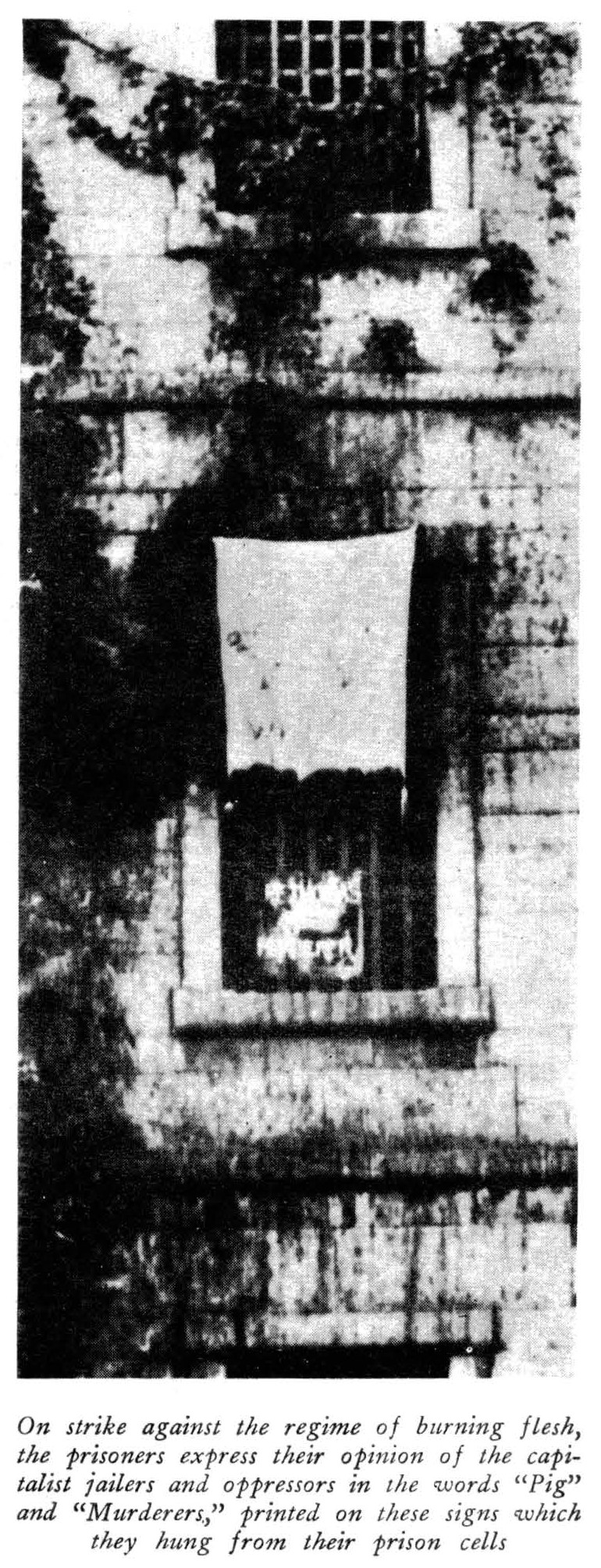
Revolt after revolt has taken place during the last year in American prisons. They are the attempts on the part of the ever-increasing prison population to force better treatment.
Jails and prisons are filled to overflowing. Hundreds of new criminal laws make a network in which thousands of the poorest section of the populace are caught. “Law enforcement” committees composed of businessmen continually demand more stringent statutes for this and that offense and more drastic administration of the criminal laws.

Prohibition law violations send thousands to jail but it is noticeable that powerful gangsters and racketeers rarely see the inside of a prison. It is the small fry that is caught and jailed.
But the mere existence of the prohibition law does not explain the rapid increase in the prison population. Neither does it explain the increasing severity of the punishments inflicted nor the passage and enforcement of such medieval measures as the Baumes law-making life imprisonment automatic for the fourth offense.
The real explanation is to be found in the worsening conditions of the masses-the creation of a permanent army of unemployed through rationalization, in the permanent displacement of hundreds of thousands of workers by labor displacing machinery, new chemical processes, the speed-up, and finally by actual curtailment of production as a result of the deep economic crisis.

The relation of “crimes against Property” to “bad times” industrial depression, periods of exceptionally high prices for the necessities of life, unemployment, etc. has long been recognized. Both Marx and Engels pointed out how the increase in certain crimes in England paralleled bad crop periods and high prices for wheat.
Prices in the United States are dropping but an army of workers displaced by rationalization have for a long period now found it impossible to get jobs in other industries. “The absorption” of workers displaced by rationalization in the older industries, by the “newer” industries is a fiction of capitalism.
The standard of living of the working class is being lowered rapidly. A certain percentage of the Workers are forced into the ranks of the slum proletariat and criminal element. They have no other choice except starvation.
In addition to the hundreds of thousands thrown out on the street by labor-displacing machinery and the speed-up, the chronic and deepening agricultural crisis is driving some 200,000 farmers into the industrial centers every year. Furthermore, between 1,500,000 and 2,000,000 children reach working age every year.
These contingents swell the ranks of those looking for jobs in industries where production is increased with less workers employed.
The answer of the ruling class is the enactment of more restrictive laws, the erection of more jails and prisons. The most “liberal” section of the capitalist class advocates “better prisons and a better prison system.”
To say that prisoners in the United States are treated like beasts would be wrong. A peasant who treated his live stock like prisoners are treated would be brought to task by his neighbors for cruelty.
Four and six men are jammed into cells too small for one or two. Prison food, for the most part, is slop and garbage fit only for fertilizer. The prison officials are grafting pets of crooked politicians, the guards are the scum of humanity.
The few prisoners who have money can buy anything in a penitentiary- morphine, cocaine, whiskey, prostitutes. But prison regulations regarding visitors, letter writing, books and newspapers are very strict because, so the officials say, the above commodities might otherwise be smuggled in. Tobacco is precious enough to serve as a medium of exchange, but this too must pay its toll of graft to the prison ruling class-from screws to warden.
The number of prison revolts is not the remarkable fact- what is remarkable is that there have not been more of them.

Socialists, Norman Thomas, for instance, claim to see in the numerous exposures of corrupt city, state and federal judges, and in their resignations and removals, a turn for the better. Capitalism is cleansing itself, they say, and they are overjoyed. Socialists, of course, are for honest capitalist judges and policemen and capitalism is proving that democracy means something to the working class after all in spite of Communists’ claims to the contrary. What is actually happening is that the more intelligent capitalists see the tremendous process of disillusionment that is taking place among workers as a result of permanent mass unemployment, rationalization and the growing suppression.
It is therefore necessary to pick out a few scapegoats upon whom all the sins of capitalism, and its courts and police, against the working class can be heaped. They are sacrificed and the capitalist press loudly calls attention to the fact that the scales of justice will not be permitted to remain in dishonest hands. “Rich and poor are equal before the law,” but the poor fill the jails and prisons. Rich and poor alike, said Anatole France, have the right to sleep under bridges.

No better examples of the use of the criminal code against workers are to be found than in the treatment handed out to Comrades Foster, Minor, Amter and Raymond by the New York courts, and the jailing of Comrades Powers and Carr in Atlanta, Ga.
The constant clamor for more rigid law enforcement by press, preachers and other mouthpieces of capitalism is essentially preparation for still more sweeping suppression of all militant union and revolutionary activity.
The campaign has two objectives-to secure the passage of more drastic anti-working class legislation, and to create a situation where protests against legal suppression will meet with little response. Under the guise of crime suppression the capitalist class is preparing further onslaughts on the legal liberties of the working class–especially upon the Communist Party and the militant trade unions. The A. F. of L. leaders, like Woll, take the lead in the campaign.
The widest agitation must be earned on against this offensive. Mass agitation must be followed by mass organization and protest. We must fight stubbornly for every inch-we must not fatalistically surrender by failing to fight against further restrictions on press, speech and assemblage.

We must show the difference between the criminal code in the Soviet Union, its legal system, and the criminal code and prison system of American capitalism.
We must now carry out a huge mass mobilization for the unconditional release of all class war prisoners-one of the outstanding political issues confronting the working class. It is an issue which, properly connected with the other basic issues arising out of the drive against the working class, can become a leading slogan in a mass political strike.
Labor Defender was published monthly from 1926 until 1937 by the International Labor Defense (ILD), a Workers Party of America, and later Communist Party-led, non-partisan defense organization founded by James Cannon and William Haywood while in Moscow, 1925 to support prisoners of the class war, victims of racism and imperialism, and the struggle against fascism. It included, poetry, letters from prisoners, and was heavily illustrated with photos, images, and cartoons. Labor Defender was the central organ of the Scottsboro and Sacco and Vanzetti defense campaigns. Editors included T. J. O’ Flaherty, Max Shactman, Karl Reeve, J. Louis Engdahl, William L. Patterson, Sasha Small, and Sender Garlin.
PDF of full issue: https://www.marxists.org/history/usa/pubs/labordefender/1930/v05n06-jun-1930-LD.pdf
 Revolution's Newsstand