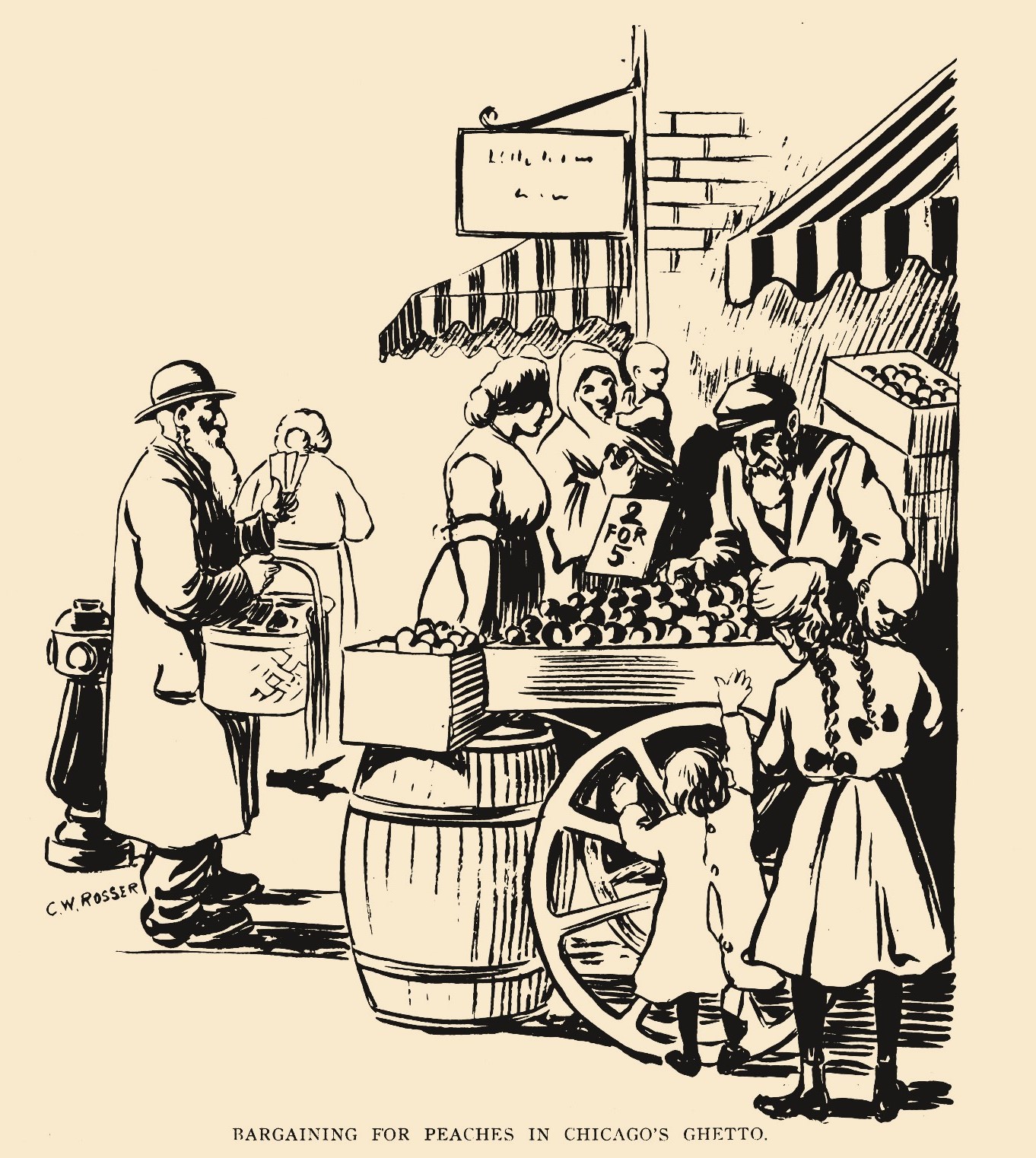
‘The Gulf Between the Michigan Fruit Belt and Chicago’s Ghetto’ by Palmer Hoke Wright from The International Socialist Review. Vol. 16 No. 7. January, 1916.
OUR very best physicians assure us that fruit is one of the greatest blessings nature has bestowed upon mankind. I am not a physician, but I do know that when one’s stomach is empty, fruit is a very good substitute for corn beef and cabbage. I also know something else about fruit, for I spent a couple of weeks in the great Michigan fruit belt, and then went back to Chicago and put in a few days in the ghetto district of that proud metropolis. In Michigan I found one of the finest fruit crops that district has known for many years, but I also found something else, the something else being the sight of tens of thousands of bushels of peaches, pears and apples rotting on the ground. On the other hand, in the poorer districts of Chicago, the best bargain I could drive with the peddlers was three miserable-looking pears for a dime and the same coin would purchase from four to six peaches, according to the stage of decay.
If this state of affairs arouses the reader’s curiosity, as it aroused mine, perhaps we can get together on a common basis and figure out just why it is that a large number of people in Chicago are hungry while a little more than ninety miles away enough food to feed every starving victim of the competitive system of distribution rots on the ground.
Now, you will ask, just why should the fruit grower let his product go to waste when there is a great market so near at hand? The answer is simply this:
Neither the grower nor the various commission merchants who derive profits from the industry are the least bit interested in seeing to it that everyone is supplied with all the fruit they want at a reasonable price. They are interested solely in the proposition of making as much money as possible in the shortest possible time. In order to accomplish this purpose, the growers band together and we have a number of organizations which are known as Fruit Growers’ Associations. These associations are formed in order that the growers can control the market in such a way as to assure big prices. The theory is that it is much more profitable to get a big price on a small amount of fruit rather than a low price on greater quantities. You can easily see just how the consumer is not taken into consideration.
The associations make arrangements with the South Water street commission merchants in Chicago to handle so much fruit at a certain price. The South Water street merchant, in turn, disposes of the product, at a profit, of course, to the outlying commission men who deal with the retailer, the man from whom the ordinary mortal buys. Every time the fruit changes hands the price changes also — it goes up. The result is that only the well-to-do family can have fruit; the rest of them can exercise the divine privilege of wishing for it all they please. Verily, the way the capitalistic class has of preventing the distribution of food is wondrous to behold; it is a marvel of perfection — for the capitalist.
Socialism offers a certain remedy for the conditions just set forth. Under a Socialist form of government, the government, which would be yourselves, friend readers, would own the fruit lands of Michigan. You would also own the railroads and steamship lines which connect the market with the source of production. These systems of transportation would be conducted in a far different manner than the one in vogue today. Instead of the fallen down, poorly equipped and badly managed railroads, you would have well organized, properly conducted and splendidly equipped steam lines which would do away with all the waste and lost energy so common today. The fruit would be raised by responsible leaseholders of government-owned lands who would take pride in sending to market the finest fruit nature can produce, and it would be such a simple matter to get the product to market that there could be no possible excuse for any of it going to waste. When the fruit reached the great centers of population it would be taken immediately to the government-owned distribution stations, which would be so placed as to make them easily accessible to everyone. We would eliminate all chance for waste. The prices would be low. Fruit would become an article of every-day consumption rather than something intended for only the very rich. There would be no haggling middlemen to extort a profit; there would be no such incidents as the one which happened in Chicago the other day when commission merchants destroyed eleven car loads of peaches to prevent glutting the market.

Perhaps all that sounds like an Utopian dream. Perhaps you will continue to look upon such statements as the product of a mind given to dreaming. On the other hand, perhaps you will start to thinking the matter over and become enough interested in what Socialism has to offer to make a study of what it proposes. That is all that is necessary. When you start to thinking you will become socialistically inclined. You can’t help it if you really think.
I have told you why it is that fruit rots upon the ground while people are hungry. Similar conditions exist in the production and distribution of every other item of food; of clothes; of coal and wood; of medicine, in fact, of everything. What are you going to do about it? Think Socialism and keep on thinking it. It won’t be long before you will be doing more than thinking. You will act.
The International Socialist Review (ISR) was published monthly in Chicago from 1900 until 1918 by Charles H. Kerr and critically loyal to the Socialist Party of America. It is one of the essential publications in U.S. left history. During the editorship of A.M. Simons it was largely theoretical and moderate. In 1908, Charles H. Kerr took over as editor with strong influence from Mary E Marcy. The magazine became the foremost proponent of the SP’s left wing growing to tens of thousands of subscribers. It remained revolutionary in outlook and anti-militarist during World War One. It liberally used photographs and images, with news, theory, arts and organizing in its pages. It articles, reports and essays are an invaluable record of the U.S. class struggle and the development of Marxism in the decades before the Soviet experience. It was closed down in government repression in 1918.
PDF of full issue: https://www.marxists.org/history/usa/pubs/isr/v16n07-jan-1916-ISR-gog-Princ-ocr.pdf
 Revolution's Newsstand