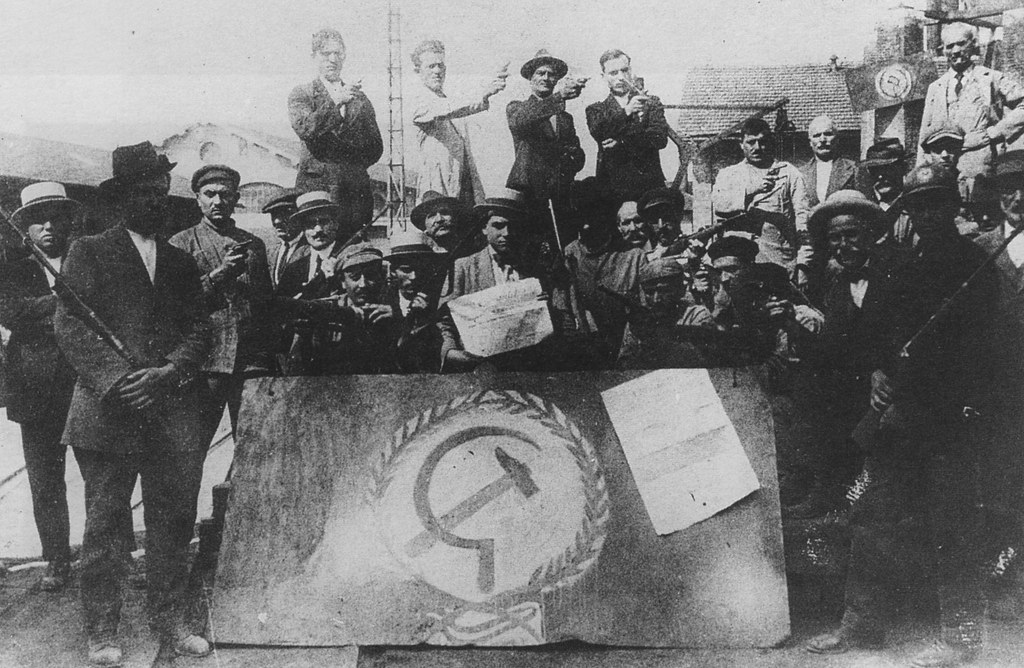
The Italian Revolution arrives in New York City. Michael Gold reports on the visit of the Crema, a freighter owned by the militant Italian seaman’s union, The Cooperative Garibaldi, to Brooklyn’s docks during the Biennio Rosso, and boycott of equipment going to Russia’s counter-revolution by transport workers around the world.
‘Under Two Flags: Italian Radicals in New York’ by Michael Gold from The Liberator. Vol. 3 No. 10. October, 1920.
THE Italian revolution was visiting here in New York this last month; a pretty thing, a graceful, fiery creature, impudent and romantic as a young girl, and as beautiful to the sad eyes of one who has beheld only our common-sense, ground-gripping, home-grown revolutionary spinsters these many, many years.
I saw the blessed little foreigner, after it had slipped in one dawn between the decks of a husky grey weathered freighter named the Crema, that the Italian seaman’s union has bought along with five other ships and is running not for profits, but to pile up finances for- you know what.
I went aboard on a bright Neapolitan day, with a deputation of Italian socialists and others, to see what was to be seen. There was the long desolate wooden Brooklyn pier, with the usual bilious guards brooding on their flat feet amid the hillocks and tarpaulin-covered pinnacles of assorted freight. There were the sweating, docile longshoreman, and then the grimy, angular old unregenerate beast of a Crema, herself, sitting on the greasy river up against the docks. The sun beat on her, the stench and sound of work rose from her dark insides, she was ugly and real as a pile driver or a railroad tie.
The steward came out to meet us, a tough little fighting man of about thirty-five, with one of those hard masculine proletarian faces that have taken the heaviest blows of history and have always come back for more. He grinned joyously behind his tawny moustache as he shook our hands and greeted us. His blue eyes gleamed. He told us he was glad to see America. Then he drew our attention to something floating from the masthead. He was an old Italian Syndicalist, and knew what would be the best way of pleasing a fellow-worker.
It was the Red Flag! The flag of our poor, bleeding, betrayed fatherland, the World, waving there against the New York sky! Within binocular distance of all this- our slums, our skyscrapers, our vast hypocrisies, our overwhelming shames-the New York that we know!
“You see, just like Russia!” the little steward said proudly, tipping me a Rabelaisian wink, and folding his arms in a wonderful Italian gesture.
Russia! The young wireless telegrapher, the carpenter, the chief mechanic and some of the crew in their loose-clothed, sunbrowned, easy muscular pride stood about and repeated enthusiastically, “Como Rusia! Como Rusia!” And most of the talk that afternoon was about Russia, and the great and good thing that is being hammered out there in the dreadful flaming forge of the proletarian Revolution.
One of the crew, a barrel-chested, black-haired seafarer, massive as an oak, with tattooed fists and jolly eyes like a kid’s, told of what he had done for Russia. He had helped take apart some of the machinery in one of a fleet of ships that was destined to carry supplies from Genoa to Kolchak. These ships, belonging to the Allies, are still riding in the harbor, out of the way of mischief. Another chap told of the swift times he had had during one of those many general strikes that finally, in their own crude and unlettered way, taught the refined Italian government intellectuals the higher diplomatic wisdom of recognizing Russia which so pleased and amazed our own liberals.
Russia!…About two weeks later, fifty-five members of the crew of the Calabria, Italians working on an English Anchor line ship, struck rather than transport 800 Polish reservists to Danzig for service against Russia. They walked out, every man jack of them, down to the cook and the mess-boys. They forfeited their pay, and their passage home, rather than hurt the little finger of Russia. They wandered about for two weeks broke and jobless, and then the Italian Chamber of Labor here, of which Arturo Giovannitti is secretary, found the crew and fed them and showed them the Rand School, the Call building and all the other sights, and then finally had them sent home as the honored guests of the red ship, the Crema.
“We felt that we could not hold up our heads when we went back to Italy if we had worked on the ship bringing Polish soldiers to Danzig,” said the spokesman of the crew. “Our fellow workers would call us traitors to the working class. We would rather starve than help the Polish and anti-Soviet imperialists!”
The Liberator was published monthly from 1918, first established by Max Eastman and his sister Crystal Eastman continuing The Masses, was shut down by the US Government during World War One. Like The Masses, The Liberator contained some of the best radical journalism of its, or any, day. It combined political coverage with the arts, culture, and a commitment to revolutionary politics. Increasingly, The Liberator oriented to the Communist movement and by late 1922 was a de facto publication of the Party. In 1924, The Liberator merged with Labor Herald and Soviet Russia Pictorial into Workers Monthly. An essential magazine of the US left.
PDF of original issue: https://www.marxists.org/history/usa/culture/pubs/liberator/1920/10/v3n10-w31-oct-1920-liberator-hr.pdf
 Revolution's Newsstand