
A report on the Communist party’s educational work of its New York school. ‘A.G. Bosse’ was the Party name of Alfred J. Brooks, a public school teacher at Bronx P.S. 61, and worker with the Communist International’s Agtiprop department.
‘The American Party School’ by A. G. Bosse from International Press Correspondence. Vol. 6 No. 60. September 2, 1926.
For three or four years educational work in the New York District was not taken seriously, the policy was one of drift, and the situation. was complicated by the year and a half factional struggle, the absorption of the leading comrades in other Party work and the general lack of interest on the part of the membership. In November of last year with the re organisation of the Party, with the organisation of the Agitprop Department under Comrade Wolfe, the educational work of the district was transformed.
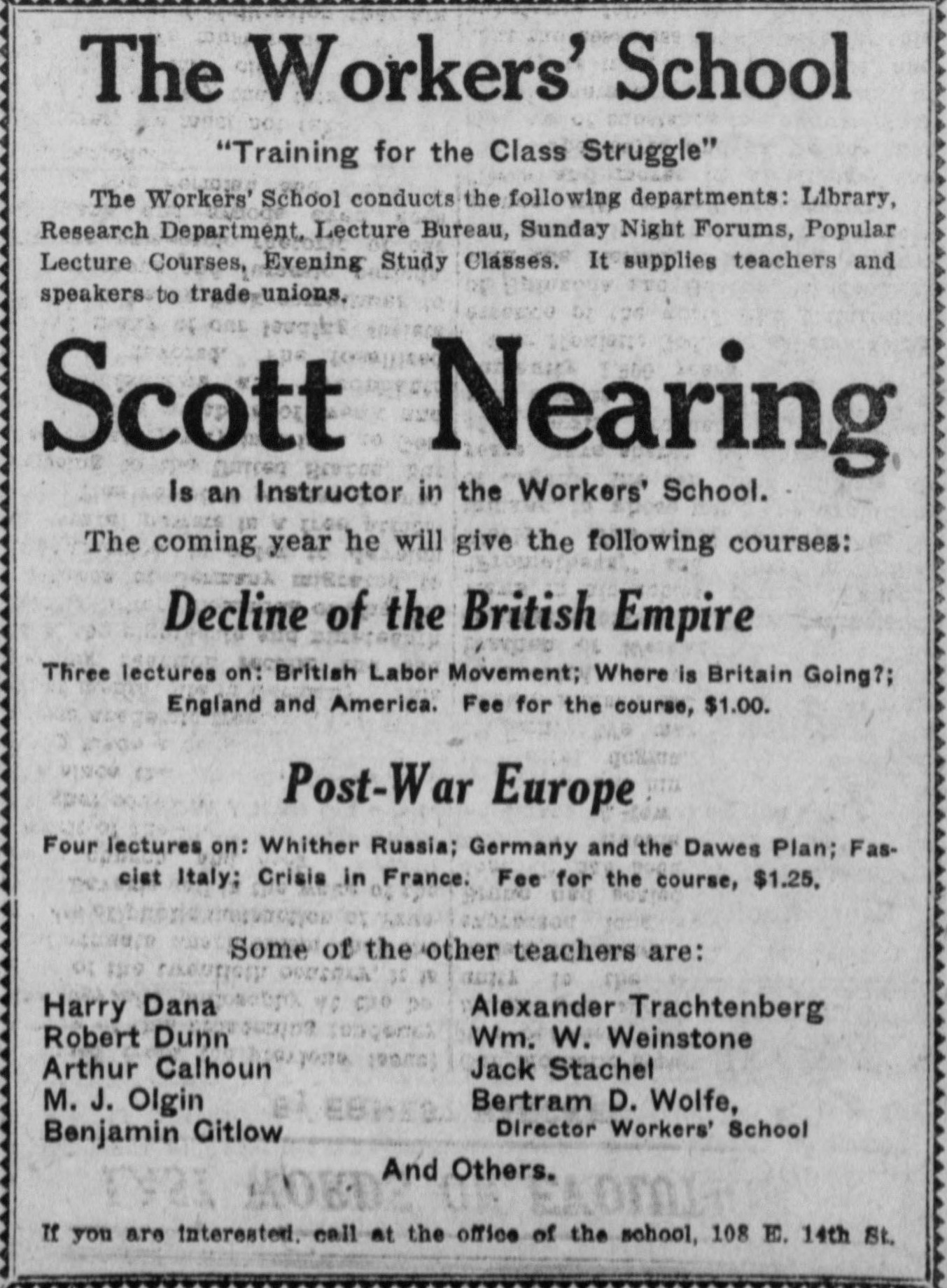
The slogan of the school is: “Training for the class struggle”, and its success both as a Party training school and as a Left Wing school with a mass following, has been great.
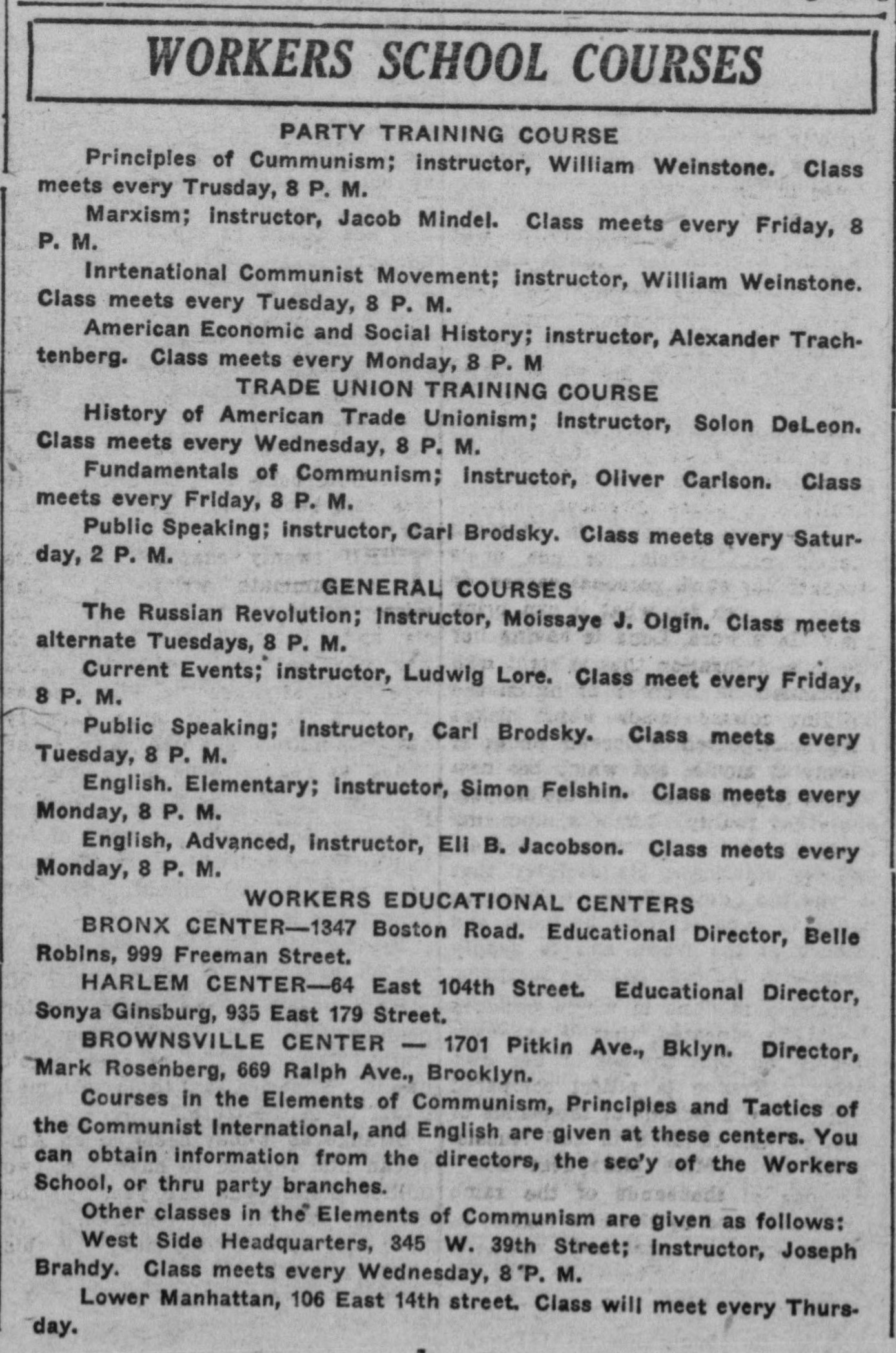
The Party training course consists of classes in Marxism, Leninism, the Party’s history, structure and problems, and Communist work in the trade unions. About 150 students applied and half were selected. The students were sent by the street and shop nuclei and were admitted on the basis of Party activity, trade union activity, and theoretical preparation. Most of those taking the course were Party functionaries, active trade unionists, and leading Party workers. The teachers were the Agitprop director of the district (Wolfe), and his assistant (Benjamin), the General Secretary of the district (Weinstein), and the industrial organiser (Miller, later Zack). In the trade union course other comrades who are specialists in their particular field of work, were drawn in for special sessions of the class.
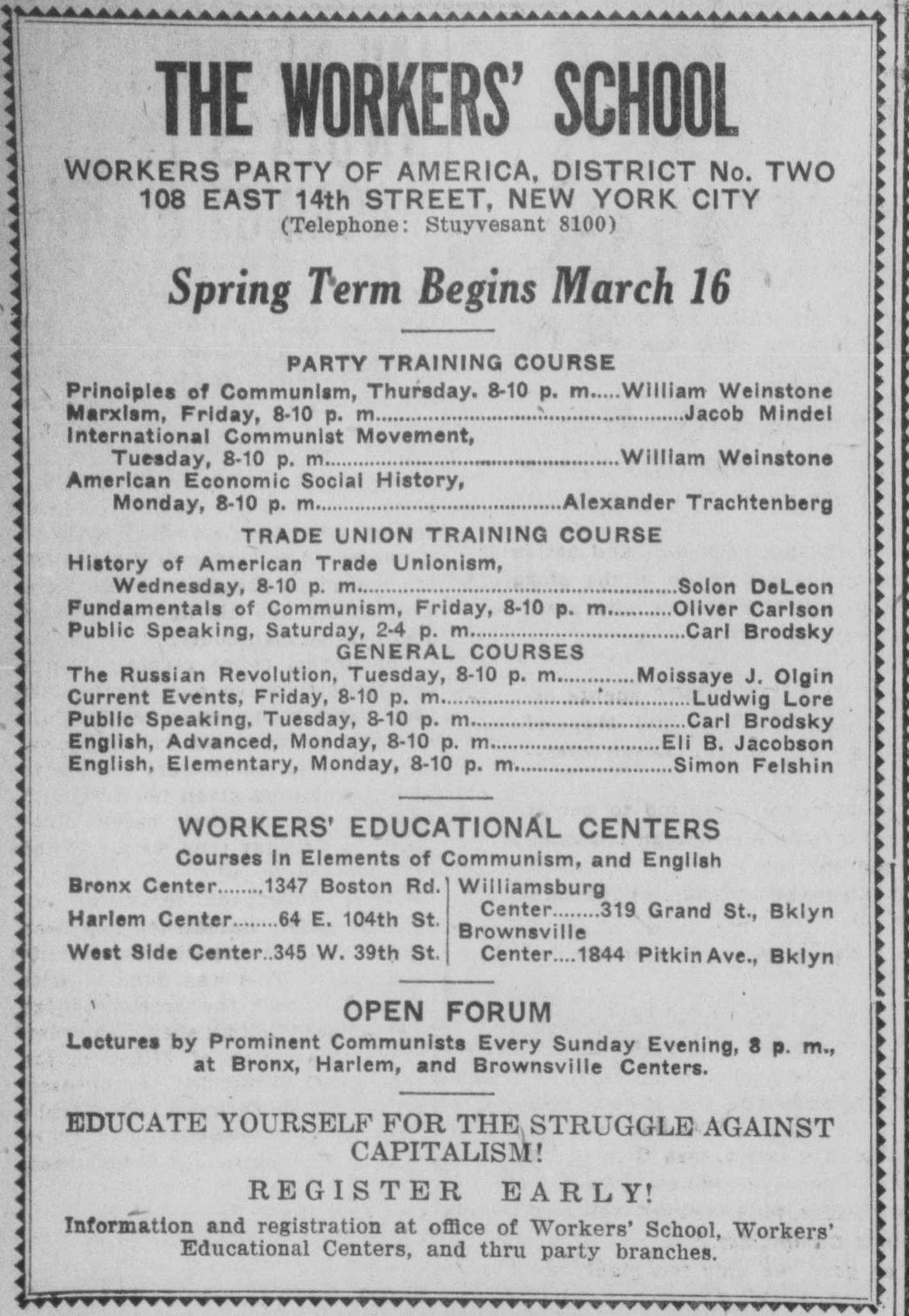
The other Party training course, “Fundamentals of Leninism”, was for members of the shop nuclei only. When the course began, the Party was in the process of reorganisation, and most of the comrades were still in territorial branches. The nucleus selected the comrade, usually the organiser, paid his fee and exacted regular attendants from him. The class met every other week and in alternate weeks, the comrade led the political discussion in the nucleus on the matters discussed in class. The course dealt with “the theory and practice of Leninism in their concrete application to the American Party in general, and the needs and problems of the shop nuclei in particular.” The instructor was the organisation secretary of the district (Stachel).
The other courses were open to all workers who wished to attend. The English courses were graded from elementary courses for those unable to speak English, to advanced English, advanced public speaking, workers correspondents, and modern literature from the point of view of historic materialism. In economics there were elementary and advanced courses.
Financially, the school was faced with great difficulties at the beginning. The director was pad now and then, the secretary served voluntarily, and the only one paid regularly was the clerical secretary. The rent was paid tardily, the chairs broken, and other facilities lacking. Tie classes were held in the district headquarters and despite constant noise of Party and fraction meetings in adjacent rooms, the classes carried on with great regularity. To put the school on its feet financially, the Agitprop Committee decided upon a drive for funds.
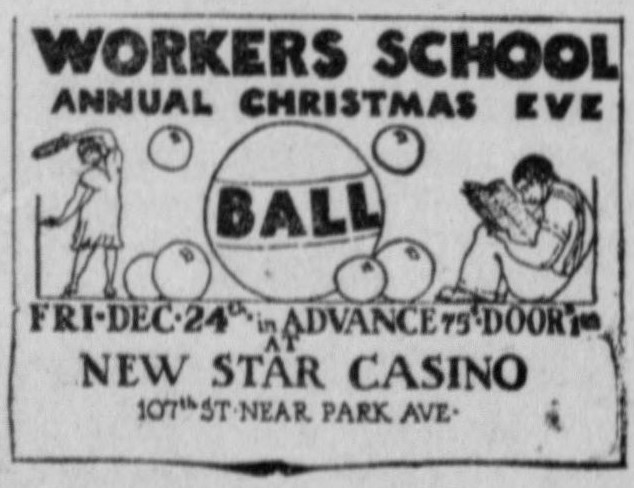
An application to the Garland Fund (a million-dollar fund whose interest was used for labour, education. the labour press, labour publication, and the like) was refused on the ground that the school taught sectarian doctrines and was not a real workers’ school. The Agitprop Committee decided to go ahead with its drive, and began with a banquet to which as many workers’ organisations as could be reached were invited. At this banquet a couple of thousand dollars was pledged. A concert and mass meeting brought another 2500 dollars and a six-week’s intensive drive in the Party, the trade unions, fraternal and other workers’ organisations, brought the total to 8,000 dollars. The Garland Fund which had granted the library 1,000 dollars was asked to send a representative to investigate the school, and the favourable report made resulted in a grant of 5,000 dollars. With the fees which students paid the school was put up on- its feet financially, and the director was able to eat and breathe freely again.
All the students paid fees (unless on strike or unemployed) of 2.50 for a l-hour a week three-months term, and 4.00 for the 3-hour a week Party training course. The fees helped to pay a large part of the school expenses for rent, light, telephone, printing, etc. The teachers were paid, but all turned their wages back to the school. (They are all Party members).
Next year the school is to be broadened out into a Left Wing school, by the addition of some sympathetic non-Party instructors. The Agitprop Committee of the district runs the school, and has approved of this extension of activities. An attempt was made this year to supply teachers to the unions, but due to a shortage of teachers and to mass strikes in which many of the Left Wing unions were engaged, little was done along this line. A new building, probably together with the district office, will be the object of another drive this coming school year. The school attempted by the reactionary A. F. of L. Central Labour Council of New York, (with 800,000 members affiliated) has been a failure, and the Socialist Party Rand School is practically dead. The Workers’ School has the field to itself, and is successfully burying its roots in the local mass organisations of workers.
The mass character of the school is indicated by the 800 students registered last year (November 1925 to June 1926). Of these more than half remained in regular attendance through June. How good a record this is can be seen if we contrast it with the work in the public evening schools where only 200 students out of a registration of 800 remain after six months. Half the students were Party members and half non-Party workers, mostly of Left Wing organisations. Most of them were members of unions. The content of the courses was such as to constantly link up the class-room work with the mass struggles of the workers. The basic course, which was given at the central school and at all the section branches in New York and in nearby cities, was the Fundamentals of Leninism. The text used was the “ABC of Communism” by Bucharin and Preobroshensky, but at teachers’ conferences, stress was laid upon the adaptation of this text to American conditions.
The slogan “Discover America” indicates the attempt to concretise and “Americanise” ali the teaching. When the Passaic textile strike broke out, all the energies of the school were directed toward aiding to win the strike. Teachers spoke in the strike area (Comrade Weisbord, the leader of the strike, had been a teacher of one of the branch classes); the English classes used the strike in their reading and composition work and in their workers correspondents’ class; the class in economics studied the centralisation of industry and the concentration of capital of the textile industry; the research class turned its efforts toward conditions in the industry, profits, interlocking directorates, and foreign connections; the trade union class took up the question of organisation of the unorganised and similar questions in the light of the Passaic strike.
In the Furrier’s strike a delegation of the administration, teachers and students appeared before the strike committee, and offered to put the school at the disposal of the strikers. The hall committee of the strikers asked the school administration to help out with speakers, musical talent and entertainment of other sorts, and the school got in touch with some of the people it had listed for such work.
The most interesting feature of the work of the past year has been the success with which the school has combined the functions of a truly Communist training school with those of a Left Wing mass school. The prospects of the coming year are very favourable for a still further broadening out of its work. An intensive training course for selected Party functionaries from all over the country combined with an institute for teachers for the next year is the chief work of the summer.
International Press Correspondence, widely known as”Inprecorr” was published by the Executive Committee of the Communist International (ECCI) regularly in German and English, occasionally in many other languages, beginning in 1921 and lasting in English until 1938. Inprecorr’s role was to supply translated articles to the English-speaking press of the International from the Comintern’s different sections, as well as news and statements from the ECCI. Many ‘Daily Worker’ and ‘Communist’ articles originated in Inprecorr, and it also published articles by American comrades for use in other countries. It was published at least weekly, and often thrice weekly.
PDF of full issue: https://www.marxists.org/history/international/comintern/inprecor/1926/v06n60-sep-02-1926-inprecor.pdf
 Revolution's Newsstand