
New Leader editor Edward Levinson pays respects to artist Gan Kolsksi, a leading figure in the John Reed Club and chairman of the Rebel Arts movement, whose wonderful work has been presented here many times. Kolski took his life in a public protest of poverty and unemployment in 1932 during the Great Depression. A collection of his woodcuts from the New Masses can be found here.
‘The Death of Gan Kolski’ by Edward Levinson from New Leader. Vol. 13 No. 7. April 23, 1932.
THE George Washington Bridge rises high and graceful, a beautiful structure of concrete and steel set in an ever-changing background of blue skies and sunsets. Under its majestic arch, the Hudson river pours its broad stream into the ocean. It is a triumph of man’s skill and labor. It is another symbol of man’s capacity to conquer the physical barriers nature has erected against him.
An unemployed young man threw himself from the wall of the bridge Tuesday, and fell two hundred feet to the rocks below. When police came to the scene and searched his clothes to identify him, they found a note which he had written. It said:
“To all; If you cannot hear the cry of the starving millions, listen to the dead, brothers. Your economic system is dead.”

This was the last word of Gan Kolski, young Socialist and artist, written before he hurled himself from the bridge.
The act was a deliberate one. Kolski had the warm friendship of comrades. He had accomplishments which had already brought him recognition. He was fired by the ideal of Socialism which gave him joy and purpose in life, and those who worked with him in rallying artists to the cause of Socialism never doubted that he was enjoying, life.
Gan Kolski’s death was not a way out for him. He needed no escape for himself. He took his life in a protest against the monstrous system which has placed millions of men and women in the shroud of living death which is hunger, poverty and the killing fear of what the next day might bring. His note made this plain.
Gan Kolski wanted to do something for the jobless, the men and women who have made the wealth of our nation and today cannot find a crust of bread to still their hunger pangs, or a roof to shelter them. Unemployment to Gan Kolski was not a matter of statistics. He suffered with the children sent to school without food, and with distressed mothers who searched haggard faces of their men for signs of hope which never came.
Gan Kolski gave his life as a protest against the suffering of the unemployed. And The New York Times gave the incident two and a half inches.
The mouthings of double-dealing politicians crowd the front pages. A nation reads columns daily of the personal tragedy of the kidnapping of one baby. Tabloids and movies continue their undisputed domination of the minds of men. The unemployed are with us, but they are something to be put aside so that they will not trouble our thought too much. The death of one young man on the threshold of life does not change the current.
Yet Kolski has not given his life in vain. He has forced into the minds of many the terrifying picture of what unemployment has meant to one man. In his unheeding sacrifice of himself, he has given his comrades an example of unselfishness which is rare… He stands today in the ranks of the martyrs of Socialism the world over who have fearlessly faced the hangman and the firing squad of crazed reaction.
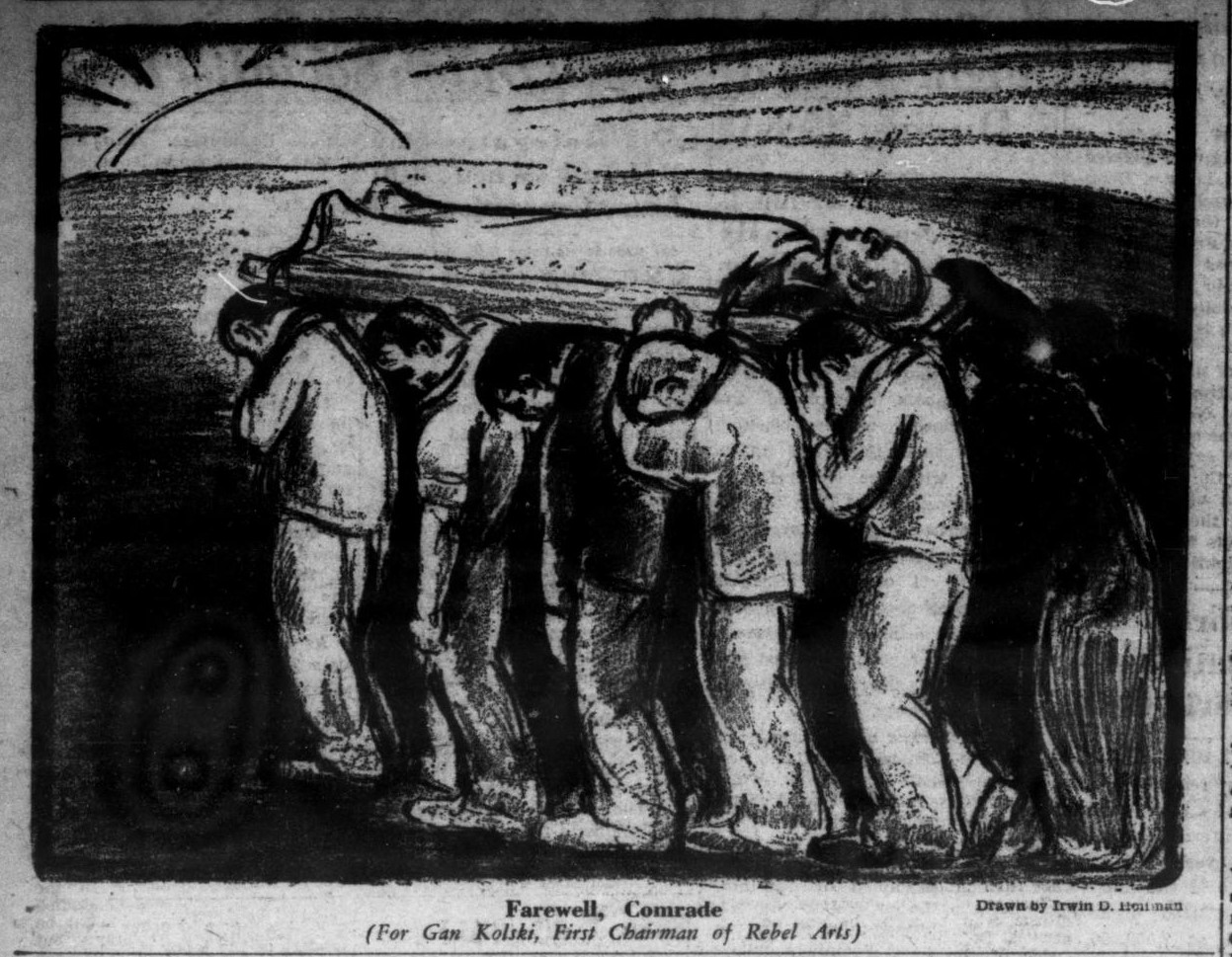
But no one will imagine that suicide is the way out. Gan Koski never intended to foster such a thought. Suicide is of the old order. The struggle and the new world which it promises needs fighting and constant devotion. It needs life. It needs life dedicated to a merciless, unceasing war on poverty and hunger. To help create such life, Gan Kolski died.
New Leader was the most important Socialist Party-aligned paper from much of the 1920s and 1930s. Begun in 1924 after the S.P. created the Conference for Progressive Political Action, it was edited by James Oneal. With Oneal, and William M. Feigenbaum as manager, the paper hosted such historic Party figures as Debs, Abraham Cahan, Lena Morrow Lewis, Isaac Hourwich, John Work, Algernon Lee, Morris Hillquit, and new-comers like Norman Thomas. Published weekly in New York City, the paper followed Oneal’s constructivist Marxism and political anti-Communism. The paper would move to the right in the mid 30s and become the voice of the ‘Old Guard’ of the S.P. After Oneal retired in 1940, the paper became a liberal anti-communist paper under editor Sol Levitas. However, in the 1920s and for much of the 1930s the paper contained a gold mine of information about the Party, its activities, and most importantly for labor historians, its insiders coverage of the union movement in a crucial period.
PDF of full issue: https://archive.org/download/sim_new-leader_1932-04-23_13_17/sim_new-leader_1932-04-23_13_17.pdf
 Revolution's Newsstand