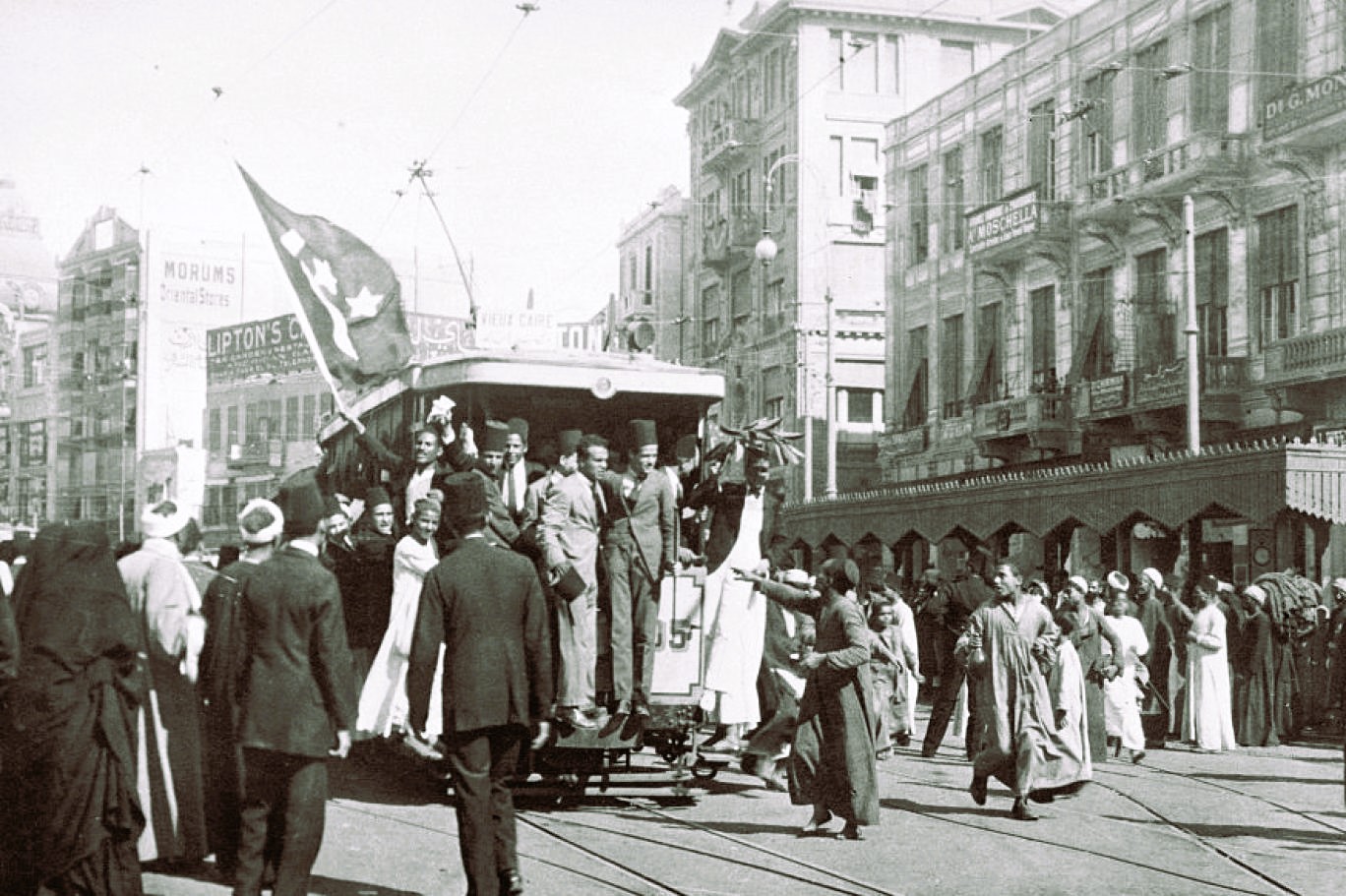
‘Communists Hunger Strike in Egypt’ by Nefnil Ahmed from Communist International. Vol. 2 No. 9. February, 1925.
A NUMBER of strikes took place at various shops and factories in the district and city of Alexandria in February-March, 1924, in which the strikers adopted a special method to compel the employers to give in their demands: having quit work, they did not quit the factory premises, and did not admit either blacklegs or representatives of the administration, with whom they would negotiate only through their leader, Comrade Antoine Maroune, a member of the C.C. of the Egyptian Communist Party, who enjoys great popularity among the workers.
The red spectre of Communism had scared the government just formed by Zaghlul Pasha, who had until recently been in exile. It decided to adopt severe measures against the Communists, and to show that the Nationalists were not less able to suppress the workers’ discontent than the previous rulers who had been put in office by Great Britain.
By means of “fatherly” persuasion, backed by detachments of troops and police, the government liquidated the seizure of shops and factories, and started penalising the ringleaders, the Communists; all the members of the C.C. of the Egyptian Communist Party and of the headquarters of the General Confederation of Labour were arrested, the premises pf the Party were put under seal, although they had hitherto worked quite openly, hundreds of homes of Communists and suspected sympathisers were raided, many foreigners identified with the labour movement were banished from Egypt, and so on.
The arrested Communists were remanded on the charge of undermining the foundations of the social-economic and political order in Egypt, and of attempting to violate the principle of private property. They were tried under the harsh laws passed by the previous government in September of last year, on the eve of the return of Zaghlul Pasha from his exile, laws which were chiefly aimed at his supporters.
The trial of our comrades took place early in October. The Government was so afraid pf the spread of Communist contamination, that it even forbade the press to publish the speeches made at the trial, not only by the defendants and their counsel, but also by the Crown prosecutor. The court passed the verdict that was ordered by the Government: four members of the C.C. of the Egyptian Communist Party, Comrades Antione Maroune, Hosni Al-Orabi, Safoin Abdul El-Fat, and Shahit Ibrahim, were sentenced to three years imprisonment and hard labour, and five other comrades to six months imprisonment.
The condemned members of the C.C. of the Egyptian Communist Party were put in the terrible Hadra prison at Alexandria and subjected to a regime usually applied to criminal prisoners. By means pf this humiliation, the government hoped to curb the will-power of our comrades, and to compel them to abandon their convictions.
On the 5th of October, our imprisoned comrades declared a hunger-strike, demanding that they be treated as political prisoners, and not as thieves and robbers. But the administration had for three weeks remained deaf to their demands and to the numerous pleas made by their relatives. Equally unsuccessful were the pleas made both to Zaghlul Pasha, “father of the country,” and to King Fuad himself. The administration justified its conduct on the plea that it had to act according to law, and the Egyptian law provided no particular regime for political prisoners.
Our comrades were reduced to a state of extreme emaciation, but they bore courageously all the pangs of hunger. At last, the government yielded after 23 days of the hunger strike our comrades were transferred to another prison and permitted to wear their own clothes, read books and to have interviews with their relatives once a fortnight.
Honour and glory to the valiant fighters for Communism in Egypt. Ignominy and shame on their torturers.
The nationalists who persecuted the Communists did not suspect that very soon there was to be a change of government in Egypt, under the pressure pf British Imperialism, which would throw into jail some of the prominent members of their own Party and compel them to ponder at their leisure over the difference between common criminals and political.
The ECCI published the magazine ‘Communist International’ edited by Zinoviev and Karl Radek from 1919 until 1926 irregularly in German, French, Russian, and English. Restarting in 1927 until 1934. Unlike, Inprecorr, CI contained long-form articles by the leading figures of the International as well as proceedings, statements, and notices of the Comintern. No complete run of Communist International is available in English. Both were largely published outside of Soviet territory, with Communist International printed in London, to facilitate distribution and both were major contributors to the Communist press in the U.S. Communist International and Inprecorr are an invaluable English-language source on the history of the Communist International and its sections.
PDF of full issue: https://www.marxists.org/history/international/comintern/ci/new_series/v02-n09-1925-new-series-CI-riaz-orig.pdf
 Revolution's Newsstand