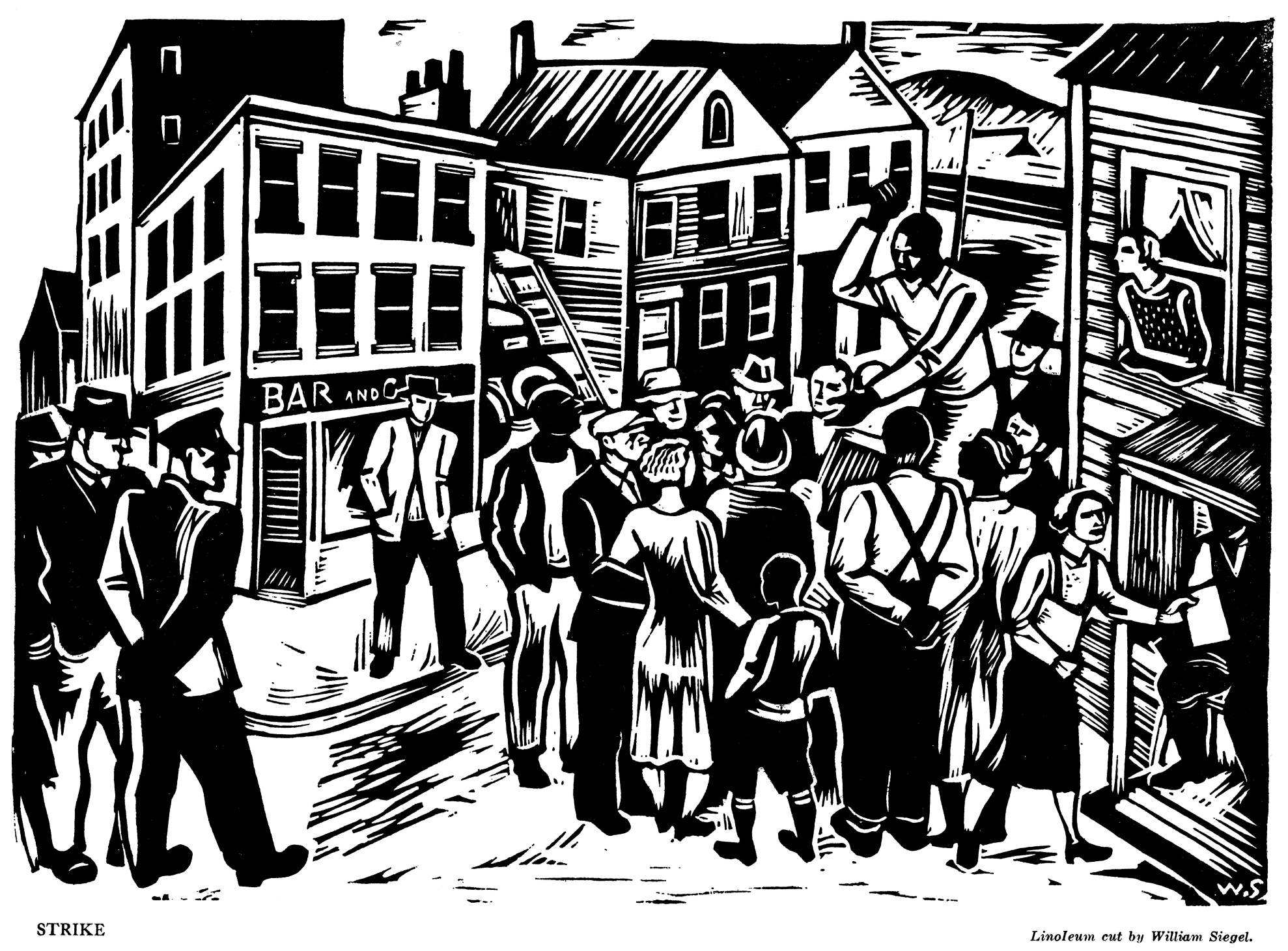
The great Hugo Gellert reviews a show of two contemporaries and comrades in radical art, William Siegel and Albert Abramowitz, from 1935.
‘From Nat Turner to the Moscow Subway’ by Hugo Gellert from New Masses. Vol. 17 No. 7. November 12, 1935.
ON the walls of the A.C.A. Gallery (52 West 8th Street, New York) a story is told in pictures. One side of the story is about people who live in America. The other side of the story is about people in the Soviet Union. On one hand the pictures speak of the struggles of man against man. On the other hand, the pictures portray the struggles of man against the forces of nature.
The heroic combat of Negro and white workers against hunger, unemployment, race hatred, fascist vigilantes and war make the pictures of William Siegel’s America. The struggle against oppression, from the day of Nat Turner down to a present-day meeting of Negro and white workers in the South is utilized as a rich store of subject matter for his drawings.
In his choice of objects, through which Siegel conveys his ideas, greater selectivity would. be desirable. Also greater variety in composing them. The pictures taken singly are satisfying, but the need for variety arises when viewed as component parts of an exhibition. His individual pieces are impressive; William Siegel has a great deal to say.
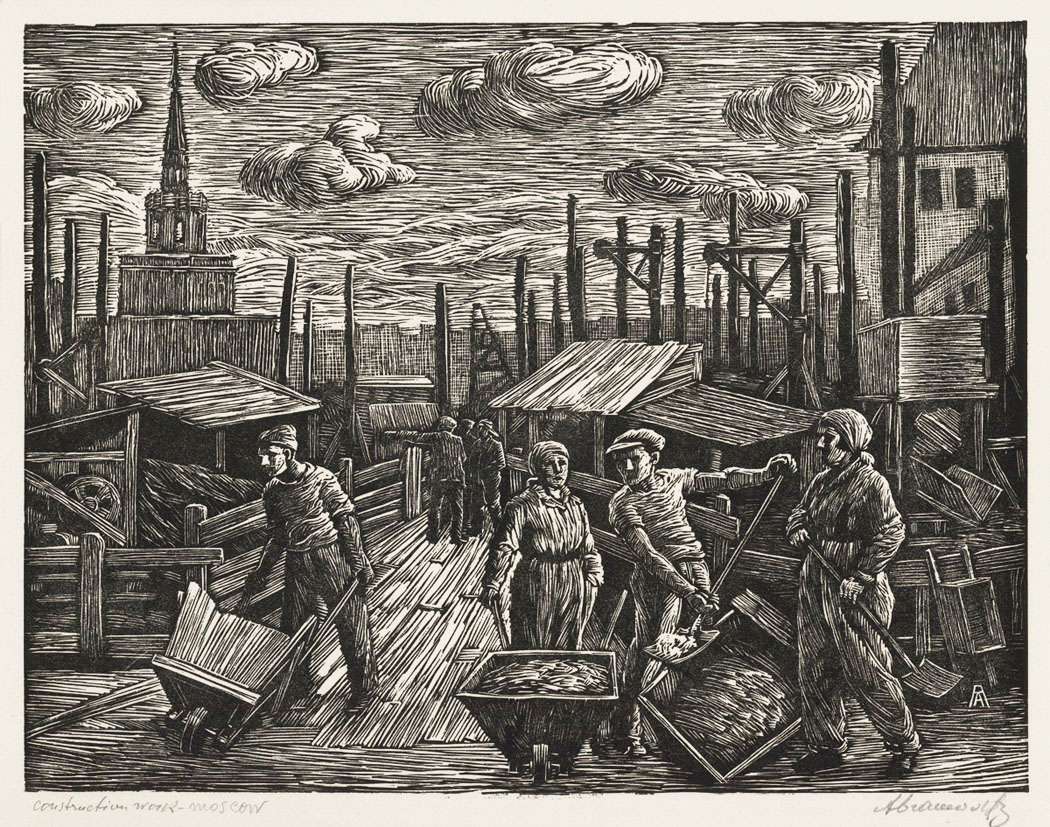
Albert Abramowitz restricts his pictures to a single phase of Soviet life; even to a single incident: the building of the Moscow subway. Russian workers, men and women, break ground, buttress shafts, mix concrete, work when the sun is high, work at night. Comrades arriving to help in the work, meeting in the shafts to discuss the progress of the work and all make interesting patterns painted in oil, or cut into wood.
Through the pictures by Abramowitz we follow a simple process of labor and we arrive at a victory of man over the forces of nature. The color in the paintings, however, which should be jubilant has too much restraint. The artist’s wood cuts are more colorful. The luscious clouds in the print, “The Open Cut,” has zest not found in the paintings.
These pictures of two different worlds hanging side by side places this exhibition in a class by itself.
The New Masses was the continuation of Workers Monthly which began publishing in 1924 as a merger of the ‘Liberator’, the Trade Union Educational League magazine ‘Labor Herald’, and Friends of Soviet Russia’s monthly ‘Soviet Russia Pictorial’ as an explicitly Communist Party publication, but drawing in a wide range of contributors and sympathizers. In 1927 Workers Monthly ceased and The New Masses began. A major left cultural magazine of the late 1920s to early 1940s, the early editors of The New Masses included Hugo Gellert, John F. Sloan, Max Eastman, Mike Gold, and Joseph Freeman. Writers included William Carlos Williams, Theodore Dreiser, John Dos Passos, Upton Sinclair, Richard Wright, Ralph Ellison, Dorothy Parker, Dorothy Day, John Breecher, Langston Hughes, Eugene O’Neill, Rex Stout and Ernest Hemingway, Artists included Hugo Gellert, Stuart Davis, Boardman Robinson, Wanda Gag, William Gropper and Otto Soglow. Over time, the New Masses became narrower politically and more journalistic in its tone.
PDF of full issue: https://www.marxists.org/history/usa/pubs/new-masses/1935/v17n07-nov-12-1935-NM.pdf
 Revolution's Newsstand