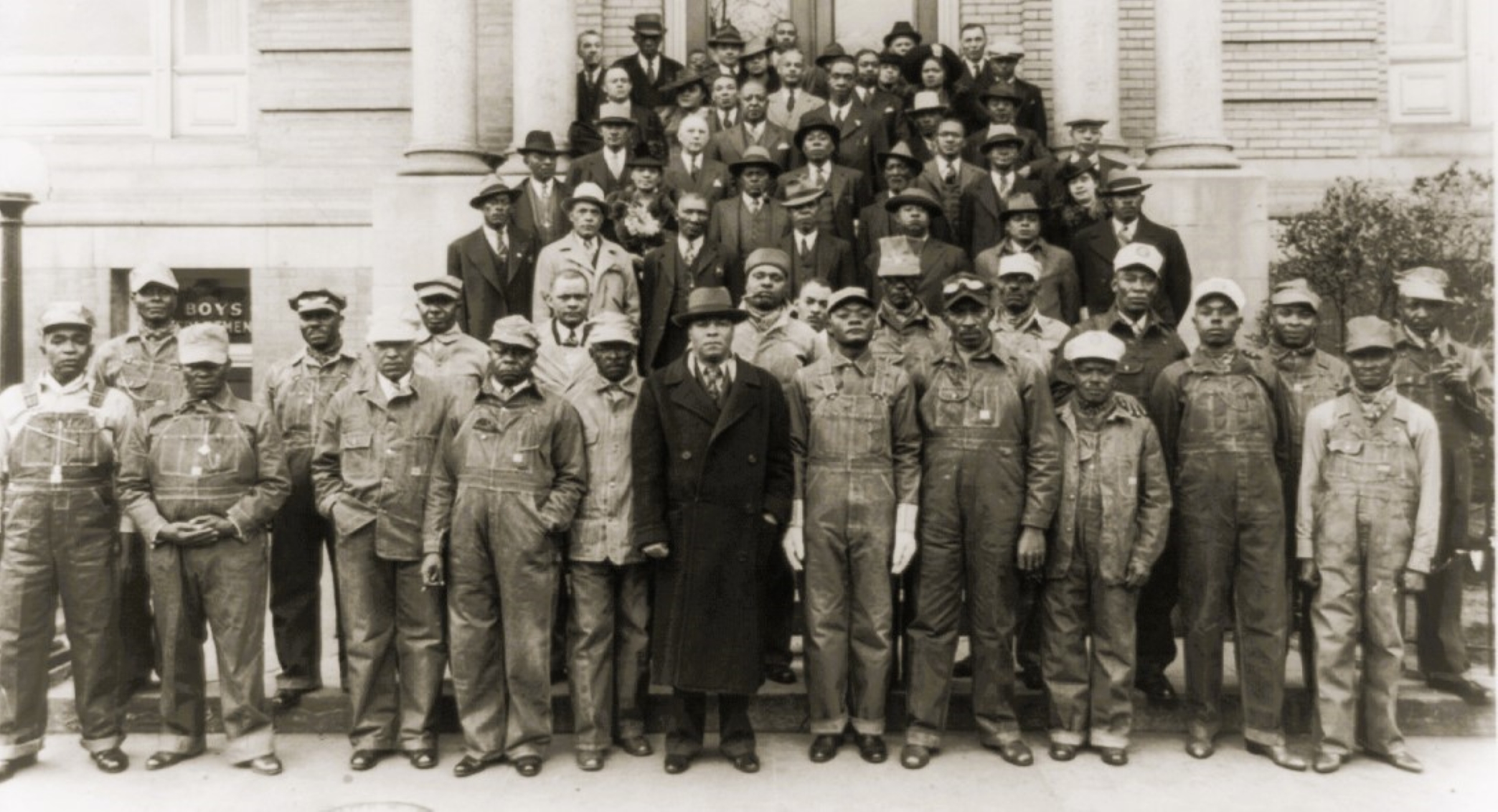
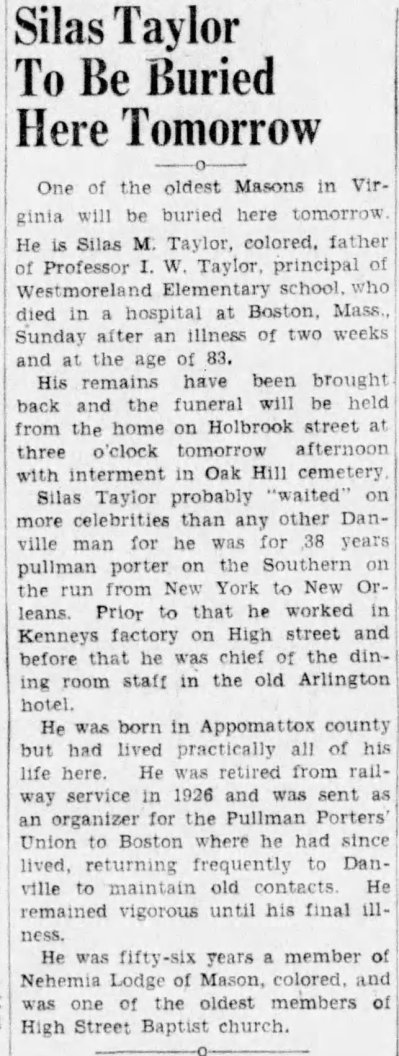
Frank Crosswaith, then organizing for A. Philip Randolph’s Brotherhood of Sleeping Car Porters tells the story of Silas M. Taylor, a railroad porter born into slavery in Virginia who became Boston organizer for the union. Taylor lived to see the union established, dying in 1934 at 83.
‘An Ex-Slave Who Fights for the Next Emancipation’ by Frank Crosswaith from The Messenger. Vol. 8 No. 11. November, 1926.
To those who still deny the essential humanhood of the Negro and, who yet maintain that fate has decreed him to be the eternal footstool of a supposedly strong, pure and virile white race, the case of Silas M. Taylor should prove of deep interest.
When the movement to organize the Pullman porters got under way, among the first to enlist was Silas M. Taylor, sympathetically called “Si” by his fellow workers. Si was born a slave at Appomattox, Va., not far from the historic spot where Grant graciously accepted Lee’s surrendered sword, and recalls quite clearly the leader of the Confederate forces to whom he delivered many important messages during the hottest days of the conflict. He remembers being ushered past the numerous guards in gray and fawning flunkies into the secret cell of the military genius of the South’s cause. Si’s master was one of Virginia’s richest slave holders, and as usual bore a military title “Colonel,” being the prefix in this instance. With flashes of fire in his small black eyes, Si tells of seeing his mother whipped several times by her master. “On the day she was buried, thirteen years ago, I saw for the last time the long, deep scars made upon her brown back by the Master’s lash, and there over her lifeless limbs, I rededicated myself to strike on for the final emancipation of my race.”
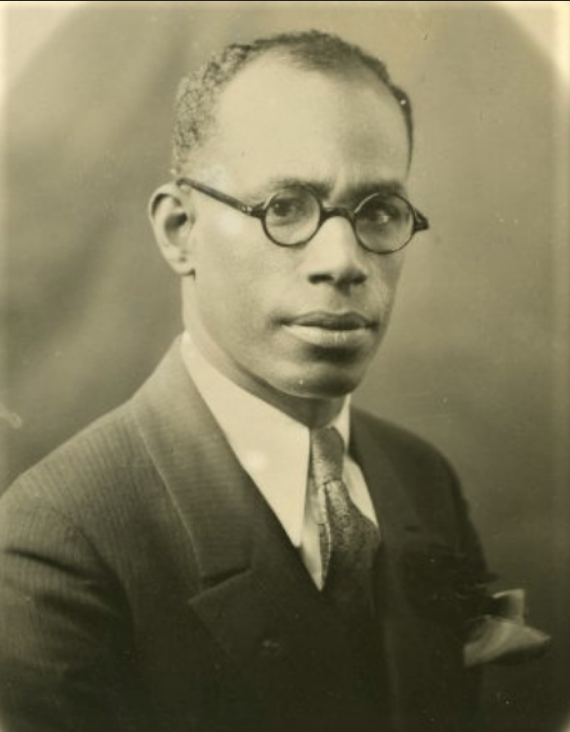
With the military subjugation of the South and the attendant emancipation of the slaves, young Taylor found himself looking out upon a world he did not understand, a world that seemed to offer him naught but despair, drudgery, and finally death. With no master any longer to command his services and claim him as “my n***r,” Si, like so many hundreds of thousands of his fellow ex slaves, saw ahead of him one wide wilderness of bewilderment. His status in the world had suddenly changed; he no longer belonged to any one master; none could legally claim him; he, perforce, must seek a master; therefore, into a tobacco factory in Danville, Va., the freeman went to begin his education that was eventually to convince him of the fact that Appomattox signified only the end of one form of human slavery and the beginning of another which would break more thoroughly than before the lines of race, color and sex. In this Virginia tobacco factory Si worked and wept, until one morning, amidst the stifling odor of tobacco the revolutionary idea burst forth into bloom in the minds of Si and his co-workers, the idea that united they had the power which the owner of the factory could not overcome. It is a most fascinating picture this ex-slave paints of “the strike” on a tobacco plantation in old Virginia. The strike was won after twenty-four hours, and leaderless these workers were, for none knew how to direct a strike, and all still remember the lash of the master and somewhat nursed the fear these lashes had engendered in their souls. As an example of courage and as an indication of the inherent germ of revolt in the bruised breast of the proletarians of all races, this is a brilliant example.
After five years of new freedom in this tobacco environment, Si decided to change his vocation, and finally secured a new master when he obtained a position as a waiter in the Arlington Hotel in Danville. Shortly after, Si voluntarily “changed masters” again, this time securing a job in a corporation at the head of which was to stand the son of the man whose Proclamation a few years before had made him legally a free man. Si became a car cleaner for the Pullman Company and finally was made a Pullman porter, working in that capacity for almost forty years. As a Pullman porter, Si tells many interesting experiences; for instance, he tells of an occasion when Booker T. Washington was denied certain accommodations en route from the South and which he (Si) managed to accord to him.
During his nearly forty years as a Pullman porter, Si has served most of our captains of industry, politicians, and statesmen, men in whose hands are entrusted the affairs of the Nation.
When the idea dawned upon the minds of the Pullman officials that Si and his fellow-porters needed a union, and one that would be not unlike the “American plan,” immediately they organized and gave to the porters a “union” with a high-sounding name. Had they called it by its right name-a Company Union-why, even the Pullman porters would have been inclined to heed the historic warning: ”Beware of Greeks bearing gifts.” It was, therefore, baptized “The Employee Representation Plan,” and like the historic Babe which was born some nineteen hundred years ago in Bethlehem of Judea, porters saw in the “Plan” their star of hope, and, not unlike the fabled wise men of the East, they came to worship and give thanks and sing hallelujah to the new born thing that was to hypnotize them and make them satisfied with long hours of work, starvation wages-in some instances no wages and brutalizing treatment. Si, however, with that uncanny and somewhat instinctive suspicion which slavery has imbedded in the minds of most Negroes when dealing with white men, refused to trust his fate wholly to this Company Union. He had at all times the respect and confidence of his co-workers, and because of his mental equipment was chosen as one of the committee men representing the porters and who was to make the Plan perform the miracles the Company had claimed for it. As a committee man, Si soon learned what is now common knowledge to every porter in the service, i.e., that when it comes to serving the porters in their legitimate desires to increase their wages and reduce the hours and conditions of their work, the Plan “just would not work.” In every effort made along these lines, the porters’ representatives on the Plan found the dice loaded against them. Thereupon, Si, with a few of his more daring fellow workers, began a secret hut mighty wave of agitation calculated to discredit the Plan and finally destroy it.
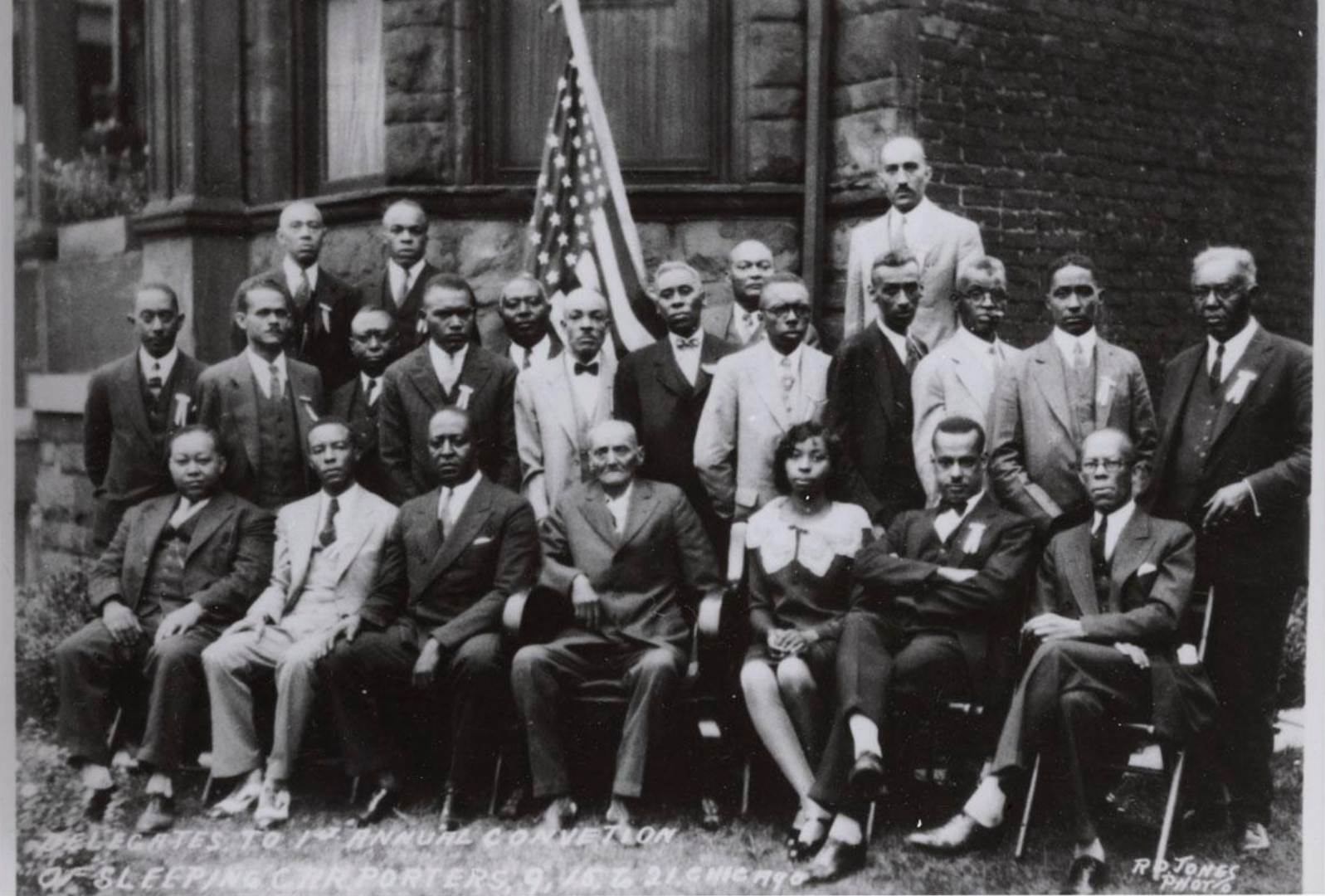
About this time, unknown to Si, some of his comrades launched the Brotherhood of Sleeping Car Porters with A. Philip Randolph as General Organizer. When news of this event reached him, Si enlisted as the 310th soldier in the first great attempt to introduce Negro workers to the cause of Industrial Democracy. He entered the struggle with the same zest and fervor that characterized his activities in the early days of his freedom on the tobacco plantation in Virginia. He is today among the most militant members of the Brotherhood’s nation-wide army. When information reached the Pullman Superintendent that Si had joined the Union and that official undertook to question his subordinate, Si did not deny it; he manfully admitted that he had, and even offered to produce his Union membership card. Naturally, after this demonstration of militancy, Si was slated to go. How to conveniently do it was the problem the Superintendent had to solve. Si’s record was clean; he was a model porter from the point of view of the exacting physical and mental requirements of the Pullman Company. Finally it dawned upon the Company officials that Si could be retired.
Like most men of his time, Si did not know his age, and so, the Company has retired him and, as a last act of revenge, Si is threatened with being deprived of the meagre pension the Company benevolently bequeaths to its retired worker. But even this final act of ingratitude has not soured his soul or cooled his ardor for the Cause.
“They can withhold my pension,” says this old man, fired with a burning love for justice, ”they can do to me the worst they know how. I am not old. I was born when the Brotherhood of Sleeping Car Porters was born. I will stand by my Union, come what may. Lincoln’s Emancipation Proclamation freed my people and me. When the shackles fell from our limbs, Lincoln’s son girdled again our loins with a new form of slavery. I hope to live long enough to see these, too, broken, and the race to which I belong take its place in the world of men to do an honest day’s work and receive honest wage for the same, rather than to depend upon tips. The service a porter gives to the traveling public is honorable service and deserving of honorable remuneration, not tips.”
Men of every race in every age have spoken like this ex-slave speaks today. His voice is, therefore, a recognition of the fact that in the bruised breast of every toiler, be he a chattel or a wage slave, there smoulders a live spark of revolt which, when universally kindled, will rid the world of the exploitation of man by his fellows, and place human values above the level of dollars and cents, and when service, performed even by the humblest in society, will be recognized as man’s greatest claim to the respect and reward of his fellows.
The Messenger was founded and published in New York City by A. Phillip Randolph and Chandler Owen in 1917 after they both joined the Socialist Party of America. The Messenger opposed World War I, conscription and supported the Bolshevik Revolution, though it remained loyal to the Socialist Party when the left split in 1919. It sought to promote a labor-orientated Black leadership, “New Crowd Negroes,” as explicitly opposed to the positions of both WEB DuBois and Booker T Washington at the time. Both Owen and Randolph were arrested under the Espionage Act in an attempt to disrupt The Messenger. Eventually, The Messenger became less political and more trade union focused. After the departure of and Owen, the focus again shifted to arts and culture. The Messenger ceased publishing in 1928. Its early issues contain invaluable articles on the early Black left.
PDF of full issue: https://www.marxists.org/history/usa/pubs/messenger/v8n11-nov-1926-Messinger-RIAZ.pdf
 Revolution's Newsstand