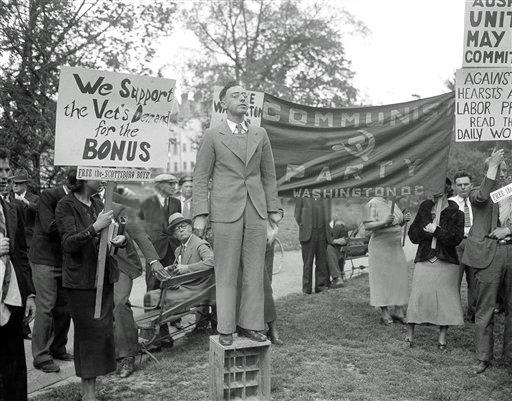
Advice from the Communist Party’s internal bulletin to members on holding meetings.
‘How to Conduct Open-Air Meetings’ by Julius Codkind from Party Organizer. Vol. 2 No. 7-8. July-August, 1928.
TO be successful an evening open air meeting should be opened at eight o’clock sharp, and in no case should it last above two and one-half hours. Usually two hours is sufficient to hold a meeting. Within this time the speaking, literature sale, and collection should be made and questions answered. Exceptions to the two-hour rule are advisable only when there is great interest or great excitement or enthusiasm.
It is always bad to have a crowd melt away while the meeting is still in progress. It is much better to discontinue a meeting at the two-hour limit with the announcement of when the next meeting will be held on the same spot. As a rule, the crowd will come back for the next meeting if your meeting was successful in gaining their interest or attention.
Advertising the Meeting
Open-air meetings can be built up very easily with a little organization. If the meeting is to open at 8 p.m., the platform should be on the corner with a sign at least an hour earlier, announcing the time when the meeting will be opened. Try this a couple of times, and you will soon discover that the function of the chairman is to make a pleasant five-minute introduction of the meeting rather than to act as a loudspeaker extraordinary. Where there is a newspaper, the meeting should be announced in the press. In small towns the local bourgeois paper will often carry a notice of even Communist meetings. A little three- or four-line notice is often very helpful.
Building the Meeting
In large cities open-air meetings can be built up by choosing a particular evening of the week for a given corner and having a meeting on the corner on the same evening every week. The crowd will soon learn to come to that corner every Monday or Wednesday or Friday, as the case may be.
Maintaining Order
Maintain perfect order. An open-air meeting is a favorite spot for certain types of comrades to gather for sociability. They will stand around the groups, generally below the platform, and carry on all sorts of discussions. They become very noisy, become highly offended when approached to maintain order, and quickly succeed in demoralizing the meeting. Many good speeches are interrupted and numerous splendid meetings are destroyed by this nuisance. A strong committee, trained to deal gently but firmly with this evil, will quickly rid a corner of it.
Disturbers
A worse evil even than the one described is the disturber who knows more than the speaker. With a few telling remarks, he quickly destroys the faith of an audience in any speaker. This type of crank can never be enticed to go up on the platform to show what he can do.
Very often he will not express his opinion openly. He simply decides that the speaker is not making a good enough job, so he finds a victim and sets out to convert him to Communism in his own way. Our crank is soon in the midst of a most enticing, know-nothing political discussion.
The crowd, always attracted by a novelty, quickly commence to gather around the debaters, a third will enter into the discussion, then a fourth. The debaters split off into two teams each with its circle of admirers. This process continues until the speaker finds himself talking to several circles of backs, and the meeting quickly tomes to an end.
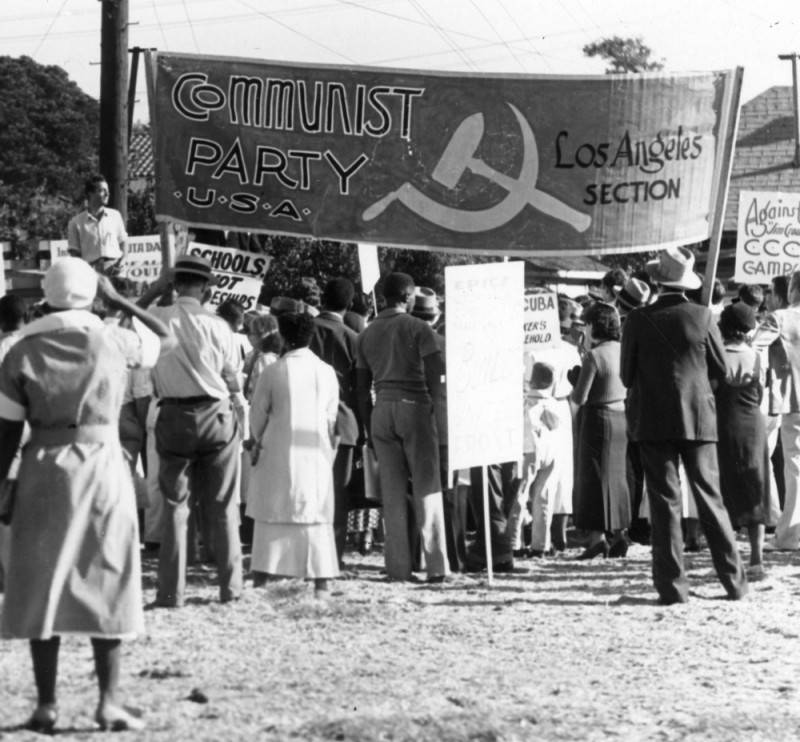
The best method of dealing with this disease is to have a member of the committee break up the discussion by calling the debaters quietly aside and appealing to the debater who is friendly to discontinue. If he refuses, he can be invited to go to another corner and hold his own meeting. Sometimes a show of force is necessary. Sometimes a very popular speaker can appeal to the audience to expel the disturber. This nuisance is an ever-present danger, with which it is most difficult to deal. The trouble lies in the fact that these disturbers secretly believe that they are superior to the speaker. As a general rule, this is not true. A speaker can be successful only thru special study of his subject, and is, therefore, the one best qualified as a propagandist. Besides this, the speaker always has the advantage of being on a platform, which helps him to carry a mass appeal and to gain results far beyond anything that can be hoped for from the best of cranks.
“Packing” the Audience
Interest is contagious. A crowd standing around with plenty of room to move around in will never have a good result as an audience that is closely packed. A well-organized committee can quickly pack a crowd by going to the outskirts and gently pushing forward. This is a very delicate maneuver. The crowding forward must be so carried out as to seem entirely unintentional and the result of great interest in what the speaker is saying. If clumsily done trouble is very likely to result.
Patrolling the Meeting
The best and most experienced comrades should be posted on the outside of the crowd to safeguard the meeting from disturbances of all kinds, to be ready to deal with cranks and nuisances, and to attend to the process of packing the crowd.
Order of Business
A well-conducted meeting will open at 8 p.m. sharp with a five-minute speech by the chairman, not for the purpose of getting a crowd but to make a few important remarks and announcements. Chairmanship of this sort Is first class training for beginners.
About 75 minutes should be given to speaking, to be followed by a collection, then the sale of literature, and then questions. Special announcements can be made after the sale of literature. Good speakers do not lose the crowd by making a collection. If the crowd cannot be held thru a collection, it is best not to attempt the collection.
While the collection is being taken and literature sold, the speaker must frequently refer to the fact that the meeting is about to be opened for questions.
The Party Organizer was the internal bulletin of the Communist Party published by its Central Committee beginning in 1927. First published irregularly, than bi-monthly, and then monthly, the Organizer was primarily meant for the Party’s unit, district, and shop organizers. The Organizer offers a much different view of the CP than the Daily Worker, including a much higher proportion of women writers than almost any other CP publication. Its pages are often full of the mundane problems of Party organizing, complaints about resources, debates over policy and personalities, as well as official numbers and information on Party campaigns, locals, organizations, and periodicals making the Party Organizer an important resource for the study and understanding of the Party in its most important years.
PDF of issue (large file): https://files.libcom.org/files/Party%20Organizer%201-3.pdf
 Revolution's Newsstand