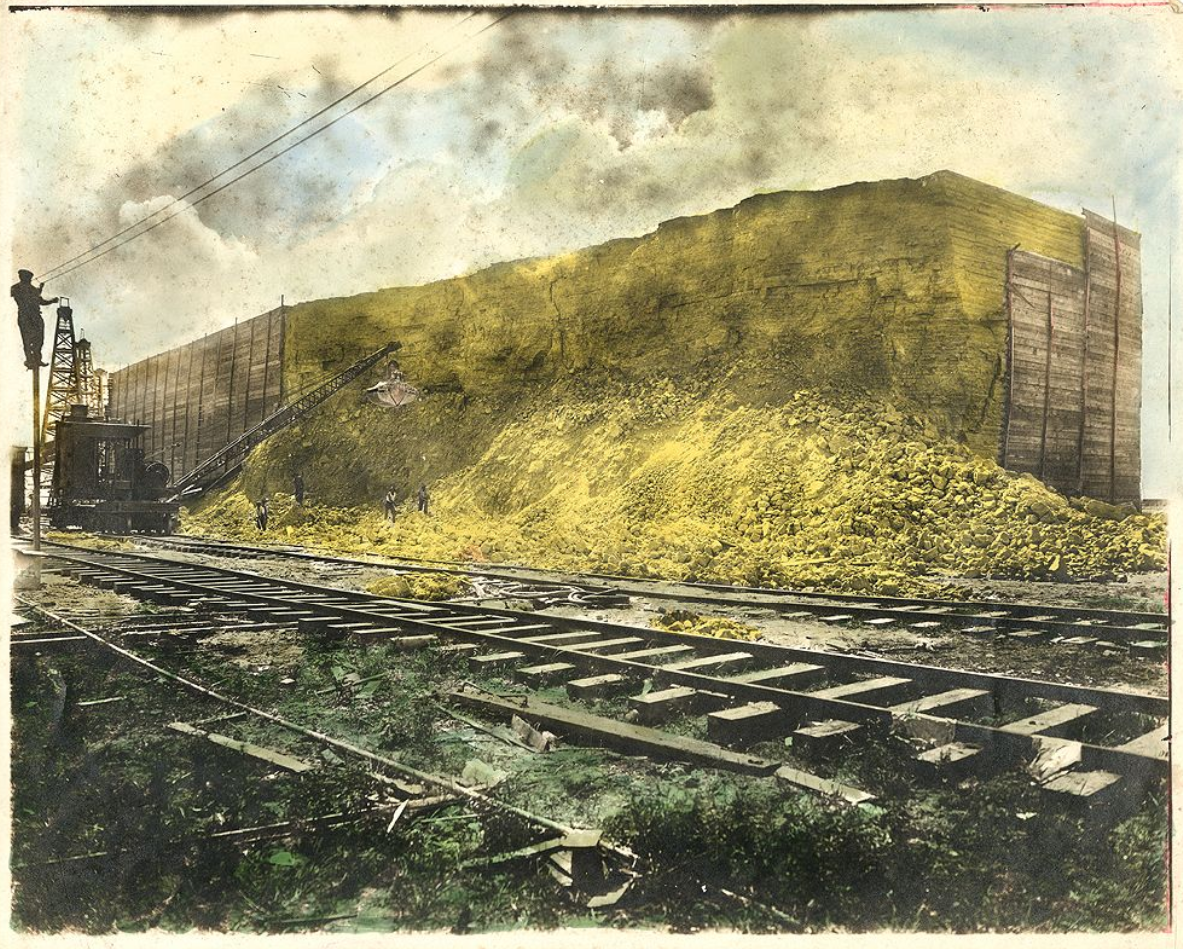
An early article from Harrison George on the toxic conditions of sulphur mines in the U.S.
‘Sulphur and Brimstone: A Hell of a Job!’ by Harrison George from the International Socialist Review. Vol. 16 No. 6. December, 1915.
NEXT to Billy Sunday, the United States leads the world in the production of brimstone, known as sulphur when pulverized. The Rev. B.S. states that his hell contains an inexhaustible supply of this substance, produced by the Almighty for the delectation of the damned. Anyhow, as a promoter of the natural resources of Hades, he and his kind have made it pay even better than the capitalists who exploit labor in the sulphur mines of the west and south.
Brimstone is obtained from soft ore bodies, usually in volcanic regions; although it’s connection with volcanic action is unknown. Perhaps it seeps up from the evangelist’s hell via the volcanic route. In the United States the discovered bodies lie chiefly in Louisiana, Wyoming, Texas and Utah.
The utilization of chemicals in industry has caused an enormous demand for sulphur products in the last few decades, although its existence was known to the ancients, and it was used to some extent at least during the middle ages for burning the bowels out of heretics and like pleasantries.
Outside its ordinary uses, including sugar refining, sheep-dip and tree-spray, etc., the derivatives of sulphur figure in the manufacture of explosives, and the sulphur mines of America are now running day and night to supply the direct political action argument in progress over-sea.
Up till the later nineties Sicily led the world in sulphur production. The Sicilian method was delightfully simple and painfully wasteful. They just piled the ore in pits and set fire to it and what didn’t burn ran to the bottom and was saved.
In America they have improved upon this by adopting the retort method for quarry or shaft mined ore, and the French system of well-mining for deeplying ore bodies, as in Louisiana.
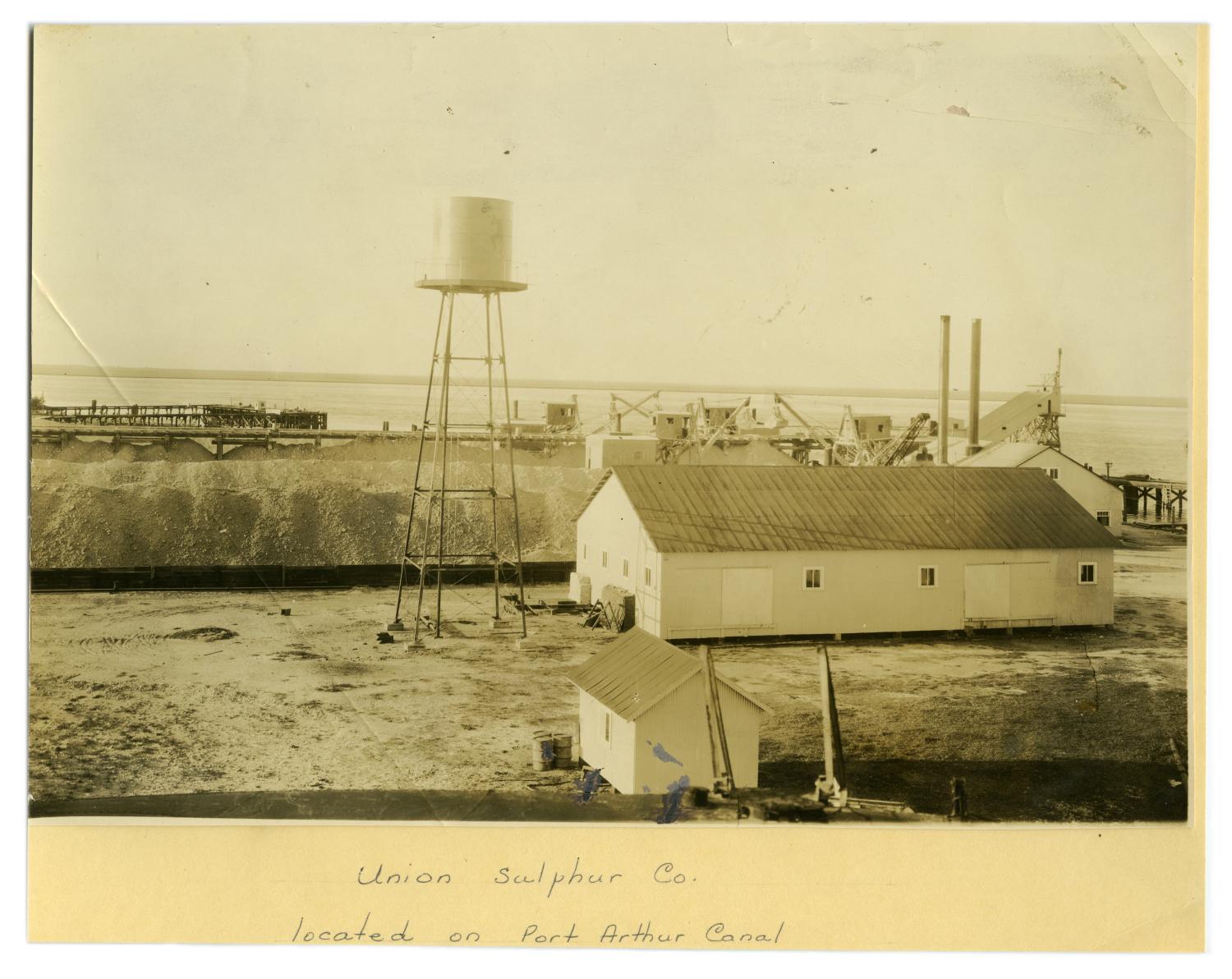
By this method a well is driven as for oil or gas into the ore stratum. The well is then lined with four lines of pipe of different diameters, the outer being ten inches and the smallest in the center, one inch in diameter. Superheated air and water are forced down the outer pipe, melting the sulphur in the ore body. This semi-liquid mass, which runs into the sump or depression at well-base is then forced out the intermediate pipes, by hot air sent down the one inch pipe under pressure. Upon reaching the surface it is run into vats, where it hardens quickly. This is brimstone, which, when ground is the common commercial sulphur.
In the Wyoming mines the retort process is used, as the ore is taken from the quarries and shafts. It is loaded upon especially constructed cars and four cars at once are sent into a large retort, where steam is turned on the mass. The melting sulphur is drawn into vats and the waste stays in the cars to be sent to the dump.
In the pulverizing mill the worker runs a continuous handicap with sudden death as impurities cause frequent explosions in the grinder, shattering timbers and wageslaves, firing the sulphur and generating gas a few breaths of which will put one out of commission.
For all this hard and hazardous work the sulphur slaves are paid at the same rate as un-skilled labor in the different localities. Workers of all races and nations sweat and swear side by side as in the other industries. And in bunk-houses that almost equal a pig’s boudoir they sleep, these sulphur slaves; sleep, smoke and talk — talk of the work, the wages and the war.
Upon these topics Joe and I were talking one day while outside the bunkhouse, the sulphur smell contended with the pungent odor of desert sage in the crystal air of the Wyoming mountains. Joe had confessed to a previous acquaintanceship with the One Big Union obtained in an eastern factory.
Joe was from the south of Europe and was fixing his shoes. He now punctuated his remarks with an up-raised hammer, “Socialista in ol’ countree go crazy like hell. Biga man say ‘defend.’ Defenda what? I lika know. I don’t know what Unit’ State socialista ‘tink, but da I-doubl-doubl-u’s say, ‘Defenda home? Defenda hellI! t’ing ma job same like that ‘home;’ shovel brima-stone alia night. Job jus’ lika hell, hell jus’ lika job.”
The International Socialist Review (ISR) was published monthly in Chicago from 1900 until 1918 by Charles H. Kerr and critically loyal to the Socialist Party of America. It is one of the essential publications in U.S. left history. During the editorship of A.M. Simons it was largely theoretical and moderate. In 1908, Charles H. Kerr took over as editor with strong influence from Mary E Marcy. The magazine became the foremost proponent of the SP’s left wing growing to tens of thousands of subscribers. It remained revolutionary in outlook and anti-militarist during World War One. It liberally used photographs and images, with news, theory, arts and organizing in its pages. It articles, reports and essays are an invaluable record of the U.S. class struggle and the development of Marxism in the decades before the Soviet experience. It was closed down in government repression in 1918.
PDF of full issue: https://www.marxists.org/history/usa/pubs/isr/v16n06-dec-1915-ISR-riaz-ocr.pdf
 Revolution's Newsstand