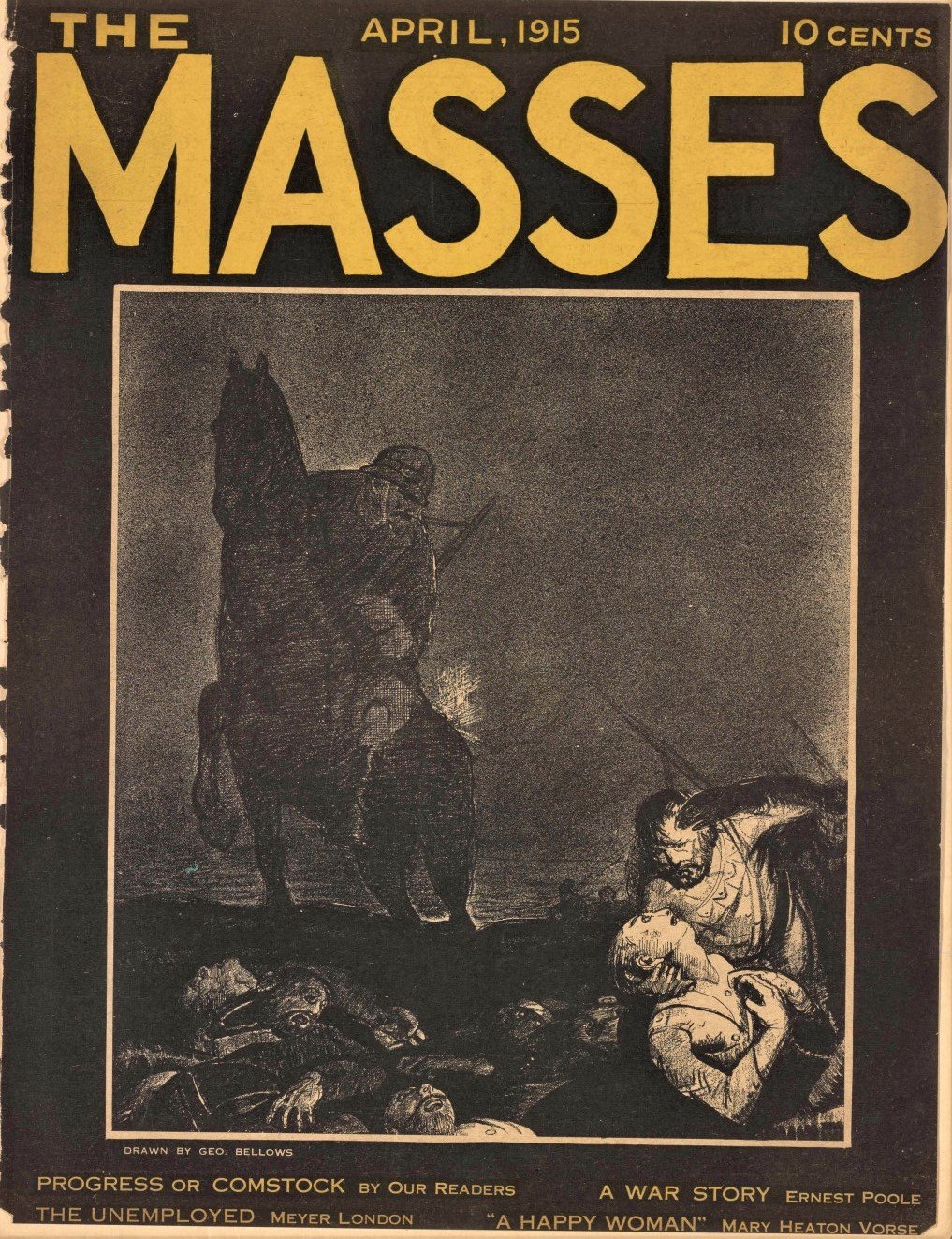
The Masses. Vol. 6 No. 7. April, 1915.
Contents: Knowledge and Revolution by Max Eastman, Invocation by M.E., Prison Literature by Frank Tanenbaum, Travel by Harry Kemp, In the Social Whirl by Howard Brubaker, ‘Submarines’ by Ernest Poole, Poems by Clement Wood, Meetings by Elsie Clews Parsons, Overlords of Charity by Irvin Ray, Gentlemen the King! by Witter Bynner, Heavenly Discourse by Charles Erskine Scott Wood, Billy Sunday by Frederic W. Raper, The Incentive by Sara N. Cleghorn, After the Strike by Edmond McKenna, Pat Quinlan, Putting One Over on Woods, The Happy Woman by Mary Heaton Vorse, Fashion Note, The Unemployed by Meyer London, Booze and Revolution by Kate Richards O’Hare, The First Few Books: Book Reviews by Max Eastman, ‘The Harbor’: Book Review of ‘The Harbor’ by Ernest Poole by Edmond McKenna, ‘The Likes ‘o Me’: Book Review of ‘The Likes o’ Me’ by Edmond McKenna by Floyd Dell, Progress or Comstock?, What Every Young Woman Ought to Have Known by Elizabeth Grieg, ART BY Maurice Becker, K.R. Chamberlain, Art Young, Maurice Becker, John Sloan, Stuart Davis, George Bellows, Harry Osborne, H. J. Glintcnkamp, Cornelia Barnes.
The Masses is among the most important, and best, radical journals of 20th century America. It was started in 1911 as an illustrated socialist monthly by Dutch immigrant Piet Vlag, who shortly left the magazine. It was then edited by Max Eastman who wrote in his first editorial: “A Free Magazine — This magazine is owned and published cooperatively by its editors. It has no dividends to pay, and nobody is trying to make money out of it. A revolutionary and not a reform magazine; a magazine with a sense of humour and no respect for the respectable; frank; arrogant; impertinent; searching for true causes; a magazine directed against rigidity and dogma wherever it is found; printing what is too naked or true for a money-making press; a magazine whose final policy is to do as it pleases and conciliate nobody, not even its readers — There is a field for this publication in America. Help us to find it.” The Masses successfully combined arts and politics and was the voice of urban, cosmopolitan, liberatory socialism. It became the leading anti-war voice in the run-up to World War One and helped to popularize industrial unions and support of workers strikes. It was sexually and culturally emancipatory, which placed it both politically and socially and odds the leadership of the Socialist Party, which also found support in its pages. The art, art criticism, and literature it featured was all imbued with its, increasing, radicalism. Floyd Dell was it literature editor and saw to the publication of important works and writers. Its radicalism and anti-war stance brought Federal charges against its editors for attempting to disrupt conscription during World War One which closed the paper in 1917. The editors returned in early 1918 with the adopted the name of William Lloyd Garrison’s The Liberator, which continued the interest in culture and the arts as well as the aesthetic of The Masses. Contributors to this essential publication of the US left included: Sherwood Anderson, Cornelia Barns, George Bellows, Louise Bryant, Arthur B. Davies, Dorothy Day, Floyd Dell, Max Eastman, Wanda Gag, Jack London, Amy Lowell, Mabel Dodge Luhan, Inez Milholland, Robert Minor, John Reed, Boardman Robinson, Carl Sandburg, John French Sloan, Upton Sinclair, Louis Untermeyer, Mary Heaton Vorse, and Art Young.
PDF of full issue: https://www.marxists.org/history/usa/pubs/masses/issues/tamiment/t49-v06n07-m47-apr-1915.pdf
 Revolution's Newsstand