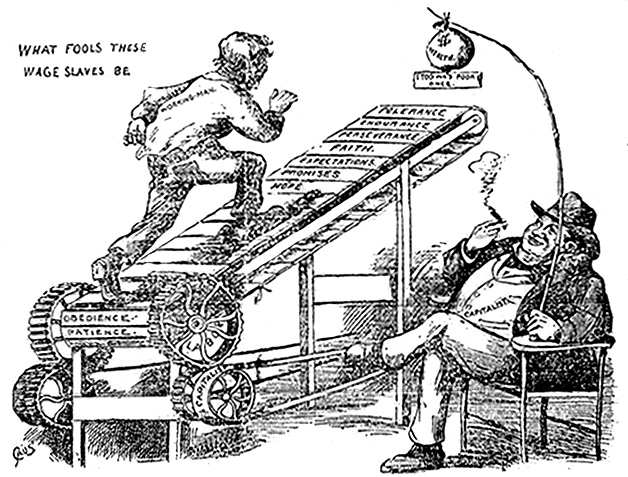
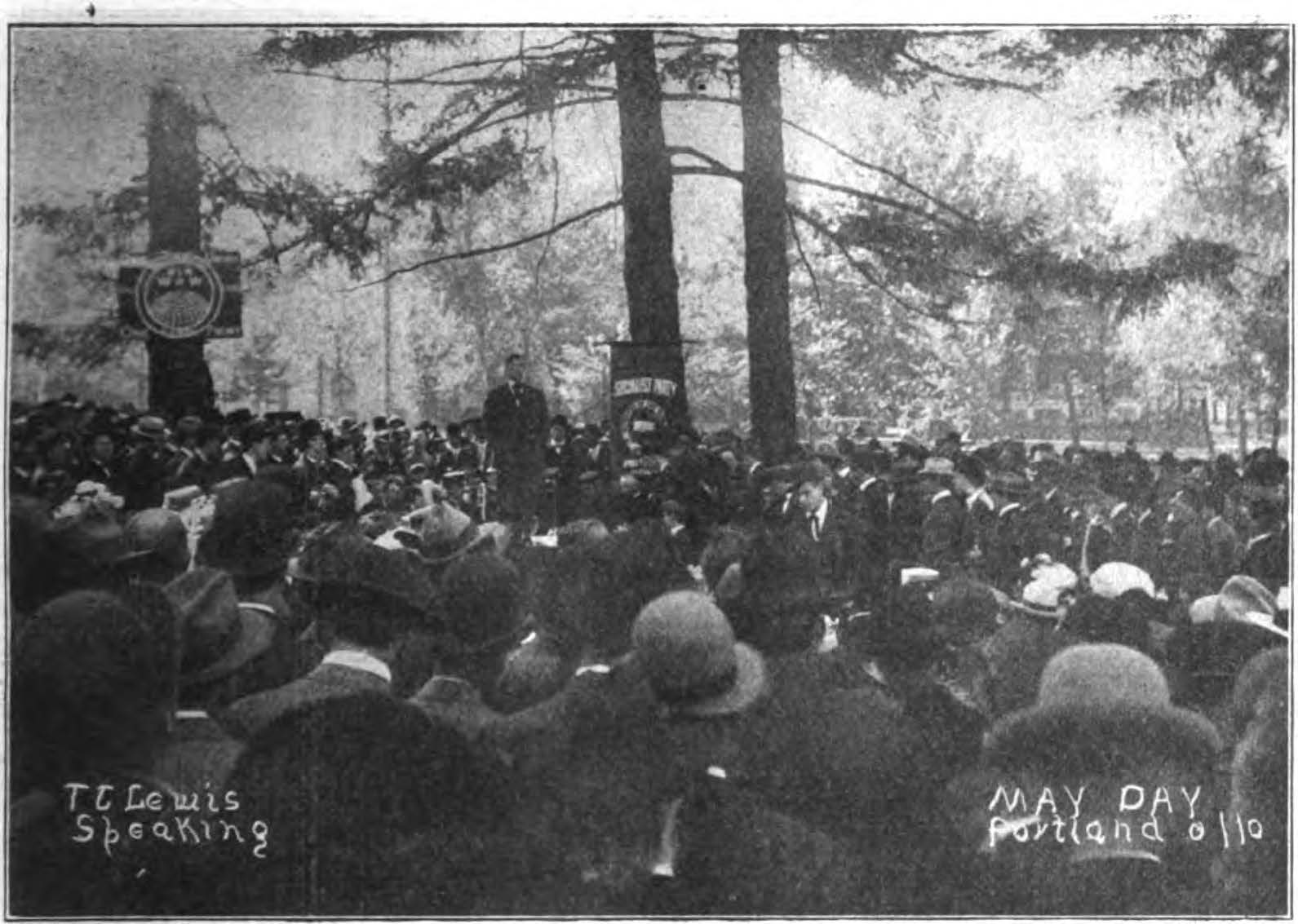
Veteran Socialist labor agitator, and founding Communist, Tom Lewis gives a popular lesson in Marxism for the T.U.E.L.’s ‘Labor Herald.’
‘Wages: What Are They?’ by Tom Lewis from Labor Herald. Vol. 1 No. 6. August, 1922.
A PERSON often hears the word “wages.” In fact all working people use it, and the reason is, that is what they get for working. But how many people really know what wages are? Some have an idea it is a gift from the boss to them from the goodness of his heart. Others again think it means what they are worth, and that to be paid more would be a crime. Then there are many who say they are getting more than they are worth, and while they believe in that fashion it may be all too true. And with some, because of being somewhat cute, they may get more for what they do than others. Yet that is no answer as to what wages are, but rather a statement of the confusion that prevails among the workers about it. And further, let it be understood that many do not even give, as to what wages are, even a thought. The ignorance prevalent on this question is simply stupendous.

Owing to the teaching some have had, they measure wages only in a religious sense, because it has been dinned into their ears that “the wages of sin is death.” Consequently they cannot see why what they get for working should be confused with the theology they have been taught from childhood. Therefore in order, if possible, to clear the atmosphere of some of this fog, this article has been written. Its intent is solely to make the solution so simple that any worker can understand it by solid attention, even by reading it once over. Watch how simple it is, then try to remember it. You may learn, like many of your fellow workers, something of importance to yourself. From that knowledge, once you have mastered it, you will gladly join with those you have previously opposed, in the movement to destroy the wages system. Because when you learn how degrading it is, and how inhuman, and what is more, what a poor chance you have of ever rising out of the ranks of the wageworkers, you will then realize that your greatest hope is to aid in demolishing a condition of society that denies the workers the right to the fruits of their toil, to say nothing of the denial of an education, leisure to enjoy art, science and literature, and Nature in all her grandeur and beauty.
First we must not allow “salary” and “wages” to be confused, because there is quite a difference. Quoting from a dictionary, here it is: “Salary, a periodical allowance as compensation for service,” while wages are “payment for services rendered.” Note the divergence- wages for “services rendered,” salary a “periodical allowance.” The dictionary further says of wages, “especially pay of workers by the day, week or month.” That ought to be plain enough, but keep in mind that the dictionary only defines words and their meaning. Apart from that we ourselves must solve the problem. Now to the subject matter, what are wages?
Wages are that which the boss pays to the worker for his labor time, whether he is skilled, common laborer, or specialty worker, so that he will return and work again. Or it can be said in other words, “wages are determined by the cost of reproduction.” Yet to those who have not studied the wages problem, that is difficult to understand, and after all that is not explaining. To make it simple, the best way is in the form of questions.

You know that the worker must eat? That he must wear clothing? That he must have some place to live in? Yes, we all know the three essential things to live, food, clothing, and shelter. Can the worker, individually, produce these for himself? No, because machinery and large scale production has driven the mass of the people to work for wages; that is, to use the machinery belonging to the boss, or work in the boss’s organization of the job, and in return get a certain amount of money to buy necessities.
Why does the boss pay him wages? Because by his labor he produces more values than the boss pays him back, and thus the boss makes a profit without himself working.
Is the amount of wages determined by the value of the workers product? No, the boss pays only as much as is necessary to bring the worker back to the job again.
Are not the varying rates of wages paid a proof that the worker’s production determines his wages? No, the only relation is that the worker must produce more than his wages, and equal to what other workers would produce for the same wage.
Wages Up and Down
To see clearly how wages fluctuate without much change in productive ability, recall what happened during the world war. In such times wages may rise, because the workers may take advantage of the relative scarcity of workers. The Government called millions into service, and war industries boomed. This is later offset, and the advantage wiped out with the return of all the soldiers not killed or crippled. Then we have wages going down, factories closing, “open shop” drives to break the unions, etc. And now look at another thing about the re cent changes in wages. During the war the greatest percentage of increase was gained by those hitherto unorganized. When the crash came their wages went down first and went lowest. The workers solidly organized in unions kept their wages up the longest and suffered the least cuts, a rule with some exceptions. In other words, the wages depend more upon the power of the workers’ organizations than upon production. Fluctuations in the world market, and economic crises effect them strongly in different ways.
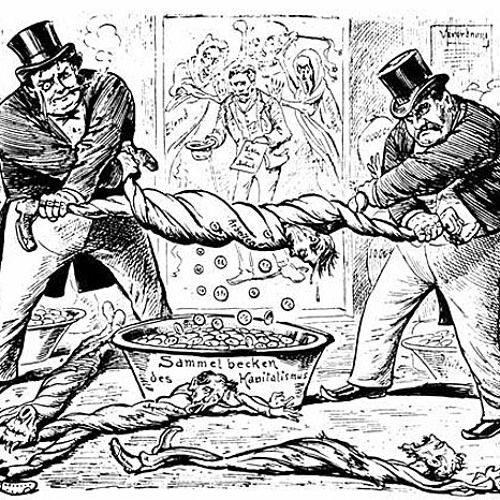
Today wages are going down. With the closing of the world war, the capitalists have taken advantage of the unemployment and economic crisis to start a wage slashing and union smashing campaign. The war between the nations has been turned into the war between the working class and the capitalist class, about wages and hours of labor. But the sad difference about this war is, the capitalist forces are well organized and conscious of their interests, while that cannot be said of the workers. The latter are largely without organization of any kind, and those who are in unions are divided into hundreds of different unions, -craft, federated, and independent. Very few of them know that they have interests as members of the working class, opposed to those of the capitalist class as a whole.
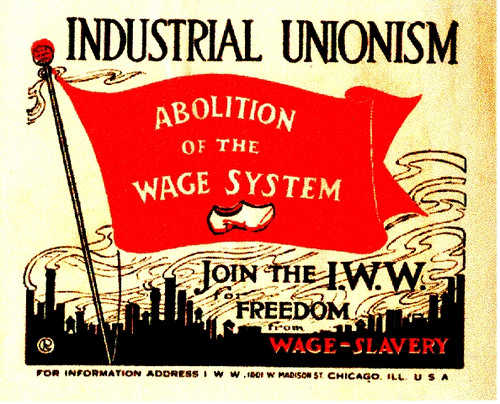
If the workers want their wages to go up, it will do them no good at all to work harder on their jobs. What is necessary is the amalgamation of all the present unions into a few industrial unions, each one covering an entire industry and organizing all the unorganized. Then with these industrial unions hooked up closely together, knowing what they want, the working class becomes a power fit to meet the power of the capitalists. Then we can fight, and have some degree of control over what the wages shall be.
Of course, even this is merely the first step in solving the problem of the workers. But until we get some kind of an understanding of this question of wages, what they are and what they mean, how can we control them? And when we finally learn some of these simple truths about wages, we find our mind reaches around the earth, because the wage system reaches round the earth-when we understand the question of wages we understand more about what is going on in the world.
Money Wages and Real Wages
We have only begun to know the interesting things about wages when we find out that they are based, not upon the amount of product but upon the reproduction of the worker. When we learn this and go on to examine more about the question, all kinds of light flows in upon our minds, showing many things hidden before. Workers are only now realizing, for example, that there is a difference between money wages and real wages.
It would seem if a worker getting $2. per day obtains an increase to $4., that he had doubled his wages. The money received is twice as much as before.
But the money is in his hands only for a few hours. It means nothing until it has been used to purchase food, clothing and shelter.
And while the workers’ wages were being increased from $2. to $4. per day, the prices of food, clothing, and shelter had increased from $2. to $5. So that the worker who thought he was getting a wage increase of 100% was being actually cut 25%.
The difference between the100% increase in money and the 25% cut in food and clothing, is the difference between money wages and real wages.
The German workers are getting an education on this subject. Before the war their wages were 1,00 to 5,000 marks per year; now they run into the hundreds of thousands, but the workers are starving; their hundreds of thousands of marks don’t mean anything. What they want is bread and meat, not marks.
This opens up a vast field for investigation. It is too big for this article. The whole question of “values” and “money” is involved. If you want more knowledge about how these things work, get the little 5c. book by Karl Marx, called “Value, Price and Profit.”
Another book worth reading is “The High Cost of Living.” You can get both from the book advertisers in the LABOR HERALD.
To End the Wage System
The worker under this system can only live by bowing to the rules laid down by the bosses. He must work the number of hours the boss says; he may shorten them a little by striking sometimes, but now the boss increases them in spite of strikes. The worker has to sell himself in competition with other sellers of labor power. He becomes like a head of cabbage or a quart of onions, sold upon the market.
The profits of the bosses, arising out of the difference between the workers product and his wages, are rapidly bringing the whole system to collapse. This is another thing we will learn, when we finally learn something about wages. But that is another story, to be told another time.
The Labor Herald was the monthly publication of the Trade Union Educational League (TUEL), in immensely important link between the IWW of the 1910s and the CIO of the 1930s. It was begun by veteran labor organizer and Communist leader William Z. Foster in 1920 as an attempt to unite militants within various unions while continuing the industrial unionism tradition of the IWW, though it was opposed to “dual unionism” and favored the formation of a Labor Party. Although it would become financially supported by the Communist International and Communist Party of America, it remained autonomous, was a network and not a membership organization, and included many radicals outside the Communist Party. In 1924 Labor Herald was folded into Workers Monthly, an explicitly Party organ and in 1927 ‘Labor Unity’ became the organ of a now CP dominated TUEL. In 1929 and the turn towards Red Unions in the Third Period, TUEL was wound up and replaced by the Trade Union Unity League, a section of the Red International of Labor Unions (Profitern) and continued to publish Labor Unity until 1935. Labor Herald remains an important labor-orientated journal by revolutionaries in US left history and would be referenced by activists, along with TUEL, along after it’s heyday.
PDF of full issue: https://www.marxists.org/history/usa/pubs/laborherald/v1n06-aug-1922.pdf
 Revolution's Newsstand