‘Art is a Weapon! Program of the Workers Cultural Federation’ from New Masses. Vol. 7 No. 3. August, 1931.
The worldwide crisis of capitalism has intensified the class struggle not only on the economic and political fields, but on the cultural as well. More than ever it is becoming clear to the workers of every country, and to those intellectuals whose economic distress or mental integrity has brought them to the side of the workers in their struggle for the overthrow of capitalism, that art and science, journalism and education, indeed every instrument for moulding the mind and imagination of man, is being utilized by the capitalist class for concealing the truth and for spreading falsehoods regarding the system of exploitation upon which its power rests.
Capitalism has reached a period of material and spiritual decline. Breadlines fill the cities of the various capitalist empires. Millions of workers the world over, with the solitary exception of the Soviet Union, are vainly tramping the streets for jobs. Starvation and misery are widespread. The bourgeois governments are making frantic pretenses of halting the crisis while energetically preparing for the next war. In this critical period it must be clear, more than ever before, to all workers, to all honest intellectuals, that the capitalist class is using the instruments of culture at its disposal for propaganda purposes, sometimes crudely open, sometimes well concealed.
This campaign of capitalist propaganda is carried on through the church, the schools, the newspapers, the magazines, the movie, and the radio. The greatest inventions for the spread of ideas, which in a socialist country like the Soviet Union are used to raise the cultural level of the masses, are used in the United States and other capitalist countries for spreading far and wide lies about the extent of unemployment, lies about the economic crisis, lies about the preparations for war, lies of the tremendous socialist construction being carried out by the workers of the Soviet Union.

This is to be expected. In all class societies the dominating class rules by controlling the instruments of culture along with economic and political power; it rules by disarming the exploited classes culturally as well as economically and politically. In the present crisis in capitalist economy, the fascist elements in every country have not only slashed wages and deprived the workers of economic and political advantages won in previous struggles; but have attacked the cultural strongholds of revolutionary working-class organizations. The American capitalist class has dropped the mask of “democracy”; it has broken up workers meetings, suppressed workers newspapers, deported foreign-born workers for revolutionary activity, attacked workers organizations, and prohibited the importation of revolutionary books and pamphlets from other countries.
The most cursory glance at American cultural institutions will reveal them at once as instruments of capitalist domination. The American school teacher who ventures the mildest criticism of the fraud and violence by which the bourgeoisie maintains its power is in danger of losing his job. Students who engage in revolutionary activities face persecution and expulsion. The public school systems are adjuncts to corrupt local political machines, while the private colleges and universities are controlled by Wall Street bankers. These institutions drill the students in the capitalist catechism based on patriotism, militarism, hatred and contempt for the working-class, sacred worship of capitalist society. Similarly, the press is a loyal mouthpiece of the ruling class, presenting to the masses, day in and day out, the capitalist version of all important events, and distracting the attention of the workers from the burning problems which confront them by stressing pornography and crime. The church, through its servile priests, ministers and rabbis, fills the minds of the masses with the most childish superstitions, hands them spiritual opium to make them forget their class interests, identifies the gospel of Jesus with the gospel of J. P. Morgan and brands as heresy and heathenism any effort of the oppressed toilers to better their condition. Keeping pace with the times, the church has now established itself as a recreational and cultural center in order to hold the workers in leash.
Such semireligious institutions as the YMCA, YWCA, YMHA, and YWHA serve the same purpose.
Bourgeois sport, to which the press gives more space than to the most important political and economic questions, has ceased^ to be sport in any real sense of the word and has become a commercial and profitable form of fraud for profit. The corruption of professional sports, which are often closely connected with the underworld, is notorious. Discrimination against Negroes is rampant in both amateur and professional sports. Not content with the usual sport organizations, which are ballyhooed through the press, the movies and the radio, the capitalists have now resorted to organizing sport teams in the factories as a means of keeping the workers distracted.
From the point of view of reaching the widest masses of the population, the most important cultural instruments are the movies and the radio. Here we have two “arts” monopolized by a handful of capitalists organized in trusts, handling billions of dollars, reaching every day and every evening millions of people. Here bourgeois censorship has full sway. The movie writer, the radio speaker must conform to bourgeois policy or get out. While the literary teas still like to babble about the “freedom of the artist,” the radio and the movies turn the American intellectual into a slave whose utterances are controlled in the interests of the sacred rights of private property. On this score even highly paid writers in Hollywood have complained. In the radio and the movie wo have reached the industrialization of art under capitalism the mass production of bourgeois ideas. It is no wonder that Hollywood turns out dozens of insipid films of “passion” and racketeering, while completely ignoring the life of the masses of the population; it is no wonder that workers organizations cannot broadcast over the radio.

Capitalist culture in the twentieth century is imperialist culture. The American ruling class exports capital to foreign countries — and movies. American gunboats and missionaries are sent to China; American schools are opened in Cuba, Haiti, China, the Philippines for the sons of the middle classes who are trained to become efficient betrayers of their people while keeping the masses in ignorance. Beneath this upper crust of “Western culture,” imperialism preserves intact the stagnant pre-capitalist cultural forms and levels, preventing the development of an independent national culture.
Within the United States itself this cultural domination is most evident in the case of the Negro. Negro children in the South (and in many northern states), when they get any schooling at jail, are segregated in Jim Crow schools that are vastly inferior to the white schools. Most southern states spend from four to ten times as much on the education of white children as on Negro children. In contrast, Negro preachers, bible-thumpers and holyrollers of all kinds flourish amidst the economic, social and cultural exploitation of the Negro. In the North the Negro is patronized culturally, kept at the level of a blues-singer and tapdancer for the amusement of tired businessmen and white thrillhounds.
To the culture of capitalism in decay the new culture of the Soviet furnishes a striking contrast. For the first time in history, a true mass culture on a high level (as distinguished from the culture of primitive Communism which was based on a very low development of the productive forces) is being developed. The entire working population of the Soviet Union is participating in the creation of a new culture, molding it on the basis of their own lives and struggles.
“Art belongs to the people,” said Lenin. “It must have its deepest roots in the broad mass of the workers. It must be understood and loved by them. It must be rooted in and grow with their feelings, thoughts and desires. It must arouse and develop the artist in them.” In contrast to the spiritual exhaustion, mysticism and despair of bourgeois literature, there is tremendous vitality and a creative strength in Soviet literature, rooted in the shops and factories and fields, fertilized constantly by the worker and peasant correspondents. In the other arts even bourgeois specialists are forced to express their admiration. It has become a commonplace that the Soviet drama and cinema (particularly the latter) lead the world. The cultural revolution in Soviet Russia, which is an integral part of the social revolution, has given complete cultural, as well as political autonomy to the numerous nationalities that were formerly oppressed by Russian czarism and imperialism. Stalin’s formulation: “proletarian culture — national in form, proletarian in content” is being realized in life. Soviet culture is not only aiding the struggles and developing the creative powers of the Russian masses* but is a mighty force helping to undermine the domination of bourgeois culture throughout the world. In every capitalist country, in varying degree, we already see the birth of a proletarian culture within the womb of capitalist society. Just as the epoch of the bourgeois revolution witnessed the upsurge of bourgeois culture, the epoch of the proletarian revolution is producing a powerful development of cultural activities among the working-class.

In performing its historic mission of creating the material basis for the socialist society, capitalism also creates the basis for socialist culture. The development of the press, the spread of literacy, the establishment of publishing houses, libraries, the movies, the radio, in short, the entire cultural apparatus of capitalism becomes the foundation for mass proletarian culture and the arsenal from which the workers take their cultural weapons even before the overthrow of the bourgeoisie.
The possibilities for the development of proletarian culture in the United States have been immensely widened by the economic crisis which has shaken the pillars of capitalist society, has radicalized the workers, as well as large numbers of intellectuals, and destroyed in them the illusions about “prosperity,” “the American standard of living,” etc., which the ruling class had so carefully cultivated.
The economic crisis has roused many intellectuals out of their Indifference to social questions and has brought them closer to the workers. Thousands of engineers, musicians, teachers, writers, artists and newspapermen are walking the streets unable to find jobs. Even before the crisis, rationalization (speedup), technological improvements (e.g. the movietone) and trustification (e.g. newspaper mergers) had thrown large quantities of skilled mental labor out on the streets. Here too the anarchy of capitalist production plays its part. The colleges and universities “produce” thousands of teachers, engineers, chemists, etc., for an unknown “market” which is already glutted and cannot absorb these surplus “commodities.” And as in industry, we find that skilled mental labor is being dumped into the ranks of the relatively unskilled. Many lawyers, for example, who imagined that they were “going into business for themselves,” have been reduced to the position of little more than clerks for large banks and trust companies. How true today are the words of The Communist Manifesto: “The bourgeoisie has stripped of its halo every occupation hitherto honored and looked up to with reverent awe. It has converted the physician, the lawyer, the priest, the poet, the man of science into its paid wage laborers.”
The lowered economic and social status of the intellectuals, coming in the period of the decay of bourgeois culture and the rise of the culture of the proletariat, has produced a deep social ferment among them and a decisive swing to the left on the part of many. This leftward swing is of varying degrees and though it is accompanied by characteristic confusions and vacillations, it is nonetheless immensely significant. The first organizational expression of this radicalization occurred at the very beginning of the economic crisis with the formation in October, 1929, of the first association of revolutionary writers and artists of the United States, the John Reed Club. This gave an impetus to the general proletarian cultural movement, which found organizational form in the Workers Cultural Federation of New York, founded in June 1931.
The Workers Cultural Federation of New York, formed at an enthusiastic conference at which 130 organizations, with a total membership of about 20,000, were represented, comes forward in the most acute period of the capitalist crisis. It is an expression on the cultural front of the will to struggle, on the part of thousands of workers, for the overthrow of the system that makes crises, starvation, misery, and war inevitable. Against reactionary capitalist culture and its liberal, reformist servants we oppose the swiftly developing forces of revolutionary proletarian culture. Against the treacherous policy of cultural class collaboration and the open or concealed support of reactionary organizations, we pursue the policy of class struggle in culture and openly support all the revolutionary organizations of the working-class. Against ideological reaction, fascism, mysticism, liberal tightrope walking and pseudo-scientific apologetics that have become the platform of the cultural representatives of capitalism, we stand firmly on the platform of dialectical materialism, on the discoveries and teachings of Marx, Engels and Lenin.
For many years American working-class organizations of various nationalities have been engaged in some form of cultural activity. This activity has, however, been uncoordinated and has affected for the most part only the foreign-language workers. Little cultural islands have grown up among the various nationalities and though all have common aims, there has been no contact among them. Moreover, this work has been confined largely to the big cities and to the advanced workers, while the broad masses in the shops and factories, and especially the native-born workers, have not been touched at all.
It was to remedy these defects and to broaden and develop cultural activity as a weapon in the struggles of the workers that the Workers Cultural Federation of the New York District was formed — the first step toward a nationwide federation of all proletarian cultural groups. The Fifth Congress of the Red International of Labor Unions and the Kharkov Conference of Revolutionary Writers and Artists, held last year, gave the immediate impetus to the establishment of the federation* The experiences of the highly developed proletarian cultural movements in Soviet Russia and Germany have shown us the way. That way is into the shops and trade unions! The revolutionary trade unions must, in fact, become the base of all the cultural work, from which it will penetrate into the other mass organizations, into isolated industrial and farming communities, into strike struggles and political campaigns, into all the activities of the working-class.
The broad masses must be the basis for all our work and not merely the advanced workers. Special attention must be paid to the Negroes among whom the influence of the church is especially pernicious. It is our job to develop cultural activities with a special appeal to the Negro masses and to draw Negroes into the already existing cultural organizations. In this work the cooperation of the League of Struggle for Negro Rights is essential. Similarly, the Latin- American workers in the United States, who like the Negroes, bear the burden of a double oppression are sorely in need of cultural organizations.

Strong ties with the worker correspondence and shop paper movements are essential if we are really to be close to the masses and respond to their needs. New and more varied forms of cultural activity need to be developed. Of paramount importance is the creation of a strong proletarian anti-religious movement to free the workers from the strangle-hold of the church.
The youth, both proletarian and intellectual, holds not only the future of the proletarian cultural movement, but its dynamic, vitalizing present. The Labor Sports Union, the radical students’ clubs and the Pioneer movement must be given all possible aid and their work coordinated with that of the other cultural groups.
Coordination of activity, broadening of our work to include larger numbers of workers and radicalized intellectuals, an interchange of material and experience, the development of greater internationalism among the workers in this country, relentless struggle against bourgeois culture, the development of a great mass proletarian culture to vitalize the lives of the workers and aid them in their struggles — these, in brief, are the aims of the Workers Cultural Federation. They can be achieved only on the basis of the platform adopted at the Kharkov Conference which urged support of the workers revolutionary movement, struggle against imperialist war and in defense of the Soviet Union, struggle against fascism and its “socialist” twin brother, social-fascism, struggle against the persecution of Negroes and the foreign-born, struggle for the release of all political prisoners, which include many cultural workers.
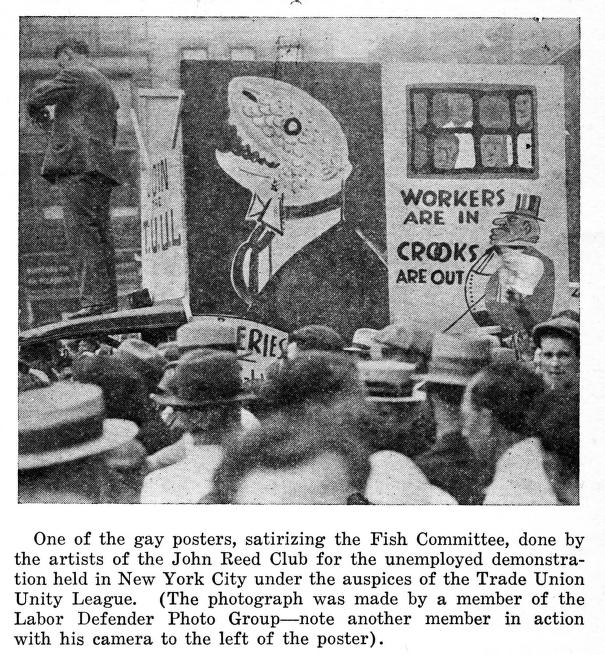
The struggle against imperialist war and in defense of the Soviet Union is especially important because of the widespread illusions that exist on this question. In the last war most of the writers, artists, scientists, teachers and other intellectuals went over bag and baggage to the imperialist governments and did their best to lead the workers in the same direction. Today many of them are consciously or unconsciously doing the same sort of work, aiding in the ideological preparation of the new war, a war which will most probably be directed against Soviet Russia. To deny the war danger is to bury one’s head in the sands; the Workers Cultural Federation calls on all American workers, farmers and intellectuals to unite in the struggle against the criminal war preparations of the American government which spends billions for war, but not one cent for unemployment relief. We call on them to defend the Soviet Union.
Our federation emerges at one of the critical moments of history, the moment when the struggle between two systems of civilization has entered a decisive stage. We enter this struggle in order to hasten the death of the old world; we enter it in unshakable faith in the creative powers of the working-class and in its ultimate triumph. Among the working masses in shop, mine, mill and field, among the toiling and thinking youth of America our work will be noted. To all those who like Romain Rolland and Theodore Dreiser, by their opposition to the old world of oppression, of hypocrisy, lies and corruption, already stand in the ranks of the fighters for the new, we hold out the hand of comradeship. The proletarian revolt sweeps on; whatever the vicissitude of its fortunes, it sweeps on to victory.
July 25, 1931. WORKERS CULTURAL FEDERATION.
The New Masses was the continuation of Workers Monthly which began publishing in 1924 as a merger of the ‘Liberator’, the Trade Union Educational League magazine ‘Labor Herald’, and Friends of Soviet Russia’s monthly ‘Soviet Russia Pictorial’ as an explicitly Communist Party publication, but drawing in a wide range of contributors and sympathizers. In 1927 Workers Monthly ceased and The New Masses began. A major left cultural magazine of the late 1920s to early 1940s, the early editors of The New Masses included Hugo Gellert, John F. Sloan, Max Eastman, Mike Gold, and Joseph Freeman. Writers included William Carlos Williams, Theodore Dreiser, John Dos Passos, Upton Sinclair, Richard Wright, Ralph Ellison, Dorothy Parker, Dorothy Day, John Breecher, Langston Hughes, Eugene O’Neill, Rex Stout and Ernest Hemingway, Artists included Hugo Gellert, Stuart Davis, Boardman Robinson, Wanda Gag, William Gropper and Otto Soglow. Over time, the New Masses became narrower politically and more journalistic in its tone.
PDF of full issue: https://www.marxists.org/history/usa/pubs/new-masses/1931/v07n03-aug-1931-New-Masses.pdf
 Revolution's Newsstand