
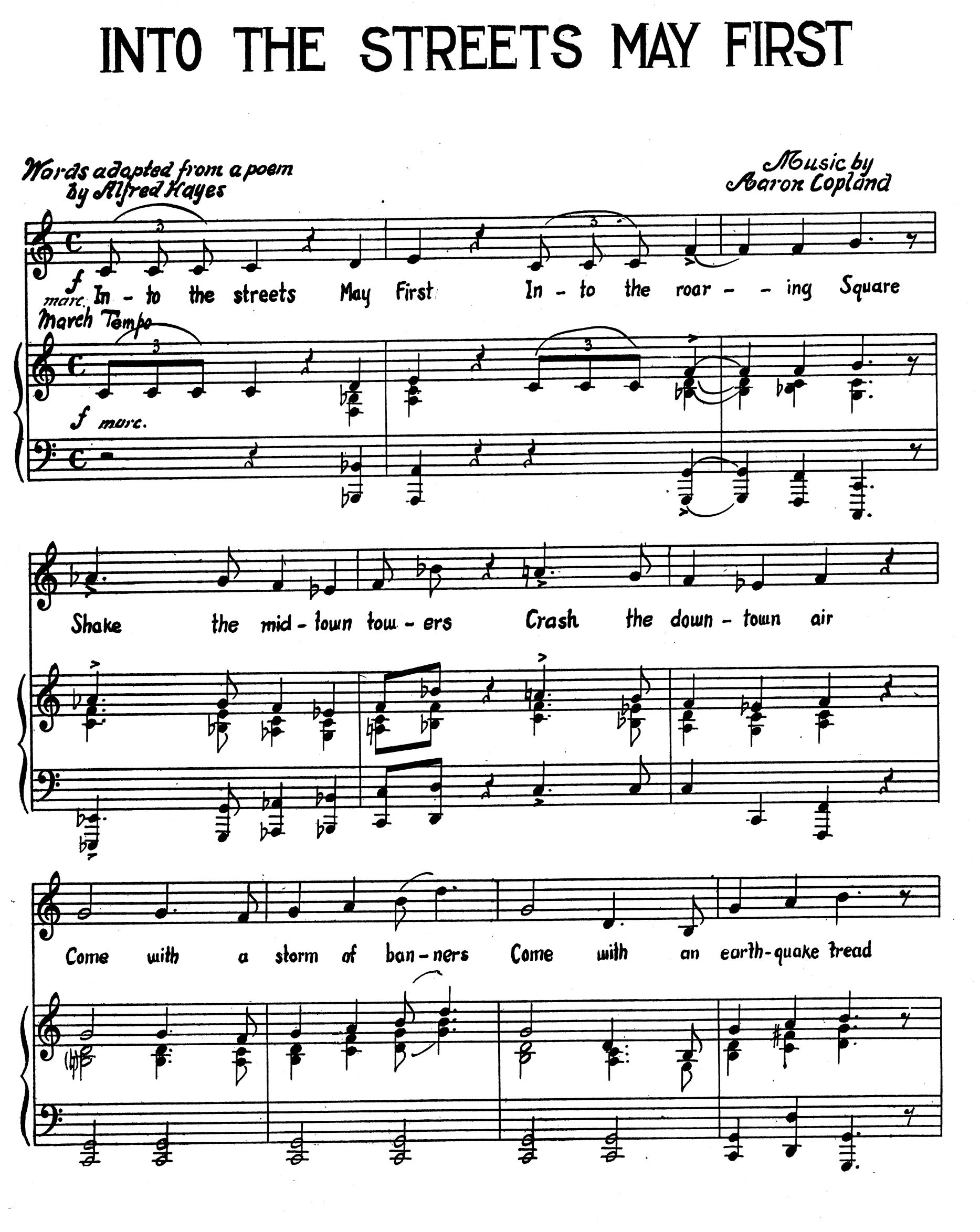
For May Day 1934 the New Masses, through the “Pierre Degeyter Clubs,” held a contest for leading new composers Lahn Adohmyan, Aaron Copland, Isadore Freed, Wallingford Riegger, Carl Sands, Mitya Stillman, and L.E. Swift to put music to Alfred Hayes’ poem ‘Into the Streets May First’ for collective singing. Aaron Copland won the honor. Ashley Pettis reviews the submissions and the emerging form of mass compositions. Copland’s score is included.
‘Marching With a Song’ by Ashley Pettis from New Masses. Vol. 11 No. 5. May 1, 1934.
ONE OF the most significant developments within the revolutionary movement has been the growth of music and music making of a nature which helps to unite and inspire masses of workers. The necessity for this kind of music as a weapon in the class struggle daily becomes more apparent. As in Russia, the idea: “We must develop our musical resources for the building of socialism” has made music both a unique power and an integral part of the lives of the people, so we are witnessing in America the gathering together of groups of workers for the making of music which is expressive of their lives and aspirations. Most of these songs have been derived from the revolutionary music of foreign lands, but because of their universal content have served the purpose of inspiring and uniting groups of workers of diverse and far-removed peoples. In addition to the formation of workers’ choruses in various cities recently, reports have come in of revolutionary songs improvised by the Negroes in the south, in conjunction with white workers.
In New York and many other cities, revolutionary musical organizations are springing up under the name of “Pierre Degeyter Clubs,” which are uniting the forces of class-conscious and politically-minded musicians. The functions of these groups are expanding daily through Service Bureaus, so that the activities of our musical craftsmen are becoming indissolubly linked with the lives of the workers in making available the best music to workers’ organizations. In New York the Composers’ Collective of the Pierre Degeyter Club has already done valuable work in the production of a number of mass songs now being sung by workers’ choruses. THE NEW MASSES feels that the time is ripe for the development of music by the various composers of America for the constantly increasing number of singing workers; a music which is characteristic of them; truly representative of their awakening consciousness and growing power; of their determination and hopes. With this in mind, Alfred Hayes’ poem, Into the Streets May First was sent out to the Composers’ Collective of the Pierre Degeyter Club, New York, as well as to a group comprising some of the most accomplished musicians of America. It was originally planned to have a national, general contest, but the time was too limited to do so and make a selection for performance and publication by May 1st. At a future date we hope to have a national contest in the production of mass songs.
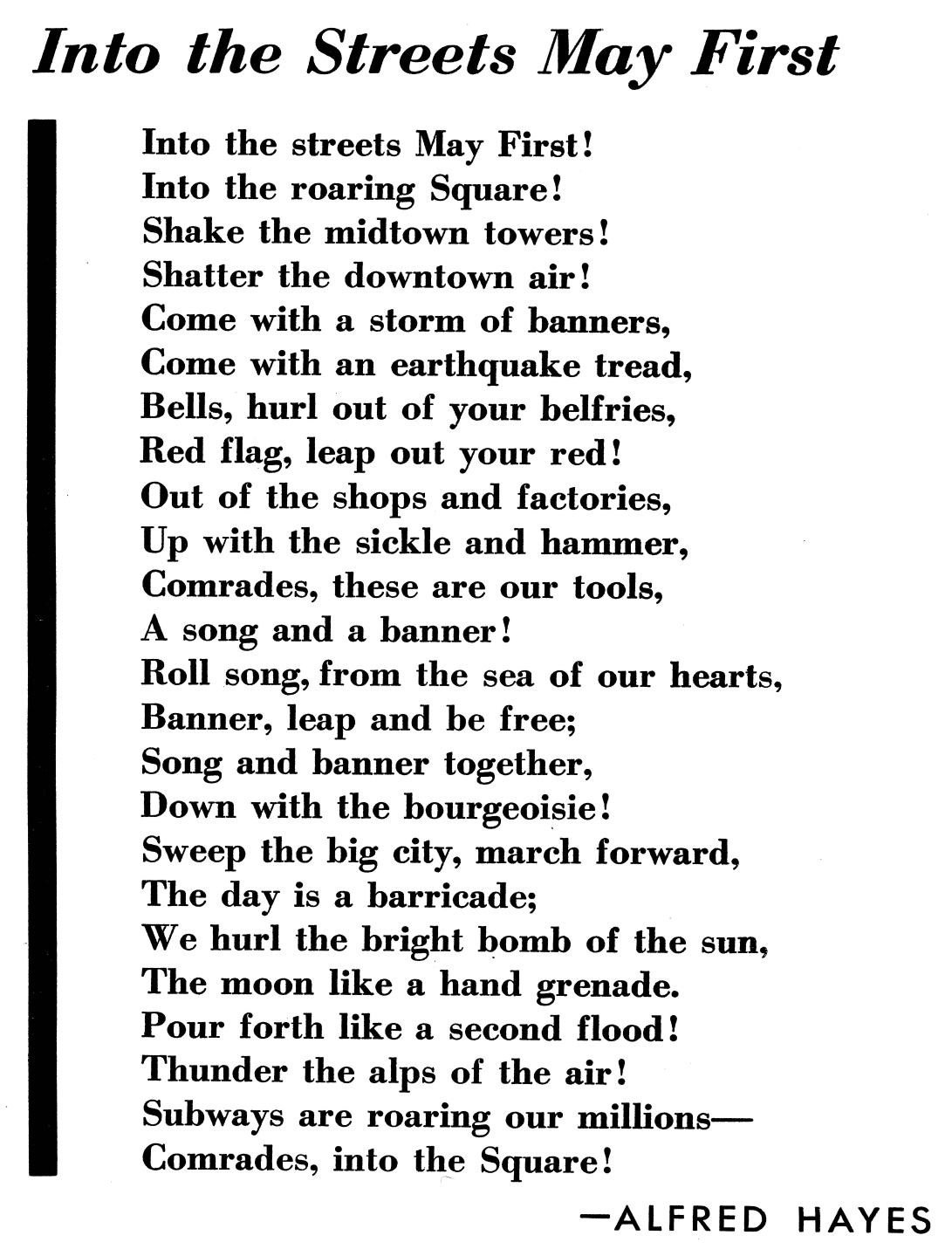
The response to the request for musical settings of the poem submitted transcended our greatest expectations. A jury comprising not only musicians from the Pierre Degeyter Club of New York, but from the rank and file selected what was considered the most practical song for our purpose. Not only was the musical excellence considered and the appropriateness of the setting, but its appeal to those who are not professional musicians. We want this song not only to be sung by a trained chorus, but to inspire others to join in the singing.
The composers who submitted contributions include Lahn Adohmyan, Aaron Copland, Isadore Freed, Wallingford Riegger, Carl Sands, Mitya Stillman, L.E. Swift and one composer who conceals his identity under the nom de plume “XYZ.”
The general quality of the musical settings was so high that it is greatly to be regretted that all these songs are not available for workers’ groups throughout the country.
The creation of new mass songs in America is, of course, only in its inception. Hence we find, in the various settings of Into the Streets May First, music of a great diversity of types. That of Carl Sands is of a familiar character, in no sense experimental. The harmonies are simple; the tune “catchy;” the whole somewhat in the style of Stephen Foster, which one of the judges considered to be typically “American”- though obviously America of another day.
Certain of the songs, such as those by Adohmyan and “XYZ” have marked excellence in the melodic and rhythmic conception, but from the standpoint of harmonic construction are perhaps too sophisticated and “modern” for singers in workers’ groups for whom mass songs are written. It is not that experiments and “revolutionary” musical tendencies are to be discouraged or eliminated in the creation of such songs. But it is absolutely necessary at this stage in the creation of the mass songs, to preserve the best of the old traditions, harmonic and melodic, at the same time injecting new life into these old forms so that the most unsophisticated singer may be drawn into the singing-in order that “he who runs” may sing! A completely new and different harmonic structure in songs which have “popularity” in the best sense as one of their principal aims, tends to repel. The undesirability of this is obvious. These songs with the addition of a less complex and “static” accompaniment, should prove to be practical and valuable compositions.
For the practical purposes of our contest, the compositions of both Swift and Freed were too long. In fact Swift added a quatrain to the Hayes poem, which, when set to music in its entirety was too long for publication in THE NEW MASSES. The Swift song possesses a fine, marching swing, and has an interesting combination of “modern” revolutionary harmonic color with a melodic “catchiness” which shows the skill and experience of the composer of the “Scottsboro Song” in the writing of mass songs.
The imposing magnificence and effectiveness of Isadore Freed’s score (with piano and drum or tympani accompaniment ad libitum) mark it apart from all the other songs entered in the contest. It should be made available for every chorus in America. Such a work is both good propaganda and splendid art. Its performance should have an extraordinarily moving and stirring effect upon any audience. The harmonies are bold and flaming in color. Here indeed the “red flag leaps its red!” May we soon hear this composition in public performance.
Fine craftsmanship is apparent in the construction of both the Riegger and Stillman songs. (Riegger submitted two scores.) These settings from the standpoint of practicability and musical excellence are valuable additions to the literature of the mass song. They are in nowise experimental. The character of the modulations, in the setting by Stillman, might prove somewhat of a deterrent in popularizing it. The tune is “catchy.” The simpler of the Riegger songs in all probability would be whistled after one hearing.

Aaron Copland’s composition, published in this issue, is most certainly an interesting and practical example of mass song. Taking everything into consideration, the judges were unanimous in making this selection. It has vigor, directness. Its spirit is identical with that of the poem. The unfamiliar, “experimental” nature of the harmonies which occur occasionally, does not tend to make the unsophisticated singer question. Copland has chosen a musical style of time-honored tradition, but he has imbued it with fresh vitality and meaning. The subtle alteration of harmonies and melodic intervals in progressions of a familiar nature, save it from being relegated to the category of the platitudinous. The harmonic structure, which in less skillful hands would have been mere “Pomp and Circumstance,” here possesses freshness and newness! Some of the intervals may be somewhat difficult upon a first hearing or singing, but we believe the ear will very readily accustom itself to their sound.
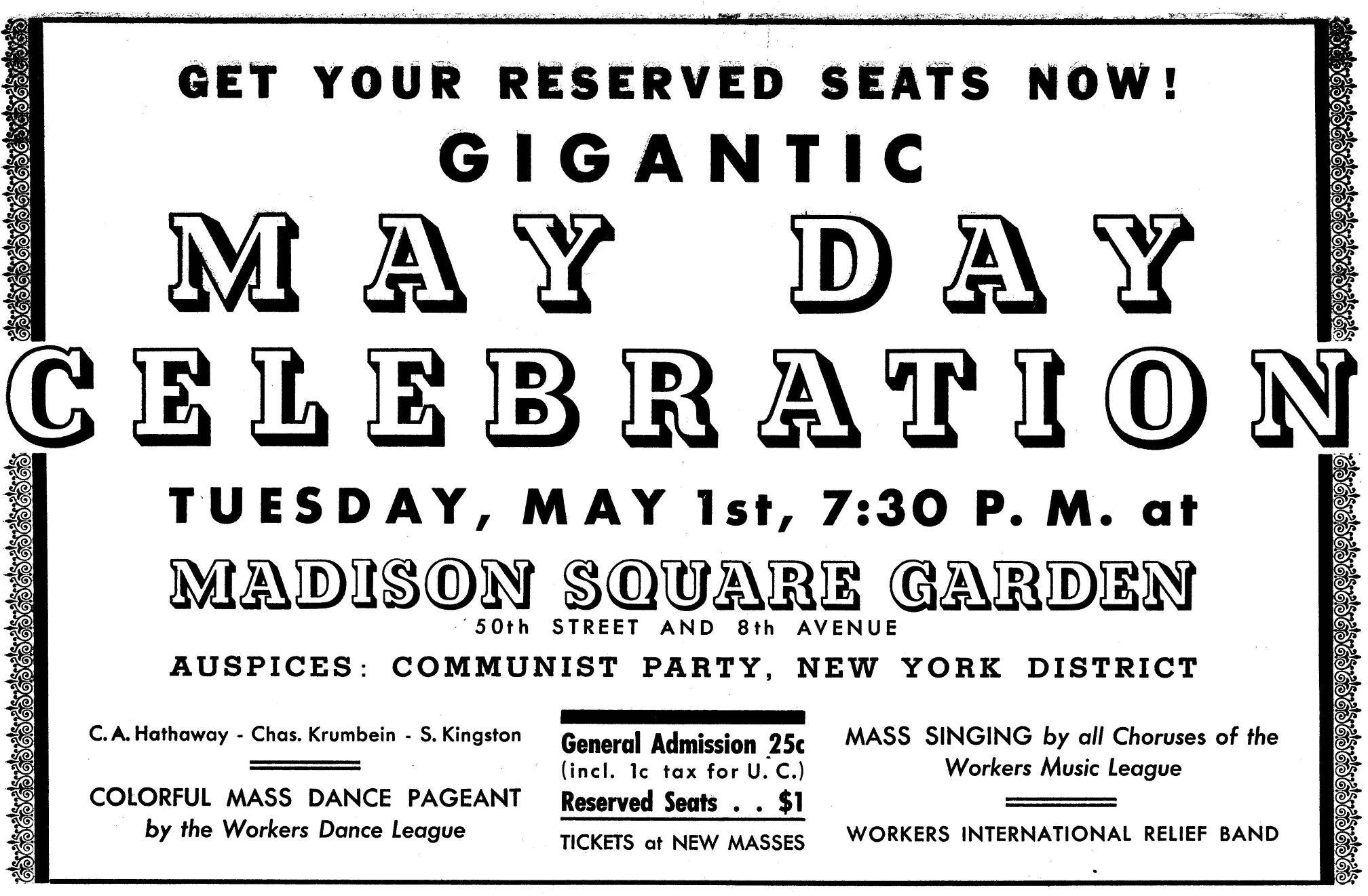
The Workers’ Music League is featuring Aaron Copland’s setting of Into the Streets May First this Sunday evening (April 29), at its Second Annual American Workers’ Music Olympiad. The entire ensemble of 800 voices, comprising the revolutionary worker’s choruses of New York, will participate. The place is City College Auditorium, 23rd Street and Lexington, New York City. THE NEW MASSES is grateful to all the participants in their first musical contest, and believes its pride in the notable result is richly justified.
The New Masses was the continuation of Workers Monthly which began publishing in 1924 as a merger of the ‘Liberator’, the Trade Union Educational League magazine ‘Labor Herald’, and Friends of Soviet Russia’s monthly ‘Soviet Russia Pictorial’ as an explicitly Communist Party publication, but drawing in a wide range of contributors and sympathizers. In 1927 Workers Monthly ceased and The New Masses began. A major left cultural magazine of the late 1920s to early 1940s, the early editors of The New Masses included Hugo Gellert, John F. Sloan, Max Eastman, Mike Gold, and Joseph Freeman. Writers included William Carlos Williams, Theodore Dreiser, John Dos Passos, Upton Sinclair, Richard Wright, Ralph Ellison, Dorothy Parker, Dorothy Day, John Breecher, Langston Hughes, Eugene O’Neill, Rex Stout and Ernest Hemingway, Artists included Hugo Gellert, Stuart Davis, Boardman Robinson, Wanda Gag, William Gropper and Otto Soglow. Over time, the New Masses became narrower politically and more journalistic in its tone.
PDF of full issue: https://www.marxists.org/history/usa/pubs/new-masses/1934/v11n05-may-01-1934-NM.pdf
 Revolution's Newsstand