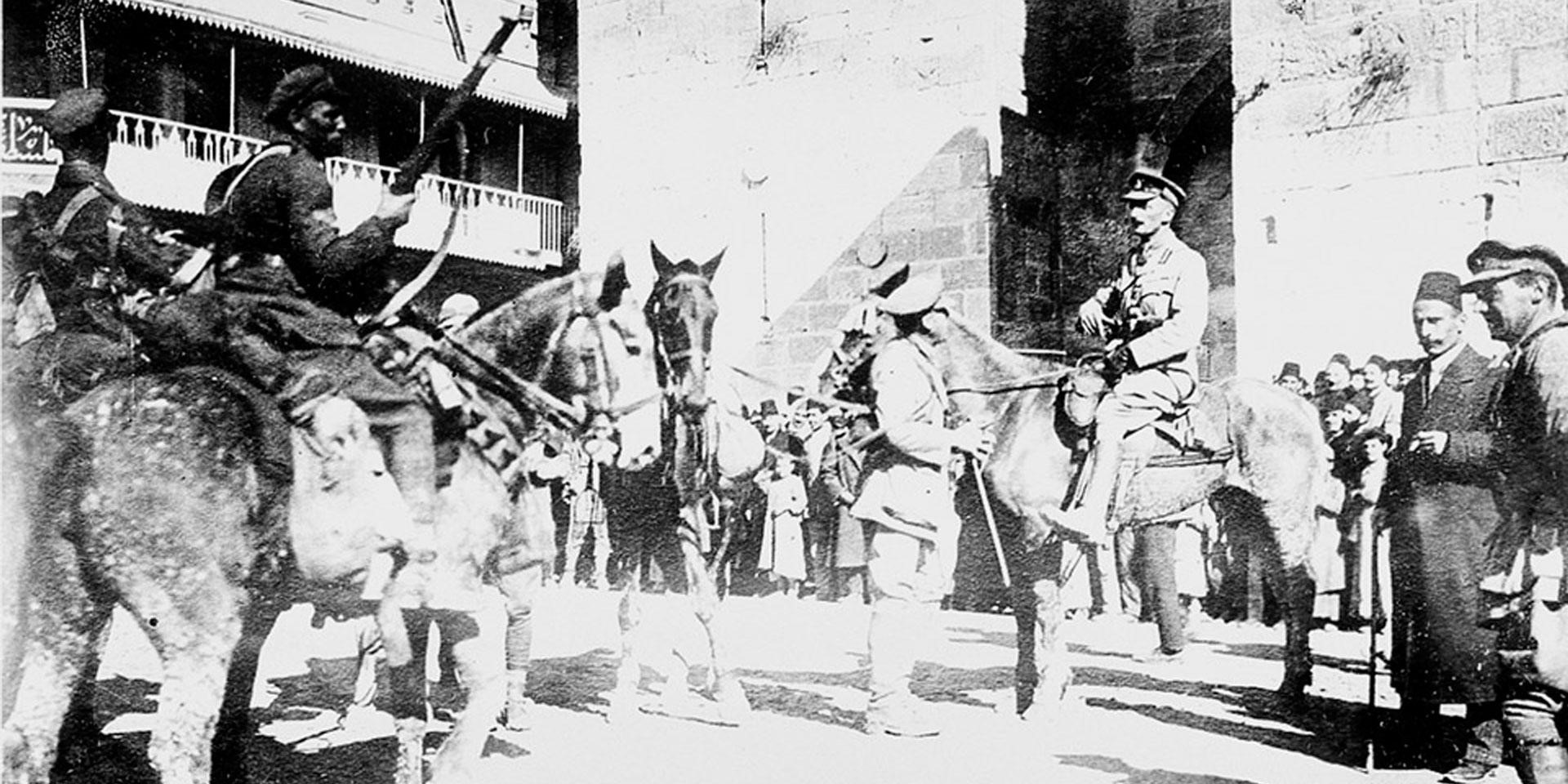
The first May Day in Palestine to see Arab workers strike as the Communist Party made a concerted effort to ‘internationalize’ the working class celebration. The protests and the Party were, predictably, attacked and the article dramatizes one of the many connections between Ireland and Palestine. Those doing the attacking were the Black and Tans who had policed Britain’s oldest colony during Ireland’s War of Independence and were sent to Palestine with their murderous expertise after the 1921 Treaty. After service in Palestine, many returned to Ireland were they formed the police force of Britain’s newest colony, Northern Ireland, the Royal Ulster Constabulary.
‘The First of May in Palestine’ by Abusjam from International Press Correspondence. Vol. 6 No. 44. May 27, 1926.
In Palestine the 1st of May has now been celebrated for about two decades. But our socialists have succeeded in depriving this day of its proletarian revolutionary content by converting it into an ordinary petty bourgeois day. The 1st of May has become a tradition, that is to say, a petty bourgeois and a nationalist tradition.
The Arab workers, the Arab. population consider this day as a Jewish national festival, the Jewish population, however, regard it as their national monopoly.
The Communist Party, ever, since the moment of its inception, has conducted a fight against the nationalist-romantic character of the labour movement of Palestine, and this struggle found its expression in the celebration of the 1st of May.
The Communist Party was confronted by three tasks in connection with the 1st of May:
1. to internationalise the proletarian holiday;
2. to revolutionise it and to convert it into a day of revolutionary propaganda and agitation by means of workers’ demonstrations;
3. to concretise the revolutionary slogans.
The fight for these three elementary tasks was by no means easy.
The 1st of May demonstration in the year 1921 ended in a bloody pogrom which was organised by the British police and the Arabian Effendis.
In addition to this the Party was shattered as a result of arrests and banishments, and it only succeeded last year in organising a great demonstration in Haifa in which Arab and Jewish workers participated.
The 1st of May 1926 appears as a real turning point in the history of the country. For the first time the 1st of May was solemnly observed by Arab workers. In Haifa 250 Arab workers struck work, whilst on this day the Jewish workers did not work at all as it was a sabbath. In Jaffa, Jerusalem etc. there took place along with the meetings of the Jewish workers, meetings of Arab workers at which revolutionary speeches were delivered regarding the 1st of May, British imperialism, Communism etc.
But the police also mobilised all its forces on this day. In Haifa armoured cars with British soldiers toured the streets. Jerusalem was filled with mounted police and soldiers. In Jaffa and Tel-Aviv the entire police reserves were mobilised, and in addition to this the English-Irish officers-division was called from the British camp of Serchield.

In Haifa and Jerusalem arrests and house-searches were carried out during the whole of the week preceding the 1st of May.
On the 1st of May the workers’ quarters of Tel-Aviv, right from the early morning, were besieged, in the literal sense of the word, by police. In spite of this the police did not succeed in preventing the Communist Party from organising a demonstration which was participated in by great masses of workers. The reformist trade union bureaucrats went among the ranks of the demonstrators and threatened the workers with expulsions, but without result. The workers marched under red flags with Communist slogans. It came to fierce collisions with the police, who had to be reinforced by the English-Irish officers’ division, with the result that seven workers, among them being three women, were mishandled in such a way that they are now lying sick with high fever; but some of the police were also injured.
The Zionist socialists, however, celebrated May Day by issuing a supplement to their newspaper in-which they emphasise the necessity of converting the first of May into a day of struggle for — the revival of the ancient Hebrew language.
International Press Correspondence, widely known as”Inprecorr” was published by the Executive Committee of the Communist International (ECCI) regularly in German and English, occasionally in many other languages, beginning in 1921 and lasting in English until 1938. Inprecorr’s role was to supply translated articles to the English-speaking press of the International from the Comintern’s different sections, as well as news and statements from the ECCI. Many ‘Daily Worker’ and ‘Communist’ articles originated in Inprecorr, and it also published articles by American comrades for use in other countries. It was published at least weekly, and often thrice weekly.
PDF of full issue: https://www.marxists.org/history/international/comintern/inprecor/1926/v06n44-may-27-1926-inprecor.pdf
 Revolution's Newsstand