
Leading Communist Party trade unionist Jack Johnstone commenting on the Harlan, Kentucky strike by the National Miners Union then raging offers advice on organizing a militant strike’s basic body.
‘Organizing Strike Committees’ by Jack Johnstone from Party Organizer (Communist Party Internal Bulletin). Vol. 4 No. 6. July, 1931.
IN this issue of the Party Organizer I will deal with only one phase of revolutionary strike strategy, the organizing of the strike committees and their tasks, because this is the weakest phase of the present miners’ strike.
In the miners’ strike, one thing stands out; the rank and file have taken charge of their strike, i.e., in this strike, there is a much larger percentage of strikers, their wives and children involved in activities than in any other strike. But there is no clear plan of organization or continuity of tasks applied in these activities. The N.M.U. has enthused the strikers to a tremendous fighting pitch. But their activities are based on fighting enthusiasm with the minimum of organization.
In the miners’ strike the strike committees should take the following forms: elected local mine strike committees with representation from the women; section strike committees composed of a minimum of 3 delegates (2 men, 1 woman), from each struck mine in a given territory; central strike committee composed of three delegates, One a woman, from every mine in the strike area. It is obvious that the local mine strike committee is the key or basic strike leadership. The weaknesses or strength of the mine strike committee reflects itself in the upper directing strike committee and affects every task and activity in the strike.
The tasks of the Mine Strike Committee are the following:
1. To be responsible for the conduct of the strike, militancy of the strikers and the carrying out of all decisions of the Section and District Strike Committee and body of strikers.
2. To organize man picketing.
3. To spread the strike to neighborhood mines.
4. To direct the collection and distribution of relief.
5. To organize and lead mine strike mass meetings.
6. To help establish locals of the N.M.U.
7. To register and check up on the activities of all strikers.
8. To elect delegates to the Section and District Strike Committee.
9. To organize tile defense of strikers with assistance of the I.LD.

It is comparatively simple during the period of enthusiasm to elect a strike committee and outline the tasks of this committee. The difficulty is to carry them out. This depends on the type of strike leadership that is elected to the strike committee. Generally the first committee elected contains unstable elements, deadheads, etc. A conscious cleansing process must be conducted during the entire strike so that the best and most class-conscious leadership is developed. Under no circumstances should the strike committee be allowed to drop members and coop-tate others. The strikers must be told at their meetings why some members should be dropped and others elected. The development of new leaders must be a conscious process by the workers.
The first duty of the strike committee is to draw all strikers and their families into strike activity in some organizational form. It must not leave the striker to decide for himself whether he should picket or not. The first organizational necessity is to organize everyone involved in the strike into groups with responsible captains. The development of these captains is also a process of developing new leading forces. Those that do not function properly should be replaced.
The extent that this elementary, but fundamental, group form of organization is developed will, to a very considerable degree, determine the tempo at which we will be able to spread and consolidate the strike. From it will radiate the fullest energy and activity in every phase of the strike.
It is impossible to give proper leadership to a strike of more than 40,000 strikers, totaling with women and children probably 150,000, covering a strike front of 70 miles, with only a handful of organizers and strike strike [sic] committee chairmen who assume the responsibility for all tasks and is arrested or become sick have not trained others to step into their place. So it becomes absolutely necessary to draw as many strikers and their families into group activity. Many strikers will accept the leadership of a group of 10, but would decline to accept work as chairman or secretary of a strike committee. In a week he will probably be ready to assume a greater responsibility. It is in this manner that we will develop a broad cadre of new leaders. In this we have so far failed in the miners’ strike.
The development of committees must start right from the beginning of the strike, if possible, this should be done during the preparatory work. However, one must use judgment. All needed committees cannot be organized at once.
To stabilize and strengthen the work of the mine strike committees, the following committees should be set up. All members of these committees need not be members of the strike committees, but the heads of these committees must be members of the Strike Committee.
1. Picket and defense committee.
2. Relief Committee.
3. Committee for Work among Women and Children.
4. Youth Committee.
5. Committee for Work among Negroes.
6. Literature and Publicity Committee.
7. Committee to Build the Union.
8. Committee on Unemployment.
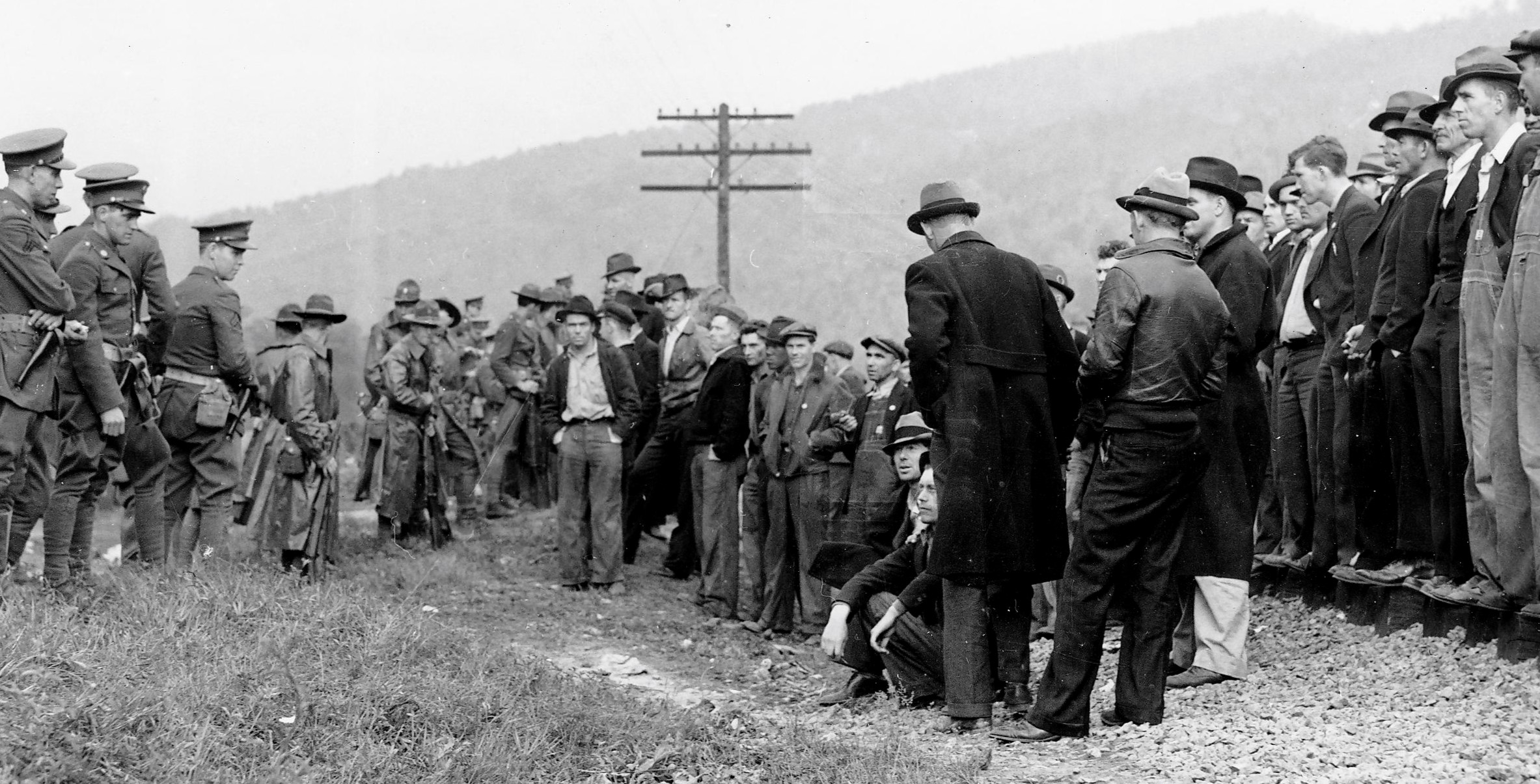
However, the quantity and quality of work of these committees is determined by the type of strike committee that has been elected and the extent that this leadership has been able to direct the organization of the strikers into various activities. A committee of 3 or 5 cannot collect relief or distribute it, or sign up every strikers in the union alone. They must draw in hundreds and thousands of workers in an organized way. We should not depend upon volunteers to collect relief. They should be assigned by the strike committee. A thousand individuals cannot be assigned unless they are organized and assigned in groups. The Committee to build the union can best draw every striker into the union by having each picket captain to sign up his group.
The Party Organizer was the internal bulletin of the Communist Party published by its Central Committee beginning in 1927. First published irregularly, than bi-monthly, and then monthly, the Organizer was primarily meant for the Party’s unit, district, and shop organizers. The Organizer offers a much different view of the CP than the Daily Worker, including a much higher proportion of women writers than almost any other CP publication. Its pages are often full of the mundane problems of Party organizing, complaints about resources, debates over policy and personalities, as well as official numbers and information on Party campaigns, locals, organizations, and periodicals making the Party Organizer an important resource for the study and understanding of the Party in its most important years.
PDF of issue (large file, contains multiple volumes): https://files.libcom.org/files/Party%20Organizer%204.pdf
 Revolution's Newsstand