
Expansive report to the Sixth World Congress on the functioning and work of the Women’s Department of the Communist International for the four years since the Fifth Congress was held in 1924.
‘Report of the Women’s Department to the Sixth Congress of the Communist International’ from The Communist International between the 5th and the 6th Congresses, 1924-28.
SURVEY OF THE WOMEN’S INTERNATIONAL MOVEMENT.
WITH every year the significance of the part played by W women in the class struggle increases. Capitalist rationalization has brought hundreds of thousands of new women workers into industry, whom the proletariat must organise into their united front.
It is in the best interests of the bourgeoisie to prevent working women from joining up with the revolutionary struggle and wherever possible to keep this new militant proletarian group away from the revolutionary movement and keep them in the service of the bourgeoisie. This fact explains why in recent years both the bourgeoisie and its allied reformists display increased interest and activity in the recruitment and organization of working’ women.
The Influence of Reformists on Working Women.
The main pillars of reformist propaganda amongst women are: Revolutionary phraseology of a vague nature, with a copious mixture of Christian Socialism, welfare work, pacifism and the swindle of bourgeois culture.
The propaganda of the Second International amongst women in its political lines is in accordance with the general policy of class collaboration, gradual development towards Socialism, confidence in the League of Nations, etc.
(a) The Second International.
Since the Brussels conference in December, 1926, there has been attached to the Second International a women’s international committee for the permanent conduct of this branch of work. For this purpose the Second International publication, “International Information,” started a monthly women’s supplement in January, 1927. Such measures have resulted in an intensification of the work of the national parties, which have recently shown signs of extending their apparatus (women’s secretariats, committees, sections, groups); they organise all national and regional conferences, membership recruiting campaigns and especially carry on intense work in the training of women officials in all sorts of courses for this purpose.
In recent years the Social Democrats have increased the number of their women members. S.D.P. in Germany; March, 1925; 153,693; December 31, 1926: —165,492; 1928, after the recruiting campaign : 181,541. Women’s Section of the British Labour Party at the Women’s Conference in Birmingham, 1925: 200,000 individually enrolled women members; at the Huddersfield Congress; 1927: —300,000. S.D.P. of Austria: 1920—70,000; October 27, 1927: —180,000; January 1, 1928, after the recruiting campaign of “woman to woman”: —220,000. In Vienna the number of women members rose as a result of the recruiting campaign from 116,187 to 127,779. S.D.P. of Holland: March 31, 1922: —9,148 women members—21.8 per cent. of the entire membership; December 31, 1927: —13,502 women members—27.1 per cent. of the total membership.
(b) The Amsterdam International.
A general exodus of women workers from the reformist Trade Unions took place in several countries prior to 1927. Their leaders did not venture, either in Germany or in England, not to mention America, to carry on serious recruiting for the Trade Unions amongst the women workers, because the strength of the newly-organised masses might become dangerous for them. However, on an international scale the international women’s committee attached to Amsterdam, in the same way as the German Trade Union bureaucrats, pretends to be actively interested in women workers and organises conferences and holds enquiries, etc. In reality, the policy of Amsterdam has been that of a continual betrayal of the most elementary interests of women workers, especially in regard to the question of wages.
The daily struggle for wages and a shorter working day in the course of the big international strike wave served to undermine the influence of the reformists on the masses of women.
(c) Women’s International Co-operative Guilds.
The Women’s Co-operative Guilds in England, with a membership of 58,000, and in Scotland with 30,000 members, constitute the proletarian backbone of the International Guilds. It is difficult to estimate the sphere of influence of the comparatively young international guilds (founded in 1921), since the other affiliated organisations are not so well organised as the British Guilds. Last year, just at the same time as the policy of the London Cooperative Alliance took a more reactionary turn a differentiation also arose within the ranks of the women’s guilds. The International leadership and the leaders of some of the women’s guilds adopted an extreme Right policy at the Stockholm Congress, but a Left opposition rallied around the Soviet delegation, composed mainly of British delegates, friendly disposed towards Soviet Russia.
COMMUNIST INFLUENCE AND REVOLUTIONISING THE MASSES OF WOMEN.

The strong traditional influence of the bourgeoisie and the reformists on the masses of working women in connection with the recent recruiting activity makes it extremely difficult for Communist Parties to gain permanent influence over large masses of women workers. At the same time there is every evidence that the Communist Parties have been able to win over large masses of women in support of all the campaigns and struggles of the working class as a whole. The big international strike wave of 1927 may Serve as an instance of the revolutionising of the masses of women under the strong influence of the C.P.; this was the case in Europe, America and Asia. In Germany, CzechoSlovakia, Italy, Poland, etc., women workers displayed a determination and readiness for the struggle and bravery in the bloody encounters with the police and military—Italy, Poland, miners’ strikes in Czecho-Slovakia and America—which could leave no doubt as to the extent of the mass movement amongst women workers. The influence of the Party cannot be estimated generally by the strength of the movement. Only in Italy, Poland, Bulgaria—where the strikes of women workers were actually headed by Communists—is it possible to get an exact estimate of Communist influence. Generally speaking, other factors must be taken into consideration in judging the organic growth of Communist influence. One proof would be the extent of the permanent gains of the C.P. as a result of the big struggles; nearly everywhere these gains are by far not in keeping with the real or apparent influence exerted during the actual movement. Still, progress has been made, even in this difficult field, such as the increase in the women membership of the C.P.G.B. during the miners’ strike, an increase which has been retained to a certain extent; the big rally of women workers to the C.P. of China: the increase in the number of women workers in the Italian Trade Unions; and the big rally of women workers to the Trade Unions in Germany in 1927.
The frequent campaigns against war and for the Soviet Union show in most countries that Communist influence on certain types of women workers is far greater than the numbers organised in the Party lead one to believe.
WORK OF THE COMINTERN AMONGST WORKING WOMEN.
Instructions were issued at the Fifth International Congress and at the Third Women’s International Conference in 1924 for greater activity on the part of the Comintern amongst women. During the last two years of the period under review the activity of the Women’s Section of the E.C.C.I. and that of the National Sections was concentrated on the International Conference on work amongst women, held in May-June, 1926. The concrete instructions of this conference were on the following lines :—
(1) Increased incorporation of work amongst women in the general Party work.
(2) Greater concentration of the work of women’s departments on factory and Trade Union work;
(3) The inauguration of systematic organisation of women’s delegate meetings in countries outside the Soviet Union;
(4) Increase in the international exchange of experiences between the Soviet Union and the Sections in other countries.
The content of the Comintern work amongst the masses of women was confined to the realisation of these tasks.
The Activity of the Women’s Section of the E.C.C.I. and the Results in the C.I. Sections.
The chief activity was the preparation for the Fourth International Conference on work amongst women, which was held in May-June, 1926. This conference submitted a plan of the policy for the main branches of work amongst women to the OrgBureau of the E.C.C.I.

The Women’s Section assisted in carrying out the international decisions in the various Sections; it controlled and inaugurated the activity of Communist Parties amongst women by the collection, study and utilisation of suitable material.
Work Amongst Women—an Important Task for all Parties.
Practically all the Sections of the C.I. carry on work amongst women. Those Parties who started this work since 1924 are: Denmark, China, and some of the smaller South American Parties; a beginning has also been made in Australia. The European Parties which absolutely fail to carry on this work are the Belgian, Rumanian, Jugoslavian, Esthonian, Spanish and Portuguese. This work on the whole is weak and one of the chief causes is the inability of the majority of the Parties to realise the necessity of special work to win over working women. Consequently, as a general rule the active leadership and support of the work amongst women by the Party leaders is still weak.
Situation as to Women Members.
The absolute and relative strength of the women membership in the Parties is still unsatisfactory. (France 1100—2 per cent.). Even when the figures are favourable (Czecho-Slovakia 25,000— 19 per cent.; Germany 848—13 per cent.; Sweden and Norway 13 per cent and 19 per cent. respectively; Great Britain 1700— 14.25 per cent.) the sociable composition is unfavourable, for practically everywhere the number of industrial workers is too small when compared with that of working-class housewives.
Work in Factories and Trade Unions.
Nearly all Sections now recognise that attention should be concentrated on work in factories and Trade Unions. Some Sections have carried on earnest work in this direction, though the results have not always been very great. But in spite of such attempts this section of the work constitutes the weakest spot in nearly every Party. The main causes of this shortcoming are to be found in the inadequate reorganisation of the Parties on the lines of factory nuclei and the general weakness of Trade Union work in most Parties. Furthermore, this work suffers from the lack of trained women in factories, and consequently the work there is restricted and slow.
In spite of all these shortcomings the following successes have been attained: Work in Factories; extensive introduction of meetings of women workers in factories and outside the factory gates, and the simultaneous circulation of literature (Germany, France, England, Czecho-Slovakia, Poland) inauguration of factory newspaper containing women’s pages Germany, France, England, Italy, America) the organisation of a considerable number of women worker correspondents in many countries (Germany, France, England, Czecho-Slovakia, Austria, Italy, America; the formation of the first women worker circles and factory groups in Germany, Italy, Poland, Latvia and Norway.
Trade Union Work.
In Germany, in connection with successful strikes, there has been a great increase in the number of women workers in Trade Unions, especially in the Metal Workers Union (14,000 new members, quite a considerable number of whom were women; Tobacco Workers Union 8,000, 70-80 per cent. women; Textile Workers Union 7,000 women); the conquest of local managing boards by the opposition after strikes of women workers and the convention of opposition conferences of women workers, etc.
In France in the C.G.T.U. the inauguration of numerous women’s commissions and the convention of women’s Trade Union conferences.
In Czecho-Slovakia in the I.A.V. the inauguration of women’s commissions in connection with the executive, the textile and clothing workers union and a campaign to recruit women in 1924, during which new women members were secured.
In America the foundation of women’s Trade Union Clubs in connection with certain Trade Unions to win over women workers to the Minority Movement. In China and Japan the first women’s Trade Union commissions have been formed. In Italy the creation of a cadre revolutionary women workers, who form the backbone of all the strikes.
Women Delegate Meetings.
This type of work, to which the Fourth International Conference attach particular importance, is only receiving the consideration of the majority of Parties.
Many of these Sections have not moved beyond the stage of discussion, congress resolutions, preliminary work, etc. (Sweden, Norway, Denmark, Italy, Poland, China). In a more or less developed form women delegates meetings have been held in Germany, Czecho-Slovakia, England, America, France, Finland and Mongolia.
Generally speaking, there have been but a limited number of women delegate meetings up to the present. Women delegate meetings are primarily a link between the Party and women workers and presuppose a certain Party basis in the factories and Trade Unions. The weakness Of this basis in the majority of Parties continues to handicap the development of the women’s delegate movement. For this reason, too, Parties who had not a sufficiently strong basis in the factories begun to organise women’s delegate meetings on other lines, which should be further developed according to the international policy in this respect. Hence the picture of the position of women’s delegate meetings varies very much in the different countries.

In Germany, where Trade Union and factory work is better developed than in any of the other Parties, the type of women’s delegate meetings is most in accordance with the international instructions. The delegates were either elected or chosen from amongst a definite class of working women, mainly factory delegates then delegates of unemployed women and housewives. They held meetings periodically and in the intervals between the meetings carried on definite work (propaganda of the Party slogans, circulation of literature, compilation of simple propaganda material, recruiting for Trade Unions, etc.). In this way a body of working women was brought into active work and trained, and agitation was carried by these delegates for definite campaigns. The most important activity was the Workers Congress, held in 1926, which served as the starting point for the election of the first women’s delegate meeting in Berlin and five other centres. After the first successes there was a setback in the movement. Even all the women’s delegate meetings started were not maintained, and in others the number of delegates declined and the activity and regularity of the meetings deteriorated. However, those delegates who remained under the leadership of the Party did good work during the various struggles in mobilising and organising women in Trade Unions; this was mainly the case in Berlin and Solingen.
A protocol on the experiences of the German Party, compiled by the Women’s Section, made all Parties acquainted with the results attained in Germany. An article on women’s delegate meetings in Germany was published in the Inprecorr, Extensive information on the women’s delegate meetings in the Soviet Union was sent to all the Sections in the form of the original programme and policy, partly contained in articles (Inprecorr) and in the bulletin of the Women’s Section of the E.C.C.I.
In New York in 1927 a women’s delegate conference, on the lines laid down by the international policy, was convened with representatives from the factories. The meetings were to be held periodically and a newspaper was started. The first experiences show a lack of participation of factory nuclei and Trade Union factions.
Women’s delegate meetings are quite different in England. Since the C.P.G.B. has practically no supporters amongst women in factories and Trade Unions an attempt was made to get into contact with the women organised in the strong reformist women’s organisations and gain influence over them by the convention of women’s delegate conferences, composed of chosen representatives from the Women’s Co-operative Guilds, Women’s Section of the Labour Party, Trade Unions, etc. Women workers were in a minority and only recently has a beginning been made in sending delegates directly from the factories, but so far this section of the work is weak. One of the fundamental defects of these meetings is that they are on a basis which does not provide for the main source of strength to come from the factories, whilst another shortcoming lies in the fact that the delegates do not carry on systematic work. But their success lies in the fact that the little Communist Party has been able to get into touch with large masses of women under the leadership of our opponents and to spread Communist slogans amongst the masses.
In Czecho-Slovakia the first women’s delegate meetings were held in 1927 in Bruex and Dux (Aussig district) just as a miners’ strike was in progress. The meetings were composed of delegates from the miners’ wives, factory and home workers and elected representatives of the Social Democratic and National Socialist Parties. On a few occasions they met with great success amongst the masses, but when the strike was concluded the meetings died out.

Recently attempts have been made in Czecho-Slovakia and France to organise women’s delegate meetings through the Red Trade Unions. These meetings, which have already been held, were composed only of women workers organised in the Red Trade Unions. Delegate meetings on such lines can be very useful in those countries where the C.P. is illegal.
As a general rule it is most important for all Sections to establish close contact between the women’s delegate movement and the Trade Unions, but this should not imply that women’s delegate meetings be restricted to Trade Union work only.
Work in Women’s Non-Party Organisations.
This branch of work forms an important section of the activity of certain Parties. Women’s non-Party organisations have helped (o establish contact between the Parties and factory workers, though in certain instances this activity has not been specially successful. In Canada the Women’s Labour League and in Holland the Proletarian Women’s League constitute practically the only link between the weak Parties and the masses of women, but in Norway the work has been concentrated almost entirely on Housewives Societies. In the United States women in factories and Trade Unions have been neglected and all attention directed towards the organisations sympathising with the Party, which existed before systematic activity was carried cn amongst women.
In Germany and France there has been also a certain amount of ideological vagueness and consequent political deviations in the work amongst non-Party women’s organisations. The Red Women’s and Girl’s League copies the Communist Party too closely, and therefore cannot be so effective in recruiting the backward masses of women.
In France the contrary occurred. The “Union fraternelle des femmes contre la guerre” was so intent on adapting its policy to the pacifist tendencies amongst the masses of women that in the beginning it quite lost the character of a Communist Party.
Work in the Non-Party Mass Organisations.
This must be increased. Steady and successful work is carried on in the Co-operatives by the C.P.G.B., which has been very active during the past year within the Women’s Guilds, the C.P. of Czecho-Slovakia has formed a whole network of women’s commissions in the Co-operatives under Communist influence and several important Co-operative women’s conferences have been held where women Communists were strongly represented. In Germany a definite women’s Co-operative movement has also started. The most active forces in the Red Aid and the International Workers’ Aid in practically every country are the women members under the leadership of Communists.
Press.
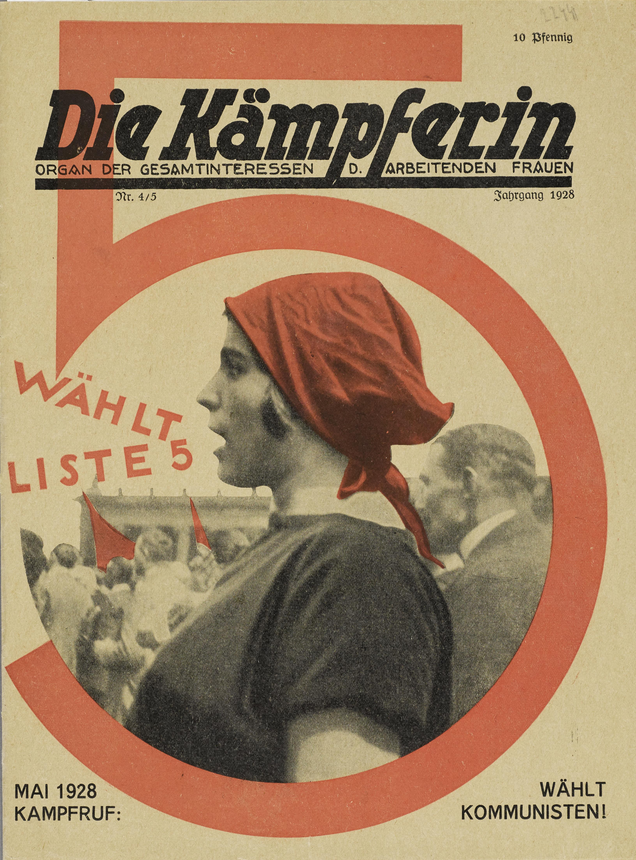
The press is used by nearly all Parties as a means of carrying on propaganda amongst women. But only very few sections have special women’s paper. New women’s papers were started in Germany in 1926 (‘Kaempferin’); England, 1926 (‘Working Woman’); Austria, 1926 (‘Arbeiterin’); Norway, 1926 (‘Gnisten’); Italy (‘Campagna’); papers revived include: in the United States, 1927 (‘Working Woman’); Canada, 1926 (‘Woman Worker’). In those Sections where there is no special woman’s paper there is usually a woman’s section in the Party press, and in some instances this exists as well as a special paper. Such papers have opened out on new lines and broken with the usual traditions, with the exception perhaps of the ‘Rozsevacka,’ Czecho-Slovakia; they are all closely connected with the masses, mainly with the factory workers; this is greatly assisted by the constant increase in the number of women worker correspondents.
The main defects in the press are: the Party daily press, and to a still greater extent the theoretical organs, pay too little attention to the question of work amongst women.
The political and theoretical level of the special women’s press in the majority of countries is not satisfactory. Without exception progress has been made during the past few years by the women’s press, and some are exceedingly well-edited, such as the ‘Kaempferin’ (Germany) and the ‘Campagna’ (Italy).
Educational Work.

On the whole, the work of training cadres for work amongst women has been too weak. The Communist Party of Austria carries on systematic and serious work in this direction, and also the C.P. of Poland. In the winter of 1925/26 the C.P. of CzechoSlovakia made a most successful attempt by starting district schools for women, where 500 women officials were trained, but the work has since been neglected. Some Parties are afraid of cultivating feminism by starting special training schools for women.
Work to Paralyse the Activity of Opponents.
This branch of work is in practically every country aimless and unorganised. One of the reasons why the Communist Parties fail to retain the working women who are won during successful campaigns and struggles must be attributed to the lack of political discussions with opponents on fundamental points.
METHODS OF WORK OF THE WOMEN’S DEPARTMENTS OF THE E.C.C.I.
The Women’s Section of the E.C.C.I. instructed the individual Sections in respect to work amongst women on the lines laid down by the Comintern. Chief attention was concentrated on the following questions: —
(a) Incorporation of Work Amongst Women in the General Party Work.
In this connection in certain countries ideological vagueness and deviations had to be overcome; these arose from the fact that certain sections of the Party denied the need for “special” work amongst women, prevented the formation of a special department for this work, or rejected the individual demands of working women on the grounds that the struggle was a united class struggle for working men and women. (Sweden, Czecho-Slovakia). The Women’s Section of the E.C.C.I. advised that the women’s departments in the various Parties be strengthened and closer connection be established between the W.S. and the other departments of Party work. The Women’s Section supported the women’s departments of the various Sections by utilising the general campaigns of the Party for the mobilisation of working women.
(b) Establishment and development of the apparatus for work amongst women.
Instructions were issued for the completion of the network of women’s departments, especially in the most important industrial districts; the allocation of women organisers for work in the factory nuclei and Trade Unions, the inclusion of women workers in the women’s departments and that a definite programme of action and concrete plans of work be drafted for women’s departments.
(c) Intensification of work in the factories and Trade Unions.
All instructions issued for international campaigns definitely urged that work in this connection should also be carried on in factories and Trade Unions. The instructions for the International Women’s Day 1927-28 made a feature of the mobilisation of women workers; in addition to this many Sections were given instructions bearing on definite questions (viz., in Germany the women’s day in 1928; CezchoSlovakia, work in the I.A.V; American, Passaic; Sweden, lock-out; Norway, circles for working women; Latvia, women’s sections in the independent Trade Unions, etc.). The Women’s Section issued a special Bulletin with reports and material on work in factories and Trade Unions.
(d) Women’s delegate meetings.
The Women’s Section followed and studied the experience gained in the preparation and organisation of women’s delegate meetings in the various countries. Special instructions and criticism based on the reports were sent to the Sections with suggestions for further work. The Women Section issued instructions for the development of the women’s delegate meetings movement in connection with the Jubilee of the Soviet Union and the International Women’s Day in 1928.
PRESS.
The Women’s Section made a close study of the Communist women’s press and expressed opinions to the Parties in question on the following papers: Kaempferin (Germany), Woman Worker (England), Arbeiterin and Roscevacka (Czecho-Slovakia), Ouvriere (France), Arbeiterin (Austria), Working Woman, Woman at Home in the Shop, Voice of the Working Woman (America). The W.S. gave advice on the use to be made of the general Party press and factory papers and the development of women worker correspondents.
CAMPAIGNS.
In connection with the other departments of the E.C.C.I. and allied organisations (Y.C.I., etc.), the Women Section of the E.C.C.I. participated in a number of international campaigns and congresses through instructions and articles on the mobilisation of working women. (May Day, International Co-operative Day, Youth Day, Children’s Week, March 18th, etc.). The W.S. arranged for women delegates at the Fourth R.I.L.U. Congress, collected and compiled material relating to international women workers and Trade Unions and supplied articles for the campaign.

The W.S. issued two circulars in connection with the Anti-War Campaign for the international press and published two bulletins on the role of women in war. In connection with the China campaign, one bulletin and one circular were issued.
The Campaign on behalf of the Soviet Union was carried uninterruptedly, culminating in the Jubilee of the Soviet Union and the International Women’s Day. The Women’s Section, with the assistance of the women’s departments in the C.P.S.U. and the C.C., supplies the Sections with articles, reports, photographs, posters, newspapers, pamphlets, diagrams, etc., dealing with the working and peasant women in the Soviet Union. Two bulletins on this subject were issued in connection with the International Women’s Day 1927-28, one of which was devoted to the women of far eastern countries. The W.S. took part in the propaganda preparation and utilisation of the women’s delegations to the Soviet Union in the press, by supplying information, etc.
INTERNATIONAL EXCHANGE BETWEEN THE SOVIET UNION AND ABROAD.
(a) A bulletin is published periodically by the W.S. in four languages to keep the Sections informed of the most important occurrences in the international women’s movement and the experience made in Party work. (December, 1926, to March, 1928, 10 numbers).
(b) The W.S. regularly supplies the Press Service of the Women’s Newspapers of the Soviet Union with material on the international women’s movement, and writes or suggests special articles on important questions for the women’s press and the general press in the Soviet Union.
(c) The W.S. constantly supplies the International Press with articles on its special work. These have been sent partly in the form of M.S.S. to the Sections (March, 1927 to March, 1928 95 articles and letters of information), or appeared in the Inprecorr (October, 1924 to March 1928, 80 articles). In addition to this Press work eleven pamphlets were published.
 Revolution's Newsstand