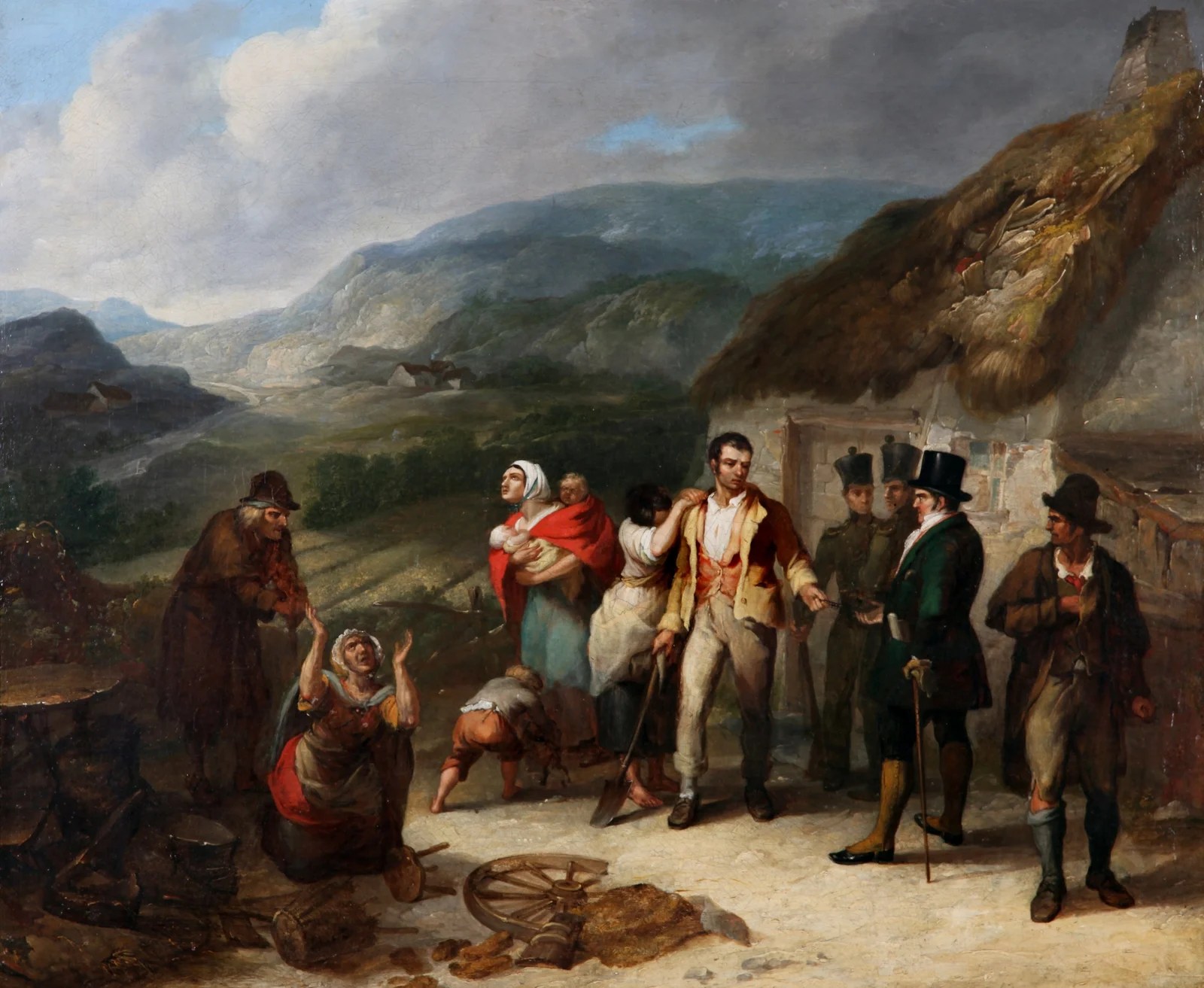
Karl Marx comments on the dying Whig Party’s newly installed Lord Lieutenant in Ireland and his attempt to clear the land of Irish tenants by claiming there was a nationalist conspiracy, whipping up a dormant Orange Order, and using touts and provocateurs in a way entirely consistent with Britain’s murderous infiltration of the modern Republican movement. Ironically, several months after Marx wrote this, claiming that British provocations could lead to real conspiracies, the most consequential of all Irish secret societies, the Irish Republican Brotherhood, was formed in Dublin by James Stephens. All written with the searing wit Marx retained for the English ruling class.
‘The Excitement in Ireland’ by Karl Marx from the New York Daily Tribune. Vol. 18 No. 5530. January 11, 1859.
London, Dec. 24, 1858
A Government, representing, like the present British Ministry, a party in decay, will always better succeed in getting rid of its old principles, than of its old connections. When installing himself at Downing street, Lord Derby, doubtless, made up his mind to atone for the blunders which in times past had converted his name into a byword in Ireland; and his versatile Attorney-General for Ireland, Mr. Whiteside, would not one moment hesitate flinging to the wind the oaths that bound him to the Orange Lodges. But, then, Lord Derby’s advent to power gave, simultaneously, the signal for one coterie of the governing class to rush in and fill the posts just vacated by the forcible ejection of the other coterie. The formation of the Derby Cabinet involved the consequence that all Government places should be divided among a motley crew still united by a party name which has become meaningless, and still marching under a banner torn to tatters, but in fact having nothing in common save reminiscences of the past, club intrigues, and, above all, the firm resolution to share together the loaves and fishes of office. Thus, Lord Eglinton, the Don Quixote who wanted to resuscitate the tournaments of chivalry in money-mongering England, was to be enthroned Lord Lieutenant at Dublin Castle, and Lord Naas, notorious as a reckless partisan of Irish landlordism, was to be made his First Minister. The worthy couple, arcades ambo, on leaving London, were, of course, seriously enjoined by their superiors to have done with their crotchets, to behave properly, and by no capricious pranks to upset their own employers. Lord Eglinton’s path across the channel was, we do not doubt, paved with good intentions, the vista of the Vice-royal baubles dancing before his childish mind; while Lord Naas, on his arrival at Dublin Castle, was determined to satisfy himself that the wholesale clearance of estates, the burning down of cottages, and the merciless unhousing of their poor inmates were proceeding at the proper ratio. Yet as party necessities had forced Lord Derby to instal wrong men in the wrong place, party necessities falsified at once the position of those men, whatever their individual intentions might be. Orangeism had been officially snubbed for its intruding loyalty, the Government itself had been compelled to denounce this organisation as illegal, and very unceremoniously it was told that it was no longer good for any earthly purpose, and that it must vanish. The mere advent of a Tory Government, the mere occupancy of Dublin Castle by an Eglinton and a Naas revived the hopes of the chopfallen Orangemen. The sun shone again on the “true blues”; they would again lord it over the land as in the days of Castlereagh, and the day for taking their revenge had visibly dawned. Step by step, they led the bungling, weak, and, therefore, temerarious representatives of Downing street from one false position to the other, until one fine morning at last, the world was startled by a proclamation of the Lord Lieutenant, placing Ireland (so to say) in a state of siege, and turning, through the means of £100 and £50 rewards, the trade of the spy, the informer, the perjurer, and the agent provocateur into the most profitable trade in Green Erin. The placards announcing rewards for the detection of secret societies were hardly posted, when an infamous fellow, named O’sullivan, an apothecary’s apprentice at Killarney, denounced his own father and some boys of Killarney, Kenmare, Bantry, Skibbereen, as members of a formidable conspiracy which, in secret understanding with filibusters from the other side of the Atlantic, intended not only, like Mr. Bright, to “Americanise English institutions,” but to annex Ireland to the model Republic. Consequently, detectives busied themselves in the Counties of Kerry and Cork, nocturnal arrests took place, mysterious informations went on; from the south-west the conspiracy hunting spread to the north-east, farcical scenes occurred in the County of Monaghan, and alarmed Belfast saw some dozen of schoolmasters, attorneys’ clerks and merchants’ clerks paraded through the streets and locked up in the jails. What rendered the thing worse was the veil of mystery thrown over the judicial proceedings. Bail was declined in all cases, midnight surprises became the order of the day, all the inquisitions were kept secret, copies of the informations on which the arbitrary arrests had been made were regularly refused, the stipendiary magistrates were whirling up and down from their judicial seats to the ante-chambers of Dublin Castle, and of all Ireland might be said, what Mr. Rea, the counsel for the defendants at Belfast, remarked with respect to that place, “I believe the British Constitution has left Belfast this last week.”
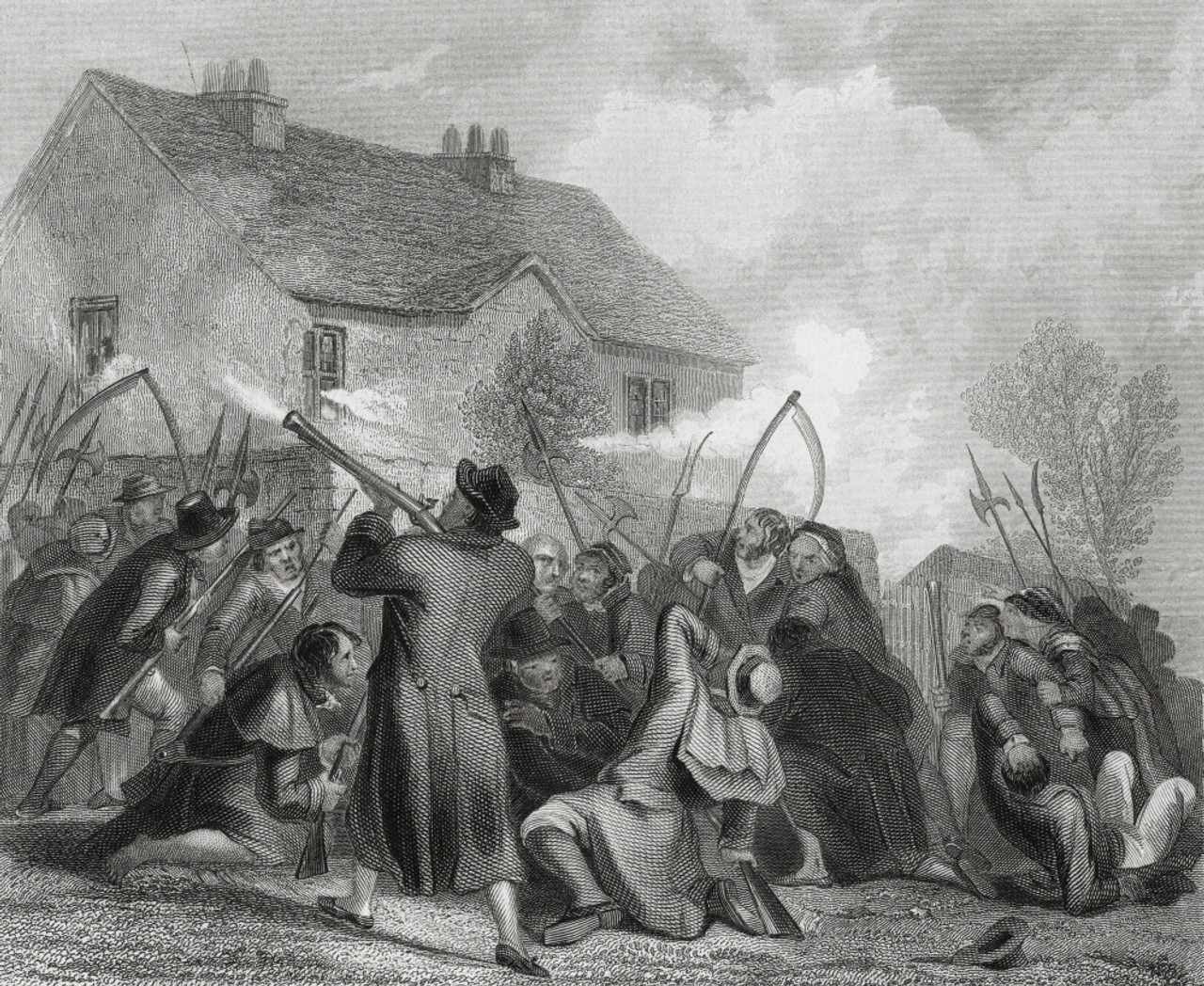
Now, through all this hubbub and all this mystery, there transpires more and more the anxiety of the Government, that had given way to the pressure of its credulous Irish agents, who, in their turn, were mere playthings in the hands of the Orangemen, how to get out of the awkward fix without losing at once their reputation and their places. At first, it was pretended that the dangerous conspiracy, extending its ramifications from the south-west to the north-east over the whole surface of Ireland, issued from the Americanising Phoenix Club. Then it was a revival of Ribbonism; but now it is something quite new, quite unknown, and the more awful for all that. The shifts the Government is driven to may be judged from the manoeuvres of The Dublin Daily Express, the Government organ, which day by day treats its readers to false rumours of murders committed, armed men marauding, and midnight meetings taking place. To its intense disgust, the men killed return from their graves, and protest in its own columns against being so disposed of by the editor.
There may exist such a thing as a Phoenix Club, but at all events, it is a very small affair, since the Government itself has thought fit to stifle this Phoenix in its own ashes. As to Ribbonism, its existence never depended upon secret conspirators. When, at the end of the eighteenth century, the Protestant Peep-o’-Day boys combined to wage war against the Catholics in the north of Ireland, the opposing society of the Defenders sprang up. When, in 1791, the Peep-o’-Day boys merged into Orangeism, the Defenders transformed themselves into Ribbonmen. When, at last, in our own days, the British Government disavowed Orangeism, the Ribbon Society, having lost its condition of life, dissolved itself voluntarily. The extraordinary steps taken by Lord Eglinton may, in fact, revive Ribbonism, as may the present attempts of the Dublin Orangemen to place English officers at the head of the Irish Constabulary, and fill its inferior ranks with their own partisans. At present there exist no secret societies in Ireland except agrarian societies. To accuse Ireland of producing such societies would be as judicious as to accuse woodland of producing mushrooms. The landlords of Ireland are confederated for a fiendish war of extermination against the cotters; or, as they call it, they combine for the economical experiment of clearing the land of useless mouths. The small native tenants are to be disposed of with no more ado than vermin is by the housemaid. The despairing wretches, on their part, attempt a feeble resistance by the formation of secret societies, scattered over the land, and powerless for effecting anything beyond demonstrations of individual vengeance.
But if the conspiracy hunted after in Ireland is a mere invention of Orangeism, the premiums held out by the Government may succeed in giving shape and body to the airy nothing. The recruiting sergeant is no more sure to press with his shilling and his gin some of the Queen’s mob into the Queen’s service, than a reward for the detection of Irish secret societies is sure to create the societies to be detected. From the entrails of every county there rise immediately blacklegs who, transforming themselves into revolutionary delegates, travel through the rural districts, enrol members, administer oaths, denounce the victims, swear them to the gallows, and pocket the blood-money. To characterise this race of Irish informers and the effect on them of Government rewards, it will suffice to quote one passage from a speech delivered by Sir Robert Peel in the House of Commons:
“When I was Chief Secretary of Ireland, a murder was committed between Carrick-on-Suir and Clonmel. A Mr — had a deadly revenge toward a Mr. — , and he employed four men at two guineas each to murder him. There was a road on each side of the River Suir, from Carrick to Clonmel; and placing two men on each road, the escape of his victim was impossible. He was, therefore, foully murdered, and the country was so shocked by this heinous crime, that the Government offered a reward of £500 for the discovery of each of the murderers. And can it be believed, the miscreant who bribed the four murderers was the very man who came and gave the information which led to their execution, and with these hands I paid in my office in Dublin Castle the sum of £2,000 to that monster in human shape.”
Karl Marx and Frederick Engels (for Marx) wrote hundreds of articles in English for the New York Daily Tribune which ran from 1841 and was closely associated with Horace Greeley and, until the founding of the Republican Party, progressive Whigs. Marx contributed from August 1851 to March 1862 as the Tribune’s London correspondent. One of the largest papers in the U.S., Marx’s work was read widely, including by Lincoln who was a subscriber. The Tribune was an important outlet for Marx’s political ideas in the years of European reaction between the failure of ’48 and the International. Marx would break with the paper in 1862 over its increasing conservatism and compromising attitude towards the abolition of slavery during the Civil War. The ten years of political writings for the Tribune in the 1850s, often covering European wars, empires and politics, show Marx’s evolving understanding of imperialism, particularly his work on India and China.
PDF of full issue: https://chroniclingamerica.loc.gov/lccn/sn83030213/
 Revolution's Newsstand