Ralph Chaplin, between prison stints, introduces a new I.W.W. department, a project that would take increasing prominence the following years, and gives a sample questionnaire to worker-researchers for the construction industry.
‘The I.W.W. Bureau of Industrial Research and its Work’ by Ralph Chaplin from One Big Union. Vol. 2 No. 7. July, 1920.
The one question that confronts the organization at the present time is the publication of new literature. Everyone is agreed that new books and pamphlets are vitally necessary. The point to consider is where these are to come from.
The last convention arranged for the organization of the much talked of Bureau of Industrial Research. A secretary was employed and the work of producing the new publications was started at once. Already the booklet for Industrial Union No. 400, Agricultural Workers, is hammered into shape. It is held up at present because the members of No. 400 have not taken hold of the questionnaire as they should.
A booklet for No. 573, Construction Workers, is also started and the questionnaire published. If members of this union will send in for questionnaires and answer the questions, or a few of the questions on the list, the matter of putting out a splendid pamphlet for 573 is as good as settled.
But both 400 and 573 will have to get back of the Bureau of Industrial Research and support it with their experience and energy if these booklets are to appear in proper time. The booklets will not make themselves. Either the rank and file will have to get busy and produce its own literature or we will have to wait month in and month out for new literature, as we have in the past. Immediate action is necessary.
Any worker anywhere who knows anything about either the Construction or the Agricultural industries is urged to send for the questionnaire. Full instructions are supplied with each one. Branches and industrial unions are also urged to see that wide circulation is given the questionnaires and that members are encouraged to help make the plan a success.
Please don’t delay. We have simply got to get the 400 booklet out in time for the harvest. No. 573 should come out in a short time also. Get busy at once. It’s up to you.
Send all mail to Bureau of Industrial Research, 1001 West Madison Street, Chicago, Ill.
Can the Rank and File Write Its Own Literature?

The time has come when the Industrial Workers of the World must produce a statement of its true principles. The capitalist press has vilified us until the public is sated with lies. A great many working people are looking to us to learn from our own lips of the things we believe. These are willing to listen to our side of the question. What literature have we got to offer them?
Unfortunately, our meager supply of pamphlets has always been inadequate from every point of view. The war has made much of our printed matter out of date. Some of it has been garbled and misinterpreted until it is useless. The Publishing Bureau must cease to function as an open forum. There is a crying need for new literature—our I.W.W. literature. We need one clear, strong and attractively printed pamphlet for each of the Industrial Unions. We need a number of general pamphlets as well. We need them quickly.
The question is, must the Industrial Workers of the World be dependent on a few “high-brows”— whether sympathizers or members—or can the rank and file take the matter into their own hands and tell in their own words what the organization means to them and what the organization has done for them?
The idea of the Bureau of Industrial Research and the new literature for the organization was conceived in the Cook County Jail in 1917. Imprisoned workers from many different industries found they could learn a lot from one another. Cannot the entire membership do likewise?
Five hundred or a couple of thousand members can write a better booklet than any ONE man that ever lived. Let’s collect the knowledge and experience of our many members in various industries and preserve them in printed form for the benefit of all who care to investigate.
Questionnaires are already prepared for all the principal industries. Ask for the one you are interested in today. You don’t have to write a lot. If each member would write only a little—and that little the best there is in him—we would have results that would be astounding. Do your part. Get busy at once. Send in any good photos or illustrations you may have. Each booklet will be well illustrated. Send in also any suggestions you may have about the plan. But DON’T DELAY. Let’s get in action for the greatest educational campaign the world ever saw. Address
BUREAU OF INDUSTRIAL RESEARCH, 1001 West Madison Street, Chicago, III.
SAMPLE OF QUESTIONNAIRE Note—Pick out as many of the following questions as you feel qualified to answer. Write distinctly and briefly on a separate sheet of paper. Mail to above address without delay.
CONSTRUCTION
1. How is the Department of Construction divided? Explain the importance of the general construction workers.
2. Explain how impossible civilization would have been without the labor of men employed in this industry.
3. What was construction like in primitive times? (Dwellings, bridges, etc.)
4. What was construction like in ancient times? (Public buildings, irrigation works, monuments.)
5. What do you know of the construction of castles, cathedrals, etc., of Mediaeval times?
6. What was the condition of construction workers under primitive communism? Slavery? Serfdom?
7. How have changing methods of construction affected the construction industry and its workers? (Wood, stone, brick and steel and concrete.)
8. Have modern methods of construction tended to eliminate the skill of the workers? Give general outline of evolution of tools and materials.
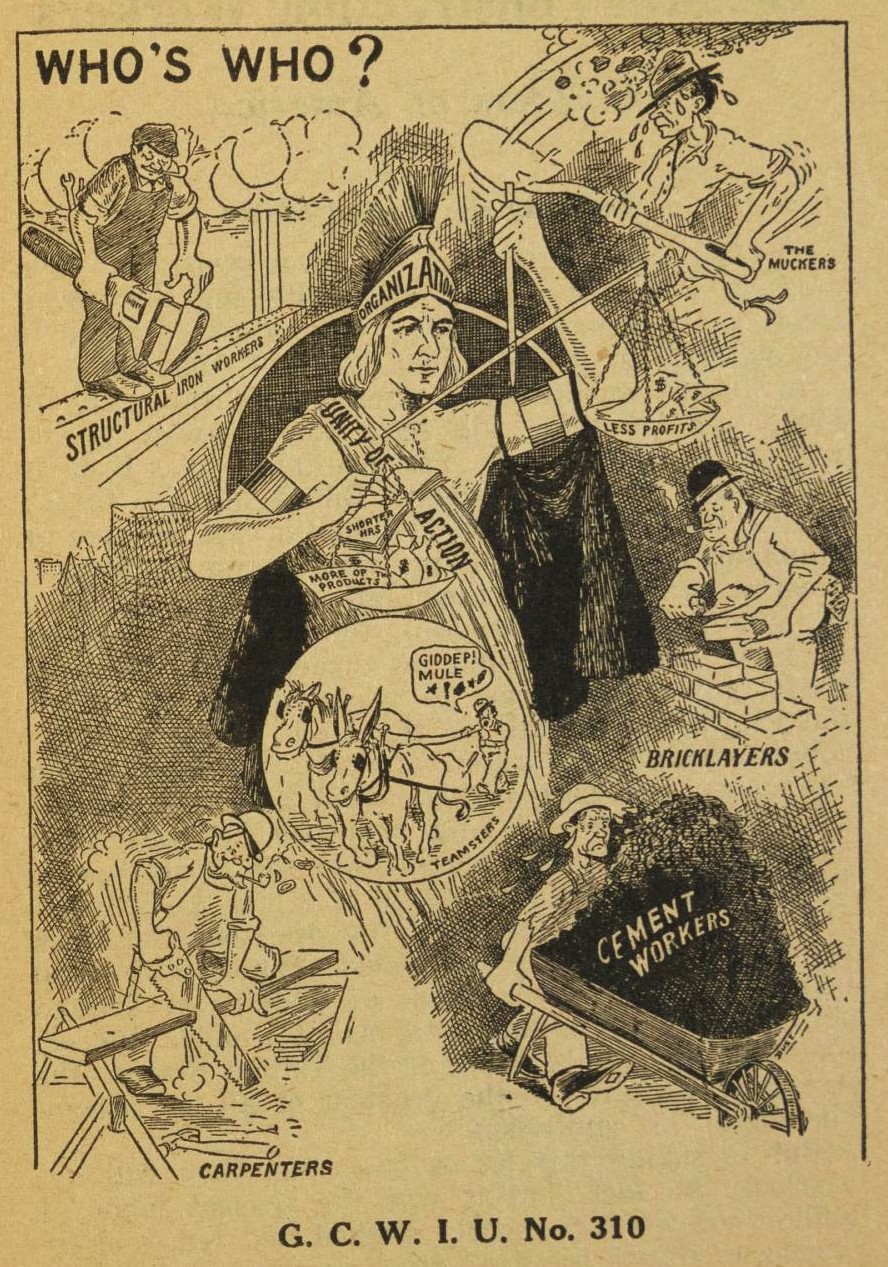
9. How is the modern construction industry interrelated to other industries? (Transportation, steel, concrete, lumber, etc.)
10. How are present-day construction bosses different from those of ancient days? Fifty years? Have the workers and employers interests in common?
11. Have great fortunes been made by the master class in the construction industry? (Give details showing the concentration of wealth into fewer and fewer hands.)
12. What are the conditions of the construction workers of today? (Need for organization.)
13. Contrast conditions in organized and unorganized districts in this and other countries.
14. How and when did craft unions first start to organize general construction workers?
15. Is the craft form of organization suitable for the construction industry?
16. When did the I.W.W. first start to organize construction workers? (Show strength of the One Big Union form of organization, solidarity, job tactics, etc.)
17. How has the I.W.W. bettered the conditions of construction workers? How can it better conditions still more? (Give examples and contrast with previous conditions.)
18. How are construction workers exploited at the point of production? (Give immediate aims of I.W.W. in construction industry.)
19. What are the principles, tactics and ultimate aim of the I.W.W. in construction industry?
20. How is the One Big Union of construction workers related to the One Big Union of related industries? Of all industries?
21. Why are construction workers necessary te a program of social change?
22. How is the I.W.W. helping to build the structure of the new society within the shell of the old in the construction industry?
23. How will construction workers function in the new society?
24. What does solidarity mean to construction workers organized in the I.W.W.?
25. Give your best reasons why construction workers should join the Industrial Workers of the World and suggest how best to work for the organization. (Lining up members, distributing literature, getting subs, etc.)
26. Have you any suggestions for the improvement of the pamphlet to be published on the construction industry?
Answer these questions and mail your papers to us.
One Big Union Monthly was a magazine published in Chicago by the General Executive Board of the Industrial Workers of the World from 1919 until 1938, with a break from February, 1921 until September, 1926 when Industrial Pioneer was produced. OBU was a large format, magazine publication with heavy use of images, cartoons and photos. OBU carried news, analysis, poetry, and art as well as I.W.W. local and national reports.
PDF of full issue: https://archive.org/download/sim_one-big-union-monthly_1920-07_2_7/sim_one-big-union-monthly_1920-07_2_7.pdf
 Revolution's Newsstand