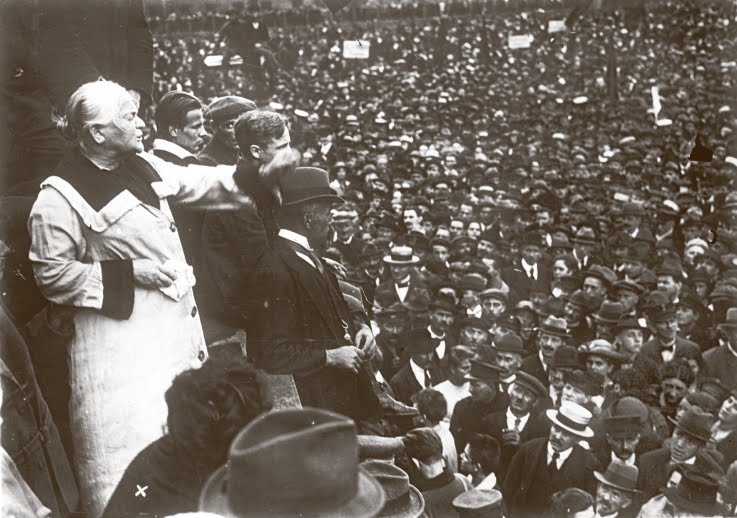
Written on the occasion of the Revolution’s ninth anniversary, the German veteran and living link in the revolutionary chain gives voice to the profundity of the impact of 1917 then felt, indeed still felt, by all those seeking freedom. Beautiful.
‘The Russian Revolution a Source of Moral Force for the World Proletariat’ by Clara Zetkin from International Press Correspondence. Vol. 6 No. 68. October 21, 1926.
History holds recorded in indelible letters how infinitely much the world proletariat in its fight for liberation owes to the Russian revolution, to its heroic, self-sacrificing standard-bearers, to its far-seeing, intrepid leaders. The Russian revolution has, both in theory and practice demonstrated and justified the fact that the Soviets of the producing masses are the revolutionary instruments of war of the proletariat for subjugating capitalism in industry and in the State, the revolutionary instruments of construction for the establishment of Communist Society. It has brought the whole essential difference between proletarian and bourgeois democracy out of the dim light of the study and of parliamentary illusions into the glaring, searching light of social reality, with its class contradictions and class fights. It has shown that only the proletarian dictatorship throws open the door to a society free from class distinctions, exploitation and bondage. It has compelled attention to the fact that the conquest of the power of the State by the proletariat, the establishment of its dictatorship is only the beginning and not the end of the social revolution, and that the latter will, in its course, inevitably bring up new problems, meet with new difficulties every day. It has impelled us to test, to perfect, to supplement over and over again the methods and means of the proletarian fight for emancipation, to chose or reject according to the historical circumstances of the time: even then all is not told.
In short, the Russian revolution of November 1917 is for the world proletariat a mine of wealth of theoretical and practical knowledge, a mine of wealth almost as immeasurable and inexhaustible as life itself. How could it be otherwise? Is not the Russian revolution life, historical, social life, aglow with sacred fervour, the conscious, active life of hundreds of thousands; the instinctively divined, emotionally perceived life of millions; the reality, the fate of a gigantic community? Just for this reason it must be appreciated for more than the wealth of guiding discernment, for the significance and value of which the world proletariat struggles seeking, groping, weighing and daring. This is what the Russian revolution really is, an act of will on the part of the workers of the broadest masses of the working people. This is the Russian revolution, an expression of conscious fighting, working, sacrifice, and endurance of untold numbers, famous and unknown, both in the great moments of its historical course and in its calmer development from day to day which, in the eyes of many, is without lustre. This is the Russian revolution, the meeting of the best mental and moral forces of a people of workers which has forced its way into spice and freedom, out of the narrowness and constriction of a society which subordinates the living man to dead property, and which, as the new order of society permits man to be completely man, man in his totality. This is the Russian revolution as the embodiment in flesh and blood of the idea of Socialism, of Communism Undoubtedly! Not yet the mature embodiment of the idea, but at any rate a resolute beginning of it.
In order clearly to grasp the significance of all this in its effect on the workers of other countries, we must bear in mind the historical hour at which the proletarian revolution in Russia raised its head, great, gigantic, triumphant. The capitalists and the troops which defended them were jubilant. Socialism seemed, together with the II. International, to have drawn its last breath on the imperialist battlefields which were reeking with the blood of the proletarians who were slaying one another. The bourgeoisie no longer trembled for its profit and its dominion in dread of the threatened attack of the proletariat. The class struggle did not weld nationally and internationally the exploited with the exploited. In its place was the imperialist war of the groups of States which were struggling for world power and world plunder. “Holy Unity”, “Collaboration of Classes” exploiters and exploited in the warring countries. The international solidarity of the proletariat is an antiquated, discarded illusion, Socialism a worthless Utopia. In the murderous fight against his brothers in the uniforms of foreign countries, the worker discovered his “country”. Thus sounded the echo throughout the world, drowning with the thunder of guns the message of peace and freedom, the message of international revolutionary Socialism It was just in the countries in which the latter had its strongest, best organised and best equipped, armies that it was most shamefully betrayed.
Small was the number of those who resisted the nationalist frenzy, who remained true to their faith in Socialism and Communism and looked to the revolutionary proletarian class war and not to the imperialist war of nationalities and States for bread, freedom and education. Still smaller was the group of the upright and courageous ones who dared to say this openly to the proletarian masses, who called upon them to put a stop to the imperialist massacre by the proletarian revolution. Their voice was swallowed up by the resounding janizary music of the nationalist orchestra of the imperialists of all countries, demanding war to the bitter end.
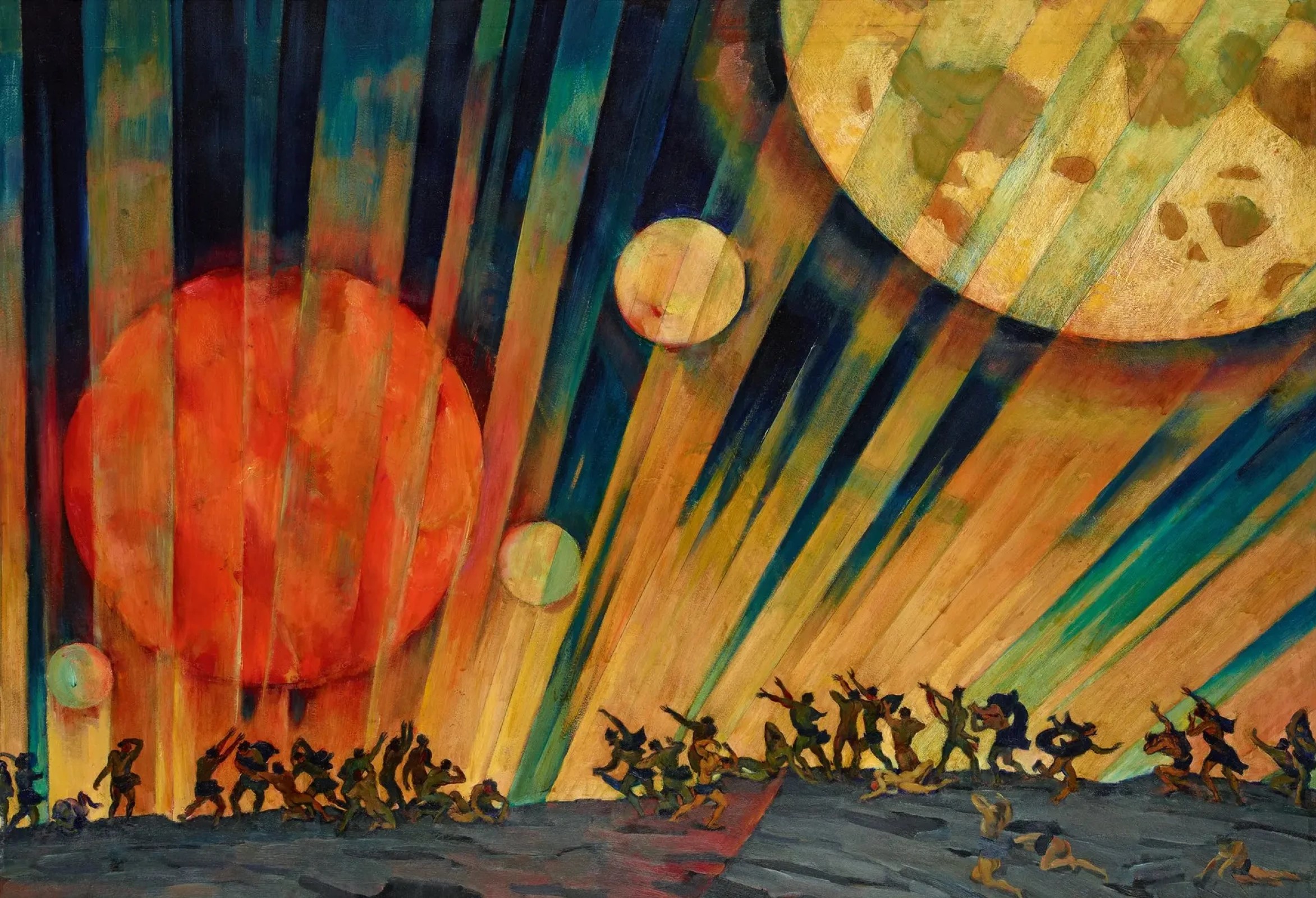
Then, in November 1917, after three years of unspeakable horror, arose a cry, louder and more powerful than the sighing, groaning, complaining, pleading and cursing of millions who were dying, wounded, crippled, starving, care-worn, deserted, fugitive. A cry, louder and more powerful than the uproar of the Witches’ Sabbath, which was celebrated in all capitalist States by the usurers and speculators in coffee, bread, materials, in human bodies and human souls, who were covetous of laurels and gold. In Russia, Revolution, the proletarian revolution had raised its head! With stentorian voice it cried throughout the world: “I was, I shall be.” And lo! A strong rousing spirit passed over the world. The faith of those who were convinced of the immortal life, of the sublime task of the revolution, gained gigantic force. The doubters and waverers stood once more firmly on their feet, and those who had become faint-hearted pressed forwards. Wherever capitalism had made the people weary and heavy-laden and had coined riches out of their distress and suffering, backs were straightened and heads were carried high and defiantly. The gladiators and the tools of profit of capitalist imperialism began to reflect about themselves, began once more to think and feel as proletarians who, in the revolutionary fight, had a historical aim of their own before them, — that of throwing off the yoke and exploitation of capitalism, thus rescuing mankind from the tyranny of possession.
The Russian revolution fanned into a bright, blazing flame the spark of longing for emancipation through Communism, of faith in Communism, of the will to bring it into being by fighting; a spark which had been buried under the ashes of nationalism. Those who had been bled and trampled upon in all countries learnt to trust once more in their own power with manly confidence. That which the usufructuaries and protectors of capitalism had denied and mocked at was true, had become a reality: a new social order of justice and freedom could he constructed, must be constructed, if the working masses reeognised it, willed it and fought for it. The Russian revolution put on the agenda of history the question: Capitalism or Socialism, Communism as the predominant question of the day: as the plain and simple question of the day. The revolution appeared before the eyes of the world proletariat as liberator, avenger, as judge, with the sword bared and the trowel in her hand, and — what was most inspiring and uplifting —as the very deed of the exploited and suppressed themselves. To this deed of liberation the Russian revolution called those who were hungering for peace, for bread and for freedom in all countries. Her first word was the glowing, fervent proclamation of international proletarian solidarity, an expression of an almost religious faith in it and its power.
Sparks and flames from the gigantic conflagration of the Russian revolution leapt across the borders. They kindled the first great demonstrations of proletarian class-life in Western Europe, demonstrations which still lacked clearness of purpose and power, which were partly inspired by pacifist confusion of thought instead of by revolutionary determination, but which nevertheless revealed the stirrings of recognition and of will. Take as instances the imposing peace demonstration in Vienna, the mass strikes in Germany in January 1918 etc. Outside Soviet Russia, it is true, the proletariat of the world dragged on in ‘its misery due to war and under the crushing burden of capitalism. Nevertheless the glorious example of their Russian brothers and sisters left indelible traces in their heart and mind. When the military force of the Central Powers collapsed, when revolution rose there also with gigantic power, arming and guiding the fists of the proletariat, the Russian example became a living force in the souls of the proletarians. Like mushrooms after a rain-storm, workers’ soldiers’ and peasants’ councils sprang up almost in a night. Councils as supporters of and ministers for a new, higher social life and thought, as foundation stones of a more perfect order of society, was the slogan of the revolutionary day. It was the pillar up which climbed the longing and energy of untold numbers of proletarian men and women whose discernment had been sharpened, whose passion for fighting had been inflamed by the Russian revolution. The revolution in Germany, it is true, and in the Republics which rose from the ruins of the Austrian Habsburg monarchy, lagged far behind their Russian precursor. The proletariat began it indeed, but did not make the best of it, did not carry it through to the end. It stopped half-way, at the limits of the bourgeois republic, fooled and betrayed by hesitating, short-sighted leaders, who feared fighting and responsibility, a victim also of its own illusions and weaknesses, especially of the lack of confidence in its own power. Even now, in these countries, only a vanguard of the proletariat is engaged in the revolutionary fight, ready to clear the way for Communism, the greatest act of creation in history, by shattering capitalist exploitation and domination in the State and in economic life. The same applies to the other States and territories in which capitalism still chastises the have-nots with scorpions.
In the vanguard of the world proletariat alone, the titanic life and struggle of the Russian revolution has all the force it had on the day of its birth; and spirit of its spirit, flesh of its flesh is the III. International, the young world power of the workers of all countries, who know that in the revolutionary fight they have a world to win and nothing to lose but their chains. Beyond this however, the Russian revolution, through the undying example of its fighting, labouring existence, is constantly raising more and more proletarians from the indignity of patient bearers of their cross to proud rebels against capitalist despotism who are conscious of their aim and cognisant of the path which leads to it. It makes them toil for knowledge and enlightenment; it releases currents of energy, of self-denial, of joy in sacrifice; it inspires miracles of self-abnegation and heroic intrepidity. It is a well-spring of the spiritual and moral rebirth of worn-out, dull and apathetic slaves of capital into fighting communists.
International Press Correspondence, widely known as”Inprecorr” was published by the Executive Committee of the Communist International (ECCI) regularly in German and English, occasionally in many other languages, beginning in 1921 and lasting in English until 1938. Inprecorr’s role was to supply translated articles to the English-speaking press of the International from the Comintern’s different sections, as well as news and statements from the ECCI. Many ‘Daily Worker’ and ‘Communist’ articles originated in Inprecorr, and it also published articles by American comrades for use in other countries. It was published at least weekly, and often thrice weekly.
PDF of full issue: https://www.marxists.org/history/international/comintern/inprecor/1926/v06n68-oct-21-1926-inprecor.pdf
 Revolution's Newsstand