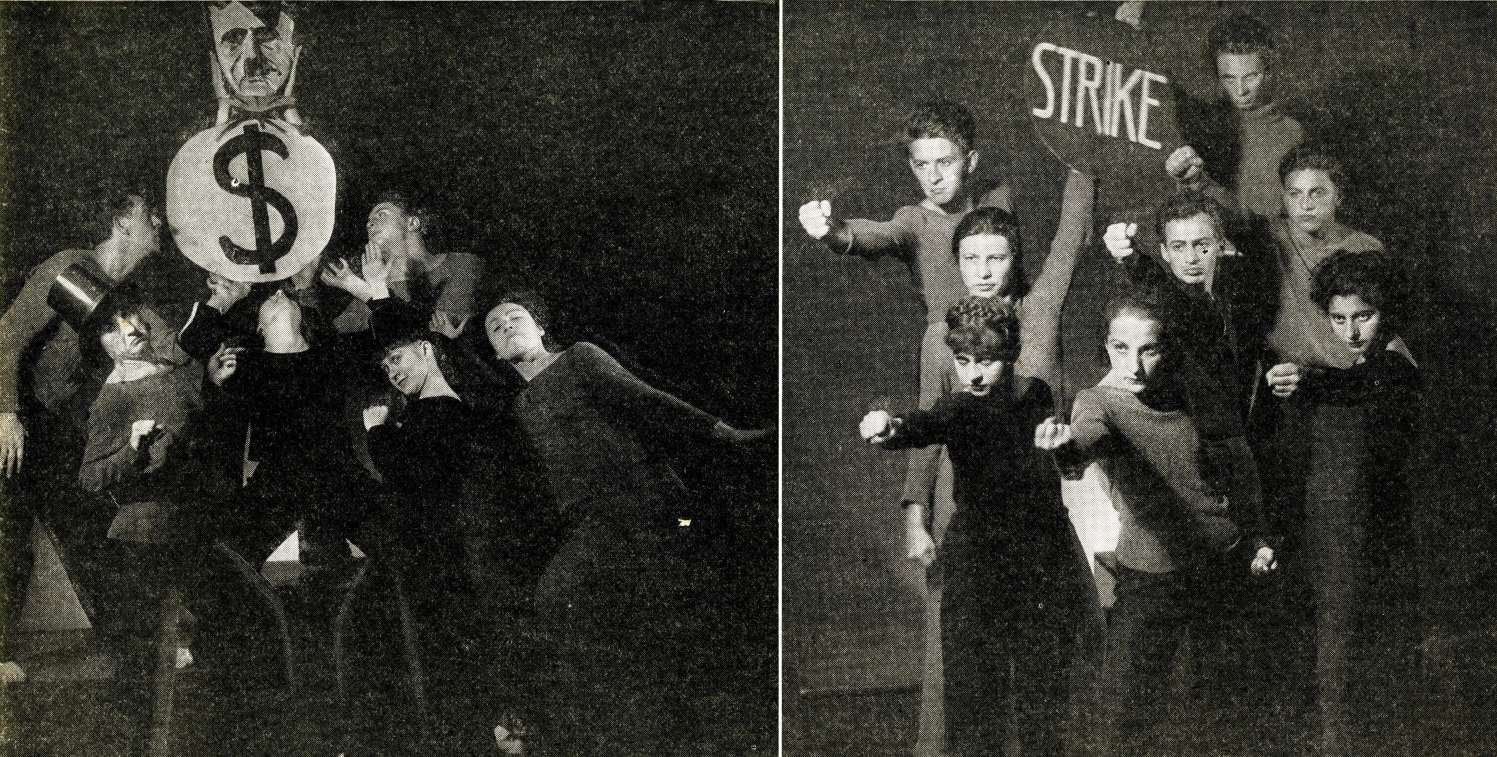
They lived communally, studied Marxism and acting, wrote revolutionary scenes, and performed guerilla theater on the streets of New York during the Great Depression. Meet the Shock Troupe of the Workers’ Laboratory Theatre.
‘A Day With the Shock Troupe of the Workers Laboratory Theatre’ by Peter Martin from the Daily Worker. Vol. 11 No. 123. May 23, 1934.
The Shock Troupe of the Workers’ Laboratory Theatre strives to be an actual example of what the living revolutionary theatre of today should be; it does not wait for the audience to come to it, but goes out and seeks its audience in the broad masses, bringing them a revolutionary message in terms of its theatre art.
The Workers’ Laboratory Theatre has two part-time production units in addition to the Shock Troupe and, although their function is theoretically the same as the Shock Troupe’s, they are prevented by their very nature from being able to meet fully the requirements of a real emergency unit. Consequently their best use is as dramatic companies which perform at meetings and social functions that have been planned for in advance; they come with their revolutionary message and leave a clear and definite picture of the revolutionary situation. But since they are manifestly incapable of the flexibility and thorough immersion in revolutionary activity which the living revolutionary theatre demands—the members having other obligations such as supporting or helping toward the support of their families —the burden of carrying the fight to the struggling masses, going out to them in the midst of their conflict, falls upon the Shock Troupe. The Shock Troupe lives collectively so that it may work better collectively, and it is supported by a small subsidy from the Workers’ Laboratory Theatre, and by voluntary contributions from interested individuals. The amount and the quality of the personal sacrifices of each member of the Troupe need not be gone into here; it is enough to say that they often do not get enough to eat, and that they are in need of clothing. Of the nine members only two are native New Yorkers; one is a Westerner, another is a Middle-Westerner, still another is a West Indian; three are Russian-born and the last hails from the City of Brotherly Love. The age-range is from 18 to 28. And the theatre experience of each member varies; a few have been in stock and in little theatres, others have been “social directors” and in burlesque and in the cabaret world, and one has had theatre experience in France and in the Soviet Union with Meyerhold and with the Theatre of the Revolution. Several were forced to leave school at an early age, while some have attended college; one, in fact, has attended no less than six colleges. Three have traveled extensively in the Soviet Union and elsewhere; one is an ex-sailor of the mercantile marine.
As a whole the Shock Troupe constitutes a vital group developing along many lines which converge at the point of effective revolutionary activity, and unlike the actors of the bourgeois stage with a job and a “career” they have a grasp of the realities behind their theatre art which enables them to correlate their work to the broad historical process of which they are a part. How does the Shock Troupe spend a day?

They rise at eight, have breakfast, then clean house, and arrive at the theatre at about ten o’clock, where another half hour is spent in cleaning the theatre. Then daily classes begin; the subjects studied are current politics, dialectical materialism, make-up, technique of acting and bio-mechanics, and are given by the comrades in the Troupe most developed in the respective subjects. At one o’clock the daily rehearsal of material in repertory begins; new material is whipped into shape and the songs, skits and plays to be performed during the week are gone over and over in an attempt to achieve as perfect a performance as possible. Frequently these afternoon rehearsals may be suspended because of emergency strike bookings, because of appearances at demonstrations and mass meetings. At four o’clock there is individual rehearsal, wherein the comrades study their shortcomings and try to improve their technique and broaden their conceptions of the characters they are creating. Supper comes at six, before, during, and after which the day’s work is reviewed. (Each member serves as the cook for a week at a time.) In the evenings there may be bookings—Fridays. Saturdays and Sundays are invariably taken up—and during the week several members attend the nightly classes given for the evening groups. while others either give these classes or direct the productions of the evening groups.
It is a full day and it takes in every branch of the theatre—directing, study and rehearsal and performance. In addition, several members of the Troupe serve in the Artistic Council and on the Executive Committee of the Theatre. It is clear that the Shock Troupe is the nucleus of the Workers’ Lab-oratory Theatre; not only is it the dynamic wedge in forcing the revolutionary issue, but its separate members help to guide an organization of over one hundred people, divided into departments of acting, classes, playwriting, stagecraft, dramatic dance and dramatic chorus “Shock Troupe Nights” are a monthly feature at the Workers’ Laboratory Theatre. 42 E. 12th St.; on these nights the Shock Troupe gives a “studio review” of its plays and skits, to which the public is invited.
The Daily Worker began in 1924 and was published in New York City by the Communist Party US and its predecessor organizations. Among the most long-lasting and important left publications in US history, it had a circulation of 35,000 at its peak. The Daily Worker came from The Ohio Socialist, published by the Left Wing-dominated Socialist Party of Ohio in Cleveland from 1917 to November 1919, when it became became The Toiler, paper of the Communist Labor Party. In December 1921 the above-ground Workers Party of America merged the Toiler with the paper Workers Council to found The Worker, which became The Daily Worker beginning January 13, 1924. National and City (New York and environs) editions exist
PDF of full issue: https://www.marxists.org/history/usa/pubs/dailyworker/1934/v11-n123-may-23-1934-DW-LOC.pdf
 Revolution's Newsstand