
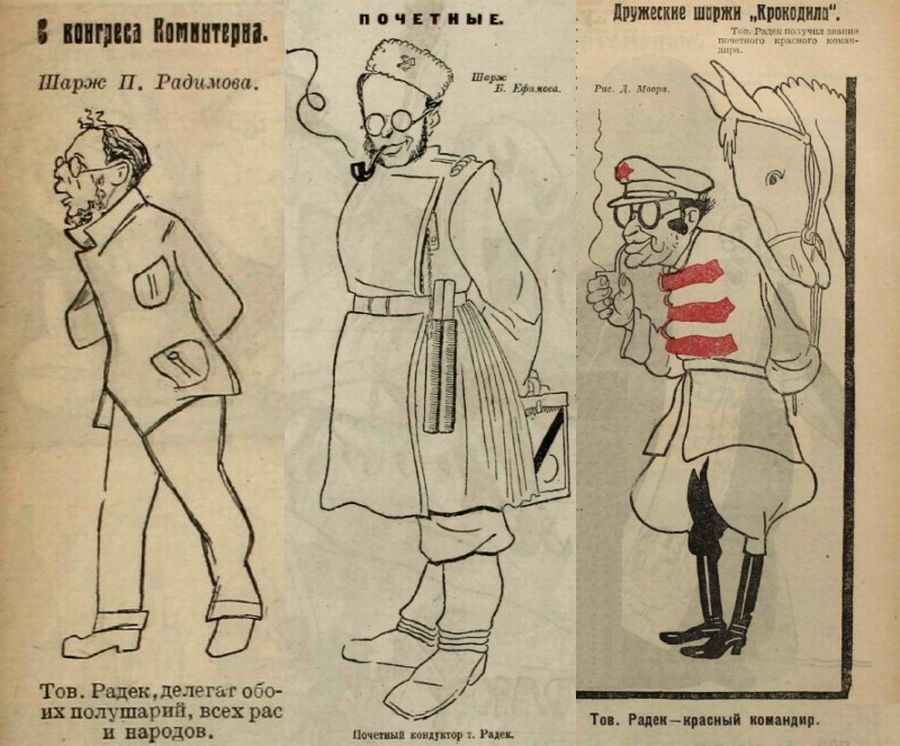
Karl Radek’s valuable report on one of the most consequential Bolshevik gatherings. Coming near the end of the Civil War and after the debate on trade unions, the Congress introduced the New Economic Policy, placed a virtual ban on factions, and saw the Kronstadt Rebellion break out during its meetings.
‘The Tenth Congress of the Communist Party’ By Karl Radek from Soviet Russia (New York). Vol. 4 No. 22. May 28, 1921.
Unity of the Party
ONCE again the bourgeois press of the world was filled with information about the impending downfall of the Soviet Government, and once again all their expectations came to nothing. The Kronstadt uprising is liquidated, the local peasant uprisings in Siberia suppressed, and the political work of the Tenth Congress of the Russian Communist Party completely destroyed all the hopes of the Russian counter-revolutionists. The decisions passed by the Congress with regard to the two most important questions on the agenda, namely, the question of the attitude to the peasantry, and that of the relations between the Communist vanguard of the proletariat and the more backward masses, were carried by an overwhelming majority and showed the Congress to have been firmly united. The differences of opinion prevailing in the party with regard to the second question, i.e., that of the Labor Unions, were settled not without some disagreement. Six comrades voted against the resolution adopted by the Congress. But as a matter of fact, the discussion on this question, which had been carried on since the month of December, involving the widest masses of the Party, and giving rise to an extensive literature, has straightened out the most important points of difference. The authority of the Party Congress and the overwhelming majority of the Party which came out for the Lenin platform make it perfectly certain that the comrades will submit to that majority without reserve. This, of course, is self-evident. The leaders of the Communist Party of Russia know not only how to make the masses submit to party discipline, but also how to submit to that discipline themselves. Just as the great organizer of the Red Army submitted to party discipline, so did the leaders of the so-called “labor opposition” of Shlyapnikov and others, who were inclined to give a syndicalist interpretation to the dissatisfaction of the tired and exhausted non-party masses of the workers. The Party Congress condemned these syndicalist leanings, but recognized the services of these comrades in the struggle against bureaucratic methods with which we are confronted as a result of the long war, and the weakening of the proletarian ranks. The Congress elected some of these comrades into the Executive Committee in order that they might help in rooting out the abuses which actually exist, and strengthen relationships with the non-party masses. These comrades were of course not altogether pleased by the fact that the Congress condemned their syndicalist tendencies. But so great is the authority of the Congress, and so strong the consciousness that the Communist Party of Russia, in spite of all its faults, and weaknesses, brought about by the war, is nevertheless the only Party, and the regime created by it the only regime possible in Russia today, that the leaders of all the various groups acquiesce in the decisions of the Congress.
The Attitude Towards the Peasants
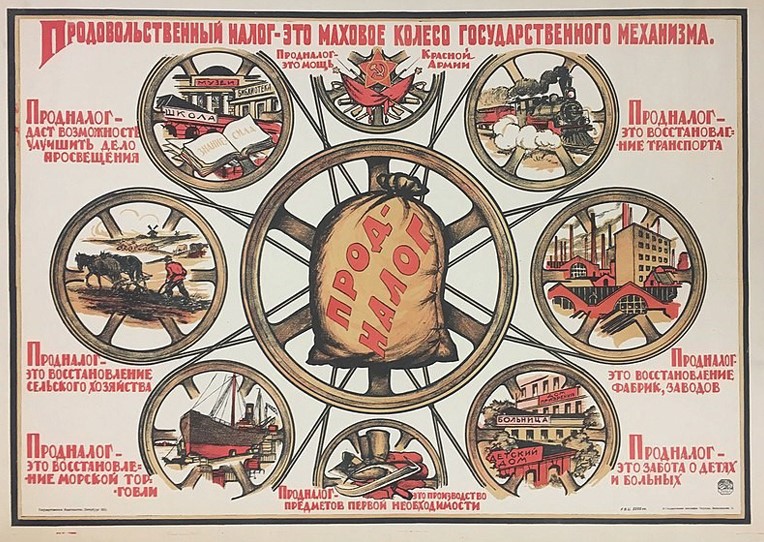
As I said above, the first question the Congress had to deal with was that of the attitude towards the peasants. The precarious state of agriculture, caused by seven years of war, and the confidence gained by the peasants that the restoration of feudalism was no longer possible, led to a disturbance in the relationships between the working class and the peasantry. Some of the latter are of the opinion that the proletarian government is imposing upon them obligations too difficult to fulfil. It was the concern of the Congress to investigate the matter and see whether there was any possibility of easing the burdens of the peasantry without at the same time jeopardizing the food supplies of the city workers. The Congress had to examine the possibility of modifying our food policy, and it came to a unanimous conclusion that this can be done, that our policy in this matter can be modified in such a way as to meet’ the needs of the peasantry and to lessen their dissatisfaction without injuring the food supplies of the towns. This modification consists in the abolition of the system of requisitioning all the foodstuffs that remain in the possession of the peasants in excess of the direct needs of their respective households. The Congress decided to replace this by a tax in kind which would take from the peasants only a certain part of their products fixed in accordance with the number of members in each family, the number of head of cattle, and the proportion of the crops, leaving the rest in the hands of the peasant to dispose of at his discretion.
Probable Effects of the Tax in Kind
Thus the Congress adopted a measure which will result in getting the peasants interested in increasing the area of cultivation and raising the productivity of labor. The peasant will be afforded the opportunity of exchanging the products of agriculture for articles of manufacture which will be supplied to him out of a special fund created by the Commissariat of Food Supplies for that purpose. This fund of manufactured articles for the needs of the farmsteads is to be set up partly from goods acquired abroad, and partly on the products of our nationalized industry which will not be overburdened by the needs of the army and the war, as was the case hitherto. In view of the fact that the partial demobilization of the army will strike from the list a couple of million persons dependent upon the government for their food supplies, and in view of the fact that the trade agreement with England, which will probably be followed by similar agreements with America and Germany, will put the Soviet Government in the position of an intermediary between the capitalist world-market and the Russian peasantry, we may confidently assert that this modification of our food policy will improve the condition of the peasantry without at the same time curtailing the food supplies of the cities. The most important point in this matter is the fact that it will tend to raise the interest of the peasants in extending their crops and will put on a firm foundation the measures adopted by the recent Congress of Soviets for the purpose of widening the area of cultivation. This new policy is of course not without its dangers, for in those cases where the Soviet Government will not prove to be in a condition to effect the exchange of the agricultural products for manufactured goods, the peasant will endeavor to trade his surplus agricultural products with the peculator and the handicraftsman, and this might lead to a reintroduction of the factor of private capital in Soviet Russia. This danger can be averted only by intensifying the production of nationalized industry. Should this intensification be brought about, the speculator and the handicraft worker will of course not be able to compete with the nationalized industry, and will not succeed in accumulating any capital. The strengthening of the nationalized industry and its development in turn depends upon whether our talk of concessions finds realization in actual investments by Western European capital. It will also depend upon whether the proletarian revolution in the West will proceed at a quicker pace and thus put the Russian Soviet Republic in the position of receiving manufactured products from the European proletariat. It will likewise depend upon whether Russia is going to enjoy a period of peace during the coming months, or whether it will be compelled to take up arms again.
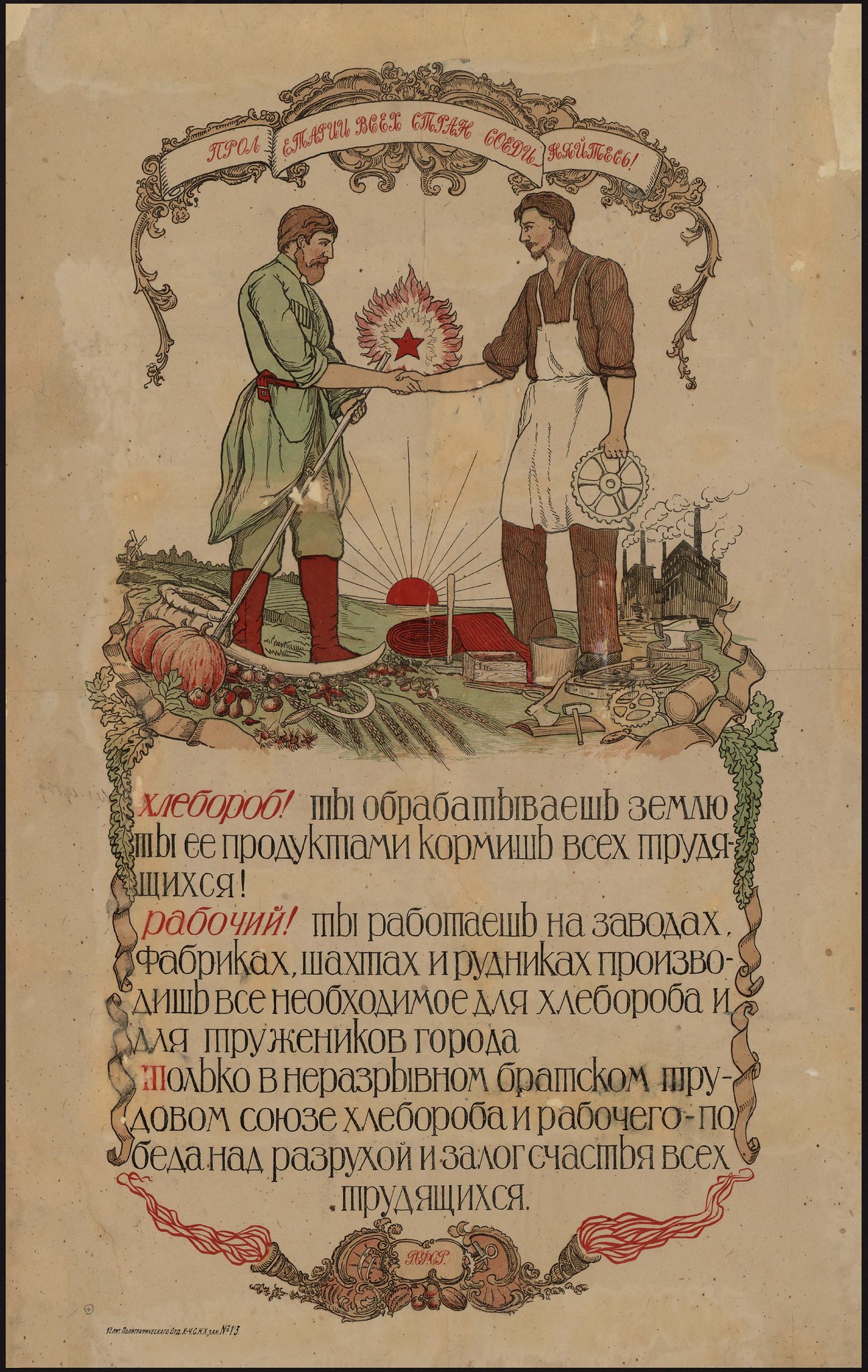
The Russian Communist Party has not been in the habit of minimizing the dangers confronting it, and it is well aware that never since the October revolution has it ever been outside the danger zone. It has based its policy all through on the principle that its cause will depend upon the development of the revolution in Europe. It is true that the European proletariat has not triumphed yet, but nevertheless the trend of events in Europe is in favor of Soviet Russia. The German revolution saved Soviet Russia from the danger of being strangled by German imperialism. The revolutionizing of the French and English workers has prevented the crushing of the Russian Red Army by Western European imperialism.
While obtaining a new breathing spell on the internal front, through its concessions to the peasants, Soviet Russia is convinced that its diplomatic strategy and the further development of the world revolution will make it possible to use this breathing spell in the interest of the Western European proletariat.
Why the Tax in Kind Was Introduced
The concessions to the peasants are dictated not only by the difficulties of the moment, but also by the desire to improve our agriculture, and thus enable Soviet Russia to serve as the granary of the European revolution should the latter be subjected to a blockade by Anglo-Saxon capitalism. This answers the accusation of opportunism and compromise with the peasantry, raised against the Communist Party by the lackeys of the European bourgeoisie and their henchmen, the “Socialists” of the Center. This “opportunism” of the Soviet Government is the greatest service which it can render to the European proletariat. Everything that contributes towards the retention of power in the hands of the Russian working class, serves the interests of the European workers. This service cannot be rendered by Soviet Russia if it were to fall in the attempt to carry out “pure socialism” in its stat of isolation. On the contrary, Soviet Russia must serve as a step-ladder for the European revolution to climb upon, irrespective of the compromises that may have to be resorted to for the moment. What matters is that the vanguard of the proletariat should retain the power of government in its hands and thus prevent the European counter-revolution from using the millions of the Russian peasants for the suppression of the growing European revolution, and also of utilizing the economic resources of Russia for the restoration of European capitalism.
The Non-Party Masses
In making all these concessions to the petty bourgeois of the Russian village and the European capitalists, the Russian Communist Party must endeavor to strengthen its own social basis on the foundation of the working class. During the war and during the revolution, the Russian working class underwent very considerable transformations. While the war lasted, hundreds and thousands of peasants, mechanics and shopkeepers were drawn into the factories, partly by the high wages and partly to avoid military service. During the civil war and the accompanying scarcity of food, many workers migrated to the country. Hundreds of thousands of staunch proletarians were withdrawn from the factories to serve in the Red Army and defend the Soviet Republic, or to take part in administration. This resulted in weakening the number of the Communist vanguard in the factories. At the same time the labor mobilizations drew numbers of peasants to factory work in the cities and thus strengthened the ranks of the petty bourgeois elements in industry.
The working class, thus changed in its social composition, had to suffer extreme hardships during the war. The satisfaction of their primary necessities had to be put off in order that the army could be fed and clothed, and they were compelled to suffer privation while exerting themselves for the needs of the army. The most backward in these trying moments looked upon the Communists as hard taskmasters imposing upon them more and more sacrifices. This gave rise to some tension between the non-Communist workers on the one hand and the Communist Party and the Soviet Government on the other.
One of the most important problems of the Communist Party at the present time is to lessen that tension between the vanguard and the rearguard of the working class and to smooth out all the difficulties. This must be done both on the economic and on the spiritual field. Having adopted the platform of Lenin calling for proletarian democracy in the Labor Union, for political propaganda among the non-party workers, and for the attraction of the non-party man to Trade Union and Government functions, the Communist Party is starting anew its fight to win over the non-party workers. By setting up a special committee to take energetic measures to alleviate the wants of the working masses, this struggle for the recruiting of non-party masses is put on a material basis. Naturally, the inequalities in the position of the workers of various industries cannot be abolished yet. The miners, the machinists and the metal workers, must be given most attention in order that the work of reconstruction be pushed forward.
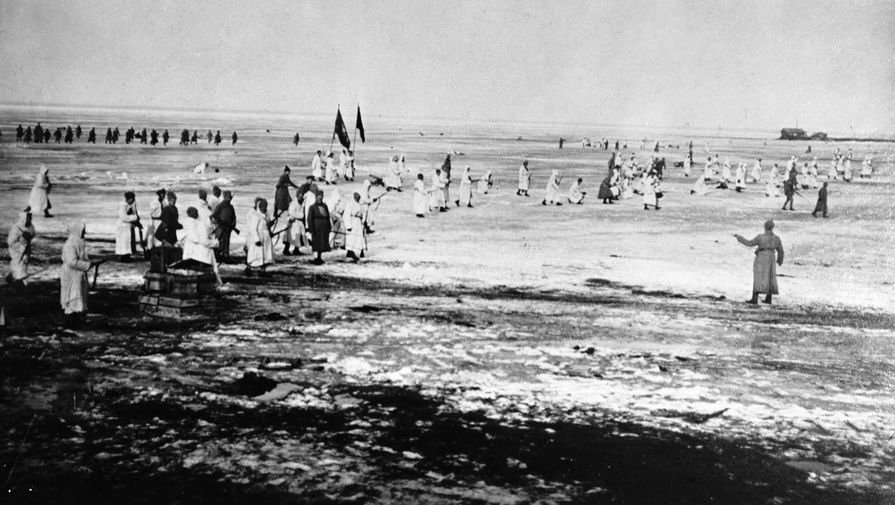
At the same time the Congress has instructed the Government to abolish all unnecessary inequalities and all undeserved privileges, as well as to adopt measures leading to the alleviation of the condition of the average worker. That the efforts of the Party in this direction will be crowned with success there is no doubt. At a number of mass meetings and conferences of nonparty men held during the last, few weeks it was brought home to the masses that the Communist Party is the only Party which, having defended Soviet Russia by arms, is in a position to get the workers out of a state of need and privation and raise them to a higher level of existence. The expectations of the counter-revolutionists that the mutiny at Kronstadt would serve as a signal for general labor disturbances among the working population and thus lead to the downfall of the Soviet government, have come to nought. The liquidation of the White-Guard plot at Kronstadt, afforded the Soviet government the possibility of proving to the non-party workers that the danger of counter-revolution was not yet over. The mere fact that the mutiny of the sailors comprising in the main, peasant youths from South Russia and from the Black Sea coast, gave the White-Guard generals at Kronstadt the upper hand; that this uprising caused all the White-Guard emigrés in Europe to start out for Esthonia and Finland with the view of directing the counter-revolution from Kronstadt against Soviet Russia; that it opened the door wide for any imperialist intervention, proved even to the non-party laboring masses that every move directed against the Soviet Government.is a move in favor of the Russian and European Junker and Capitalist counter-revolution. Thus the Socialist Revolutionists and the Mensheviks, who without possessing any program for the alleviation of privation and the solution of our social problems are endeavoring to stir up the dissatisfied and tired out masses, have once again revealed themselves to the working masses as conscious or unconscious agents of the European counter-revolution.
But the Russian working masses are not going to become the victims of the European counterrevolution. Under the pressure of the great need, the sacrifices and the hardships which the defence of Soviet Russia and the work of its reconstruction impose upon them, the working masses, especially the backward elements may waver from time to time, but in the decisive moments of danger, when the peril of counter-revolution appears before them, they close their ranks anew and rally again with doubled efforts around the Communist Party as the mainstay of the revolution.
Reconstruction of the Communist Party
In order to establish a new attitude towards the peasantry, and in order to draw the millions of non-party workers into the Communist Party, the latter must adopt new forms of organization, must rearrange and purify its own ranks. This question of party organization was closely connected with every one of the great political questions that the Congress had to deal with. Just because the Communist Party has adopted the method of concession to the petty bourgeois peasant elements, it is incumbent upon it to strengthen its proletarian ranks so that it might be the determining factor in the relationships with the petty bourgeoisie instead of succumbing to and becoming the victim of petty bourgeois influences.
The Communist Party as the dominating party has become the centre of attraction for many petty bourgeois careerist elements, especially those of the intelligentsia. But owing to its propaganda activity among the Red Army men, the Party succeeded in winning over to its side the best elements of the peasant youth who have joined the Communist organizations and attended the Communist military schools. Now the task of the Communist Party today is to rid itself of the careerist elements, to assimilate the peasant youth that had defended the Soviet government, and what is most important, to draw into its ranks hundreds of thousands of proletarians who stood hitherto outside of the Party.
Party Organization
The Party organization must be modified. When we were confronted with the task of overcoming the White-Guard hosts, the Party was compelled to resort to an iron military discipline and could not allow the principle of democracy within the Party to prevail. Thus very important decisions frequently had to be passed without preliminary discussion among the masses, The Central Committee pressed by the needs of the moment had to commandeer hundreds and thousands of members from every part of the country and the Communist Party was more like an army than a political organization. But as soon as the iron rings of the war period were somewhat loosened, the Party arranged for a discussion on the various questions of policy and organization which served to review its forces and examine its weaknesses. All the questions that had accumulated within the party were thus brought -to the front and a higher level of unity, based upon party consciousness, was brought about. The Party combatted on the one hand the tendency towards carrying over the military methods into the field of production and economic reconstruction, and on the other hand the opposite tendency toward following an unlimited democratic policy in the work of reconstruction. It refused to submit to the pressure of the non-party elements calling for the diminution of the guiding influence of the Party the effect of which would be to deliver the direction of industry absolutely into the hands of the Trade Unions although the great mass of the workers, being non-party men and tired out, would not be capable of subordinating their momentary moods to the lasting interests of the proletariat as a whole. The military tendency involved the peril of drawing the non-party proletarian masses away from the Communist Party, but the syndicalist tendency on the other hand threatens to let the ship of state drift without a rudder and without a captain. The party adopted the policy of drawing the non-party masses into its ranks and bringing them nearer to the Communist vanguard and get them to participate in the solution of the political and economic problems.

The dictatorship of the proletariat is possible only as the dictatorship of its class-conscious vanguard, i.e., as the dictatorship of the Communist Party. The Communist Party must bear in mind, however, that by itself, without the assistance of the wide masses, it will not be in a position to fulfil the historic mission imposed upon it by the revolution. Democracy within the Party is essential lest the Party become petrified and be deprived of the possibility of relying upon the voluntary and joyous subordination of the wide masses in the most trying moments.
But at the same time the Party must beware not to jeopardize the proletarian dictatorship in the interests of democratic forms. This idea found expression at the Party Congress, and was emphasized within the ranks of the party. The calculations of the counter-revolutionists upon the possibility of a split within the Communist Party, the hopes that they entertained that some elements of the Party were going to open the way for them against the fortresses of Russian revolution, have come to nought. The decision passed by the — Congress giving the authority to a two thirds majority of the Central Committee, of the substitutes and of the control committee to expel from the Party any member of the Central Committee who would not abide by the decisions of that Committee or would act at cross purposes with its policy, testifies that the Party is firm in its determination that the Central Committee should at all times hold in its hand the direction of the cause of the revolution, and should in no way resemble that war council where one order is countermanded by another resulting in a general disorder and in lack of proper direction.
The Results of the Party Congress
The Russian counter-revolutionists and the international capitalists apparently expected to see the approach of the Thermidor of the Russian Revolution. They believed that after the Communist Party had fought and won the land for the peasants, the latter being secure in their possessions will break away from the Communist Party. They also counted upon the Communist Party alienating the non-party masses by imposing excessive demands upon them and thus, deprived of its social basis and robbed of all support, collapsing. They already pictured to themselves the Robespierre of the Russian Revolution ridding himself not only of his Dantonists and Hebertists but estranging even the Paris Commune (of 1793) with its Chaumette, and they only waited for the moment when the head of the Russian Robespierre would fall at the Place de la Roquette amidst the joyous shouts of the gilded youth and the passive acquiescence of the masses who brought him to power.
But this analogy of the learned counter-revolutionist did not suit the occasion. The Soviet Government will find a way of strengthening the ties connecting it with the peasantry. The tens of thousands of peasant youths who have been trained as Red officers on the fronts and in the military schools, and who realize the present situation of Russia and understand the necessity of a union between the peasants and the working class, will serve as the connecting links. The peasantry will become convinced that the Soviet Government is the only one which is capable, not only of carrying through the agrarian revolution, but also of improving the agricultural conditions of the peasants. The Russian Communist Party did not suffer any breach as a result of the party discussion recently carried on. It has gathered together all the various groups that participated in that discussion, subordinating them to the overwhelming majority of the party, and is now proceeding to strengthen and make more close its relations to those elements that had brought it to power. The situation during the French Revolution and the fate of the Jacobin dictatorship were essentially different. Robespierre was forced to break with the Parisian proletariat for he was averse to the dream of the young proletariat for social equality.
The Communist Party of Russia is the party of the proletariat. The goal which it pursues, the Socialist organization of industry, is just as much in accord with the present times as the free individual trade was in accord with the times of youthful capitalism. The concessions made by the Communist Party of Russia to the capitalist elements are transitory. The course of the times runs in the direction of the organization of industry on a Communist basis. Only the slow course of development calls for some concessions to the past. Robespierre was washed away by the tide of history. The Communist Party of Russia will steer upon that tide to its final triumph.
Robespierre had to break with the Parisian proletariat because he was a representative of the bourgeoisie. But the Communist party of Russia will stand more and more firmly on its native soil, on its kinship with the proletariat, and draw more power from that kinship. For it is in its essence and in its goal the party of the proletariat.
The Communist Party of Russia may have to sustain even harder struggles. But it will triumph in the end. The decisions of the Tenth Party Congress are imbued with proletarian energy, and the elasticity and circumspection of these decisions stand as security for the triumphant forward march of the Russian Soviet Republic.
Soviet Russia began in the summer of 1919, published by the Bureau of Information of Soviet Russia and replaced The Weekly Bulletin of the Bureau of Information of Soviet Russia. In lieu of an Embassy the Russian Soviet Government Bureau was the official voice of the Soviets in the US. Soviet Russia was published as the official organ of the RSGB until February 1922 when Soviet Russia became to the official organ of The Friends of Soviet Russia, becoming Soviet Russia Pictorial in 1923. There is no better US-published source for information on the Soviet state at this time, and includes official statements, articles by prominent Bolsheviks, data on the Soviet economy, weekly reports on the wars for survival the Soviets were engaged in, as well as efforts to in the US to lift the blockade and begin trade with the emerging Soviet Union.
PDF of full issue: https://www.marxists.org/history/usa/pubs/srp/v4-5-soviet-russia%20Jan-Dec%201921.pdf
 Revolution's Newsstand