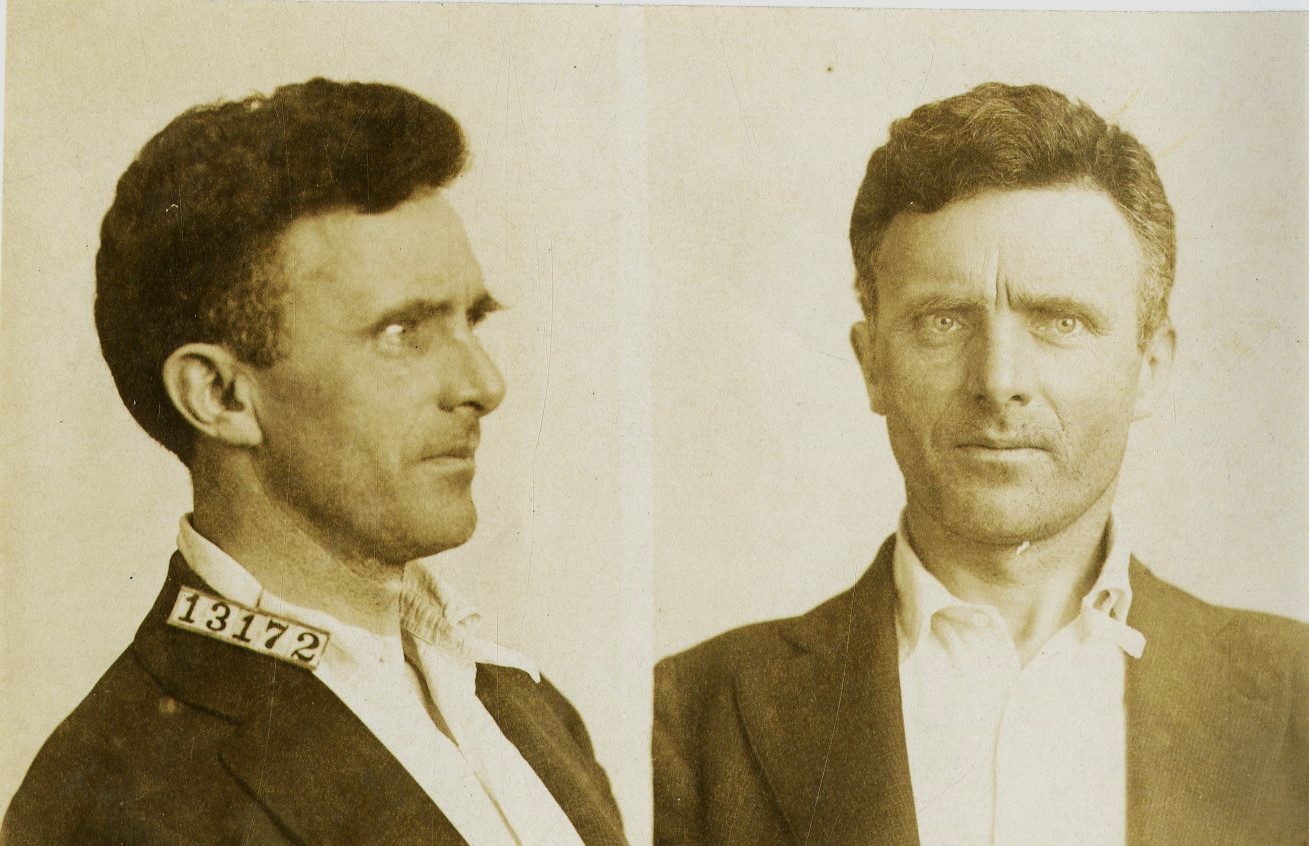
Sentenced to ten years in Leavenworth, wobbly Joseph Oates does not miss a beat organizing fellow inmates, commenting on the political situation, discussing strategy, and inquiring about comrades in this letter to the radical Butte Daily Bulletin.
‘Letter from Leavenworth’ by Joseph A. Oates from the Butte Daily Bulletin. Vol. 1 No. 141. January 31, 1919.
Leavenworth, Kan., Jan. 26, 1919.
Mr. M. C. Sullivan, 318 N. Wyoming St., Butte, Mont.
Friend and Fellow Worker:
Your welcome letter to hand and was pleased to hear you were in good health and, though one of the unemployed army of democracy, getting by, as you expressed it, fine. I note what you say about your trial next month and hope you will come clear. Seeing as you have lots of spare time on your hands, Michael, I want you to do me a favor: I sent a check for $6 to the Butte Bulletin a few days ago and I want you to go there and tell them to apply $2 for the renewal of my subscription, which, by the way, is a month overdue, and to use the other $4 in sending a paper to James H. Manning and V. V. O’Hair for three months — they are both members of our colony in Leavenworth. There is such a demand for it amongst the men in here, that the few copies we are getting were not enough to go around, and I could not see a better way to spend the few dollars the boys sent me than supporting a paper which is fearless and to the point in printing the only news worth reading–“the truth.” There are hundreds of young men in here who in the course of time will be going out into the wide open world again, and through the medium of good working class papers a vast majority of them will take a different conception of life, and instead of being a menace to society, will become a credit to it. I can honestly say that many scores of them have been benefited through mixing with the class war prisoners in here, and when they leave the inside of these walls, will be proud to become producers instead of prowlers.
The Sacramento boys came in yesterday, but we have no chance to talk with them yet.
I expect the unemployed question is getting very acute throughout the mining industry, and I for one cannot see much hope for any improvement for several months. You know it takes a long time to use up the billion pounds of surplus copper, especially when Europe is bankrupt and in the throes of revolution and in strikes—what a change in a few in short weeks. If you demanded a living wage and protection for life and of limbs a few weeks ago, the copper and press hollered and screamed, “traitors and treason.” and lynchings, deportations and frame-up trials were in order; and now, when the workers ask for the right to work and eat, they are called bolsheviks and they ought to be deported and jailed. Strange, ain’t it? When you strike you are a “traitor,” and when you demand the right to work you are “anarchists and bolsheviks.”
McKinnon and I were discussing the proposition during our Sunday exercise, and Mac put up what I call a novel suggestion. His idea was that all the miners, employed and unemployed, should take their lunches some morning and go to the different mines, and demand the right to go to work to support themselves and families. Of course, it might to not do much good, but again, it might be the means of forcing the mine owners to open their shafts again, as mass action is one thing a they are having nightmares about every night. Personally, I think now is the time to go after a reduction in hours of labor, as only through shortening of hours can the situation be temporarily relieved, and when I say temporarily, I mean it, because the workers will be always on the verge of starvation, if not actually starving, until they take over the industries and work them for the benefit of society, instead of for profits.
Tell Jack Murnien I received his letter and will write him when I get the opportunity. I wrote Joe Kennedy last week and hope he received the letter.
You mention about deporting the reds. Won’t that be terrible to send men back to the down-trodden European countries where they are working 40 to 36 hours a week, whilst in progressive America they are striking for the eight and nine hour day? “It’s a sad, sad world,” Michael, “but a big one.”
How is Jimmy Foley making it? I expect you have a hard time keeping him from “home rule whisky.” Tell the fish-eater to drop a line when he feels like writing. Give my regards to all the fellow workers, and don’t forget the Bulletin.
I will conclude with best wishes to yourself and remain
For industrial democracy,
Joseph Oates
The Butte Daily Bulletin began in 1917 in reaction to the labor wars in Montana, the Speculator Mine fire killing 168 miners; IWW organizing, and the murder of IWW organizer Frank Little in Butte. Future Communist leader and IWW organizer William F. Dunne and R. Bruce Smith, president of the Butte Typographical Union published the paper as an outgrowth of a strike bulletin with the masthead reading, “We Preach the Class Struggle in the Interests of the Workers as a Class.” It became daily in August 1918 and in September 1818 officers raided their offices and arrested Dunne and Smith on sedition charges. An extremely combative revolutionary paper, while unaligned, it supported the struggles of the Left Wing in the SP, reflecting the large radical Irish working class of Butte also supported Ireland’s and the Bolshevik revolution, as well as the continued campaigns of the IWW locally and national as well as the issues in Butte. It ran until May 31, 1921.
PDF of full issue: https://chroniclingamerica.loc.gov/lccn/sn83045085/1919-01-31/ed-1/seq-1/
 Revolution's Newsstand