
A fascinating piece of history on how, under War Communism, the Petrograd Soviet organized to feed its working class amidst the dire conditions of siege and disruption during the Civil War. .
‘The Provisioning of Petrograd’ from Soviet Russia (New York). Vol. 3 No. 3. July 17, 1920.
DISTRIBUTION OF FOOD PRODUCTS
The system of communist economy differs from the economic conditions of capitalist society: in place of the anarchy in production and free competition, it establishes as the basis for the construction of all life, a complete inventory, made in accordance with a certain plan, of all the products and articles of consumption of the greatest necessity, as well as of their distribution.
At present, when the food crisis, determined by the world war of five years, is at its height, the regulation by the State of provisioning and the distribution of food acquires a capital importance, for the quantity of available food products and other articles of consumption is insufficient to satisfy all needs, thus necessitating a certain classification in their distribution.
Under such conditions, the application of the principle of the inventory prevails most completely in the great centers of consumption, first of which is our Bed capital. Despite a considerable diminution of the population, a diminution produced by temporary causes, the total number of inhabitants in Petrograd is not below a million, of which about 250,000 are children. The entire mass of the population receives food products and articles of prime necessity, although in very small quantity, through the aid of a single organ — the Commune of Unified Consumption of Petrograd. This body is little by little enlarging its sphere of activity and aims to meet all the needs of the working population of the city. At the present time the Commune of Consumption is organized upon the following principal foundations of the economic system:
1. The concentration of baking, by which all the bread for a million of the population of the capital is baked in the minimum number of places: eight factories for bread making, and eleven bakeries.
2. Communal feeding with a large network of refectories for children in particular, and feeding stations near institutions, etc., in which most of the working population may eat.
3. A system of distribution by depots, Community shops, and distributing stations, from which products are distributed by card, the products being other than those destined for the “food commune.”
4. A system for the distribution of articles of prime necessity, among which are: raw and manufactured tobacco, matches, soap, oil, etc.
5. The distribution of clothes, shoes, fabrics, and other articles of prime necessity.
6. The feeding of cattle with fodder and other foods.
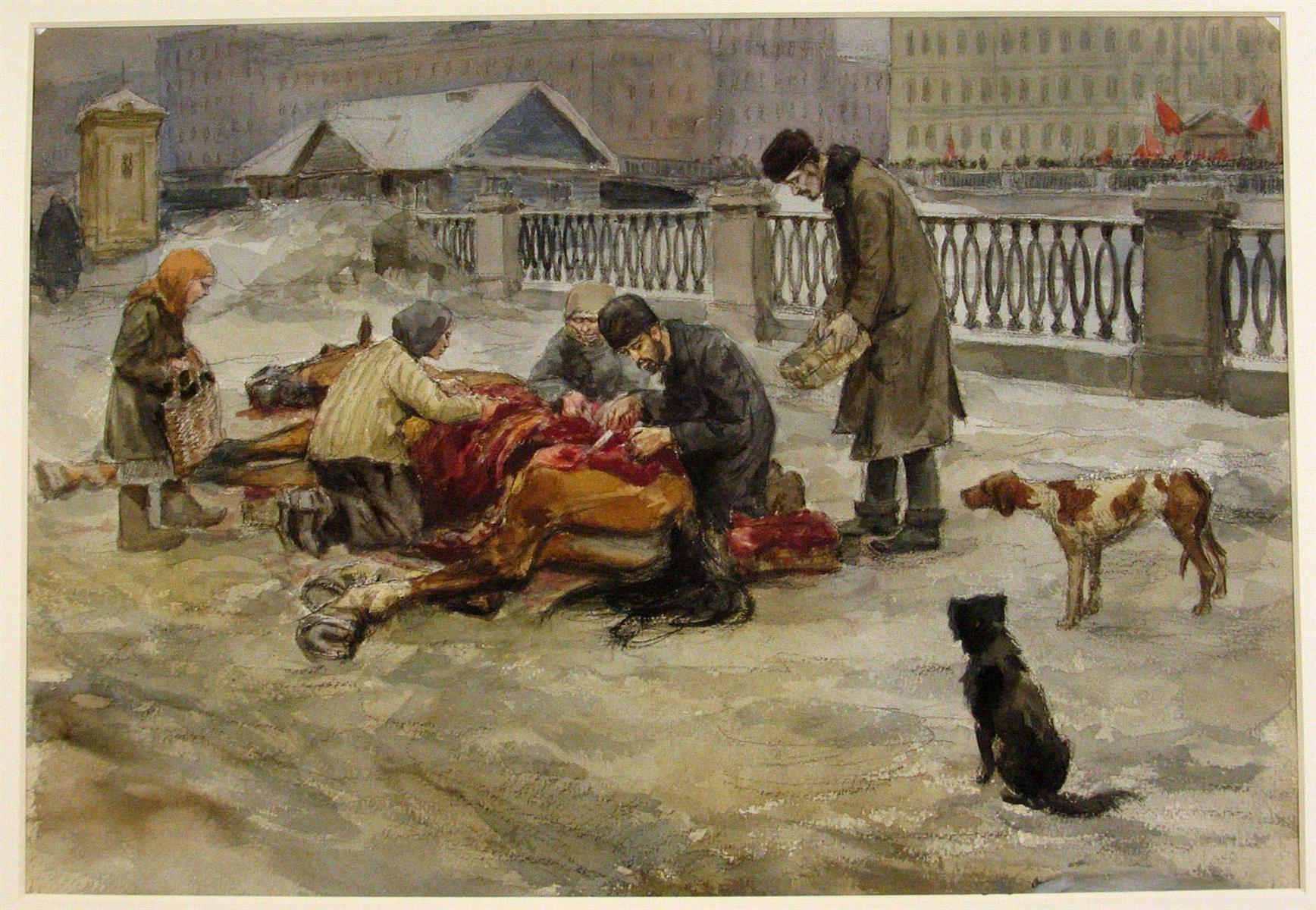
In this manner, the Commune of Petrograd is a real center, affecting all sides of the life of the working population of the city. This center directs an enormous technical system which, in turn, is divided into separate branches, sections, auxiliaries, etc.
All food products, all fodder, etc., arriving at Petrograd and addressed to the Commune of Consumption, are allotted at the moment of their storage in the depots — inventoried by the organization of distribution. They are then transferred upon special orders and according to established rations.
On the average, there pass each month, through the system of the distributing organization, one million poods of products.
Following is an approximate table of the daily distribution of products by the distributing organization of the Commune of Petrograd:
The bread is delivered daily in accordance with established rations to the amount of 15,000 poods. Next come the following products, delivered to the Communal refectories and the food stations: the vegetables which are daily distributed to the amount of 10,000 poods, the fish 4,000 poods daily, various groats almost 2,000 poods, fats distributed according to the quantity available, etc.
Bread is distributed to the population according to the ration calculated for two days. The products are delivered to the communal refectories and the institutions twice monthly, according to the established rations of consumption.
II. COMMUNAL PROVISIONING
Immediately after the first realization of the principles of the October Revolution, energetic measures were taken for the solution of the problem of the socialization of popular provisioning at Petrograd. This problem each month acquired an increasingly greater importance, in view of the food crisis, which became steadily worse.
Under the pressure of circumstances, the solution of this problem proceeded so speedily that as early as the 1st of July, 1919, the working population of the Commune of Petrograd, more than a million in number, commenced to be fed by a single food commune. The infantile population had been, for more than a month, fed altogether without cost.
The advantage of communal provisioning, compared to individual provisioning in the home, are so evident as regards the economy of fuel effected in this fashion, the economy of products and of labor, and thus the diminution of the price of foods, that from the first moment of the appearance of the food crisis, communal food organization began to arise as if created by the forces of nature.
Towards the beginning of the month of December, 1918, the number of refectories under the jurisdiction of the Central Section of Communal Provisioning of the Commissariat of Provisions of the Commune of Petrograd, reached fifty-seven, the general number of consumers was about 108,578, and that of the personnel was about 4,011.
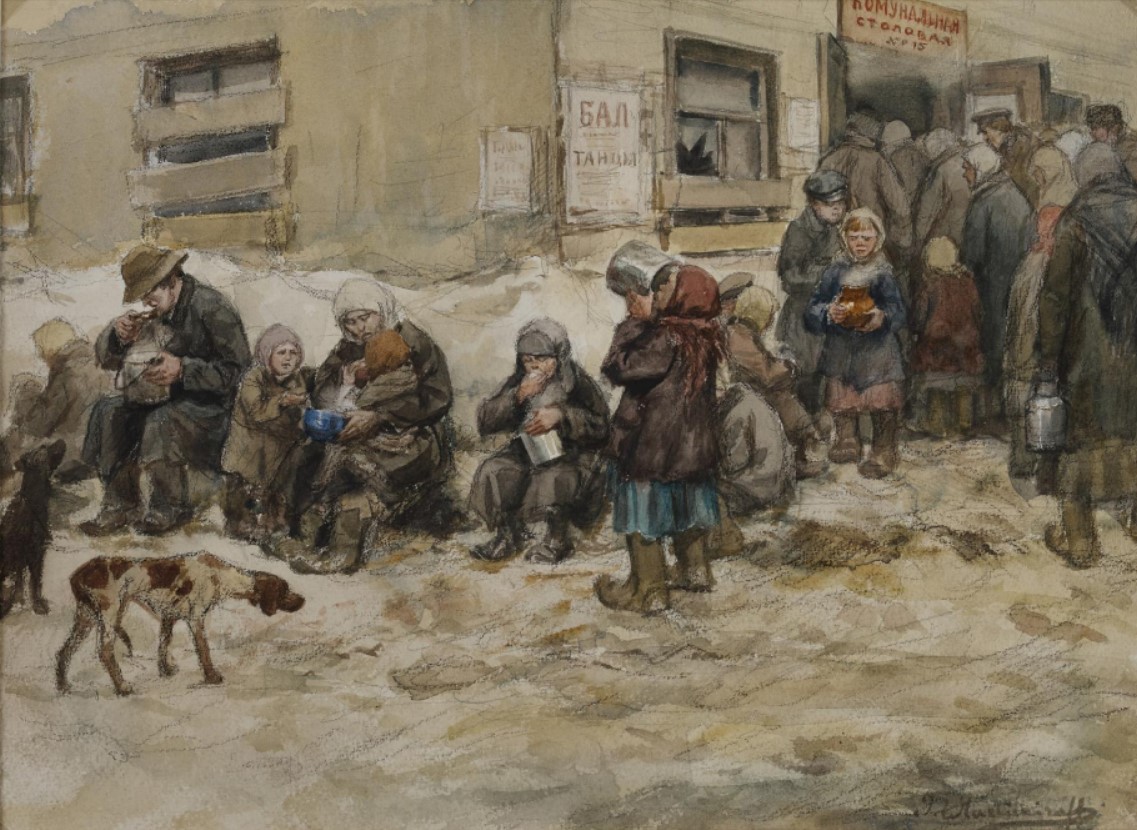
Towards the end of the year 1918, the refectories in question numbered sixty-two, with 120,133 consumers.
Parallel to the refectories dependent upon the center, communal refectories of another type were operating, such as the section refectories and the refectories near various institutions. In all, in the beginning of the year 1919, 281 refectories of different types were operating with 269,234 consumers.
In view of the continuation of the critical state of provisioning, the number of consumers in the communal refectories naturally increased a great deal. Considering this circumstance, the Commissariat of Provisioning took energetic measures for the proper operation of communal provisioning. The Commissariat attracted to an active participation in this work, on the basis of autonomy, principally the workers of the union of popular provisioning, the workers of the syndicates of employes of provisioning, the organizers of factories and shops, and the workers taken from the large masses of proletarian workers.
Thanks to these measures, an increase in the number of refectories and consumers was observed in the first half of the year 1919.
In the month of January of the same year, the central refectories alone reached the number of sixty-eight, with 154,700 consumers. In the month of February, the number of refectories remained the same, the number of consumers was about 150,111, and in the month of March about 160,687.
Parallel to the central refectories, there arose spontaneously in different quarters of the city, various organizations for communal provisioning, of lesser size. These organizations were under the jurisdiction of the Provisioning Committees of the districts and were calculated for a special number of consumers united by the place of their service, their work, or their occupations. The organizations mentioned served a relatively limited number of consumers who had attached themselves to them.
In the month of September, there were twelve great sectional refectories with 1,000 consumers and over, but less than 2,000. In the month of October there were twelve, and in December, fifteen. During the course of the year 1919, the general number of consumers in the sectional refectories continued to increase greatly.
Simultaneously with the sectional refectories a great number of refectories operated, which were closed to general consumption, as well as provisioning stations near institutions, as hospitals, asylums, prisons, refuges, schools, etc., where the provisioning proceeded by lists. All these stations reached in the month of August, 1919, the number of 550.
If one calculates the number of refectories of all kinds which operated at the moment when the whole population of Petrograd began to receive communal provisioning, one arrives at the important number of 679 refectories with 480,423 consumers.
This reform, realized the 1st of July, was effected very rapidly and energetically, despite the enormous difficulties encountered in the course of this realization, because of the necessity of promptly increasing the capacity of the refectories to meet the increased needs.

From the moment of this reform, the need naturally arose to concentrate the number of consumers in separate refectories with the purpose of encouraging products and fuel. This resulted in a subsequent increase in the number of central refectories among which arose several refectories of another type, and, at the same time, this led to a great increase in the number of consumers.
Thus, for example, in the month of July, the central refectories increased in number thirty per cent from 157 to 204, the number of consumers increased more than 100 per cent from about 340,657 to 695,852.
In the month of July, 1919, in keeping with the introduction of communal provisioning for the whole population, a very marked increase was observed in the number of consumers receiving provisions by card. The number of consumers rose to 825,363. In this manner almost the whole population of Petrograd was fed by the food commune and of ten persons an average of two children were fed without cost.
Simultaneously, a concentration of the food stations was effected, by the increase in the capacity of the best-provided refectories and the decrease in the number of the refectories having few consumers.
These results were attained in the course of but one year, and under conditions very unfavorable to the development of communal provisioning; these conditions became especially difficult in the month of July, at the very moment of the realization of communal provisioning for the whole population.
III. FEEDING OF CHILDREN
Solicitude for the children is always one of the principal problems of the Soviet power, and it marked with red ink all the enterprises of the latter. Free feeding of children, realized from the beginning of the month of May, 1919, represents one of the gigantic historic events which mark the world progress of the general unique proletarian commune.
The decree for free infant feeding, promulgated on the 17th of May of last year, declared that all food products distributed to children by the local food organs, with the exception of the food shops, as well as the public refectories, must thereafter be furnished free, at the cost of the State.

All the feeding organs were to distribute food products primarily to children. The right to free food was granted to all children, independently of the class ration received by their parents.
The right to infantile feeding was established primarily for infants, it was then extended to children under fourteen years, and later to all children to the age of fifteen years inclusive.
This right proclaimed also one of the most important principles of the new life: all children are children of the Socialist state. The importance and the historic role in the work of the organization of the Soviet Republic, of the decree regarding infant feeding, obliging the Section of Feeding of the Commissariat of Provisioning of Petrograd to take all effective measures tor its realization, — are evident.
For all that has just been mentioned, the Council of Direction of the Commissariat of Provisioning of Petrograd issued a detailed order for the distribution of dinners to children, anticipating a whole series of prescriptions concerning the hygienic phase of the preparation of the dinners, the possible variety in the preparation of the dishes, and the general attitude to be taken towards the children.
In practice, the realization of the decree for free feeding of children in Petrograd was brought about very rapidly. Towards the 16th of June, that is, no less than one month after the promulgation of the decree, eighty per cent of all the children from one to three years of age enjoyed free feeding in the communal refectories. It is almost exclusively women who direct the children’s refectories; they bring to this work much gentleness and cordiality; the refectories are often decorated with flowers and greens, and are distinguished by perfect order. In the course of these few months, the children have become accustomed to their refectories, they love them, and to frequent them has become for them a necessity. The work of infantile feeding in the institutions is not limited to the distribution to the children by the Sectional Communal Feeding of food products according to established rations: a bond is established with the Commissariats of Public Assistance and of Public Instruction. This bond had a very special importance in the summer for the organization of infant colonies, playgrounds, and excursion stations for children. The representatives of the institutions participate in the meetings of the communes: the preliminary lists of distribution and the menus are sent to them; for the control of the products dispensed, special persons are sent by the Section, etc.
IV. DETACHMENTS OF PROPAGANDA FOR FEEDING, ORGANIZED BY THE COMMUNE OF PETROGRAD
In the motion of July, 1918, the Petrograd Soviet resolved to form among the workers of Petrograd detachments to list and secure the results of the harvest. A difficult task then fell to the Soviet power. The state of provisioning in Petrograd became disastrous. Several times telegrams were sent to the places of harvest, in the name of tie* Executive Committee of the Petrograd Soviet, with a prayer to increase to the maximum the shipments of food products for the famished northern center. But that was unavailing. A certain measure had to be taken, very simple, but effective, a measure of internal organization of the masses. This measure was the creation of detachments of conscious workers of Petrograd who went to the villages of the Red north to inventory and distribute in a just manner the small amount of food products to be found in the Northern provinces, as well as the little excess which might be found in separate places. In the month of August, these detachments, under the general direction of their creator, Comrade Badaiev, set out for the provinces, dividing themselves into organized groups, assigned to various provinces, districts, cantons, villages, communes, and hamlets. The workers of Petrograd were for the most part communists. There has been described before the enormous work of organization of the party, the work of construction and cultivation which fell to the workers of Petrograd, and which was, for the greater part, accomplished by them. Committees of the poor were created in the provinces by hundreds and thousands. It was the period when, by the iron will of the revolution, division of the peasant class took place in the north, separating it into two groups: that of the poor peasants, and that of the well-to-do peasants. History decided that an important part of this work should fall to the workers’ detachments of Petrograd, sent to list and secure the results of the harvest.
In the late autumn, after the harvesting in all the provinces of the north, in the districts, the cantons, the communes and villages, and after tens of thousands of pages of investigation were collected with exact figures, then only did the chiefs of the detachments of the cantons, the districts and provinces permit their detachments to return to Petrograd.
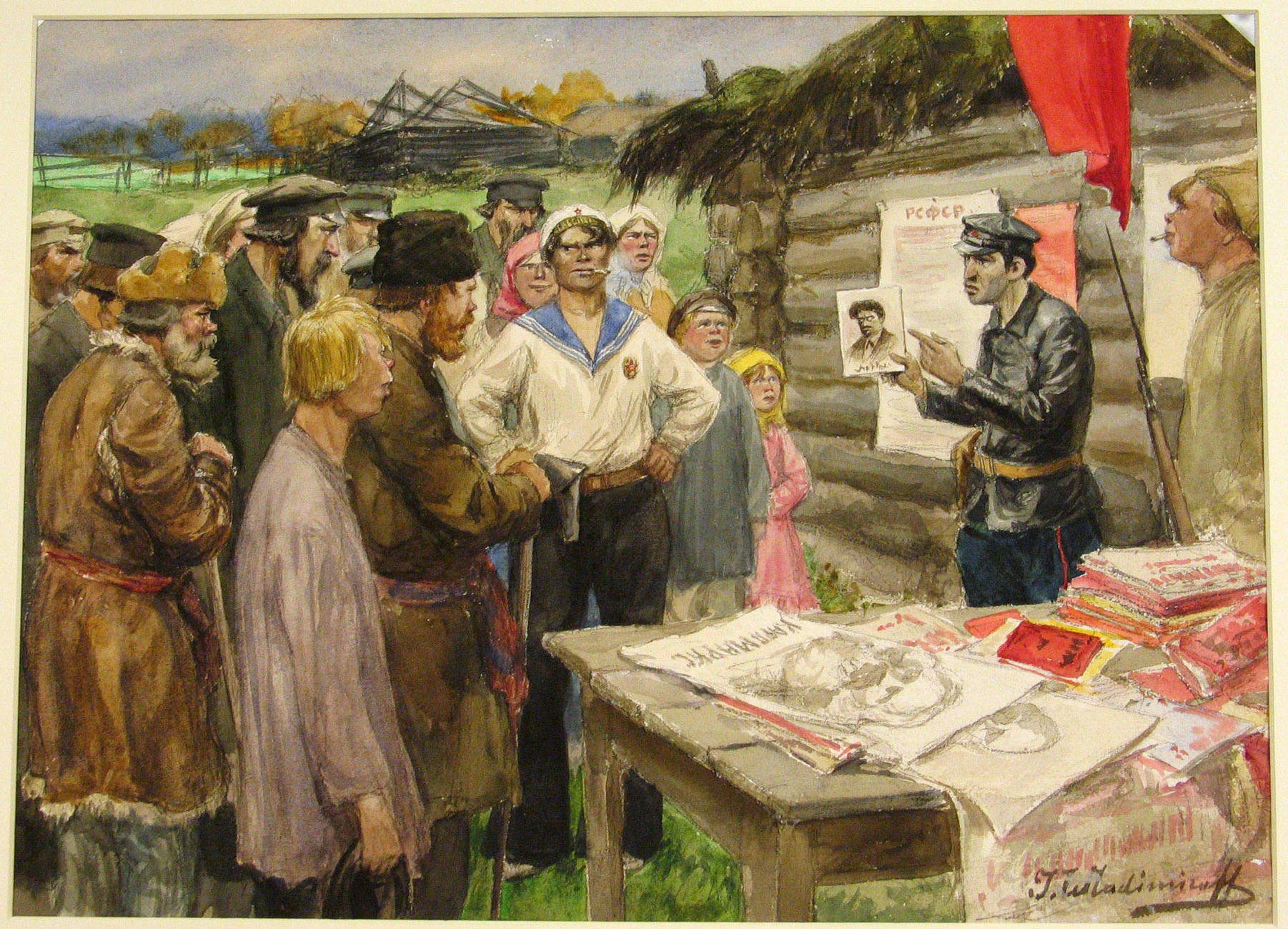
Those who took part in this campaign without precedent in the whole world, in its conception and its revolutionary character, assembled at Red Petrograd with their materials, their figures relating to their work, with interesting reports, a great acquired experience and revolutionary impressions.
The inventory of the crops and the realization of the harvests were accomplished, and, incidentally, the organization of the masses of the Red North was effected.
The surplus found in separate districts was sent to the places harassed by famine.
The reserves which could be divided between the cantons and villages, were distributed in small quantities, but with perfect equity.
The different committees of provisioning began to operate more spiritedly and energetically.
Then these detachments under their organizer, Comrade Badaiev, set out for the provinces of Viatka, Ufa and others. From the province of Yiatka alone there were exported, according to the report of the Commissariat of Provisioning, as many as 8,000,000 poods of wheat.
A considerable quantity of wheat was exported from the government of Ufa, etc.
Here the detachments, called Detachments of Propaganda for Provisioning worked not only to make an inventory of the crops, but principally to prepare reserves of grain.
In the spring of the year 1919, the detachments, after their stay at Petrograd, with renewed spirit, and reinforced by hundreds of fresh communists, were sent to work some in the Ukraine, some in the Don district. After a slight interruption in their work caused by the retreat of the Red troops, the detachments of provisioning propaganda of Petrograd were sent again to the provinces of Ufa, Viatka, Samara, Saratov, and to Siberia.
These detachments were again reinforced at Petrograd before being sent to solve new problems of provisioning. After the arrival at the places, as before, these detachments have their provincial general staffs supported by chiefs of districts, cantons and villages. They are scattered through every province, and, as before, there is going on without interruption, a work of organization and reserve of the grain supply.
Soviet Russia began in the summer of 1919, published by the Bureau of Information of Soviet Russia and replaced The Weekly Bulletin of the Bureau of Information of Soviet Russia. In lieu of an Embassy the Russian Soviet Government Bureau was the official voice of the Soviets in the US. Soviet Russia was published as the official organ of the RSGB until February 1922 when Soviet Russia became to the official organ of The Friends of Soviet Russia, becoming Soviet Russia Pictorial in 1923. There is no better US-published source for information on the Soviet state at this time, and includes official statements, articles by prominent Bolsheviks, data on the Soviet economy, weekly reports on the wars for survival the Soviets were engaged in, as well as efforts to in the US to lift the blockade and begin trade with the emerging Soviet Union.
PDF of full issue: https://www.marxists.org/history/usa/pubs/srp/v3n03-jul-17-1920-soviet-russia.pdf
 Revolution's Newsstand