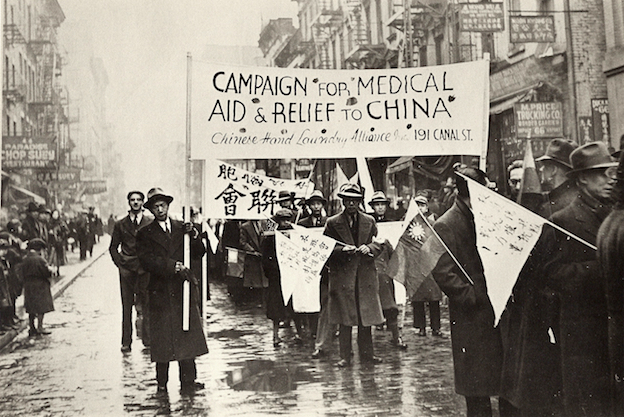
The Communist Party responds to a surge of activism among Chinese workers in the early 1930s responding both to the events in China and the Depression here in the United States. The Chinese Hand Laundry Alliance, formed in 19933, would grow out of the struggles waged here.
‘Chinese Workers’ Struggle in California’ by T.H. Li from The Daily Worker. Vol. 8 No. 99. April 24, 1931.
ON the 13th of April, about 300 Chinese laundry workers in San Francisco went on strike precipitated by the attempts of the Tung Ching Tong (employers association) introducing wage cuts and dismissing union workers replaced by cheap unorganized labor. The strike was decided and demands formulated by a general shop delegates meeting. Also a strike committee of 70 was elected to prepare the strike about two weeks ago. The strikers are very militant and enthusiastic. The strike is developing and will embrace the city of Oakland and the neighboring territories.
The Unemployment Demonstration.
Prior to this strike, the unemployed Chinese workers there have been carrying on an active struggle for immediate relief. A Club of Chinese Unemployed Workers, affiliated to the Unemployment Council of the T.U.U.L. was organized.
Beside participating in the general unemployment struggles, they put forward special demands before the Chinese Six Companies, the “Civil Government in Chinatown,” and composed mostly of leading merchants. They demand: (1) establishment of relief stations of food and shelter and free employment agencies at the expenses of the Six Companies and a special appropriation of $1,500,000 from the city funds, managed by the workers; (2) free medical services for the unemployed by the Tung Hwa Hospital; (3) free school for the children of the unemployed by the Chinese Schools. A huge demonstration was staged before the Six Companies on March 28 and on April 3 with the presentation of these demands. The struggle is going on and developing.
Significance of These Struggles.
Under the present conditions, these struggles, though on n small scale, are of great significance and instructive in the general struggles of American working class. Its significance lies in the facts:
1. That the unemployment demonstrations like a very militant form for particular concrete local demands by a small isolated section of the working class.
2. That the strike takes place in spite of unemployment situation. It repudiates the opportunist theory of impossibility of strike struggles in the period of severe unemployment.
3. That the strike takes an offensive character; the demands of reduction of working hours from 15 to 12, Sunday off, for raising wages of apprentices from $150 to $180 for five months, for accident insurance, etc.
4. That these struggles also take place in the present intensive persecutions against foreign born workers particularly the Chinese workers by the boss government. Thus, these struggles clearly refute the dangerous assumption that at present time it is very hard to develop struggles among the foreign born workers.
5. That the strike and unemployment struggles, taking place simultaneously, demonstrate the possibility and necessity of linking up the struggles of the unemployed and the employed.
6. Lastly that taking the consideration of the fact that the T.U.U.L. begins to play a considerable part in leading the struggles, and also taking place amidst strike struggles of the Philipino, Mexican and Japanese workers in California, these struggles will greatly help break down the isolation of the Chinese workers from the general life and struggles of the American working class, and organize all workers for a common struggle.
Increasing Attacks of the Employers.
The Chinese employers, closely cooperating with the imperialist government, are using every means of intimidation and terror to break these struggles of the workers. Not only the powerful instrument of immigration laws, but also the family Tongs, the fighting Tongs, district organizations (clannish) and all other forces of semi-feudalist and capitalist reaction will be employed against the struggling workers. About a hundred police were mobilized during the unemployment demonstrations. Deportations against the leader of the delegation were planned. Now four of our strike leaders are arrested already.
Reformists, Enemy of All Workers.
The Chinese employers also find very active agents, the “Left” wingers of the Kuomintang in the states. Just as their leaders in China are systematically selling the interests of workers in the yellow unions, the followers of the “Left” wingers or the “Reorganizationists,” are in the forefront to break the struggles of the Chinese workers here. Their organs, the Chinese Nationalist Daily both in San Francisco and in New York, are the first ones to attack any form of struggle of workers. (On the protection of foreign born meetings of Chinese workers in N.Y., the unemployment demonstrations and the present strike in San Francisco, etc.) But, in spite of the terrors and threats of the Chinese employers, the imperialist government, and the Chinese reformists, the Chinese workers have struck and will continue, with the help of all workers, to carry on the fight to the very end.
Our Tasks.
The T.U.U.L. and the militant workers in California must pay special attention to these struggles. They must give daily detailed guidance and assistance to the strike. They must coordinate the strike with the unemployment struggle. The mobilization of American workers, especially the Japanese, Phlliplno and Negro workers to the help of the laundry workers is an important condition for the developing, broadening and maintaining the strike. Strengthening the leadership of the Si Fu Tong (the Association of Chinese Laundry Workers) by drawing in capable and active rank and file workers is also urgent.
The revolutionary Chinese workers in other sections of the country must rally to help the strike. Connecting up with the local problems, these struggles can be stimulus to develop local struggles of the unemployed and employed Chinese workers.
The Daily Worker began in 1924 and was published in New York City by the Communist Party US and its predecessor organizations. Among the most long-lasting and important left publications in US history, it had a circulation of 35,000 at its peak. The Daily Worker came from The Ohio Socialist, published by the Left Wing-dominated Socialist Party of Ohio in Cleveland from 1917 to November 1919, when it became became The Toiler, paper of the Communist Labor Party. In December 1921 the above-ground Workers Party of America merged the Toiler with the paper Workers Council to found The Worker, which became The Daily Worker beginning January 13, 1924. National and City (New York and environs) editions exist
PDF of full issue: https://www.marxists.org/history/usa/pubs/dailyworker/1931/v08-n099-NY-apr-24-1931-DW-LOC.pdf
 Revolution's Newsstand