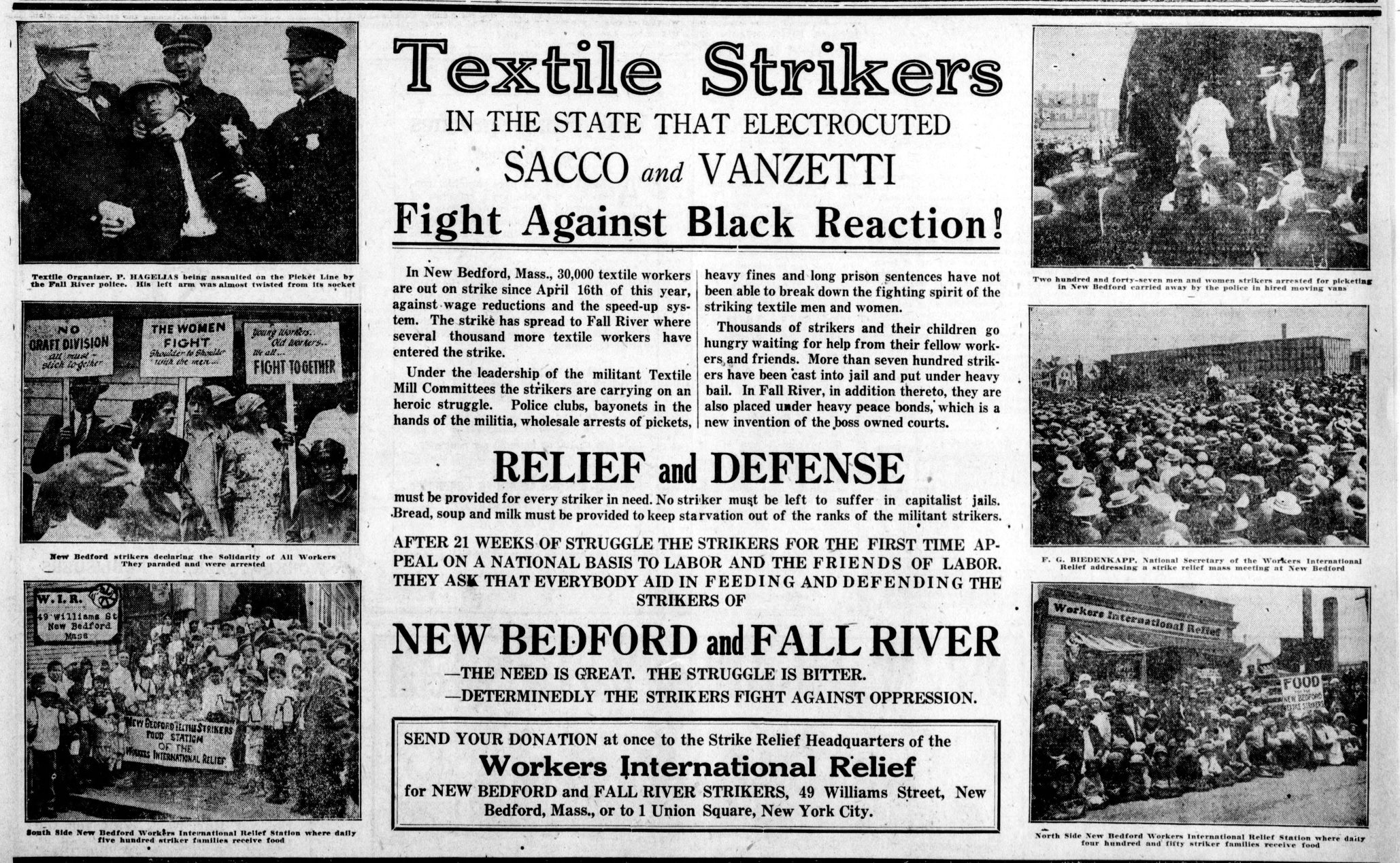
A fantastically detailed blow-by-blow analysis of the militant 1928 Fall River, Massachusetts mill strike, often overlooked by the larger and longer struggle in nearby New Bedford, from leading C.P. textile organizer Albert Weisbord.
‘The Fall River Strike’ by Albert Weisbord from Labor Unity. Vol. 2 No. 8. September, 1928.
THE Fall River textile strike is one of the boldest and most remarkable achievements in the history of the left wing. The vicious brutality of the police and the tremendous barrage laid down against the workers come mainly from the terrible fear of the employers that the left wing would be successful.
Let us consider the facts. Last February the workers in Fall River received a ten percent wage cut. This was the opening of the employers drive to cut wages generally. For obvious reasons they began their drive in the cotton section of the industry located in the southern part of Massachusetts, the centers being Fall River and New Bedford: Fall River was a better place then New Bedford to begin the drive for the following reasons:

1. Unemployment was much greater in Fall River than in New Bedford.
2. The employers could with more plausibility in Fall River than in New Bedford plead competition “from the South,” since many of the mills produced coarse cotton goods also made in the South.
3. The composition of the working class was of a very backward character, the French Canadians with their complete lack of traditions of struggle being in the majority here, whereas they are only in the minority in New Bedford.
4. For tens of years in Fall River the Mill owners had ruled with an absolute iron hand.
(a) The police chief was not controlled by the Mayor as in New Bedford and therefore was not susceptible to local opinion, but was directly appointed by the State, by Governor Fuller.
(b) There had been no general strike in Fall River since 1904.
(c) No meetings of a liberal character, nor even of the Socialist Party had ever been permitted in Fall River even during the Presidential election campaigns.
(d) Even the American Federation of Labor officials were hounded. The Central Labor Union was found complaining of police interference. The hostility of the employers to the U.T.W., the A.F.L. union, was due to the fact that the skilled workers were in an “independent” union, the A.F.T.O. (American Federation of Textile Operatives) which was completely in the hands of the mill, owners.

Mr. Tansey, the President of the A.F.T.O. while serving as union president, had been at the time a police official (for eight years). The A.F.T.O. thus was a police union. Under these circumstances, the United Textile Workers found itself the “outside” union. It came too late to serve. The bosses had no use for it. So in order to gain recruits the U.T.W. organizer had to put on a militant front, making “demands” on the bosses, “talking” strike, etc. Still the membership of the A.F.L. was small, the workers generally not trusting Campos, the organizer.
This then, was the strategy of the employers. However, when the wage cut was announced so great was the indignation of the masses, that even the skilled workers of the A.F.T.O. clamored for a strike vote. The officials were forced to take the vote. Then they “counted” the vote and found it “just” 11 votes shy of the “necessary” 2/3 votes. At the same time the U.T.W. organiser, Campos, kept on “talking” but did nothing. Thus the workers were betrayed and the wage cut drive was temporarily successful.
The plans of the employers had been acute and well executed. Having succeeded in Fall River, the employers then extended the drive to New Bedford. Everything was well oiled to sell out the workers in New Bedford also, especially as the workers saw their defeat in Fall River. Then along came the left wing, the Textile Mills Committees and spoiled the plans.
The left wing, in carrying on the New Bedford struggle determined to enter Fall River as well and carrying the fight right on to the bosses ‘territory, make up for the betrayal of the workers by the A.F.T.O. and U.T.W. officials in April.
The Left Wing analysed the situation as follows:
1. The textile industry generally was ripe for action and particularly after what happened, Fall River especially was ripe. To organise Fall River with its real and reputed obstacles, would be a most encouraging demonstration.

2. After the sell out by the A.F.T.O. and U.T.W. officials, the workers would enthusiastically hail the T.M.C. The T.M.C. would have no competition. From the very beginning it would take the leadership in the struggle and break the back of the A.F.T.O. misleadership.
3. The best way to win the New Bedford strike would be an extension of the strike to Fall River.
(a) At least 10 mills in Fall River were producing fine goods and scabbing on the New Bedford workers.
(b) The fight in New Bedford would be long and bitter. The extension would raise the morale of the workers and greatly aid in bringing the employers to terms.
(c) A strike under the leadership of the T.M.C. in Fall River would definitely break the back of the A.F.T.O. and U.T.O. in New Bedford, liquidate that organisation and definitely put the T.M.C. in New Bedford in complete control.
4. The best time to hit Fall River was the present when the workers were aroused over wage cuts, when they saw the battle in New Bedford and understood most clearly the role of the left wing.
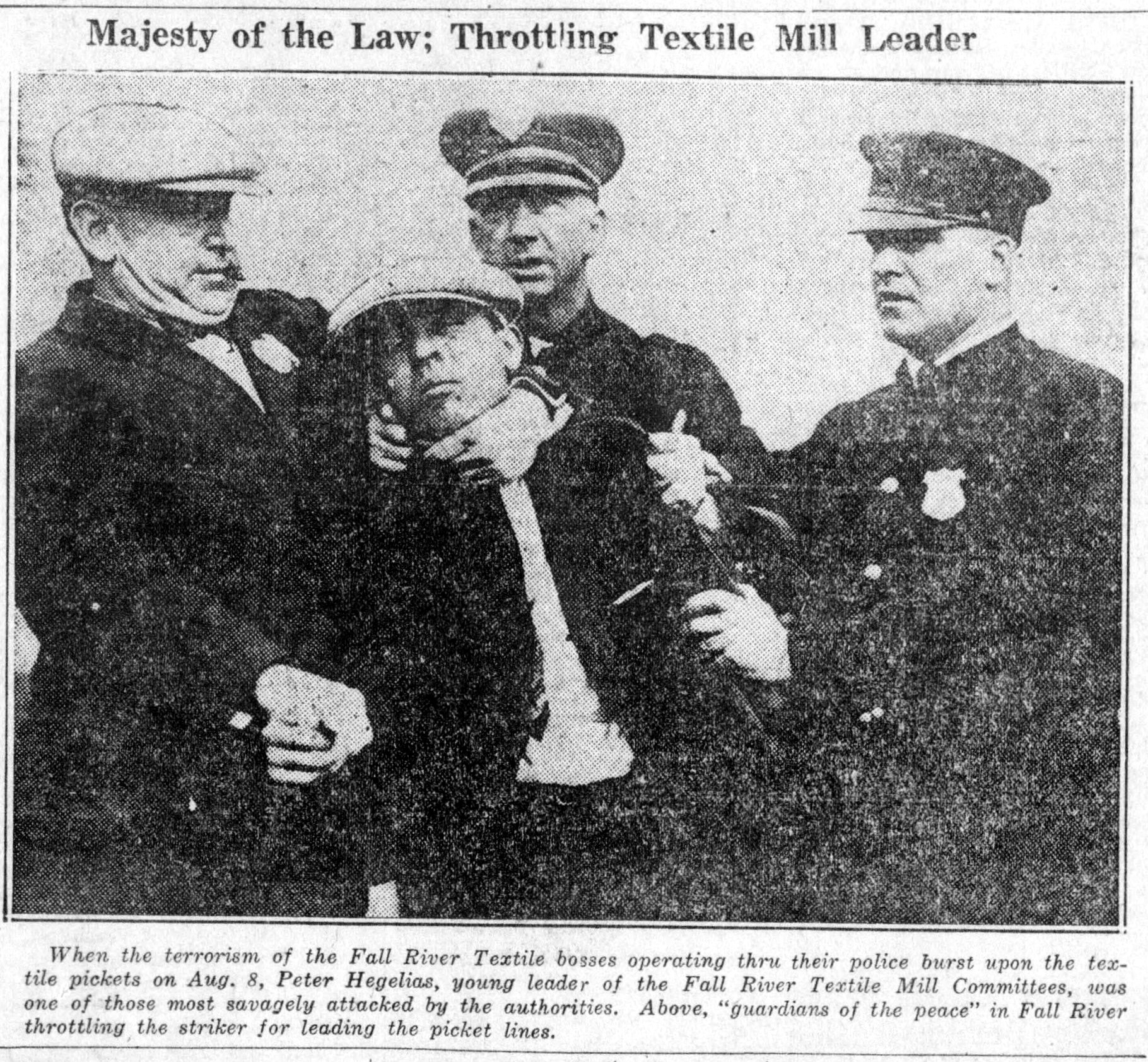
Following this logic, as soon as possible the national office of the T.M.C. sent in organisers James P. Reid, Peter Hegelias, Samuel Weisman, and Bill Sroka and later others to take up organisation work.
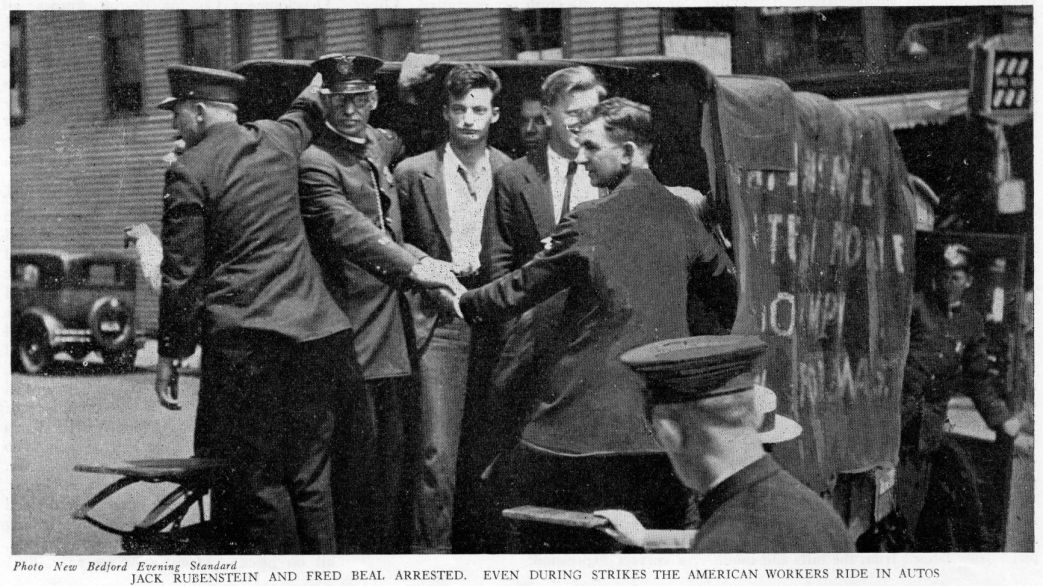
From the very beginning the work took on a heroic character. The police constantly hounded our organisers. Every hall and lot owner was visited by the police and threatened that they would be driven out of the city if they gave any place to the T.M.C. to meet. Finally after hard work a lot was obtained. And this was done only by the workers themselves chipping in and actually purchasing the property for the purpose of holding meetings. When the lot was opened and meetings carried on, tremendous enthusiasm broke out among the workers most affected. In a city where there had never been any meetings whatever, thousands came to meetings of their own. For the first time the workers could express and articulate their interests which had been suppressed for so many years. Hundreds joined the T.M.C.
Young and old alike are arrested for picketing in mill strikes.
The mill owners looked upon our advance with the greatest apprehension. If anything the police tightened up their vigil. Although we had broken through in one quarter of the city, there were three other places in the city that had to be penetrated. And before the T.M.C. could get a place in each one of the other sections of the city, the same hardships had to be undergone. At every opportunity the police tried to break up the union. At one time the police arrested the organisers for stepping on private land. Another time the police forced through the doors of a private tenement rented by the T.M.C. and tried to break up the meetings. However nothing availed. In section after section the police terror was definitely broken and meeting places obtained.
Workers Make Demands
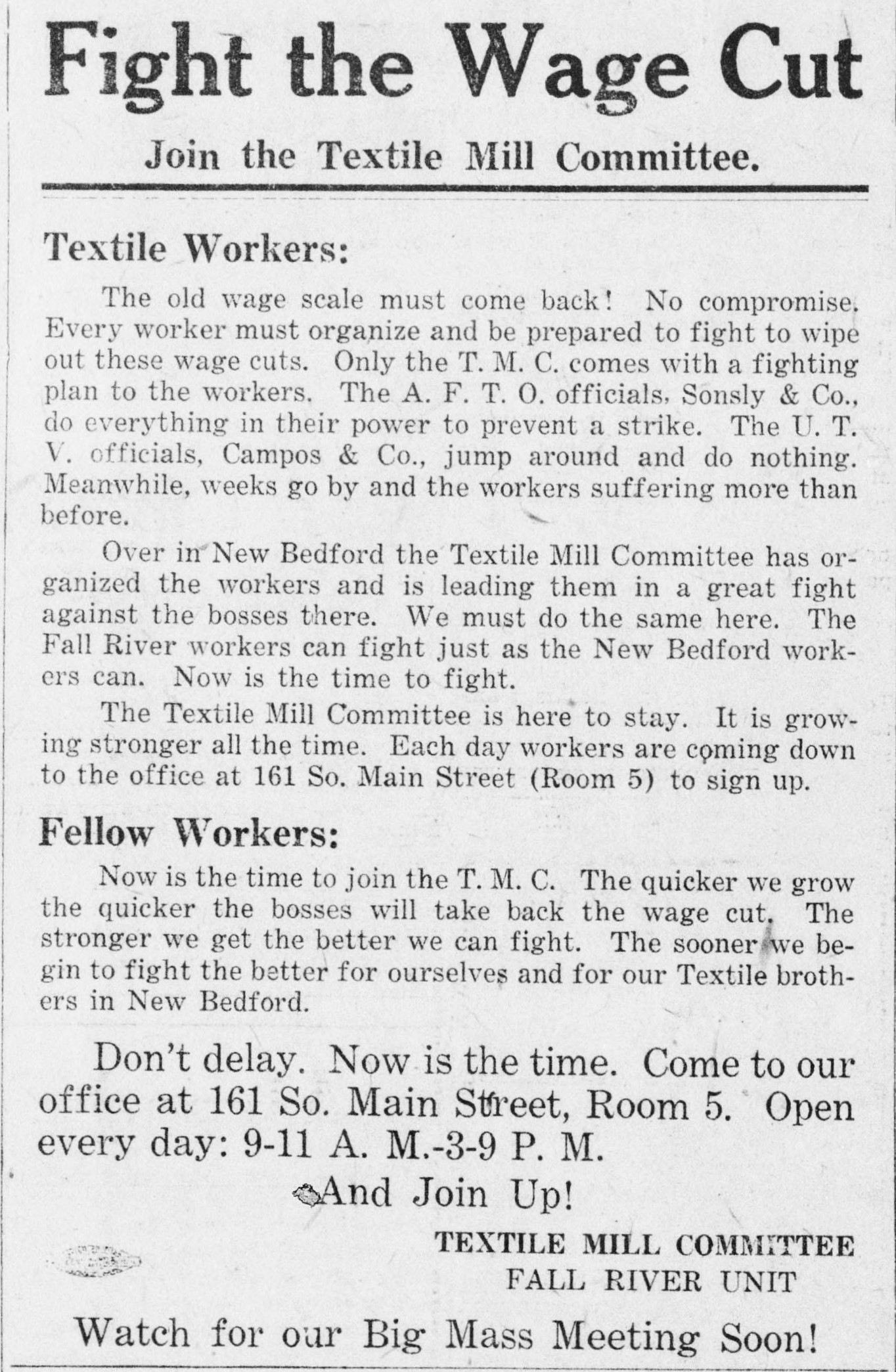
From the very beginning the T.M.C. organisers stated that they were in the city to organise the workers for struggle against the wage cuts, for a real workers union, and for the support of the New Bedford strikers. The demands of the T.M.C. in New Bedford were made the demands of the workers in Fall River. Each day brought in new recruits. Each day the workers were urged to prepare for struggle.
The employers also were preparing their ground for the fight. Their preliminary conferences were being held so that when the fight should reach the open phase the maximum pressure could be used against the workers with the maximum speed.
The Textile Mill Committee organisers concentrated on the American Print Works. This was the largest mill where the workers were most bitterly exploited and where the wage cuts had started. The workers there were most anxious to begin the fight. In a short time it seemed as though the workers were indeed ready. At a big meeting it was decided to present demands to the employers. A committee was selected to see the superintendent, Monday, August 6th and it was decided that if the demands were rejected that the strike would take place.
Came the decisive day. The committee went to see the superintendent. The committee was fired. The signal was given. And at once, in spite of the police massed at the mill, the workers in the printing division of the American Print Works in a wonderful ^demonstration poured out of the mill. Immediately efforts were made to picket the plant. At the same time some of the workers from the cotton division of the plant Representing about half the workers, started to come out also. At the same time news was received that a few of the workers in the Lincoln mill, a mill producing fine goods cloth, had walked out. Throughout the entire city there was tremendous agitation and excitement.
On The Offensive

The immediate task was the extension of the strike. To close down the cotton division of the print workers, to close down the Lincoln mill, to stimulate action in other mills, to build a huge picket line of all the workers, these were the immediate objectives which the left wing strove to carry out.
The mill owners were frantic. They were desperate. They were also very well and carefully prepared. This was the first time in the history of the textile industry that the left wing had deliberately set itself the extension of an existing strike, had deliberately gone into another city, which by its analysis it had believed to be ripe for struggle, had announced its purposes, had broken through the police terror, had set the date for the struggle, and on the time appointed, to the hour, in spite of everything the mill owners could do, had successfully called the strike. It was this more than anything else that drove the employers wild, the fact that they had lost control of the situation, that these workers who had never resisted before could now put up such an open and defiant struggle against them.
Only when one fully: appreciates the hysteria and desperation of the employers can one understand what took place. If we can say that never before did the left wing better demonstrate its boldness and correct analysis than in Fall River, we can also say that never before did the employers prepare their forces better, and throw their full power so quickly into the fray.
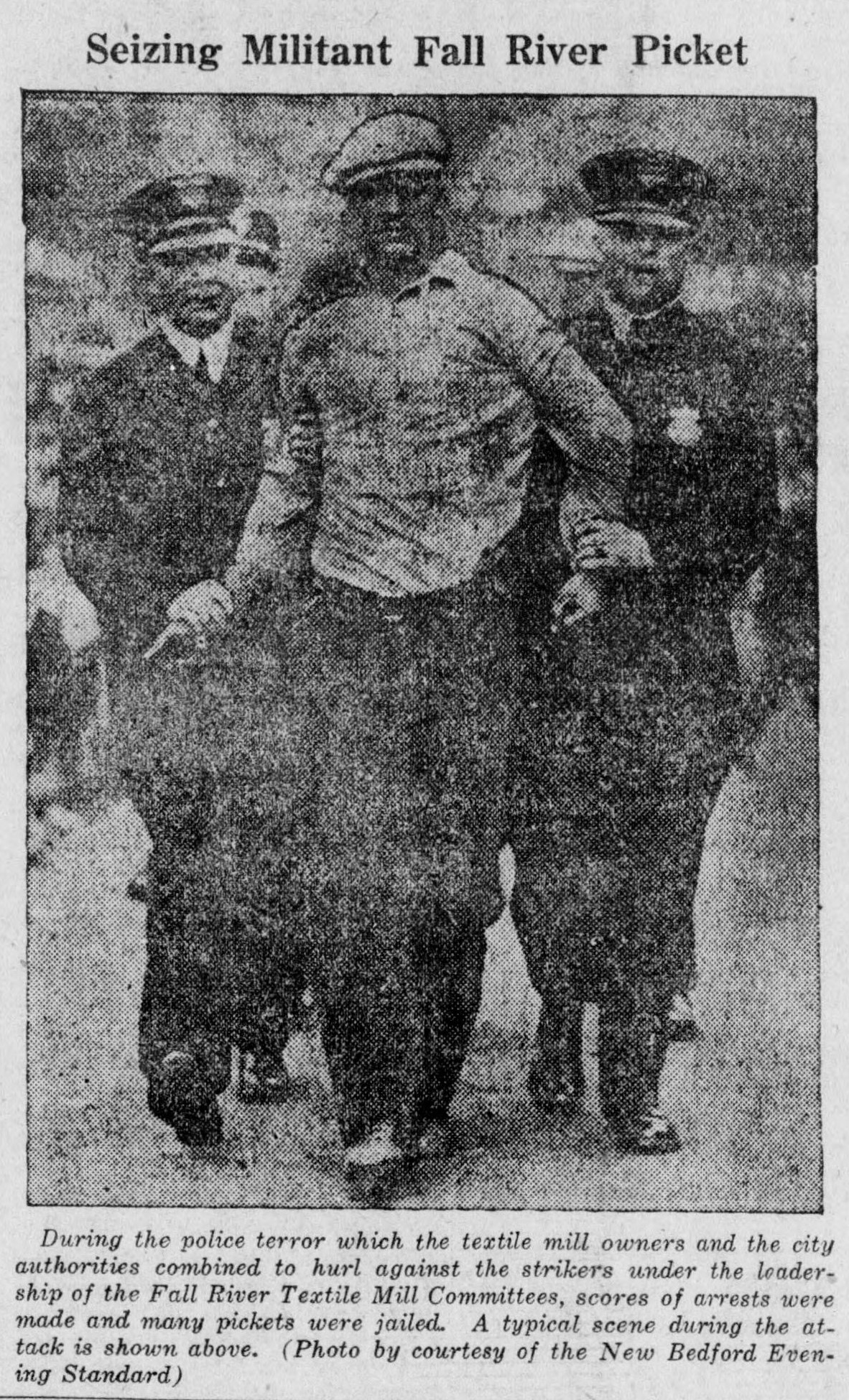
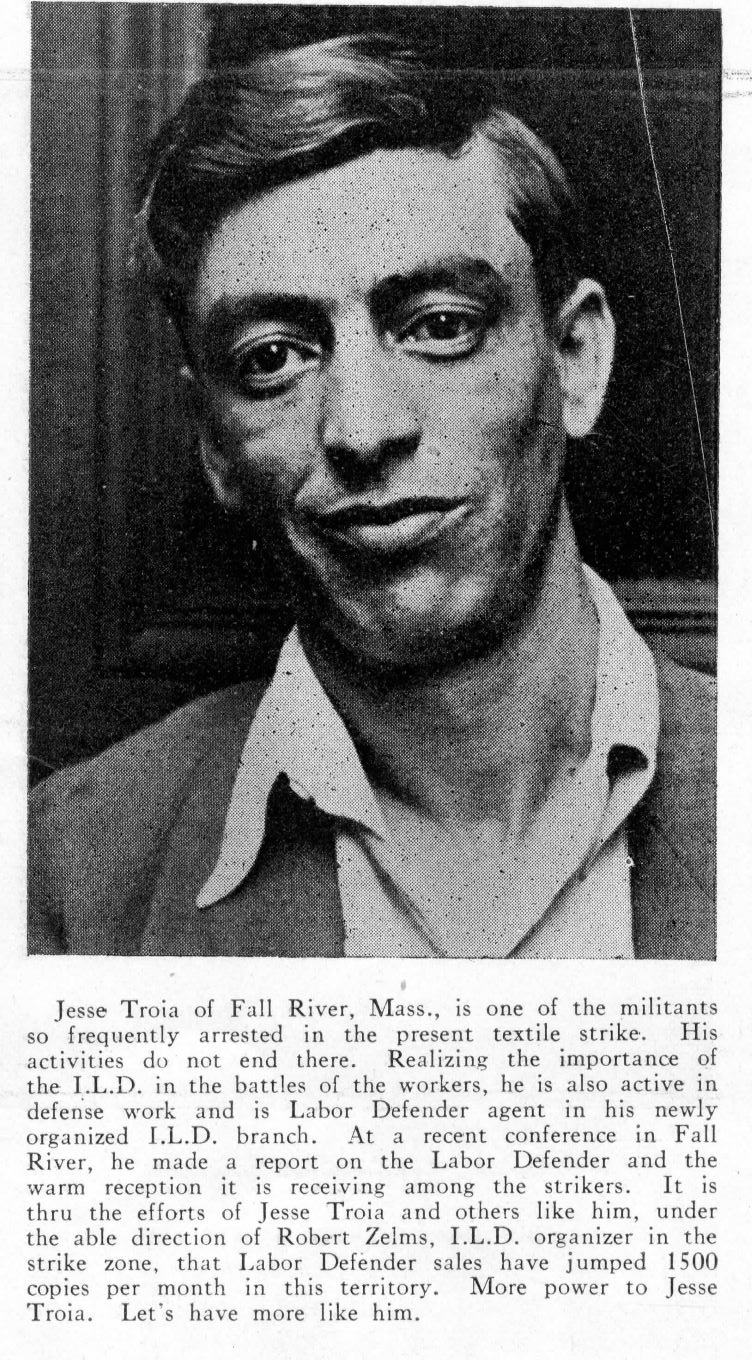
As soon as the workers were out of the printing division of the American printing works about 200 police massed outside the mill and with the greatest brutality smashed up the line. One pregnant woman was held up against the fence and squeezed until she fainted and then was sent to the hospital where she was in a critical condition. However, to the credit of the workers it should be said in spite of the unexpected fierceness of the police, they reformed their lines five time before they were finally broken up. It was only after many had been hurt and many arrested and all of the union leaders had been jailed that the workers sullenly gave up their picket line formation.
Immediate Resort To Terror
The mill owners and police well understood their business. So far only 2,000 had come out. If the left wing was to be defeated at all, if Fall River was not to be another Passaic, the police would have to crush the picket lines at the very beginning. Each moment’s delay might be fatal. It was for this reason that the entire police force of 300 men was mobilised the first day. It was for this reason that the mounted police were brought in at once. By the utmost use of the full power of the police machinery on the very first day of the strike it was hoped to crush the picket lines, and terrorise the strikers.
With the picket lines smashed the next thing was to break up the strike.
1. Wholesale arrests were made at once and over 80 strikers sent to jail and the organisers arrested again and again.
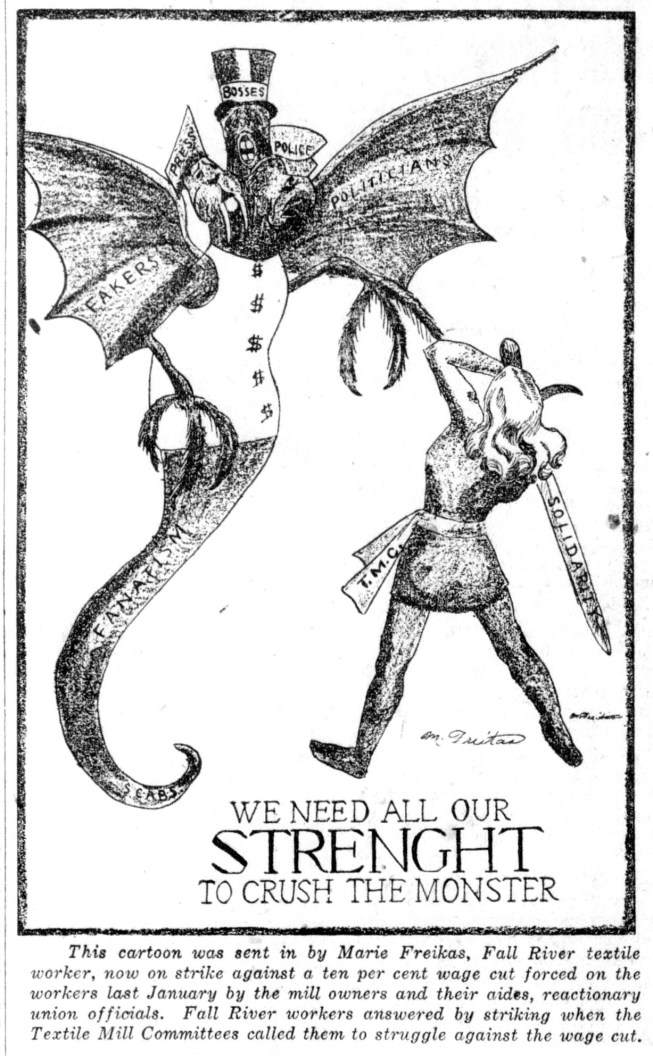
2. A veritable horde of private detectives were sent in among the strikers. These agent provocateurs did everything in their power to break up the workers 1 solidarity.
3. From the very beginning the newspapers were well prepared. Scarcely had the strikers walked out when the next hour the local Herald, a despicable filthy sheet, came out with a special editorial to the effects that the red flag of communism would j never fly in Fall River but that the whole force of the community would be thrown into the battle at once to crush the strike.
4. The American Legion at once issued a statement that it would back up the police to the limit.
5. Simultaneously with this frontal attack came the attacks from the side and from the rear. The strike was hardly on when the priests went from house to house telling the workers the T.M.C. was a blackhand union and to go back to work at once.
6. At the same time the union was told that it would have to quit its headquarters and get out immediately.
7. And to cap it all the labor fakers of the A.F. of L. and the A.F.T.O. at once rushed into the battle to break up the strike.
Official Order To Scab
On the second day of the strike Mr. Tansey of the A.F.T.O. called together a special meeting of his “executive” committee and announced that all workers must stick to their jobs, that this was the best way to help the New Bedford strikers win and that the A.F.T.O. members must scab on the job or violate union discipline. At the same time MacMahon of the U.T.W. advised the workers not to strike. Campos, the local organiser issued an open statement to the effect that if the bosses would recognise the U.T.W. he would tell the workers to go back at once. And when he finished his conference with the bosses he immediately urged the workers to. quit the strike and scab.
Never was there such a holocaust rained on the workers from all sides in such a short time as that which fell on the heroic strikers and organisers of the T.M.C. The strikers and organisers really covered themselves with glory. In spite of everything they stuck firm. Not only that but although desperately attacked they found the necessary strength to spring a surprise attack on the police and throw a picket line around a new mill, the Algonquin Printing Company employing a few hundred workers. These workers clustered around the windows, answered cheer for cheer, and the next day streamed out of the mill in a 100% effective strike.
However, with scores arrested, with all of the leaders in jail, with hundreds of police massed around the mills, with labor spies filling their ranks, faced with bitter attacks from the newspapers, from the petty bourgeoisie, from clergy, from labor bureaucrats, the workers, only 3000 strong, were very hard pressed. Especially as the mill owners soon began the maximum utilization of the unemployed, by offering them extra high wages, and bringing them in as strikebreakers. Yet the workers are still fighting hard. Very severe sentences have been handed down by the judge. All the left wing leaders will be sentenced to long terms. Extortionate bail has been exacted and threats made to have the bonds forfeited if any should get arrested again. The picket lines have been smashed. Yet the union holds.
Support Them
It is too early to state definitely all- the results of the Fall River strike. Yet it is already plain that the hold of the A.F.T.O. and the U.T.W. has been, definitely broken. The treacherous leaders of those organisations have been thoroughly exposed. They are now hated and despised by all the workers. In New Bedford, also, the honest workers see more clearly than ever the menace the U.T.W. and the A.F.T.O. leaders are to them. Secondly, the workers in Fall River have been made much harder for the struggle. We have dug in and dug in well. We shall yet break open that Massachusetts hell hole. Finally the T.M.C. and the strikers have really covered themselves with glory. When the full facts of the Fall River strike become known, this strike shall live in the annals of labor as one of the bitterest and most courageous battles fought by unorganised workers.
Workers everywhere, let us support the textile strikers to the end! Let us build a real union, a new national union, for the textile industry, which will take up the battle against wage cuts and will unite j the workers in their struggle against the employers and against the labor fakirs.
Labor Unity was the monthly journal of the Trade Union Educational League (TUEL), which sought to radically transform existing unions, and from 1929, the Trade Union Unity League which sought to challenge them with new “red unions.” The Leagues were industrial union organizations of the Communist Party of the United States (CPUSA) and the American affiliate to the Red International of Labor Unions. The TUUL was wound up with the Third Period and the beginning of the Popular Front era in 1935.
PDF of full issue: https://www.marxists.org/history/usa/pubs/labor-unity/v2n08-w27-sep-1928-TUUL-labor-unity.pdf
 Revolution's Newsstand