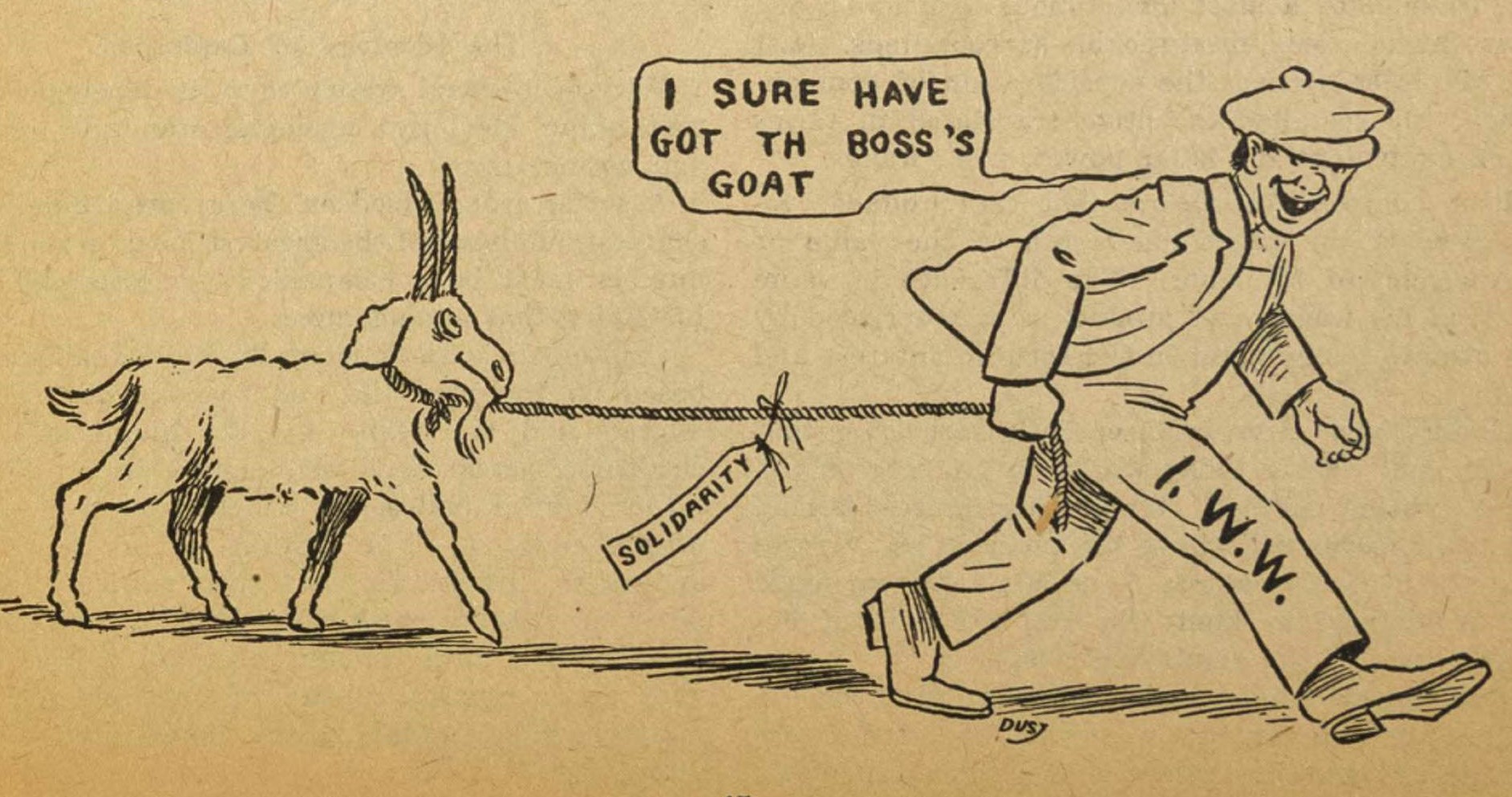
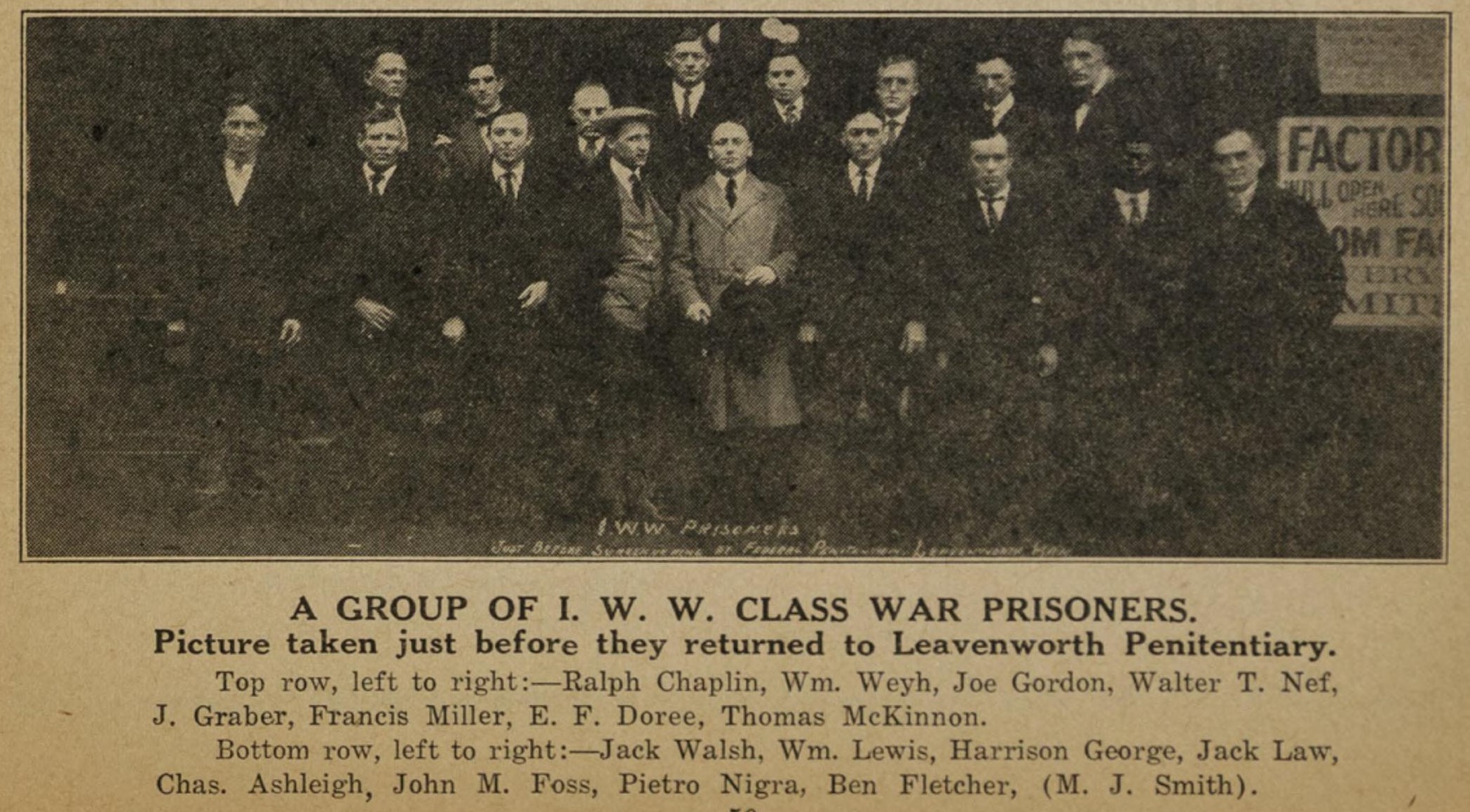
Marvelous on-the-spot notices from 1921’s 13th National I.W.W. convention held in Chicago as the organization attempted to recover from severe repression, and the imprisonment or deportation of many of its leading activists. Major disputes included the handling of the Philadelphia Marine Transport debacle and the role of defense work. Great stuff. All images from the Industrial Pioneer of 1921.
‘Scenes from a Rank-And-File Convention’ by A.S. from Industrial Pioneer. Vol. 1 No. 5. June, 1921.
ALL kinds of rumors had been filtering through the ears of the Wandering Wobbly as to what the organization had been doing in the years since he began roaming around on the Eastern side of the earth.
“Every I.W.W. is in jail,” said one report in a far away newspaper.
“The I.W.W. is smashed,” was the triumphant headline in a second paper seen in another port. Further down in the text of the article was the statement that those who were not in jail were too busy trying to get the others out to be feared. Then along came an old copy of “Solidarity,” dated May of last year, in the pocket of a sailor, telling of a series of great strikes in the Rocky Mountains, and of further I.W.W. progress in several industries.
It was all very conflicting, and the Wandering Wobbly saw that the only way to get the facts was to return to the broad land he had left several^ years ago and to find out whether the job delegates were still active in the shops, mines and forests that lie between the surges of the Atlantic and the broad swells of the Pacific.
Arriving in a Western port he ran plump into a six foot lad with a bundle of “Industrial Workers” under his arm, and five minutes later was arm in arm with a job delegate who was keeping track of all incoming sea-faring men. The delegate took him around to the local headquarters, and he saw at once that there was something wrong with those newspaper reports, at least so far as this place was concerned. Here was a scene of activity, delegates coming in with reports and going out with literature and stamps. Some were off to the lumber camps, others out to construction jobs, and still others taking armfuls of literature for use in the lodging houses that roomed the unemployed.
By this time the Wandering Wobbly had time to read the “Industrial Worker” and get the news of the General Convention about to be held in Chicago, May 9th. The stuff sounded good to him and, as he had a small stake and was independent of the employment sharks for the time being, there was nothing to it but that he should take the first train for the convention and thus get an accurate line on the organization as a whole. Things surely were humming in the movement on the Pacific coast but he wanted to see what plans were being made for gaining power in the heart of American industrialism.
Lads from Far-Away.
This is the substance of the story told to the writer by one of the visitors to Phoenix Hall, as we stacked up together against the counter of the lunch room adjacent to the Convention floor, which three Wobblies are running for the convenience of the delegates. My new fried was just one of many wanderers from different parts of the world who had come on cushions or by pick ups to get the lay of the land in the organization. It is typical of the I.W.W. that its rank and file have to see things for themselves. Sitting aside the writer at the table where we take notes, is a young fellow from Australia where the I.W.W. has been the rejuvenating force in the labor movement. He has just roughed it from New York, in three weeks of the hardest kind of traveling, to get a first hand report to forward to his fellow workers in the Antipodes. It did one’s heart good to see his eyes brighten from day to day as the convention proceeded, and now he tells me that he is going on west to the harvest fields, the metal mines and the forests, where he can see the members functioning right on the jobs from which these delegates have come.

And right from their jobs at the posts of industry they have all come, except those who had temporarily lost their jobs in the unemployment shuffle. The men who draw their livelihood direct from industry make all decisions in I.W.W. conventions. Executives are allowed a voice but no vote. It is a case of the rank-and-file of the membership, from all parts of the country, meeting face to face to thrash out the policies and programs of the organization on a straightaway give and take basis.
From Forest and Mine.
Sitting around the long horseshoe table in Phoenix Hall are lumber workers from the virgin tall timber of the vast forests in the Puget Sound country and Oregon, and the short-log lands that run from Eastern Washington to Wisconsin. Then came muckers and miners from the Rocky Mountains, who have ranged with the job from the borings of Arizona and the shafts and tunnels of Nevada, to the damp corridors thousands of feet below the surface in Butte, Montana. These are followed by rangy migratory workers from the harvest fields of Kansas and the Dakotas, the construction camp men from the midwestern and far western ‘states, and the men who pluck the golden oranges of California. They are a virile, deep chested crowd, with bold eyes, who are set straight ahead for the goal of industrial freedom.
It is a western outfit for the most part, but not entirely. There are some delegates from the docks, textile mills, metal fabricating plants and miscellaneous industries of the east, besides the railroad workers. These Eastern delegates are just as keen a lot, though of different physical make-up and manner, because they have been bred in the city instead of the camp and the field.
All for Action.
I wish that some of those students of modern sociology who love now and again to take a whirl at the I.W.W. and to point out their alleged abnormalities could see these lads collected together in Phoenix Hall. They are just a healthy and active body of workingmen, who think. The fact that they are more aggressive and possess more “pep” than most other thoughtful workingmen is because their ways of life have brought such qualities to the fore, and without this abounding energy and determination they could not have kept going through the terrific persecution of the last few years.
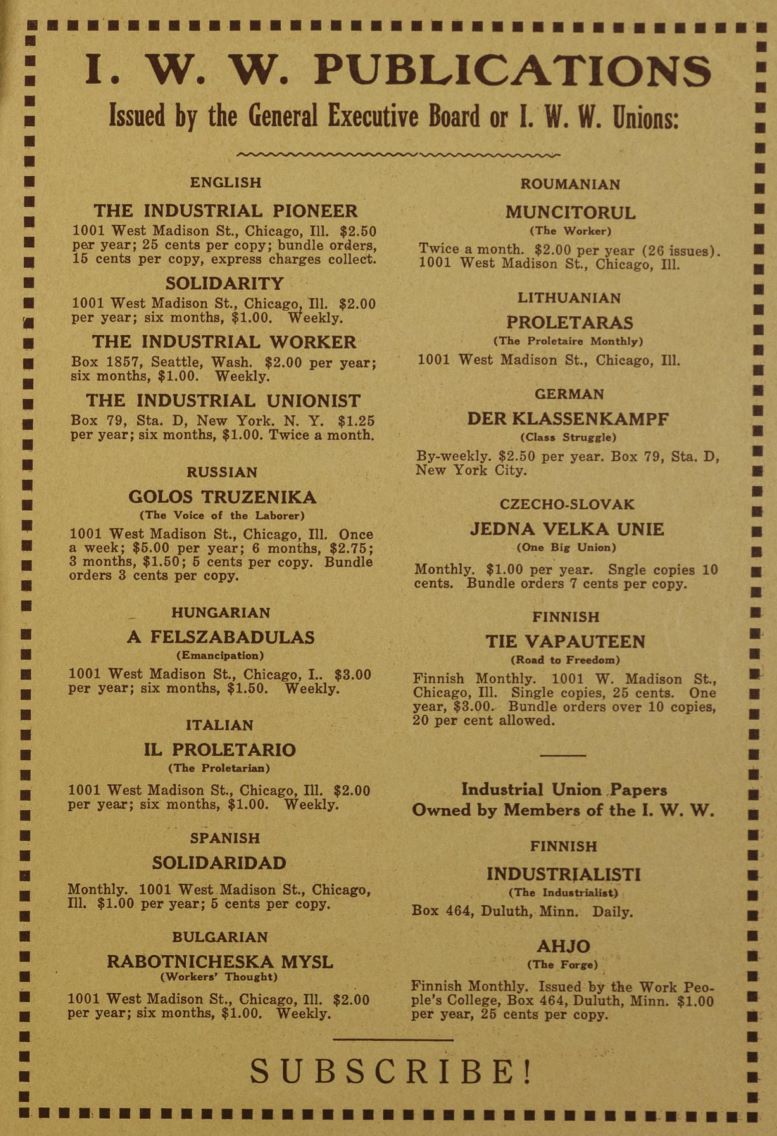
You very seldom hear these boys telling about what they did, but they tell what the organization is doing in their locality. And the reports back up their statements. What I heard a logger telling a visitor the other day is a sample of what is going on in many other places. He was telling of the I.W.W. organization in Spokane where the work is going right on in spite of the fact that the possession of an “Industrial Worker” or “Solidarity” may mean sixty days in jail, and the discovery of a card subjects one to several different kinds of charges.
“Men who are fighting through such conditions,” he finished, “are fighting because they are heart and soul in the movement. They are not just emotionalists who come and who go when the thrill comes and goes, but men who are so determined that nothing can stop them.
This deep seated determination does not find expression in a lot of wild talk or revolutionary jargon. These men are too busy with the practical details of the revolution to fan the air with phrases. In fact the word “revolution” has been hardly mentioned in the convention, as indeed, why should it be? A war is not won by talk of “war” but by the systematic capture of trenches according to methods worked out by careful planning.
Organization the Watchword.
“Organization” is really the watchword of the convention. Everything else is subordinated to that in the minds of the delegates, because they have learned by experience that nothing else gets them anywhere. They tell me that the 1919 Convention was more or less of a defense convention. The delegates were thinking of getting the boys out of jail as much as of organizing the industries, and no wonder, with harrowing stories reaching them every week of the tortures inflicted in the revolving hell at Wichita and in the other prisons scattered over the land. And the 1920 convention, also, leaned very much in the same direction. But here and now in Phoenix Hall organization is supreme. The carefully prepared reports of John Martin and George Williams, Defense Secretaries, received due consideration in passing, and then the convention went on with organization work.
There was just a flash of the 1919 psychology the second day of the convention, when a delegate made a sudden motion that telegrams of good cheer be sent to all class war prisoners. But he was cut short, just as suddenly, by an impatient delegate who shouted:
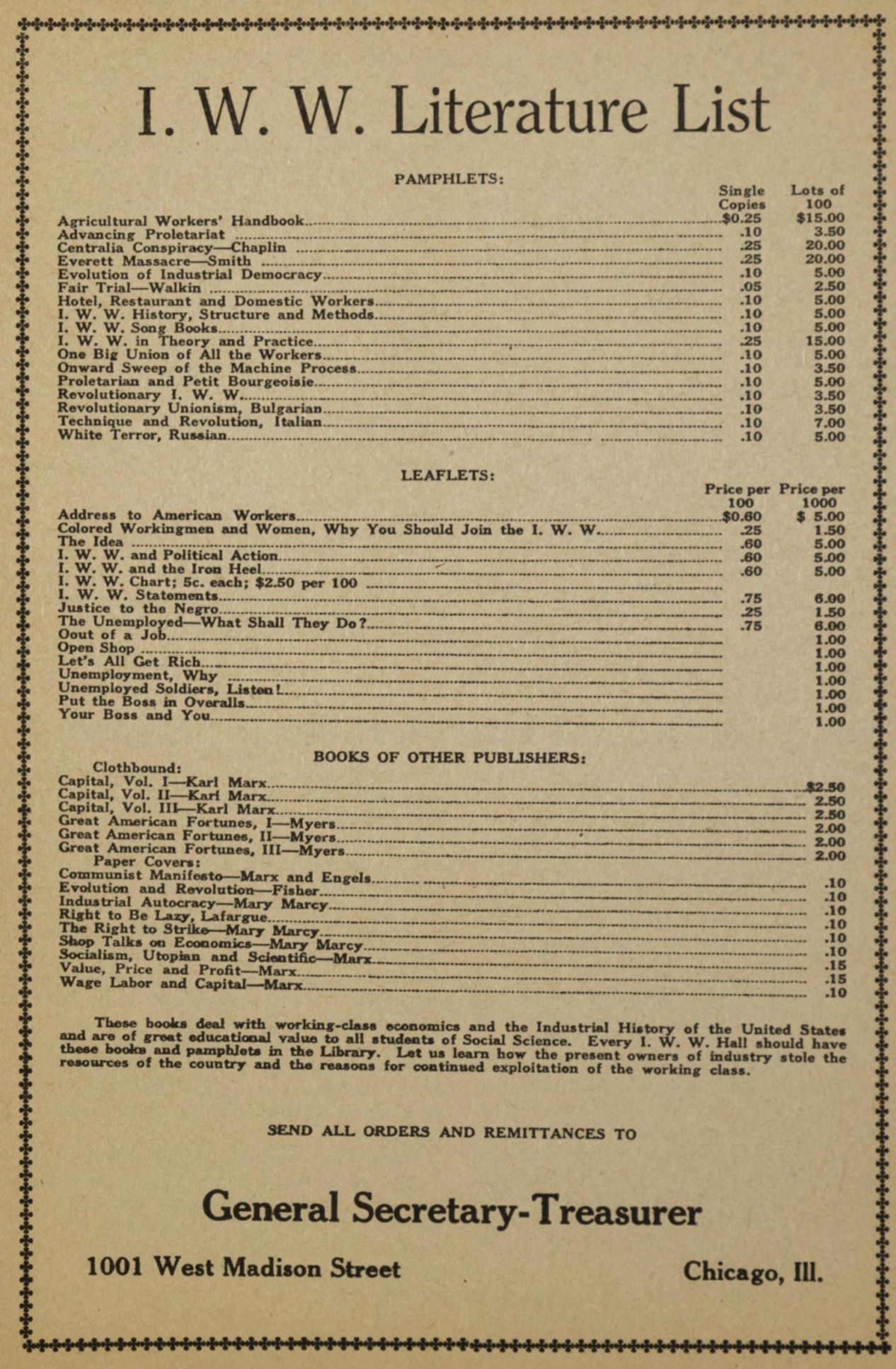
“What’s the use of burning up good money on capitalist wires. They can’t eat it and we can’t organize with it.”
No telegram was sent, though the hat was passed for some physical comforts for the men in jail, and the organization business went on.
Phoenix Hall at present is like a mirror of the industrial movement because it has brought together from all parts of the country the rank and file who have nothing to conceal from each other. The outstanding characteristic of them all is this practical, hard-hitting attitude of mind. It is a pleasure to walk around from one to another, and to listen. I was talking the other day to a sturdy, gray haired lumber worker from the Pacific coast whose class struggle battles go back to his Massachusetts carpenter days in 1880. He did very little reminiscing. His conversation ran to the future. He was planning a march on the upper reaches of British Columbia with other job delegates. New timber lands are being opened there and he saw the necessity of building the organization up with the industry. Then another lumber worker came along with the facts about the wonderful forests of lower Oregon and Northern California where intensive development is about to begin and which the union, looking ahead, is already preparing to organize.
Industrial Strategy.
Then I listened in on the conversation of two copper miners who were debating as to whether the evidence showed the Coeur d’Alene would be worked out in a few years or not. They wanted their foot-loose job delegates to go where permanent organization could be built. A lumber worker joined them, and they all agreed that the I W.W. from now on should pay stricter attention to the actual facts of industry so that energy could be centered on the strategic places.
This emphasis on industrial strategy was shown by a Duluth chap, among others. He was not thinking in terms of herding a lot of workers together off the job, nor of having a society of rebels merely, such as a lot of off-the-job revolutionists think of, but of getting power through control of industry.

“Up there,” he was saying, “we are in the iron mines. Now some boys are doing good work in the railroad lines that carry the ore away. When we have the mines and the railroads that carry the iron we have the steel industry by the neck.”
Just the day before a big check had come from Duluth for literature.
A Textile Workers Map.
Another day a delegate from the textile mills of New England was exhibiting a set of colored maps, prepared by himself, showing the location of the woolen and cotton branches of the textile industry. This is his method of convincing his fellow Wobblies that the headquarters of his industrial union should be located in the East where the industry is centered, rather than in Chicago. Whether he is wrong or right is not the question here: the interesting thing is that he knows the I.W.W. well enough to waste no time in making any kind of an argument about industrial union tactics without the proper industrial data to drive home his point.
“Talk about volunteer bureaus of industrial re¬ search!” said one of the delegates who had been arguing that every union should have the basic facts on its industry, “look at that.”
The actual carving out of the program of action for the coming year, which is being expectantly awaited, will begin this coming week. During these first six days of the convention the time has been largely spent in receiving and discussing reports of the work of the last year, and laying down measures of discipline. It is interesting to note, in this connection, that the delegates made thorough work of what disciplinary jobs came up for action.
Two full days were spent in hearing all sides of the much talked-of “Philadelphia case” in which the General Executive Board, last December, suspended a branch of Marine Transport Workers for charging a twenty-five dollar initiation fee in violation of the constitutional clause calling for a universal two dollar entrance fee. The Convention voted by a large majority to sustain the Board.
Way Open for Return.
This decision to keep twenty-eight hundred water front workers, who load the ships along a full twenty-eight miles of Delaware River docks, out of the I.W.W. was not entered into lightly, and immediately after the disciplinary action had been taken the Convention went on record for the reinstatement of the Philadelphia branch as soon as it would agree to conform to the constitution.
These longshoremen, grain ceilers and checkers have been a part of the I.W.W. for years, and last summer went through a vigorous seven weeks’ strike which is well remembered on the Atlantic seaboard. But the policy of turning the union into a “job trust” by a twenty-five dollar barrier against other workingmen, aroused such protests from so many parts of the I.W.W. that the G.E.B. felt itself obliged to act, and last October the local was notified that it must conform to the constitution. On the Philadelphians refusing to give up the twenty-five dollar fee they were automatically suspended until the General Convention should meet.
Similar action was taken with the strong little Italian baker’s local of New York City, which has “job control” of some twenty bakeries and was suspended for insisting on a fifteen dollar initiation fee.
Seeing Their Job.
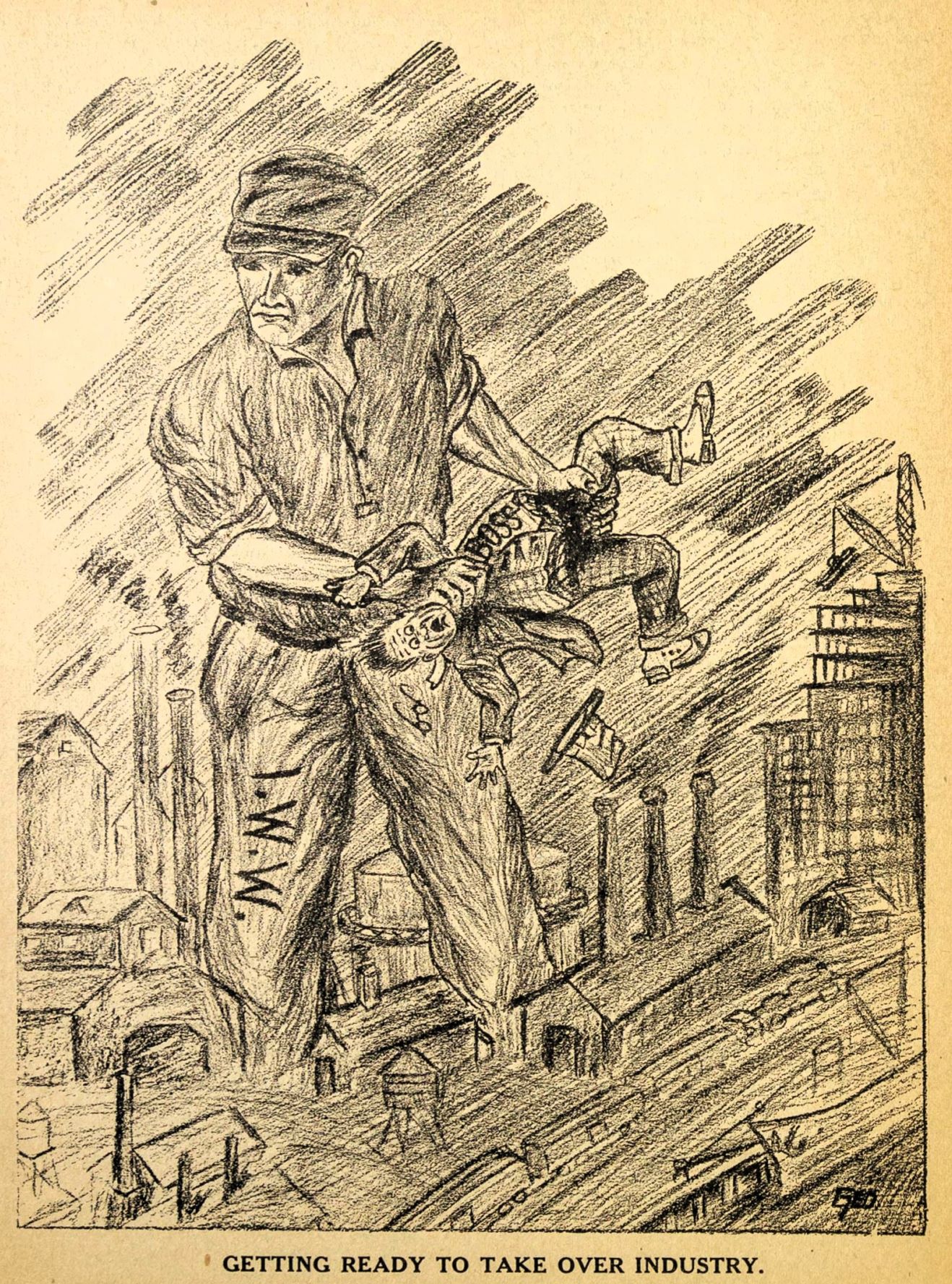
Turning from “job control” to the more essential matter of industrial control the Convention is adopting, as this is being written, a resolution calling for a survey of industrial resources and the co-operation of the engineer and technician in preparation for the actual administration of industry by the workers themselves. The Lumber Workers’ Convention held in April adopted- a plan for a volunteer bureau of industrial research for that industry and the whole trend of industrial unionism today is towards a more definite industrial basis. Capitalistic production is breaking down and the intelligent worker is equipping himself for the crisis.
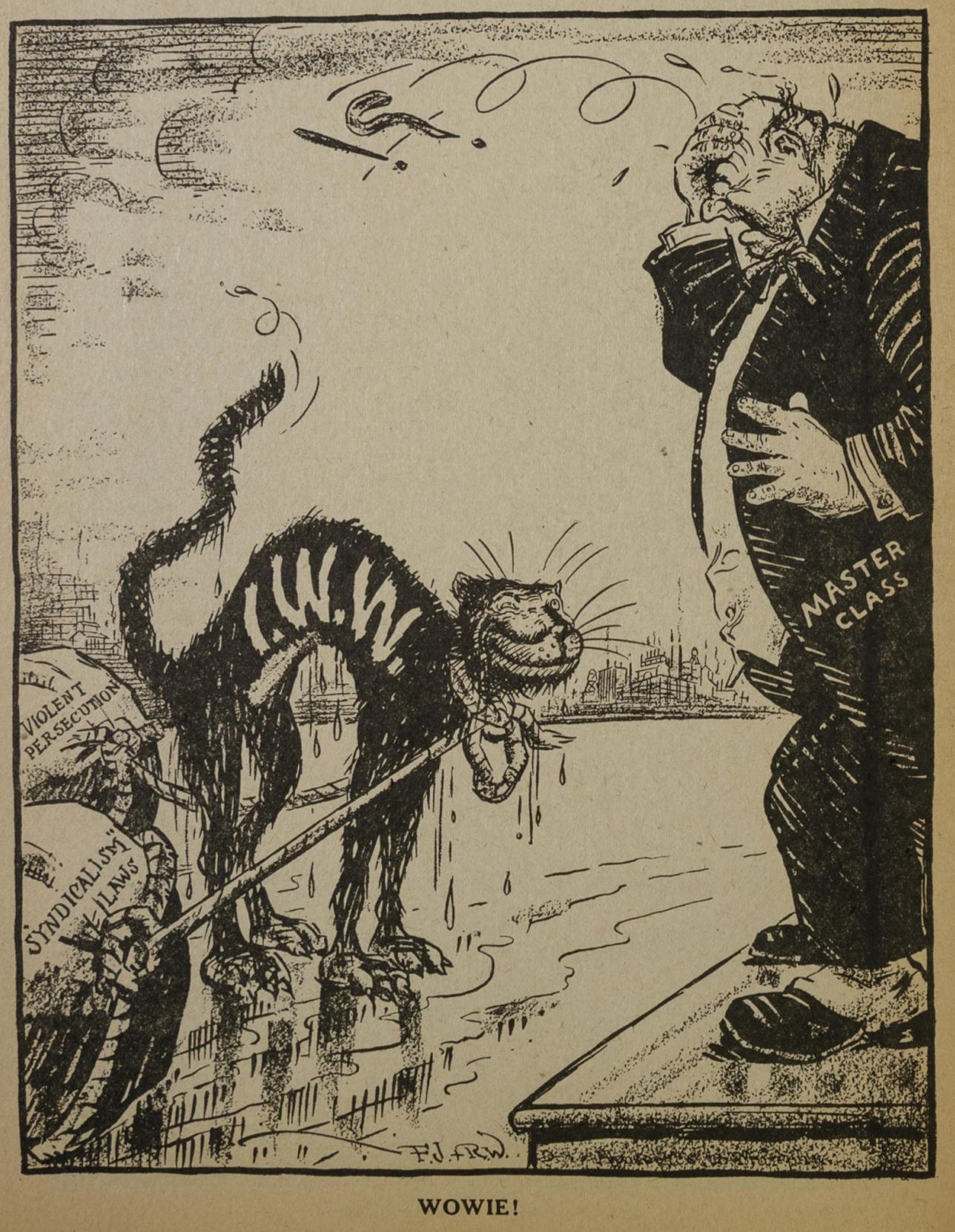
Another resolution declares that all I.W.W. propaganda, during the unemployment crisis, must be directed towards the control of industry by the workers.
Irish Workers Greeted.
So that’s that, as the Wandering Wobbly said; but before this winds up let’s see what the Wobblies think of Ireland. You know Fellow Worker Jim Connolly who led the armed workingmen of Dublin in Easter Week, 1916, was an I.W.W. organizer in the early days of the movement over here. And the Irish Transport and General Workers’ Union which he and Jim Larkin helped to bring into existence is now the most vital force in Ireland and is on a thorough going O.B.U. basis. And it is being persecuted with all the rigor used against our boys on the west coast. So what could the Convention do but give its endorsement to the “struggle which the Irish workers are now waging against world imperialism,” to quote the special resolution brought in from the Butte branch and passed.
Jack Tanner Here.
The Industrial International and the question of knitting the revolutionary labor movements of Latin America with the I.W.W. will come up later. When the across-the-seas issues are on the floor we will hear something from a quiet English workingman who has been sitting in as a fraternal delegate. This is Jack Tanner, representative of the Workers’ Committee of England, a live industrializing movement.
An interview with Tanner is found on other pages of the “Pioneer.”
This will be all for the present, but if you read your “Pioneer” next month you will get the organization program which the boys axe working out. It will be a 1921 application of the ever useful doctrine of “direct action at the point of production,” and if you are not a Wobbly and able to guess what they will do just read and find out.

And now again, good-bye for the month, but first let me give you a tip, I’d still be talking if I were not so anxious to get back to the Convention floor with the boys who do things, those live wires, the Industrial Workers of the World.
A. S.
The Industrial Pioneer was published monthly by Industrial Workers of the World’s General Executive Board in Chicago from 1921 to 1926 taking over from One Big Union Monthly when its editor, John Sandgren, was replaced for his anti-Communism, alienating the non-Communist majority of IWW. The Industrial Pioneer declined after the 1924 split in the IWW, in part over centralization and adherence to the Red International of Labour Unions (RILU) and ceased in 1926.
PDF of full issue: https://www.marxists.org/history/usa/pubs/industrial-pioneer/Industrial%20Pioneer%20(July%201921)_0.pdf
 Revolution's Newsstand