Ben Ossa of the Critics Group with a look at how artists mobilized to fight fascism in the early months of the Spanish Civil War.
‘Artists in Arms’ by Ben Ossa from Art Front. Vol. 2 No. 10 November, 1936.
THE EVENTS leading to the great upheaval in Spain are known to all. Four months have gone and the courageous struggle of the Spanish people against the fascist hordes goes on unabated. Thousands of workers have shed their blood in the defense of their democratic rights. Millions of men and women have also learned that in times such as these it is better to die fighting than to live forever in misery. But, what has happened to the artists during these trying times? Have they also responded to the historical call to arms and joined the masses of Spain in the new battle for freedom and liberty? Very little is known of their fate, but by piecing carefully those small items we see every day in the Spanish press, we are able to understand that a new revolution is taking place in Spain. A revolution of a different nature and character, a movement of such great intensity and power that in the end may affect radically the future of the plastic arts in that peninsula.
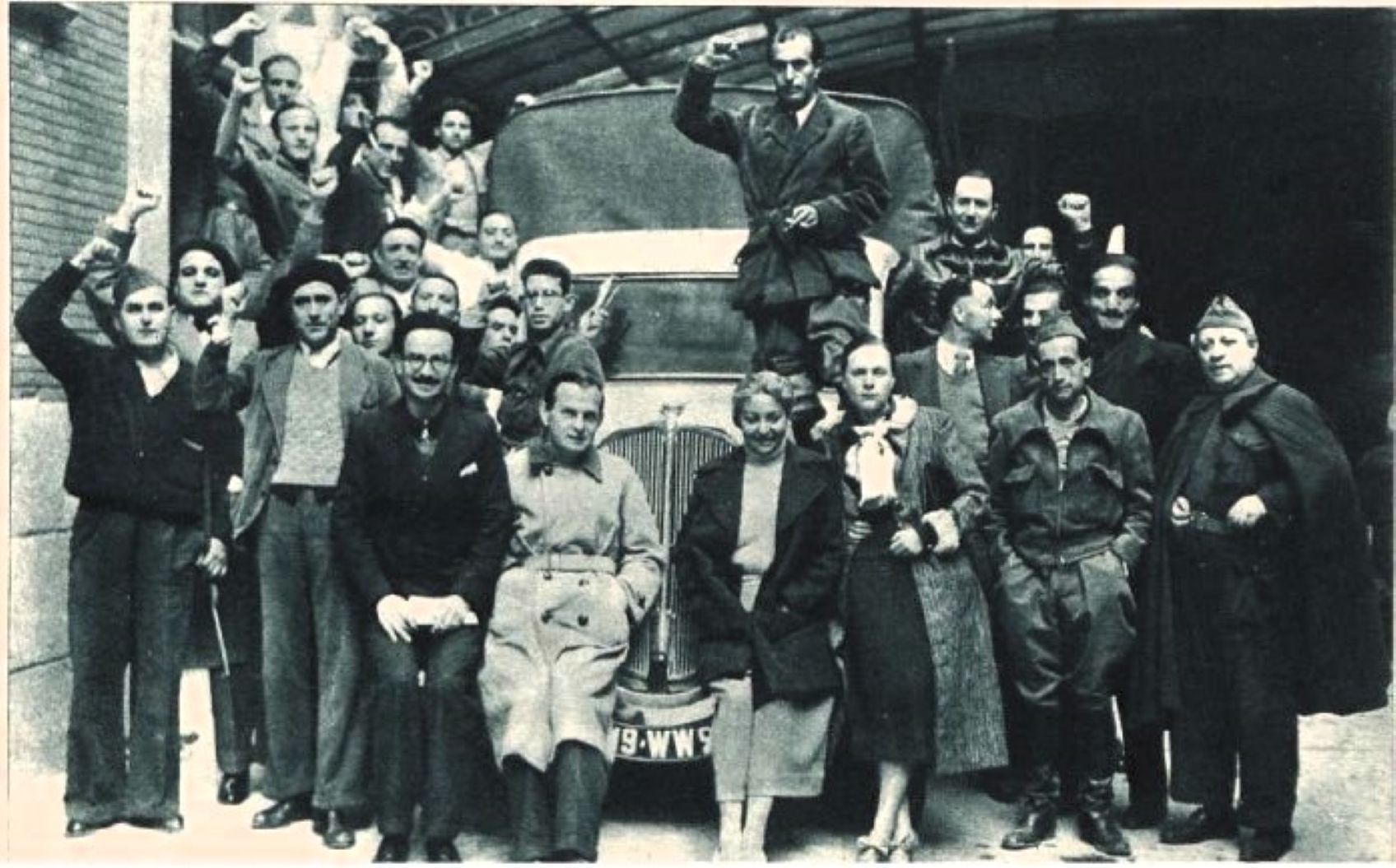
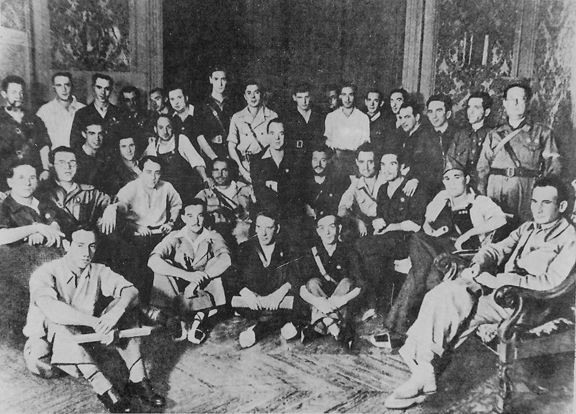
Historical conditions forced the writers, artists and intellectuals of Spain to band themselves about a year ago into an organization known as “The Alliance of Intellectuals for the Defense of Culture.” Its Plastic Arts Section, from the very first day, was in the forefront of the bitter struggle against the brutal forces of the reaction. In June of the present year, and when the smoke of the first battle cleared from the streets of Madrid, the Alliance swung its forces into action. Many artists joined the Popular Militia. Among them we may mention the ones known to the American public: the great sculptor Alberto, the art critic Serrano Plaja, the elderly and respected painter Chicharro, Ramon Peinador, Helios Gomez, Luis Quintannila, etc. But the hundreds of members of the Alliance, from their magnificent new headquarters seized from fascists hands, the palace of HerediaSpinola, laid their plans for the terrifying task of saving the Spanish Republic. A large fleet of trucks was created in a few days, with the special mission to carry on the work of propaganda and education for the illiterate masses of the people. Writers and artists, working shoulder to shoulder with printing-trade workers, seized every available printing plant. Newspapers, magazines, and pamphlets were printed by thousands, and brought to the front lines, to the barracks, to the trade unions, and to the wounded in hospitals. The Popular Culture Committee was thus created. Other committees like the one formed by archeologists, artists and art critics, searched every palace and private house for paintings. and manuscripts. Hundreds of works of art and important books were recovered, catalogued and distributed to museums, universities and public libraries. Within one month two new art museums were opened to the public. One of these, the palace of the former Duke of Alba, known to contain one of the most famous collections of private paintings in Europe, was inaugurated with a memorable lecture by the art critic Vegue y Goldoni. He spoke to a crowd of workers and art students pointing out in his lecture that a revolution was necessary to bring to the eyes of the people the hidden art treasures of the nation.
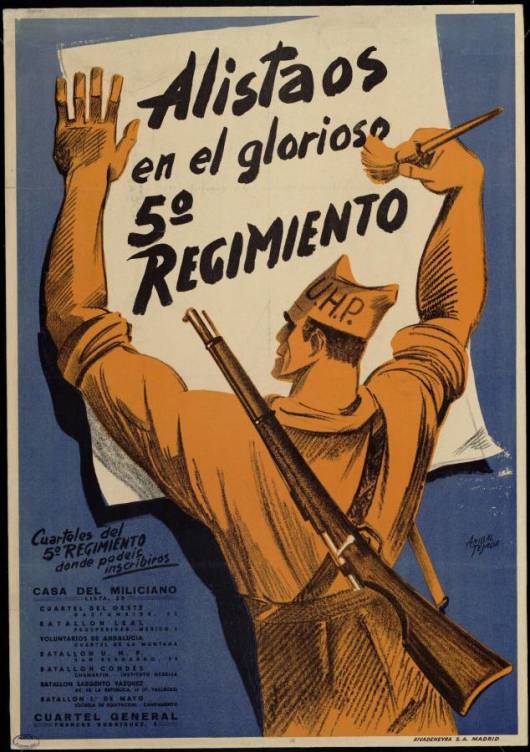
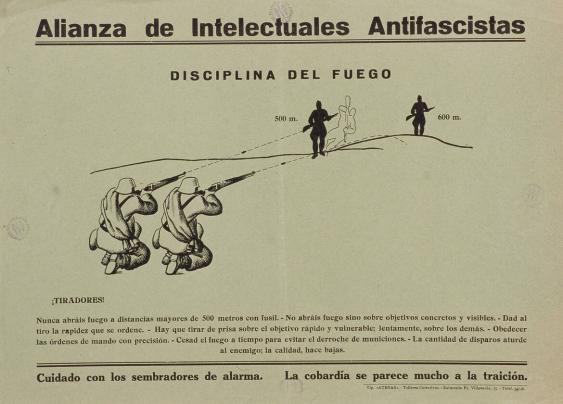
To the Plastic Art Section fell the important task of preparing all graphic material for propaganda and educational purposes. Railroad cars were decorated with cartoons and slogans. Newspapers and magazines appeared with brilliant and artistic covers and forceful drawings. Posters were made and are being made to cover every aspect of the fight. Among the artists who have contributed to the design and execution of these posters we find the best, both commercial and fine art men: such as Bartolozzi, Alonso, Garran, Giron, Gil Guerra, Hortelano, lzarra, Maroto, Moline, Peinador, Puyol, Penagos, Prieto, Sancha, etc. We read with admiration that a brigade of 30 graphic artists, painters, sculptors and photographers has been sent to the front to obtain records and to execute drawings on the actual scene of the battlefields. Among those engaged in this task we find men like Juan Mingorance, Jose Loygorri, Emanuel Cortes, Vicente Suarez, Miguel Garcia Camacho, Jose Maria Sancha, Anibal Tejada, Salvador Arribas, Rafael de Penagos, etc. As a direct result of this dangerous commission, the artists working behind the lines were able to organize traveling exhibitions, with actual documents, and coordinate the work of the Writers and Historians Committee working on the records of the civil war. Special drawings and posters were circulated among soldiers, dealing with definite subjects such as tactics, sanitation and education.
Other artists more interested in future conditions, organized themselves into a committee of Education and Museums. A new revitalizing program of studies was mapped out for the old and antiquated art school: the Academia de San Fernando. The reorganization of the Museums has been considered and plans to that effect submitted to the authorities. The response of the latter to the artists’ proposals is left to the end of the present article.
And after four months of hard fighting and terrible hardships we find the artists of Spain strongly welded together into trade unions which are affiliated to the great syndical groups, regardless of their special field or training. We find the labor label attached to drawings, posters, paintings and sculptures, and the patronage shifted from a special group to the great masses of people through their syndicates and trade unions, and through the popular newspapers and magazines.
The government is grateful to the artists of Spain. Even though it is faced with the critical question of its own existence, the necessary decrees were enacted reorganizing the art teaching and the museums of the republic. Minister of Education Jesus Hernandez, addressing a group of newspapermen on September 12th made the following statement:
“I have studied everything that concerns the artistic wealth of Spain, and the danger of its being destroyed by the fascist rebels. We must preserve it at all costs A plan has been formulated in order to reorganize the art teaching, and towards the creation of new museums, etc. Aside from the most pressing needs of the hour far as the propaganda of the People’s Front program is concerned, my office is king definite steps in order to solve the economic problems of the artists, whose position I am well aware of. The state must help the artists, especially today when so many of them, by enforced idleness, face poverty and hunger. We wish to protect also the art students in order that their lives may be devoted entirely to the pursuit of a worthy career. More specifically, I wish to state that I am determined to see that the Department of Fine Arts of the government ceases to be an archeological and dead organism and that it transform itself into a vital and create center of artistic life. It must be the instrument for reforging the new artistic Spain. I have appointed to the post of Director of the Prado Museum, and in charge of all Fine Arts sections of the government, a man who has the respect of all Spaniards and the admiration of the world. Pablo Picasso. His knowledge, his world-wide reputation, his achievements fit him better than any other for this important task.”

The artists of the United States cannot ignore the noble and important part played by their brothers in Spain, a country which in spite of a brutal attack by the enemies of culture and civilization, has become the hope of the world, a country where the artistic patrimony of the nation has ceased to be the monopoly of a few privileged individuals. They also may profit by the lesson of Spain and learn to look upon the working class, as their allies and friends in the struggle against fascism.
Art Front was published by the Artists Union in New York between November 1934 and December 1937. Its roots were with the Artists Committee of Action formed to defend Diego Rivera’s Man at the Crossroads mural soon to be destroyed by Nelson Rockefeller. Herman Baron, director of the American Contemporary Art gallery, was managing editor in collaboration with the Artists Union in a project largely politically aligned with the Communist Party USA.. An editorial committee of sixteen with eight from each group serving. Those from the Artists Committee of Action were Hugo Gellert, Stuart Davis, Zoltan Hecht, Lionel S. Reiss, Hilda Abel, Harold Baumbach, Abraham Harriton, Rosa Pringle and Jennings Tofel, while those from the Artists Union were Boris Gorelick, Katherine Gridley, Ethel Olenikov, Robert Jonas, Kruckman, Michael Loew, C. Mactarian and Max Spivak.
PDF of full issue: https://www.marxists.org/history/usa/parties/cpusa/art-front/v2n10-nov-1936.pdf
 Revolution's Newsstand