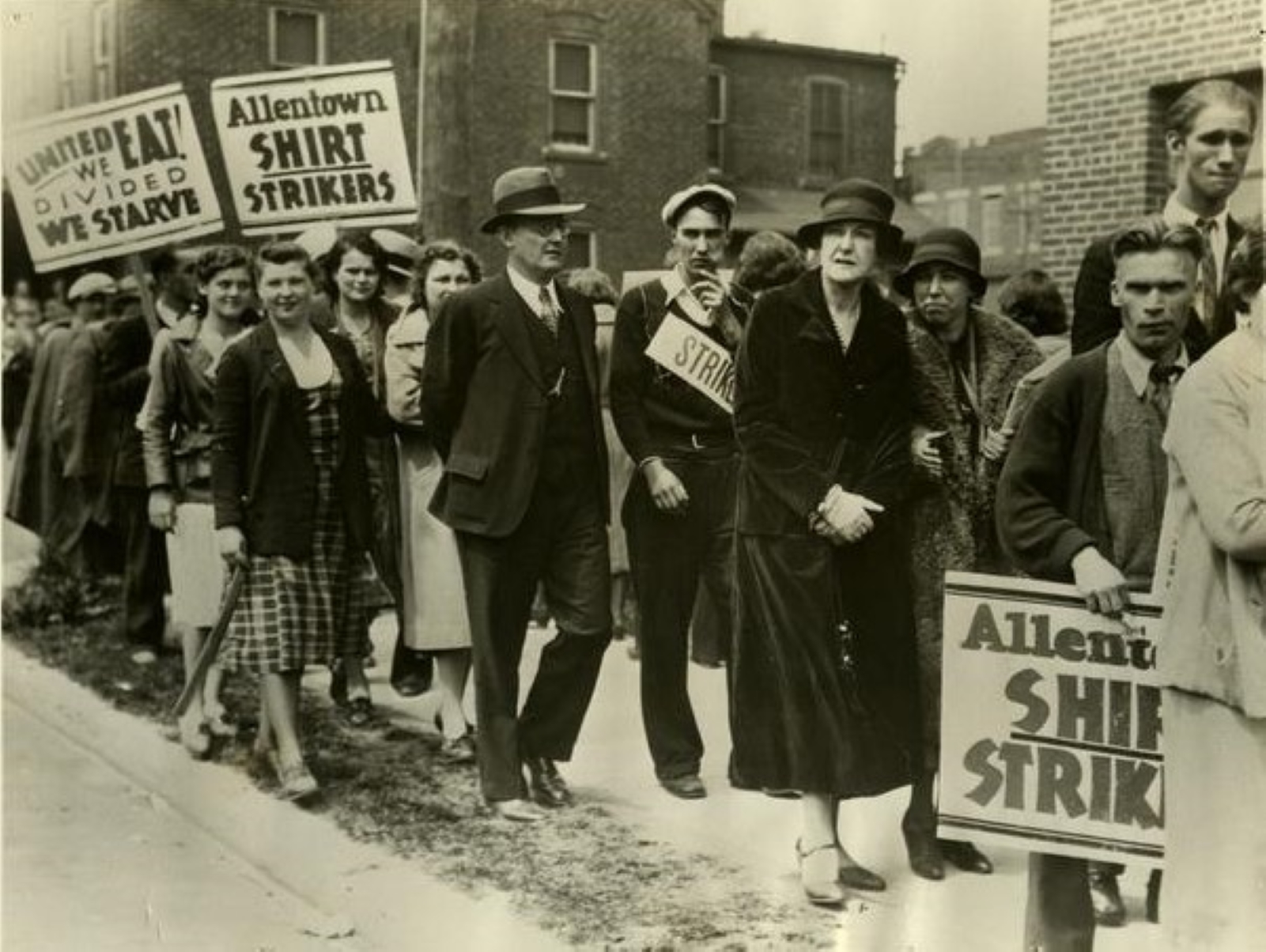
The story of how 5,000 hungry textile workers striking 31 mills in Allentown, Pennsylvania provided their own relief and helped to feed themselves, getting 20 acres and growing food, building solidarity and organization during their long confrontation throughout 1931-1932.
‘When Workers Know Their Onion’ by Larry Heimback from Labor Age. Vol. 21 No. 4. April, 1932.
HAVE you ever thought of the possibility of strikers raising their own relief — literally raising it? The textile workers of Allentown, Pa., did just that in their 1931 strike. With 20 acres of ground and $100 for seeds, plowing, and rental, we raised enough potatoes, corn, beans, cabbage and other vegetables to practically feed 300 needy families and maintain a soup kitchen for the pickets and active workers during the three months of the strike. Our farm raised more than garden truck, too—it raised our morale.
The strike, a spontaneous one, began on April 23 when the workers in the Majestic silk mill walked out in protest against a 10 per cent wage cut. In less than 10 days 5,000 workers from 32 mills were out on strike. With no organization in the beginning (the United Textile Workers did not come in until after the strike was in progress) and very little outside aid, relief was an immediate problem. And it was solved locally to a very great extent.
Somehow it didn’t occur to us to make a widespread appeal for funds. We organized dances (and made $700 on one of them), a bazaar netting $800 to which local merchants contributed everything from necklaces to floor lamps, a popularity contest on which we cleared $1,500; card parties, picnics, a show in one of the local theatres—every means of making money in Allentown we could think of. But our farm project was the most far-reaching activity, not only because of the food it furnished but because it was a genuinely co-operative enterprise.
We Begin Farming
We found a 20-acre tract of good land within walking distance of union headquarters. This belonged to a railroad company which would not lease it to the union direct but agreed to do so through the local welfare association. As we were already two weeks behind the regular planting time, the usual horse-and-plow preparation was out of the question. We hired a farmer who had a caterpillar tractor and disc harrow and he completed the plowing in two days with our eager if somewhat awkward help.
Three men solicited various seed houses and nearby farmers for seeds and potatoes for planting. Another group got together hoes, rakes, buckets, spraying materials, etc. The response was surprising. Most of the seed and implements were donated and many people gave cash besides. Even the local Sears-Roebuck store came across with a tank sprayer and a wheel barrow! We discovered several experienced ex-farmers in our group and they were given full charge of supervising the planting and harrowing.
In about a week we had two acres planted in sweet corn, five acres in potatoes, one acre each of string beans, tomatoes, and cabbage, with early lettuce, onions, carrots, egg plant, turnips, cucumbers, and pumpkins in the remaining ground. The weather man generously donated several rainy days after planting, and before long weeding and cultivating were necessary. Some mill workers with more zeal than knowledge enthusiastically pulled up lettuce and turnips and left the weeds, but we soon educated them. Girls were detailed to take picnic lunches out to the workers and to help with the weeding. The work was a happy change from the stuffy, noisy mills, and the strikers happily volunteered for the gardening.
Farm or Picket!
As our relief list grew we organized a system whereby those wanting supplies had to spend two hours on the farm or on the picket line. A card record was kept of their time. An investigating committee checked up on the genuineness of appeals for special relief and soon eliminated the inevitable spongers.
When our relief funds ran low, the farm produce often saved the situation. The success or failure of a strike is often determined by the regularity of relief rather than the amount of it. We did not sell any of our farm produce, but issued whatever vegetables were ready twice a week to the ‘“farmers” and the families most in need of relief, using the remainder in our soup kitchen which served three meals a day to the pickets and other active workers. (Another story could be told of how we wheedled a swanky hotel out of enough chipped dishes to stock our kitchen after demonstrating that we could grind off its monogram on an emery wheel.) Some 600 bushels of potatoes which were not ready to harvest until after the strike was over were distributed among the victimized strikers. The total cash value of all the produce harvested was about $700.
Of course we did not depend entirely on our farm for food. Grocery stores, restaurants, dairies, bakeries, butcher shops, etc., were canvassed systematically by committees of five strikers in each ward. Most of these establishments gave generously of food or cash. We played rival establishments against one another. “So-and-So gave us 40 quarts of milk”—who could resist the opportunity to outdo his competitor?
Allentown, with its 95,000 residents —70 per cent of whom are in working class families—is chiefly dependent on the silk industry, and the local chamber of commerce estimated that between $250,000 and $300,000 a week was removed from circulation in the town by the strike. One of our chief talking points in soliciting relief and co-operation in our various money-raising projects was the dependence of the merchants and business people on the silk workers’ buying power, and perhaps this was the chief reason for their generous response. After the Communists insinuated themselves into the situation and the newspapers played up the “red menace,” all local avenues of relief were shut off, of course.
But to return to our farm experiment—the possibilities of such a project during a strike certainly are worth consideration if the season and surroundings are suitable for it. Aside from the material gains, the outdoor work was physically beneficial. When our most active workers became irritable and discouraged—as active workers often do—a few days on the farm would put them in fighting trim again. Moreover, the psychological effect upon the workers was tremendous. They soon saw the difference between production for profit and production for the use of those who produce.
Labor Age was a left-labor monthly magazine with origins in Socialist Review, journal of the Intercollegiate Socialist Society. Published by the Labor Publication Society from 1921-1933 aligned with the League for Industrial Democracy of left-wing trade unionists across industries. During 1929-33 the magazine was affiliated with the Conference for Progressive Labor Action (CPLA) led by A. J. Muste. James Maurer, Harry W. Laidler, and Louis Budenz were also writers. The orientation of the magazine was industrial unionism, planning, nationalization, and was illustrated with photos and cartoons. With its stress on worker education, social unionism and rank and file activism, it is one of the essential journals of the radical US labor socialist movement of its time.
PDF of full issue: https://www.marxists.org/history/usa/pubs/laborage/v21n04-apr-1932-labor-age.pdf
 Revolution's Newsstand