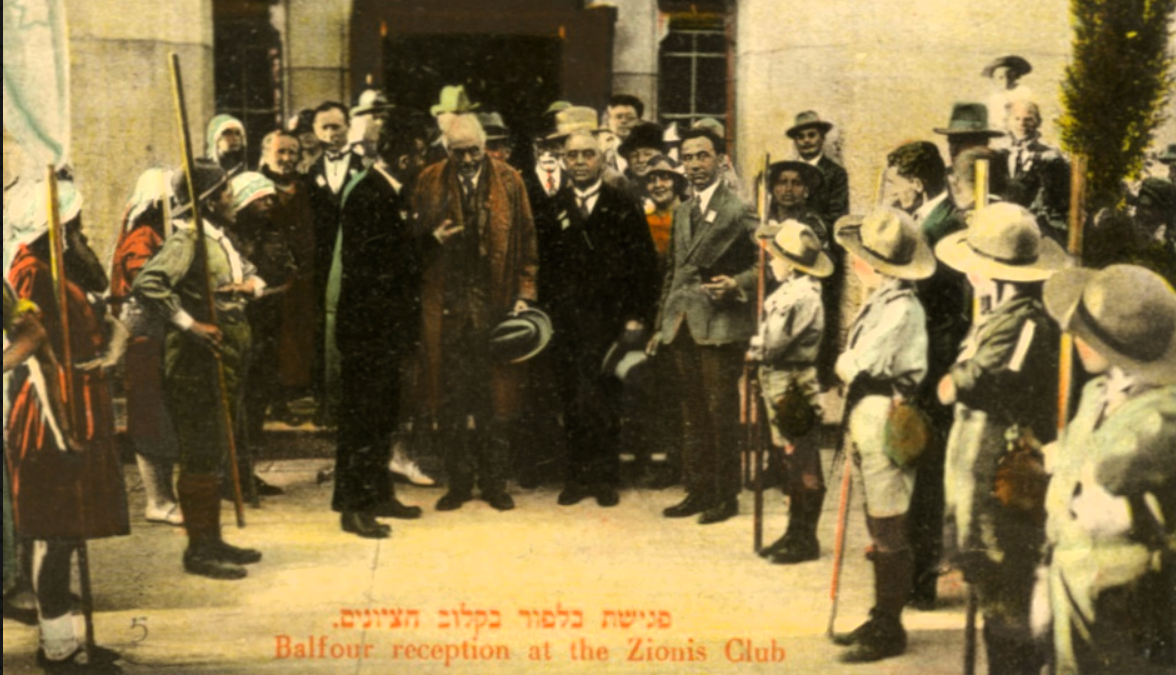
Founder and leading member of the Palestine Communist Party Joseph Berger analyzes the reasons for Lord Balfour’s 1925 visit to Palestine.
‘Lord Balfour, His Zionist Lackeys and the Toiling Masses of Palestine’ by Joseph Berger (Jerusalem) from International Press Correspondence. Vol. 5 No. 36. April 23, 1925.
Little Palestine again has been the centre of interest for a few days. The telegraphic agencies and special correspondents of the big English newspapers sent out detailed descriptions of Lord Balfour’s journey to the “Holy Land”, his arrival, his welcome, and everything else concerning the matter. But all these announcements and descriptions – probably purposely rather than otherwise – ignored the true political significance of the Balfour Trip. The ceremony of the opening of a Jewish University in Jerusalem (which, by the way, has a thoroughly Clerical character, and will be a bulwark of reaction, and with the splendour of which the Jewish bourgeoisie will dazzle the broad Jewish masses in various countries), is naturally not a sufficient reason for luring a British aristocrat, advanced in years, of high standing in political circles, such as Lord Balfour is, to Palestine. And the other “popular” explanation- that Lord Balfour came to Palestine in order to see with his own eyes how the Zionists have put the “Balfour Declaration” of 1917 into practice, in which Palestine was set aside for the Jewish peoples as a “national home”- also does not suffice. The crux of the matter is that Balfour, as one of the most “moderate” Conservatives in intimate relation with the Foreign Office at present, has been entrusted with the task, under the guise of a “visit”, to subject British policy in the Near East to a test.
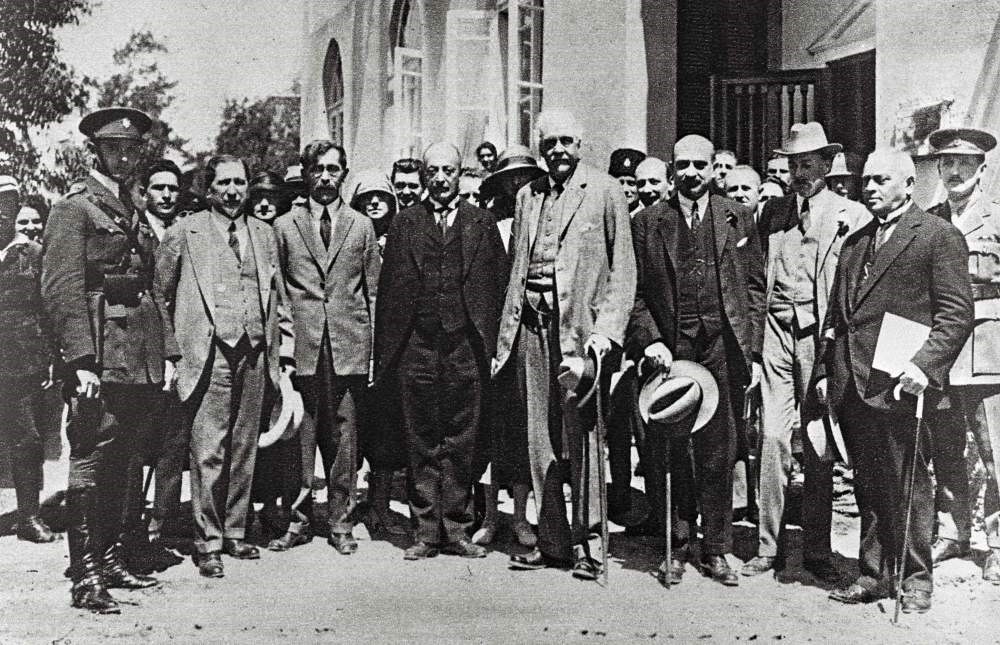
After the “stabilization” of British power in Egypt by the Zawar Pascha Cabinet, and the dissolution of Parliament and the security of the other “wing” of the British possessions in the Near East- Mesopotamia – by the cleverly incited uprising in Kurdastan, the time has now come for British policy to introduce the policy of the firm hand in the centre, i.e. Palestine and Arabia. Lord Balfour’s journey, as the British conservative weekly “Near East” itself states, was a provocation of the Arabians, just as the journey of Lee Stack to the Soudan was five months ago. But that is just what the imperialists wanted. At the same time a test was to be made to find out how capable the native population was of resisting British imperialism, and also how far the alliance with, or rather the lackey service of the Zionist bourgeoisie and the Social Democrats could be depended upon. The second test was a glorious success. The Zionist bourgeoisie and their lackeys, the Social Democratic “Poale Zion” of various tendencies, showed that they place a good deal more value on the smile of the English Lord than on the peaceful relations with the Arabian population of Palestine. The Zionist organisation, which, by the way, not only in Palestine, but also in the other countries, has put itself completely into the hands of the reactionary sections of the Jewish bourgeoisie (which recently went beyond an unscrupulous offensive against Soviet Russia and has again begun taking an active part in the intervention schemes), is ostentatiously challenging the Arabians to battle by abusing the Arabian Central Committee and the Arabian nationalist leaders. When tanks and aeroplanes are holding the Arabians in check, the Jewish bourgeoisie courageously attacks them. As a consequence, the Arabians break out in wild fury against the Jews and instigate pogroms against innocent poor Jews. It is this which constitutes the greatest service rendered by the Jewish bourgeoisie to British imperialism, because it can maintain its position in Palestine only on the basis of national antagonisms.
Thus, whilst the Jewish bourgeoisie in Palestine showed to Lord Balfour that it was a trustworthy lackey, the attitude of the Arabs showed that the native population has much more power of resistance than was expected. The two parties in the Arabian camp (the “nationalists”- the party of compromise, and the extremist party of the “Arabian Executive Committee”), as welt as the various small peasant parities of Palestine have made common cause in answer to the British-Zionist provocation, and the protest against Balfour was unanimous. Apart from the slavish and fawning Zionists, the whole country was united in its protest against brutal British imperialism personified by Balfour.

But it would be wrong to assume that this great anti-Balfour demonstration was only caused by the national question. The nationalism of the Arabian peasants, artisans and workers is not developed enough for that. It was neither a vehement protest against the economic impoverishment of the masses of Palestine and against the oppression under which they are groaning. And not only the Arabian masses, but also the lower classes of the Jewish population of Palestine, except the small group of Zionist agents, have experienced nothing but evil from imperialism, and know that there is worse to come. The Palestine Communists took an active, nay, a leading part in the anti-Balfour demonstration and urged the Jewish and Arabian workers to make common cause against the predatory lords. Thus the national protest was converted into a class protest: the entire working class population of Palestine demonstrated against imperialism and Zionism!
It is as yet impossible to gauge the results and consequences of the Balfour visit. But one thing is quite certain: the more brutal the measures of British imperialism against the population of Palestine and Arabia, and the more the Zionist lackeys lend themselves to the role of the imperialist agents- the stronger and the more unified, the bolder and the more revolutionary the national liberation movement will become. And the Communist Party, which the British Government hopes to throttle by arrests and persecutions, will in spite of it, or rather because of it, get into closer and closer contact with the masses and will take the lead in the coming struggles.
The ECCI published the magazine ‘Communist International’ edited by Zinoviev and Karl Radek from 1919 until 1926 irregularly in German, French, Russian, and English. Restarting in 1927 until 1934. Unlike, Inprecorr, CI contained long-form articles by the leading figures of the International as well as proceedings, statements, and notices of the Comintern. No complete run of Communist International is available in English. Both were largely published outside of Soviet territory, with Communist International printed in London, to facilitate distribution and both were major contributors to the Communist press in the U.S. Communist International and Inprecorr are an invaluable English-language source on the history of the Communist International and its sections.
PDF of full issue: https://www.marxists.org/history/international/comintern/inprecor/1925/v05n36-apr-23-1925-inprecor.pdf
 Revolution's Newsstand