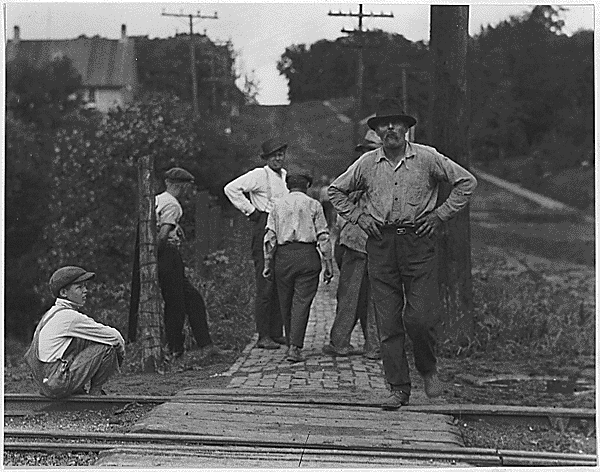
Federal intervention into labor struggles began with the railroad industry.
‘Railroad Rebels: A By-Product of Arbitration’ by J.D. Williams, Railroad Workers Educational League, from The International Socialist Review. Vol. 16 No. 5. November, 1915.
FOR years the Railroad Brotherhoods have been the despair of all men whose vision was progressive. Here was a rock of conservatism that yielded to no pounding of the waves of radical thought that were constantly sweeping against it. Would Socialism gain a foothold in America? No! Look at the Railroad Brotherhoods and be comforted if you were a reactionary.
Was there such a thing as a class struggle? No! Please don’t be absurd. Everything that vexes us can be settled by arbitration. Men will get together; look each other calmly and judiciously in the eye and all difficulties will immediately cease from troubling and the burden of life can again be taken up by the over- worked stockholder, while the employees go back fully satisfied — to the light and airy tasks of firing a “Battleship,” or running for one’s health along the slippery tops of fast or local freights.
It seems though that in the course of railroading a continual stream of things were bobbing up that did not make for peaceful conditions. The management and the men were constantly bickering about one thing or another in railroad operation and about the time they were ready to look each other calmly and judiciously in the eye each group had got pretty firmly convinced of the merits of its side in the controversy. What should we do in this deadlock? Why call in the arbitrators! We will bring men in to decide who are not set in their opinions, who have no prejudices and who will, after due deliberation, render a just and fair award.
Where are there any such men? There may be such on Mars, but surely they are very difficult to find here. Why? For the simple reason that working conditions and dividends on a railroad stand in the same relationship to each other that working conditions and profits do in all industry. A man who is directly or indirectly connected with the business of making a living out of profits can’t be expected to condemn that method of getting an easy living. While the man who is working for wages can’t help but see that his brother has a just grievance.
And under those two heads fall all of the inhabitants of this world. Impartial arbitration exists only in the imagination. “There aint no such thing.” The best demonstration of this is to make sufficient mistakes; to get “wise” and to conclude no further proof is necessary. The railroad men have written Q.E.D. after this formula. They have proved negatively that arbitration does not arbitrate, for even the awards have led to endless discussion and we have had the spectacle of arbitrators being chosen to arbitrate the award.

There have been passed two federal laws regulating the arbitration between the railroads and the railroad men, one, the Erdman Act, the other the Newlands Act. Both have been operative for some time and under the provisions of both, arbitrations have been conducted. What has been the result, the men have found out that when they “won,” they lost and when they did not win, they also lost. Think this over carefully and see how many times they won.
The mechanism called arbitration has had a fair and complete trial by the railroad men. They have backed up their Grand Lodge Officers with loyalty and money. They have played the game as the officers asked. They have seen machinery of a more and more powerful type introduced, making the work fall onto fewer shoulders. They have found themselves face to face with the question of enforced unemployment and they know now that arbitration solves none of these problems. They know now that it is even impossible to introduce such a subject as “unemployment” in the face of the railroad plea that they require all of this “efficiency” paraphernalia in order to meet fixed charges and dividends. The railroad owners never arbitrate their right to dividends.
It has taken considerable time to do it, but the mechanism of railroading is rapidly producing a rebel proletariat — a revolutionary proletariat is in the offing but plainly perceptible. Arbitration has failed to produce the result that it was hoped it would accomplish. Through it some hoped for Industrial Peace. It is, in fact, establishing that hideous monster, from the railroad owner’s point of view — Industrial Unionism.
All advocates of arbitration believe this was the one thing that arbitration would prevent, but logically and inevitably, out of the conditions in the industry is coming one great, irresistible organization to supplant what is now only the nucleus of what is going to be. This failure of arbitration has begat its own negation. Now for a trial of strength.
The Brotherhoods are now setting themselves to the task of putting their house in order. The call for solidarity proceeds from the aristocrats of the railroad world, the engineers and firemen. They want things; they see the necessary steps to be taken to get them, and they have thrown theory to the winds and are going to let the facts and the needs of their very lives, dictate their future policy. From an organization called the Railroad Workers Educational League, formed on the Boston & Maine and New Haven Systems, they have issued a clarion call to all railroad workers to join to discuss their common grievances and to take the necessary steps to form the Railroad Workers Industrial Union.
The International Socialist Review (ISR) was published monthly in Chicago from 1900 until 1918 by Charles H. Kerr and critically loyal to the Socialist Party of America. It is one of the essential publications in U.S. left history. During the editorship of A.M. Simons it was largely theoretical and moderate. In 1908, Charles H. Kerr took over as editor with strong influence from Mary E Marcy. The magazine became the foremost proponent of the SP’s left wing growing to tens of thousands of subscribers. It remained revolutionary in outlook and anti-militarist during World War One. It liberally used photographs and images, with news, theory, arts and organizing in its pages. It articles, reports and essays are an invaluable record of the U.S. class struggle and the development of Marxism in the decades before the Soviet experience. It was closed down in government repression in 1918.
PDF of full issue: https://www.marxists.org/history/usa/pubs/isr/v16n05-nov-1915-ISR-riaz-ocr.pdf
 Revolution's Newsstand