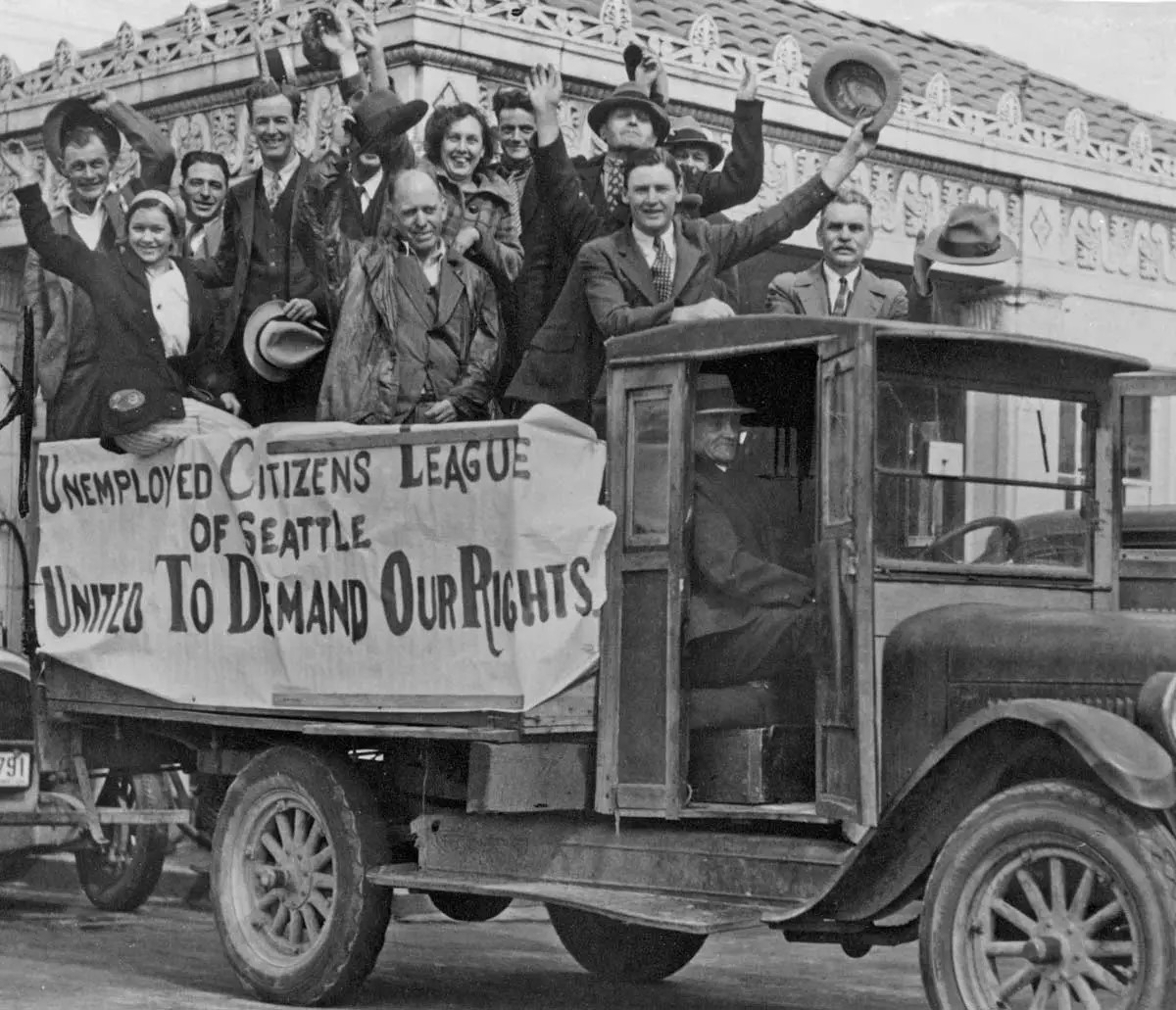
One of the largest and most effective mutual aid campaigns of the early Depression was Seattle’s Unemployed Citizens League. What began in July, 1931 by October had 22 branches in the city. A year later it would count tens of thousands of members in the Seattle area. Here is a report on the founding and early functioning of that historic organization from A..J. Muste’s ‘Labor Age.’
‘The Unemployed Citizens League of Seattle’ by B.C. from Labor Age. Vol. 20 No. 11. November, 1931.
DURING the latter part of July a small group of Seattle workers met in a community club house in the suburbs of that city one evening to discuss what might be done in an immediate, practical way about unemployment.
One of the number, a socialist in philosophy, had prepared a resolution calling upon the city administration to establish a million dollar wage fund to be expended on a highway project which was already partially under way. This suggestion was adopted.
Another proposed that a canvassing committee be organized to take a census of the neighborhood to determine the degree of unemployment. This was agreed to. A third proposed that a relief committee be chosen to give whatever assistance was possible to those who might be found in destitute circumstances. This was accepted. All agreed that the idea of organizing the unemployed was a good one and should be spread to other parts of the city. A committee was elected for this purpose.
Thus the Unemployed Citizens League was born. Today it has 20 branches in different parts of the city, meeting weekly in churches, community halls and other places which have been loaned rent free. A central federation with delegates from each branch meets once a week. The original demand for a public works program has grown to include the following planks:
A special session of Congress to appropriate five billion dollars for public works and relief; same to be repaid out of higher income of inheritance taxes.
A special session of the Legislature for unemployment relief along the same lines.
Establishment of a million dollar wage fund in the city budget to be expended without delay on public improvements.
Establishment of a $500,000 wage fund by the county for the same purpose and an additional $500,000 for direct relief to needy residents.
All work shall be done directly by the city and county without the intervention of contractors and the work to be rotated fairly among all the resident unemployed who register for that purpose.
The city scale of not less than $4.50 per day to be paid for all common labor.
No eviction of unemployed for failure to pay taxes, assessment and back rent.
School children to be provided where needed with adequate food by school board.
Abolition of dual employment.

In the beginning this program served as a rallying point to build and unify the organization. Delegations appeared before the municipal and county bodies to press these demands. A mass meeting, the largest yet held around the issue of unemployment, helped to build morale. The movement received fair news space in the daily papers and people generally began to remark at the unusual sight of more or less conservative homeowners and taxpayers organizing in their status as jobless citizens.
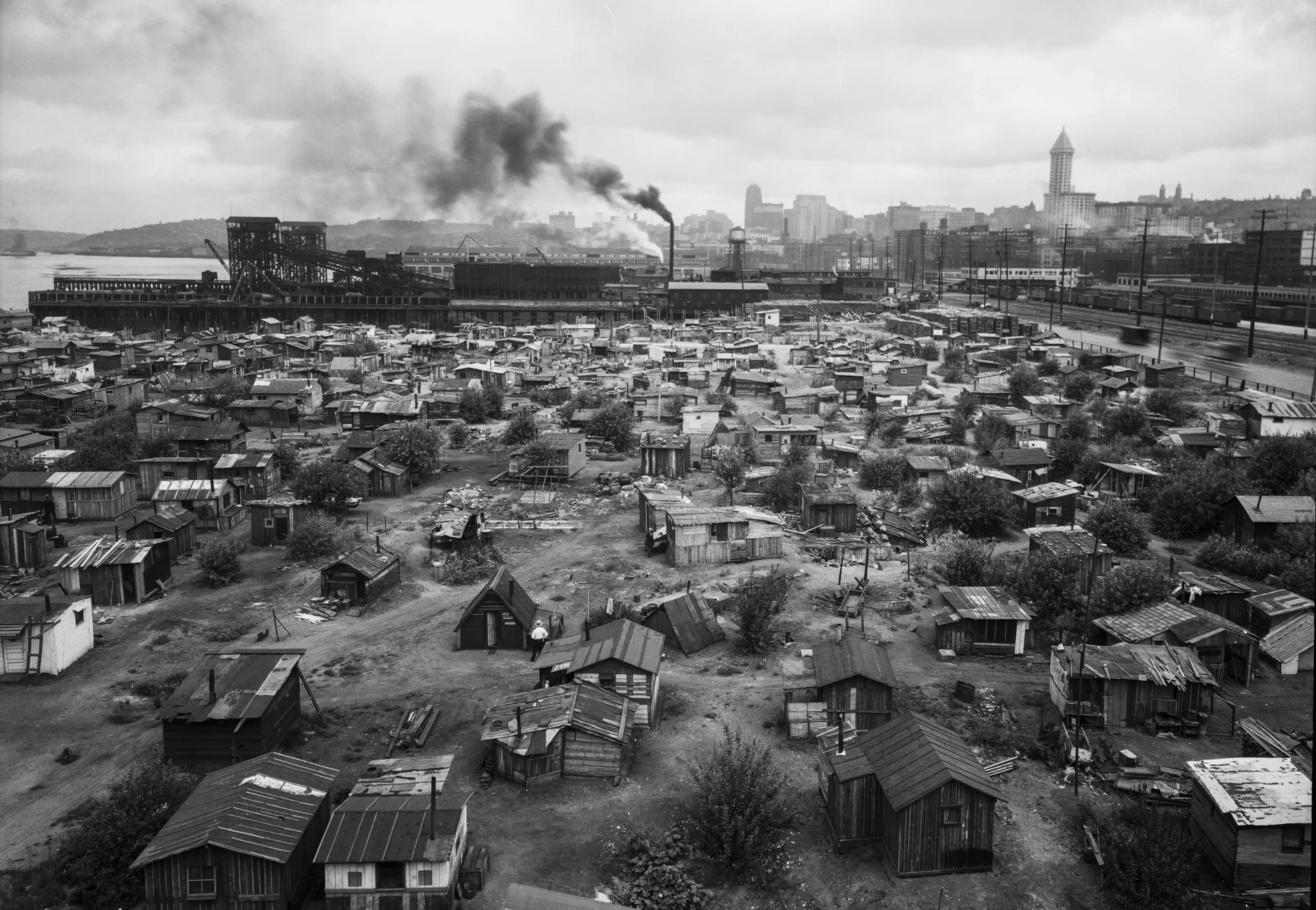
But the demands of the workless were not given very serious consideration by the City Council and the County Commissioners. The appropriations made were not up to the minimum requirements and the wage scale for unemployed was set on a sliding scale ranging from $1.50 per day for single men to $3.00 per day for those with large families. This in spite of the fact that organized labor and the veterans’ organizations also fought for the $4.50 scale with a graduated period of work according to the size of the family.
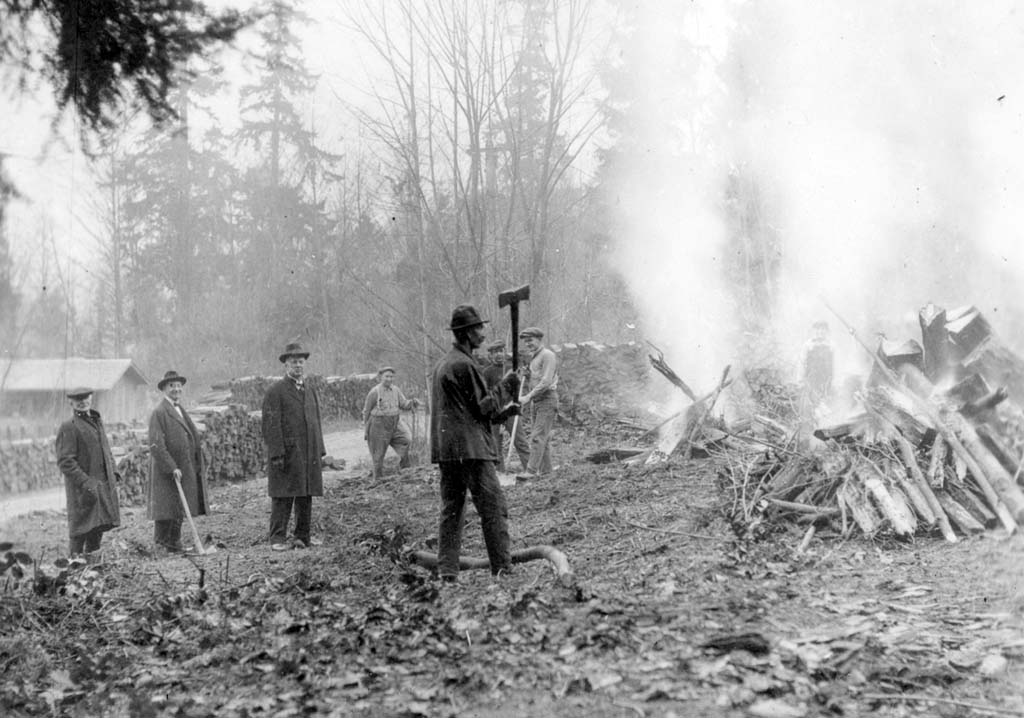
While this set-back dampened the spirit of the meetings, certain relief and co-operative self-help measures had been started which proved to be of real strength. In two districts the branches combined in a number of wood-cutting crews to supply themselves with their winter’s fuel. Land owners permitted the trees to be cut without charge; city departments loaned equipment; gasoline companies donated gas for cars, and power saws, and trucks were secured from friendly transfer firms. Each wood-cutter is allotted so much for his labor and a supply is accumulated for widows and those incapacitated. This is going forward now in other districts. The number applying to go out on this work is larger than can be taken care of.
Expeditions have been organized to canvass the surrounding market garden and farm territory for donations of potatoes, apples, carrots, cabbage, cucumbers, etc. Patches of potatoes have been found and dug on the shares. In three districts, local commissaries have been established for the systematic distribution of such food. Canning groups have been organized among the women members.
One of the most important food items is surplus fish from the boats of the members of the Fishermen’s Union. One committeeman meets all boats with a truck and takes what is unsold to the cold storage plant of the municipal port where it is frozen for future use. At each branch league meeting, members state their needs and fish is distributed to them at a central point in the district on the following Thursday. Arrangements have been made to secure large quantities of staple farm products from the rich farming lands east of the Cascade Mountains. All the work of the organization has been done by volunteers and no rent has been paid.
In the meantime the Mayor’s Committee on Unemployment (chiefly business men) is getting the machinery in shape to establish food depots in different parts of the city. It plans to feed not only the transient unemployed, but residents also. It has the support of the merchants and business men and will raise money to pay for the stuff. When this gets under way, very likely the food relief work of the Unemployed Citizens League may have to be dropped. The local merchants in many cases have refused to give of their surplus pending the organization of the Mayor’s food distribution.

This will be a test for the League. Will its members fall away when the loaves and fishes are gone? To meet this problem, the agitational and protective features will have to be intensified. Free legal service is now being given in foreclosure and eviction cases. Committees in each branch call upon hard-boiled landlords who are pressing penniless tenants for payment. Dramatic mass action must be staged to drag larger appropriations from municipal authorities, for the two weeks’ work given at the “coolie wage” is the most disgraceful sort of a make-shift. The money is virtually gone before it is received by the worker.
While thus far the League has successfully countered the charge that it was purely a propaganda or political organization, the time is coming when it will have to sponsor constructive measures of permanent character for the benefit of the unemployed. Talks along economic lines are a feature at all meetings and the way is being paved for a more far-reaching program.
Seattle’s experience would indicate that the unemployed can be organized if they are approached in a natural way with a reasonable, practical program free from propaganda taint. Give them a chance to build their own organization without outside dictation. They are not scared of progressive or even radical leadership, so long as tangible things are given proper position. Find cooperative jobs which they can do for mutual aid and which stimulate independence and working class reliance. They will not become social revolutionists over night but they will learn lessons of organized effectiveness in contrast to individual impotency.
Labor Age was a left-labor monthly magazine with origins in Socialist Review, journal of the Intercollegiate Socialist Society. Published by the Labor Publication Society from 1921-1933 aligned with the League for Industrial Democracy of left-wing trade unionists across industries. During 1929-33 the magazine was affiliated with the Conference for Progressive Labor Action (CPLA) led by A. J. Muste. James Maurer, Harry W. Laidler, and Louis Budenz were also writers. The orientation of the magazine was industrial unionism, planning, nationalization, and was illustrated with photos and cartoons. With its stress on worker education, social unionism and rank and file activism, it is one of the essential journals of the radical US labor socialist movement of its time.
PDF of full issue: https://www.marxists.org/history/usa/pubs/laborage/v20n11-Nov-1931-Labor%20Age.pdf
 Revolution's Newsstand