
Finnish-American Henry Puro (John Witta) was head of the Communist Party’s Agrarian Department when he wrote this ‘tasks’ document as the Great Depression began to decimate small farmers. The radical United Farmers League, precursor to the much better known Farm Holiday Association, came under increasing Communist influence as the crisis developed giving the Party its first opportunity for mass work among farmers.
‘The Tasks of Our Party in Agrarian Work’ by Henry Puro from The Communist. Vol. 10 No. 2. February, 1931.
The Seventh Convention of our Communist Party marked a decisive turning point in the Party’s attitude towards agricultural work, as it marked a turning point regarding all other important tasks of our Party. In the thesis presented to the Convention by the Central Committee, the agricultural question was a special point. It was stated in a self-critical manner that “the past failure of the Party to do any work among the agrarian masses is the outgrowth of an indefensible underestimation of that work.” The thesis points out the necessity and possibilities of entering into this important work.
In the Seventh Convention a Draft Thesis on the agricultural question (published in The Communist) was presented and discussed, and the line of the thesis was adopted as the basis for our agrarian program. Between the time of the Seventh Convention and the November Plenum our agrarian work was further developed by assisting the United Farmers League to prepare a program for this mass organization of oppressed farmers and by helping to revive the organ of the U.F.L., The United Farmer.
By taking these steps a basis for our agrarian work was laid during the last summer. But our work in the agrarian field is still very insufficient and unsystematic. Work in this field was limited to Minnesota, North and South Dakota, and some initial steps which were taken on the Pacific Coast and in the southern districts. But the majority of our Party districts have not taken any steps to approach the farmers. Even in our election campaign we had no concrete program and demands for the farmers.
THE NOVEMBER PLENUM ON THE AGRARIAN WORK
Realizing these shortcomings in our agrarian work, the November Plenum made the following decision:

“The development of our work among the farmers has been extremely slow. The favorable conditions for this work have been demonstrated by the development of spontaneous struggles of the impoverished farmers in some sections of the country, especially in the South, as well as by the big increase of the 7,000 votes gained by the Party in North and South Dakota in the elections, an increase of 600 per cent. With the clarification of our basic analysis and program, by adoption of the line of our draft thesis of the Seventh Convention, the Party must now energetically pass on to the concretization of this line in organization and struggle among the farmers. An Agrarian Department must immediately be formed which will systematically direct the building of a mass farmers’ paper as the weapon of leadership of the impoverished farmers in every district in the country. Each District must charge responsible comrades with developing contacts among the farmers and agrarian workers and with the formation of units in the Agricultural Workers Union and Action Committees of the Poor Farmers.
“Every District must work out, in consultation with our farmer contacts, concrete programs of demands directed against foreclosures of mortgages, against oppressive taxation, for local relief measures for the poor farmers, against the local ruling cliques of landlords and bankers on all issues affecting the daily life of the masses. In each locality, especially in the South, we must endeavor to form Leagues of Tenant Farmers and Share Croppers, uniting black and white together. All of this work must result in organizational crystallization, in the development of the financial resources for the work, from among the farmers themselves. Every district must organize committees for the distribution of the farmers’ paper and to secure the reflection of the local struggles in this paper and furnish financial support to the paper.”
THE SITUATION DEMANDS ACTION
Now that our Party has laid down the correct line, has formulated a policy of action and established a regularly functioning Agrarian Department, the whole Party must take our agrarian work as one of its most important tasks. With the continuance and deepening of the agrarian crisis, the situation of the impoverished farmers has become very critical. The agrarian crisis in this country has been chronic since 1920, but the present worldwide industrial crisis, including the United States, has greatly sharpened the crisis in agriculture. The farmers in the United States are afflicted also with the worst drought recorded in the history of this country. The drought situation last summer affected 30 states of the union. As a result, farmers’ income in these states was further reduced by 25 per cent from what it was in 1929. Manipulation of agricultural prices by the trusts, combines, and banks, further aggravates the situation for the impoverished farmers. News items from Idaho state that farmers are using their wheat as fuel, because it is cheaper to burn wheat than wood or coal, the price of wheat being $9 a ton, whereas wood costs $10, and coal $16.50 a ton. This shows the miserable plight into which capitalism has led the big majority of farmers in the United States.
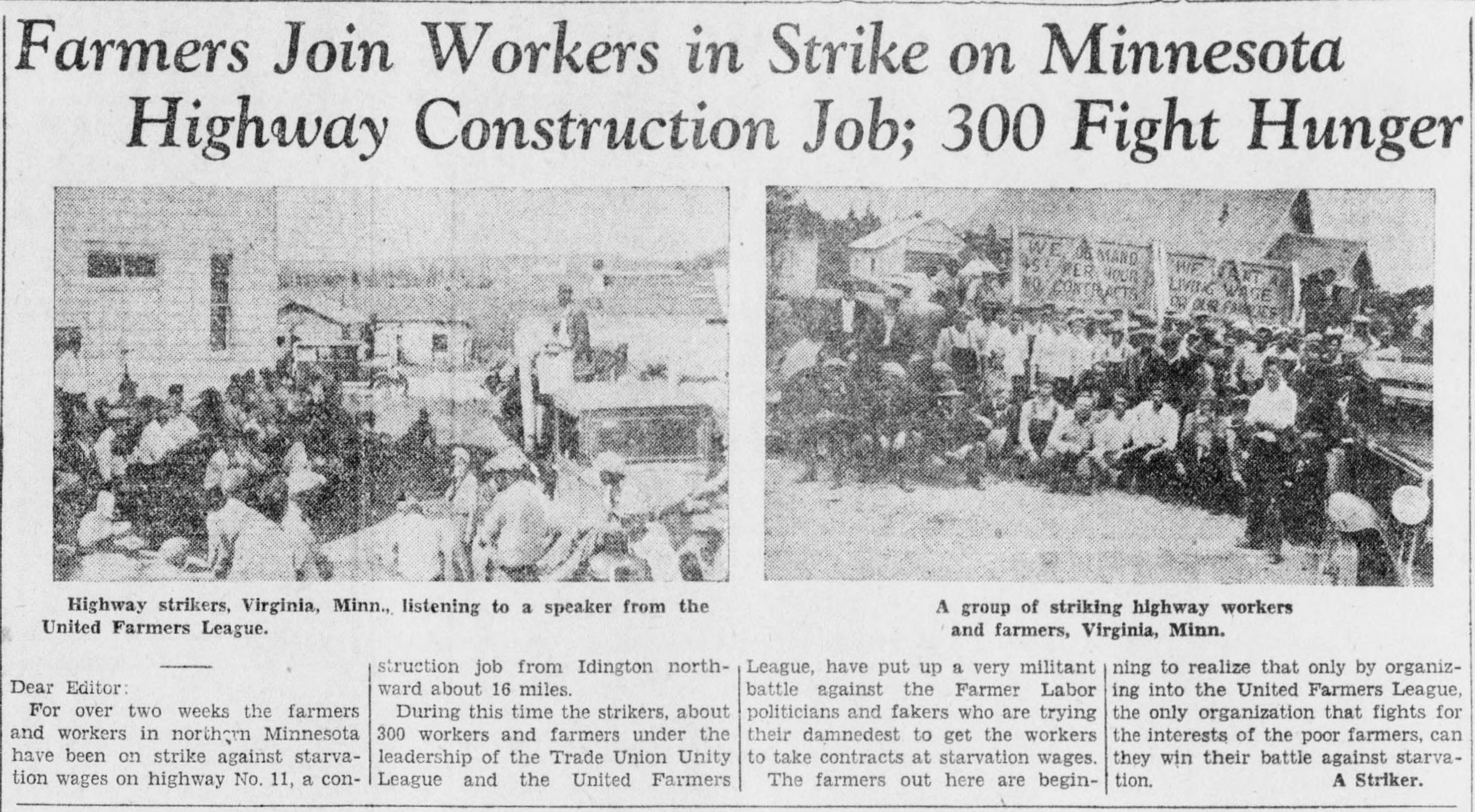
Still more tragic stories come from the South and the states immediately bordering the South. These stories tell how landlords are shooting down the poor tenant farmers on the slightest pretexts.
Tens of thousands of tenant and poor farmers are on the verge of starvation in these states.
HOOVER, HYDE, LEGGE AND COMPANY TRY TO FOOL FARMERS
Pretending to “help” the poor farmers in their miserable plight, President Hoover has created the so-called Federal Farm Board, through which he is expending huge sums for the bankers, assisting them further in their exploitation of the poor farmers. Secretary of Agriculture Hyde is compelled to admit in his report on the agricultural situation that, “due to the low world prices on agricultural products and the effects of the drought, the income from the production of 1930 is expected to be lower than for any season since 1921.” The only remedy he is able to suggest is the curtailment of production. Hyde refuses to consider any aid by the federal government for the farmers. He says, “It is evident that supply-and-demand conditions cannot be set aside by legislation, that the dumping of surpluses abroad is not feasible, that the indefinite storing of surpluses tends to prevent rather than to cause a rise of prices, that tariff duties are not effective on commodities produced largely for export, and that subsidies would increase rather than restrain production. Voluntary curtailment of production is the only logical remedy for the surplus problem.”
TRIES TO SHIFT BLAME UPON SOVIET UNION
Although compelled to admit that “in some parts of the country thousands of farm families will suffer privation,” Hyde refuses to suggest any remedy or aid for the impoverished farmers. Instead, he tries to shift the blame for the privations of American farmers from United States capitalism to the Soviet Union. By attacks against the Soviet Union in a number of speeches and interviews to the newspapers, Hyde tries to make millions of poor farmers in the United States believe that “Russian dumping” is to blame for their miserable plight, and warns that “the producers of the United States should watch carefully the possibility of keen competition from Russia for the next 10 years.”

Hyde’s attack against the Soviet Union has a twofold purpose: (1) he tries to relieve American capitalism of responsibility for the misery of millions of farmers; (2) he is preparing “public opinion” for an armed attack against the Soviet Union. We must expose these attacks and win over the poor and middle farmers for the defense of the Soviet Union by explaining to them the big improvements that have been achieved under the Soviet system for the farm population.
THE FARMERS WILL NOT BE FOOLED
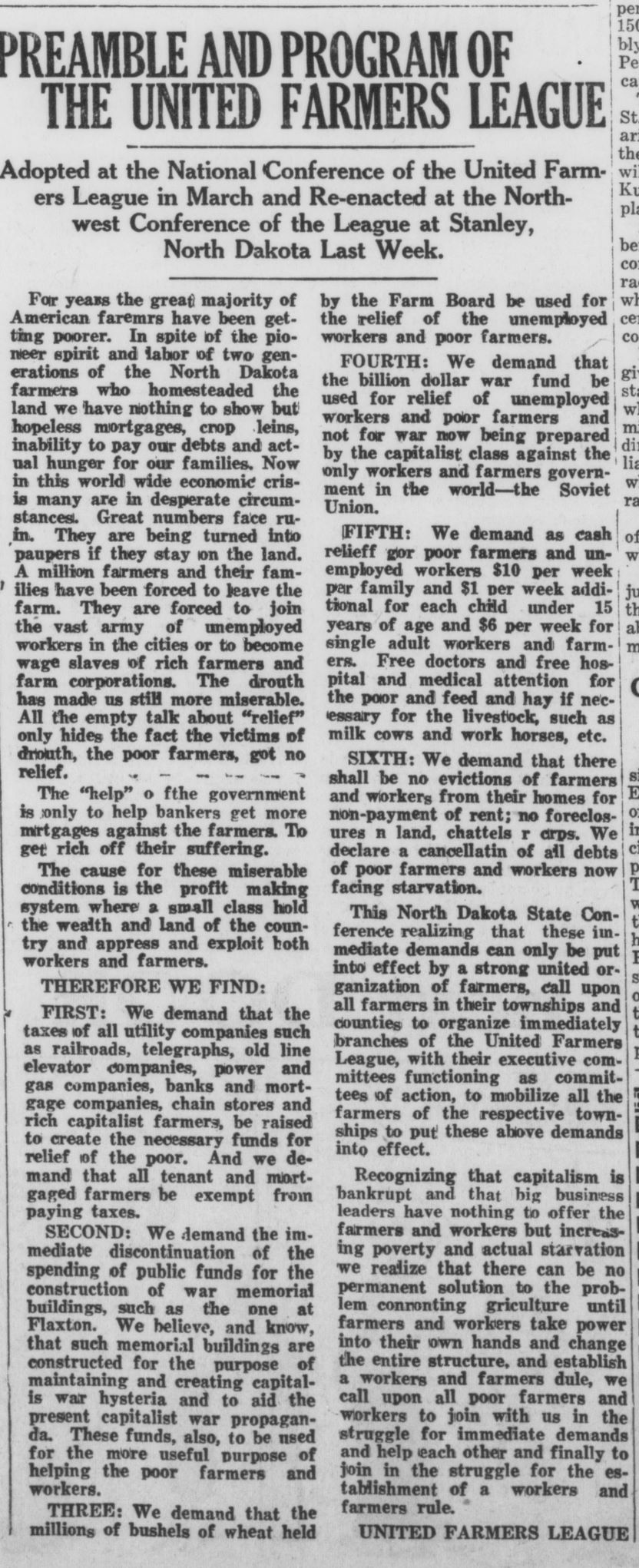
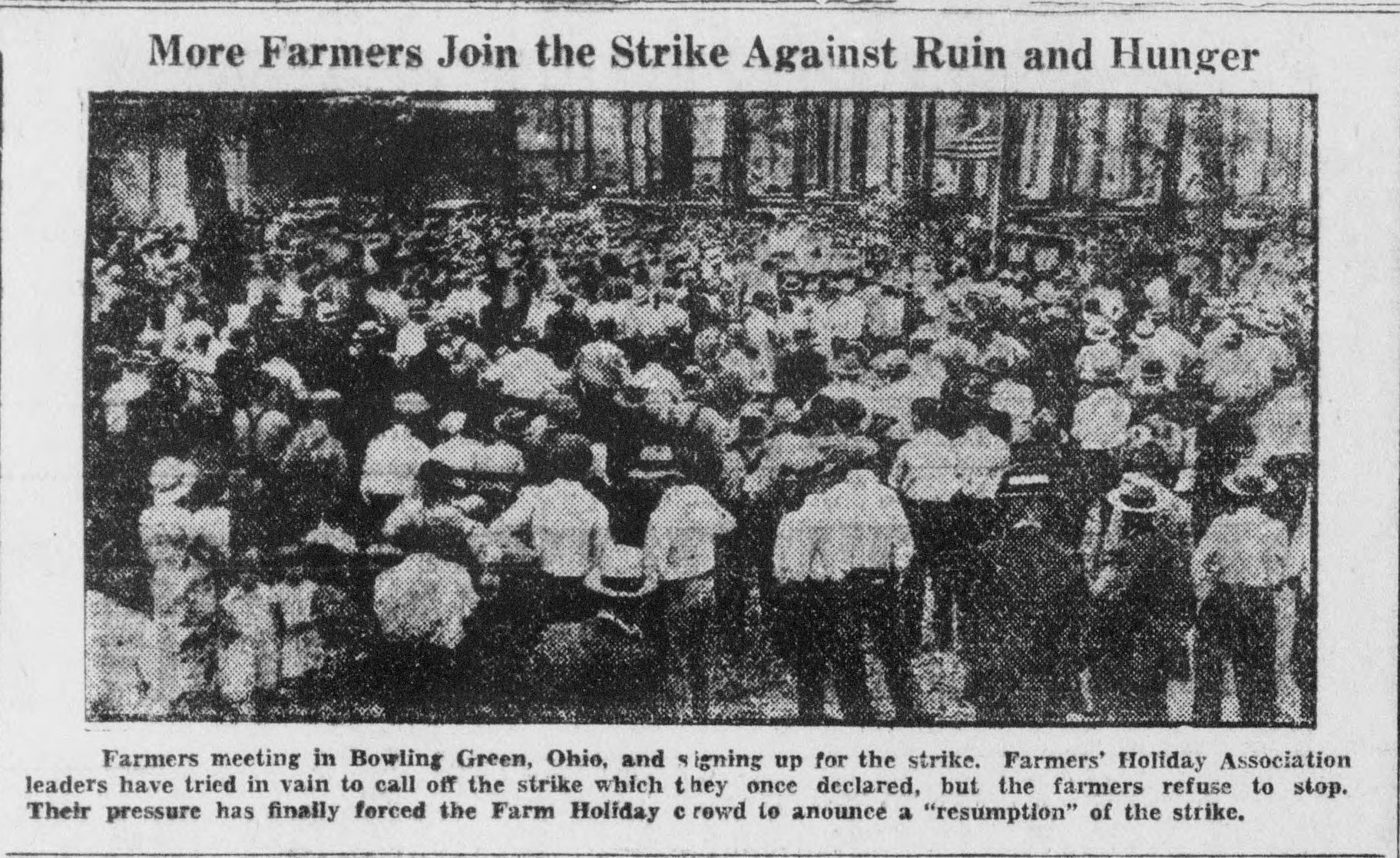
But in spite of the fake “remedies” of Hoover and his Farm Board man, Legge, and in spite of Hyde’s attacks against the Soviet Union, ever growing masses of oppressed and exploited farmers are showing readiness for struggle. This is shown partly by the increased Communist vote in many farming sections, especially in the South and in some northwestern states. Radicalization of the farmers is also clearly indicated in connection with the recent annual convention of the Farmers Union, in which the left wing elements won control of the organization on the basis of fighting against Hoover’s administration. The former leadership, which had worked hand in hand with the Hoover administration, was ousted from control. Of course it must be stated that the “left wing” in this convention was not clear. The “left” leaders will betray the interests of the poor farmers. But the revolt of the rank and file against Hoover supporters indicates a development of anti-capitalist. sentiment in one of the biggest farmers’ mass organizations. It is our duty now to give a clear perspective for these left wing elements and mobilize them into struggle against exploiters of the farmers and against allies of the exploiters within the farmers’ organizations. This split in the Farmers Union shows also the possibility of working in such existing organizations where there are a considerable number of poor farmers.
PRACTICAL TASKS IN THE AGRARIAN FIELD
The line laid down by the Seventh Convention and by the Central Committee Plenum must not remain on paper. It must be realized by beginning to do practical work in the agrarian field. The Central Committee has already adopted the Plan of Work, which must be a guide for our work in the immediate period. The following points in this Plan of Work are particularly important:

(1) Ideological clarification. It is necessary first of all to have ideological clarification on the agrarian question. For this purpose material has already been sent to the districts. ‘The Central Committee is preparing more material, and re-editing and re-publishing Lenin’s writings on American agriculture. ‘On the basis of this material, discussions must be held in every District Committee on the agrarian question. District committees must also arrange discussions in the sections, among the functionaries, and in the units. In these discussions the practical tasks must be linked up, applying our general line to local conditions.
(2) Development of practical program of action. The Central Committee has already decided to develop, on the line of our draft thesis, a practical program of action. This will be done in the near future, on the basis of further clarification and concrete study and experience that our Party is gathering. The incompleteness of our general concrete program should not, however, prevent each District and each section from developing its local action programs. On the contrary, these section programs will help us to develop our general program.
(3) Our Party must begin immediately to prepare and issue leaflets and pamphlets on the agrarian question. This is absolutely necessary so that we can agitate and properly educate the poor farming population for the class struggle against capitalism, in alliance with the industrial workers and under the leadership of the Communist Party. The Central Committee has already taken. steps in this direction. When we have some agrarian literature we will have additional means of approach to the farmers.
(4) Circulation of the United Farmer is one of our immediate and most important tasks. Now that this paper has been revived, it must be made the popular fighting organ and organizing of tenant, small, and a section of the middle farmers. In every district committee an agent must be immediately elected for the distribution of the United Farmer. Districts, sections, and units must order bundle copies of the United Farmer and arrange Sunday visits to the countryside, for distribution of this paper and at the same time to make contacts with the farmers and develop friendly relations between the industrial workers and the poor farmers.
(5) Development of local demands. Besides circulating the paper, one of the purposes of the Sunday visits of our comrades to the countryside must be to study conditions and grievances of the farmers and find out on what points they are ready for immediate action and struggle. On this basis local demands must be formulated and farmers organized into action under the leadership of the United Farmers League township committees, Tenant Farmers Action Committees, and the like. In the process of these activities the United Farmers League can be built upon a mass basis.
(6) Laying basis for Agricultural Workers Union. In our agrarian work the agricultural worker, of course, is the most important element. These workers are most ruthlessly exploited. It is our duty to assist them to organize themselves. Therefore we must, in agrarian work, make contacts with these workers and help the Trade Union Unity League to organize them into the Agricultural Workers Union.
(7) In the South we must make special efforts to win over the Negro agrarian laborers, share croppers, tenant and poor farmers, who are subjected to conditions of feudal slavery and race hatred. In the work in the southern agrarian field, the Agrarian Department must work in close collaboration with the Negro Department of the Central Committee.
ALLIANCE OF WORKERS AND FARMERS
Lenin has taught us that the proletarian revolution, especially in countries where peasants form a considerable portion of the population, is impossible without winning a decisive section of poor and middle farmers to the side of the revolutionary class struggle. The farmers are a very important section of the population in America, and only through the alliance of these sections of the rural population with the American proletariat, under the leadership of our Party, can we make the proletarian revolution successful.
There are a number of journals with this name in the history of the movement. This ‘Communist’ was the main theoretical journal of the Communist Party from 1927 until 1944. Its origins lie with the folding of The Liberator, Soviet Russia Pictorial, and Labor Herald together into Workers Monthly as the new unified Communist Party’s official cultural and discussion magazine in November, 1924. Workers Monthly became The Communist in March, 1927 and was also published monthly. The Communist contains the most thorough archive of the Communist Party’s positions and thinking during its run. The New Masses became the main cultural vehicle for the CP and the Communist, though it began with with more vibrancy and discussion, became increasingly an organ of Comintern and CP program. Over its run the tagline went from “A Theoretical Magazine for the Discussion of Revolutionary Problems” to “A Magazine of the Theory and Practice of Marxism-Leninism” to “A Marxist Magazine Devoted to Advancement of Democratic Thought and Action.” The aesthetic of the journal also changed dramatically over its years. Editors included Earl Browder, Alex Bittelman, Max Bedacht, and Bertram D. Wolfe.
PDF of full issue: https://www.marxists.org/history/usa/pubs/communist/v10n02-feb-1931-communist.pdf
 Revolution's Newsstand