
The story of the dogged strike of the Boot & Shoe Workers’ Union aided by the I.W.W.’s Local 173 against the Frank & Hymans Company in 1913.
‘San Francisco Shoe Workers’ Strike’ by F. Monaco from the International Socialist Review. Vol. 13 No. 11. May, 1913.
THE strike at Frank & Hymans shoe factory, San Francisco, has demonstrated that even a craft strike may be effective, if carried on in an intelligently militant spirit. This firm occupies a small plant at Eighteenth and Bryant streets, employing eighty to one hundred hands, and paying to the operatives from $14 to $18 a week, the “apprentices” (boys and girls of 15 to 17) getting $3.50 to $5 a week.
Making a specialty of the higher grade of women’s footwear and having the only plant of this kind in the northern part of the state, this company has a constant market for all of their output. The firm has enjoyed a large degree of prosperity, and has not even the excuse of a dull market to justify their attempt to reduce the wages of their employes.
In the beginning of October, 1912, the employes were asked to accept a voluntary reduction of 25 per cent. This they unanimously refused to do. The firm name at this time changed from “The Kutz Shoe Company” to Frank & Hyman Shoe Company. It was necessary to obtain a new union stamp from the Boot & Shoe Workers’ Union. Соnsеquently the firm was afraid to reduce the scale until the union had granted the new stamp. Some of the shrewder members of the union advocated withholding the new stamp until sufficient assurance was forthcoming that no attempt would be made to force a reduction in wages, and they convinced the union that this was the correct course to take.

The firm of Frank & Hyman then decided to eliminate the men who opposed them successfully in the union by forcing them to look for work in some other community. To this end it was announced that the factory would close down for three weeks “for the purpose of taking stock,” and all the hands laid off for this period.
During the first week of January all these workers who had taken a determined position against the reduction of wages were notified to come to the factory and get their tools. The others were notified to return to work at a 25 per cent reduction. A meeting of the union was called, and a demand made that the old scale be paid, and that none of the old employes be discriminated against because of their activities in the Union. The demands were refused, and a strike called. Every last member of the workers stood with the Union. Over $600.00 was spent by Frank & Hymans to bring scabs from St. Louis; most of whom deserted as soon as they landed in San Francisco. Although about twenty people “have been kept at work” in the plant there has not been a single case of shoes turned out since the strike was called.
The successful tie-up of the plant has been largely due to the activity of I.W.W. local 173, whose headquarters are not far from the factory. From 4:30 to 5:30 a “chain picket” is maintained while the scabs are leaving the factory, the strikers and their sympathizers forming a long line, singing “Casey Jones,” “Scissor Bill,” “Out in the Bread Line,” and other I.W.W. songs. Every Friday is “woman’s day.” All the working women for blocks round join in the picket line. The pickets followed the strike-breakers home during the first few weeks of the strike, and succeeded in getting most of them to quit work.
In case of refusal to quit a picket line was formed in front of his house the following Sunday morning, and a banner carried saying that a scab resided in the house. The employers learning of the success of this plan, engaged automobiles to carry the scabs home so that the picket could not follow them home to learn their addresses.
The union then had a man follow the autos on a motorcycle. This enabled them to continue successful in picketing the homes of the scabs. The peaceful and successful conduct of the strike has exasperated the employers beyond endurance. Hyman deliberately ran down the picket on the motorcycle, since which time constant efforts have been made to intimidate the strikers by thugs and gunmen.
During the second week of the strike four members of the shoe workers union, and three members of the I.W.W., were arrested while peacefully picketing, and charged with “vagrancy.” The charges were so palpably false that they were dismissed in court.
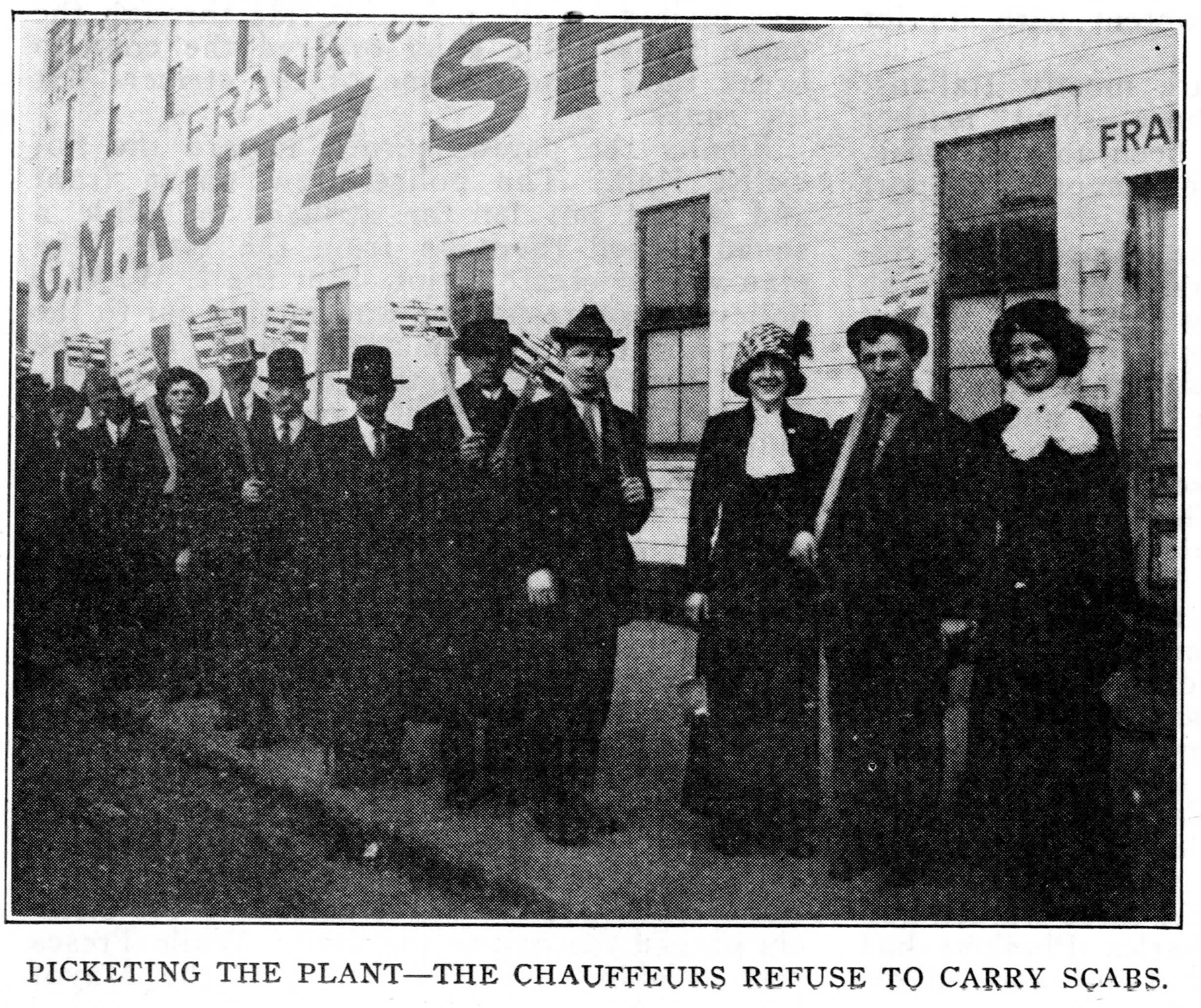
A day or two later a thug menaced two strikers with a gun. He was prevented from using it by bystanders. The police arrested the men who were menaced, and summoned the gunman as a complaining witness. Judge Deasy dismissed the charges against the unionists, and fined the gunman $20.00 for carrying a concealed weapon. A few days ago two thugs engaged in a fake fight while a unionist was passing by. One of the thugs drew his gun with a pretended attempt at self-defense, but with the evident intent of shooting the unionist who was passing. One of his bullets hit Judge Sullivan, who was passing at the time. The thug was arrested and charged with carrying concealed weapons, assault and battery, and attempt to commit murder.
The strike has been carried on in a brilliant and cool-headed manner. The aid and co-operation of the Radicals has resulted in most of the strikers joining the I.W.W. The probability is that the employers will yield before this is read by the public.
The strike has continued since the early part of the year, and is still on. In all there has been twenty-six. arrests of the strikers’ pickets and only one conviction. There are five suits pending in the civil courts by the strikers against Hyman · for damages for false arrest. The suits aggregate $50,000. Until lately not a case of shoes has been turned out. They are now turning out 60 cases. It requires 250 cases to pay “overhead” expenses (clerical help and wear and tear). Some days ago Judge Sewell of the superior court issued an injunction forbidding the strikers picketing. They continued to picket in defiance of the injunction. On the day named they appeared in court “to say why the injunction should not be made permanent.”
The attorney for Frank & Hyman did not appear. On motion of the attorney for the Shoe Workers, Frank & Hyman were given ten more days in which to appear and say why the injunction should be made permanent and the temporary injunction continued. In the meantime the strikers continued to picket regardless of court procedure. Frank & Hyman have offered to take all the strikers back at the old scale and grant all the demands of the strikers, except that seven “agitators” cannot come back to work. The strikers say they will not return till all return.
The International Socialist Review (ISR) was published monthly in Chicago from 1900 until 1918 by Charles H. Kerr and critically loyal to the Socialist Party of America. It is one of the essential publications in U.S. left history. During the editorship of A.M. Simons it was largely theoretical and moderate. In 1908, Charles H. Kerr took over as editor with strong influence from Mary E Marcy. The magazine became the foremost proponent of the SP’s left wing growing to tens of thousands of subscribers. It remained revolutionary in outlook and anti-militarist during World War One. It liberally used photographs and images, with news, theory, arts and organizing in its pages. It articles, reports and essays are an invaluable record of the U.S. class struggle and the development of Marxism in the decades before the Soviet experience. It was closed down in government repression in 1918.
PDF of full issue: https://www.marxists.org/history/usa/pubs/isr/v13n11-may-1913-ISR-riaz-ocr.pdf
 Revolution's Newsstand