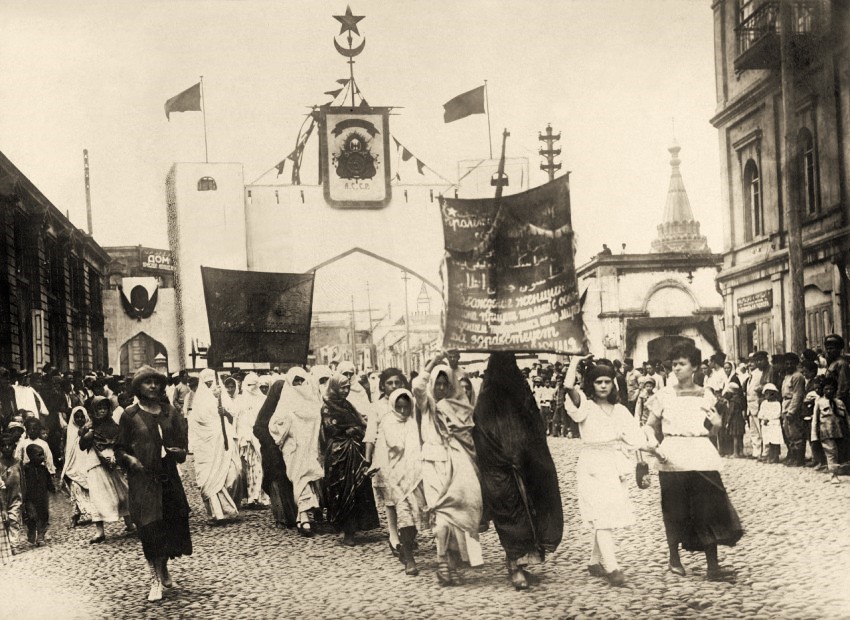
A history of women’s organizing in Baku from the turn of the last century, includes a number of short biographies of leading activists.
‘The Working Women of Baku’ by E. Arlore Ralli from International Press Correspondence. Vol. 3 No. 51. July 19, 1923.
On the occasion of the International Women’s Congress in March last, the daily paper of the Communist Party in Baku, the Bakunski Rabotschi (The Baku Worker), threw a vivid light on the history of the labor movement, and on the part played by the working woman in this movement. We append some of the data thus published, as also descriptions of the lives of some of the women most active in the movement. The working women of Baku have participated in the labor and socialist movement since 1902. The first of these, who took part in the illegal organizations of the workers, were dressmakers and milliners in the centre of the town. The first to form social political circles were Jewish social democratic dressmakers from the western provinces, members of the “federation”.
These circles were able to take the form of schools for adults. Besides the dressmakers and milliners circles, which were not only attended by the working women from outside the town, but also by the natives of Baku, who at first crowded the schools in their eagerness to learn to read and write, there were also similar circles formed in the five, tobacco factories of the city. The number of working women taking part in these circles was, however, still very small up to 1914. Propaganda and agitation were chiefly carried on by the youth of Baku (male and female students). There was no special organization for women. The women propagandists even visited the petroleum works, in order to get into communication with the workers. It is remarkable that up to the war, the number of working women in Baku was comparatively much fewer than in Central Russia. Whilst in Russia, according to the official reports issued by factory inspectors in 1900, 25% of the workers were women (this percentage rising to almost 45% by 1912), in Baku the proportion of female workers had only reached 28% by 1920-21.
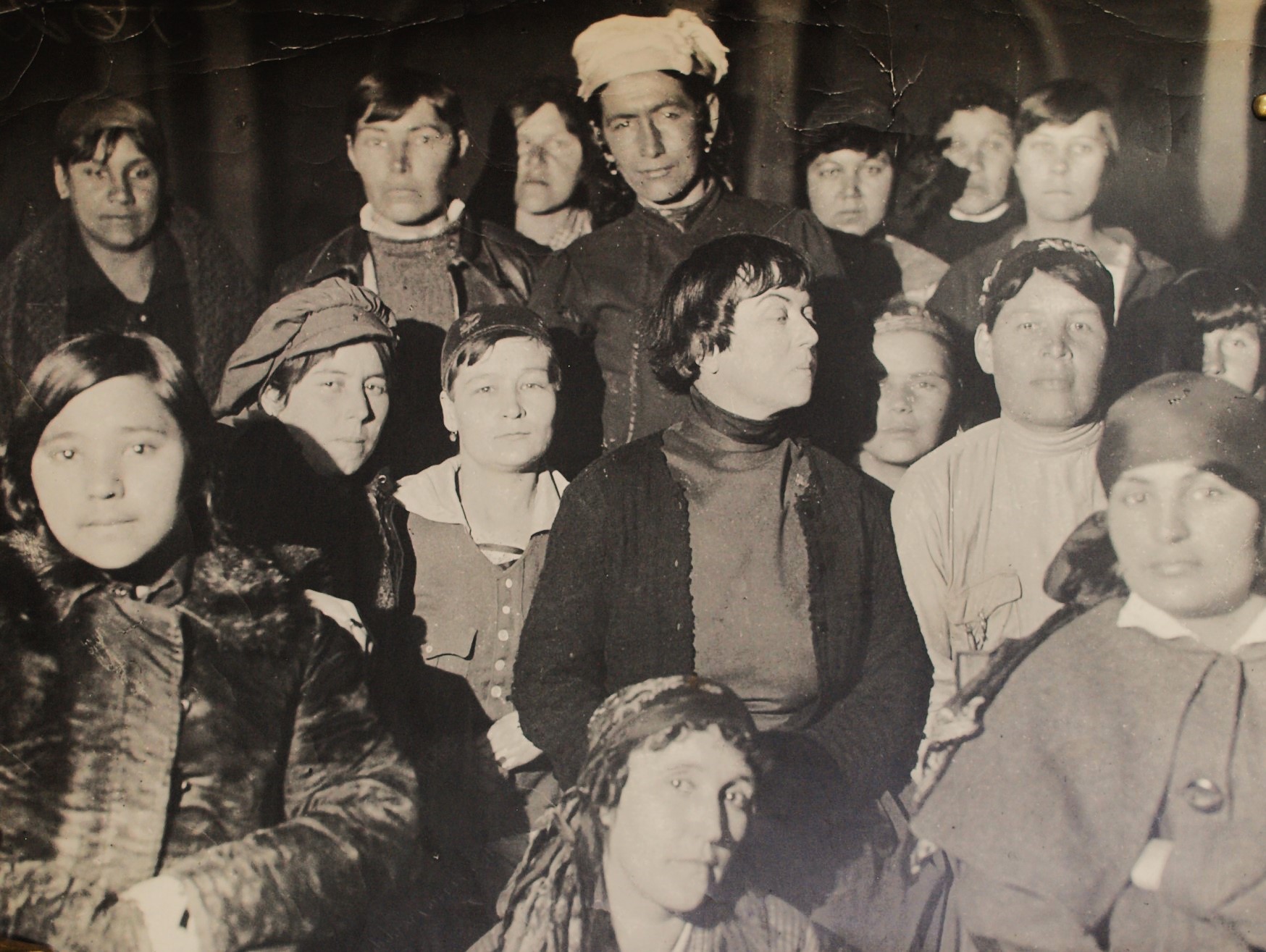
In 1914, and during the years of the war, the proletarianizing of women made rapid progress, and at the same time the women workers movement began to be better organized. The working women are gradually entering the trade unions, are taking active part in the trade union movement, and even becoming members of the trade union committees. In 1914, the working women took part in a strike of the petrol workers. The wives of the workmen revolting against exploitation by the government, organized a demonstration in the streets of Baku. The police dispersed them with knouts. 40 women were “ill-treated and sent to prison. 2 of these women were seamstresses who sympathized with the striking workers. In 1916, the membership of the tailoress’ trade union had already risen to 100. In 1915-16 the need for special propaganda among women became apparent, political consciousness being insufficiently developed. In 1915 the International Women’s Conference was celebrated for the first time in Baku, by a meeting of trade union women workers. On the 8th of March 1916, another meeting took place, participated in by 3 trade unions. Since this time the women workers’ movement has developed rapidly in Baku. Questions relating to women’s work are discussed at all trade union conferences. At the 1st trade union conference in Trans-Caucausia, the question of labor protection for women and children was placed on the agenda. In 1917, the municipal administration of Baku created a labor section dealing chiefly with this question. The organized workers speedily realized the importance of the participation of women in the orginizations. Despite this, in 1918 there were still only 2 trade unions into which women entered as members in any large numbers, these being the trade union of the textile industry, in which the percentage of women was 15.8, and in the sewing-workers trade union, in which the percentage was 4.8. Among all the 22 trade unions in existence, the men held the majority in 17, whilst women were represented in greater numbers in 5 unions only. The provision workers trade union with 70.3% of women, the textile trade union with 75.7%, the trade union of the employees of public health with 62.5%, the trade union for school teachers with 56.1%, and the sewing workers trade union with 58.8%.
In 1917, the women workers movement in Baku suffered from the influence of the bourgeois Women’s League for political rights. It is since 1920, when the Azerbaijan republic became a Soviet state, that the women workers’ movement has been really proletarian in character. Since this time, large numbers of women have found their way into the various branches of industry, and the political movement amongst women has spread greatly.

In 1922, since the introduction of the New Economic Policy, the number of female members of the trade unions fell from 28% to 14.7%; but although there has been a stagnation in the development of the economic movement, the political class consciousness of the working women of Baku has continued to develop. Since 1920 the Communist movement has extended not only to the working women of Baku, but also to the unenlightened masses, and even to the Mussulman peasant women. The Mussulman woman participates in the election the same as the man, and is even herself elected to the Soviet.
One of the most active women in the movement is comrade Nazrova. Since her youth she has been interested in socialism, and, at the age of 52, she is as energetic and active as ever. She was a seamstress and member of the trade union, and entered the revolutionary movement in the year 1917, at the age of 47. At that time she worked in a hospital, and became a member of the trade union committee for health. In 1919 she was a member of the communist secret organization in Baku, and was frequently commissioned with the execution of dangerous tasks. Since 1921, she has been working in the women’s section for propaganda among the women of the party, and has been a member of the municipal council for 3 years.
Comrade Mamedova Okima, a Mussulman working woman, has undergone all the hardships to which an oriental woman is subject. At the age of 12 she was sold to a rich merchant, with whom she lived 11 years. In the year 1920, she heard for the first time words concerning the emancipation of the Mussulman women. In 1921 she entered the women’s club, attended various courses of instruction there, became a member of the Communist Party, and has been working since 1922 in the women’s section at Baku. She is chiefly occupied with work for the children’s homes, creches, and schools. At the same time she is a member of the municipal council, and works in the section for public instruction. She acts as advocate in women’s trials, and energetically defends the rights of mothers.

In 1918. Comrade Provoka, the daughter of poor peasants, entered the asylum for foundling children as a servant girl. She could neither read nor write. She made the acquaintance of comrades who were spreading propaganda for the revolution, and from 1915 she took part in this work. In 1918 she entered the trade union, and since 1919 she has been a most energetic member of the Communist Party, at that time still existing in secret. Although she continued her work in the hospital, she carried on active propaganda among the women at the same time; she is one of the most popular women agitators in Baku.
The ECCI published the magazine ‘Communist International’ edited by Zinoviev and Karl Radek from 1919 until 1926 irregularly in German, French, Russian, and English. Restarting in 1927 until 1934. Unlike, Inprecorr, CI contained long-form articles by the leading figures of the International as well as proceedings, statements, and notices of the Comintern. No complete run of Communist International is available in English. Both were largely published outside of Soviet territory, with Communist International printed in London, to facilitate distribution and both were major contributors to the Communist press in the U.S. Communist International and Inprecorr are an invaluable English-language source on the history of the Communist International and its sections.
PDF of full issue: https://www.marxists.org/history/international/comintern/inprecor/1923/v03n51[30]-jul-19-1923-Inprecor-loc.pdf
 Revolution's Newsstand