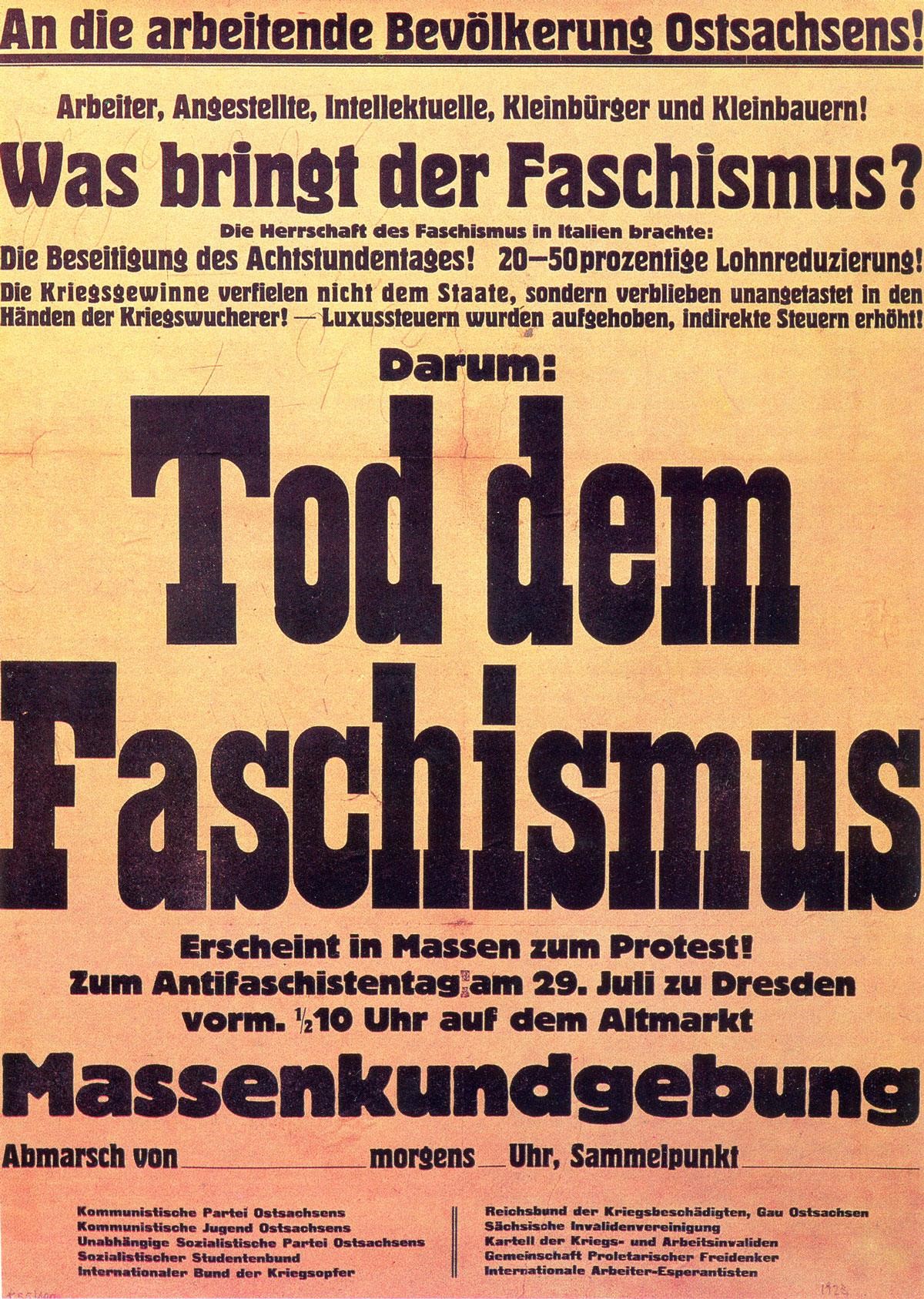
‘Anti-Fascist Day in Germany’ from International Press Correspondence. Vol. 3 No. 55. August 9, 1923.
The appeal issued by the Communist Party, to demonstrate on July 29 against the Fascist danger, was responded to by millions of workers in all parts of the country. The bourgeois press prepared for the day with a savage pogrom agitation against the working class, and especially against the communists, with the cry that “the communists are going to strike their first blow on the 29.” The government of the Republic impressed upon the provincial governments that all public demonstrations and meetings were to be prohibited. The majority of the provincial governments immediately followed this advice, above all the minister for internal affairs in Prussia, the social democrat Severing. It was only in Saxony and in Thuringia that the governments were unable to issue any prohibition against demonstrations, owing to the pressure of the working masses.
After the prohibition had been issued, the Communist Party gave out the watchword of closed meetings, i.e. meetings in public halls and enclosed spaces. Social democrats and bourgeois rejoiced at the retreat of the communists. But the 29th of July showed that this apparent retreat was in reality a mighty advance of the working class under the leadership of the Communist Party. Never before has a summons issued by the C.P. been followed by such enormous masses. In Berlin, where 17 meetings were arranged for, overflow meetings had to be held in every case. Despite the prohibition, and despite the large force of constabulary brought into service, the workers did not allow themselves to be forbidden the streets. Those who took part in the meetings left the buildings afterwards bearing red flags, and singing revolutionary songs. Thanks to the iron discipline exercised by the working class, there were no bloody collisions on Anti-Fascist day. But the day before, the police fired on workers demonstrating against starvation in Neuruppin. The result was two dead and seven severely wounded.
According to bourgeois estimates, 160,000-180,000 workers took part in the demonstration meetings in Berlin. We do not over-estimate if we judge the number of participators to have been a quarter of a million.
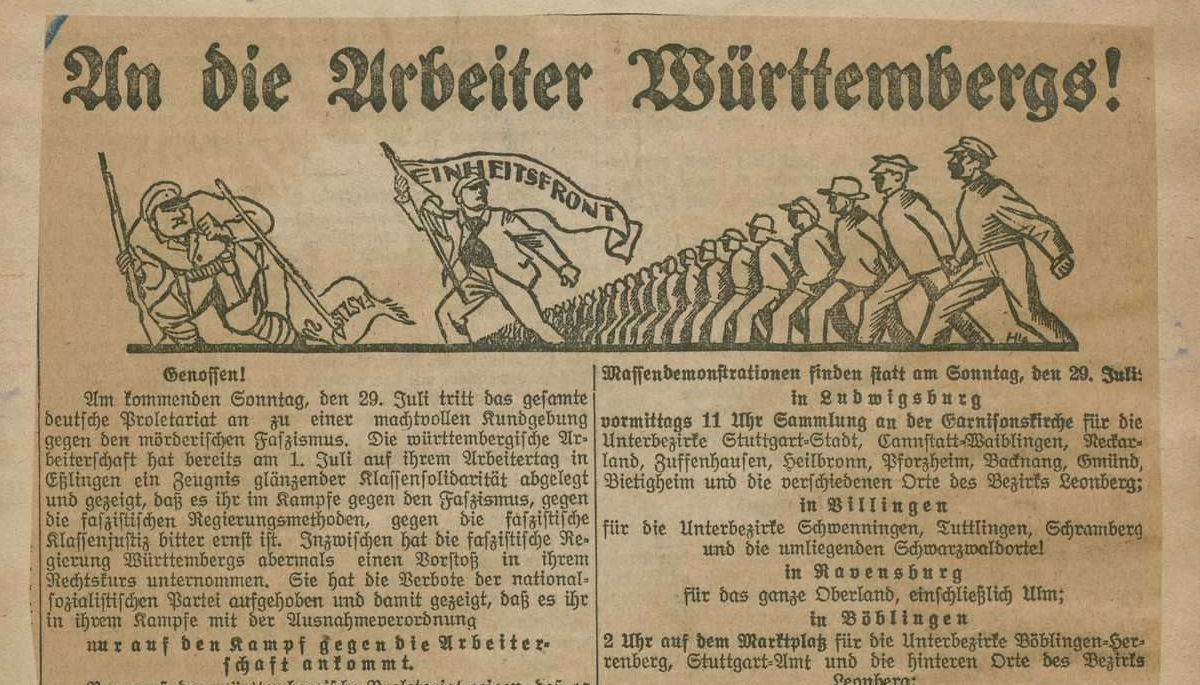
The demonstrations in Saxony and Thuringia, promoted with the idea of the united front, were of an especially impressive character. Here there were no police to be seen, and the workers marched out headed by their defence units. In Dresden 20,000 workers took part in the demonstration processions, in Chemnitz 50-60,000, in Leipzig 30,000, in the Zwickau district 17,000. In Bad Elster, the demonstration took the form of a fraternization festival with the workers of Czecho-Slovakia. About 200 comrades from Czecho-Slovakia took part in the procession which numbered 12,000. In Jena, the number taking part in the demonstration was 10,000, in Gotha over 25,000, in Meiningen 15,000, in Gera over 8,000. The meetings everywhere in Thuringia filled to overflowing. In Halle, an attempt made by the Fascisti to attack the workers’ institutions was defeated by the workers’ defence units. In Breslau, over 10,000 men demonstrated, and all over Silesia the meetings were equally well attended.
In the strongholds of Fascism, such as Potsdam, Bavaria, and Wurtemberg, the workers held fast to their right to demonstrate. In Munich there was even a demonstration pro- cession. In Wurtemberg 5 localities held demonstrations, with a total of 100,000 workers.
In Baden, where there was no prohibition, the Mannheim comrades arranged a demonstration participated in by 17,000.
In the occupied territory, where the French soldiery worked hand in hand with the German Fascisti against the Anti-Fascist day, great demonstration meetings were held in spite thereof. Over 20,000 workers demonstrated in the sport grounds at Emst near Hamm. And in other places in the occupied territory the demonstrations were attended by large numbers.
The Fascisti, who had announced great counter-demonstrations, sneaked quietly away. The day was a complete victory for the Communist Party, a review of the millions of our army before we enter into the great struggles which are approaching.
The ECCI published the magazine ‘Communist International’ edited by Zinoviev and Karl Radek from 1919 until 1926 irregularly in German, French, Russian, and English. Restarting in 1927 until 1934. Unlike, Inprecorr, CI contained long-form articles by the leading figures of the International as well as proceedings, statements, and notices of the Comintern. No complete run of Communist International is available in English. Both were largely published outside of Soviet territory, with Communist International printed in London, to facilitate distribution and both were major contributors to the Communist press in the U.S. Communist International and Inprecorr are an invaluable English-language source on the history of the Communist International and its sections.
PDF of original issue: https://www.marxists.org/history/international/comintern/inprecor/1923/v03n55-[33]-aug-09-1923-Inprecor-cpgb.pdf
 Revolution's Newsstand