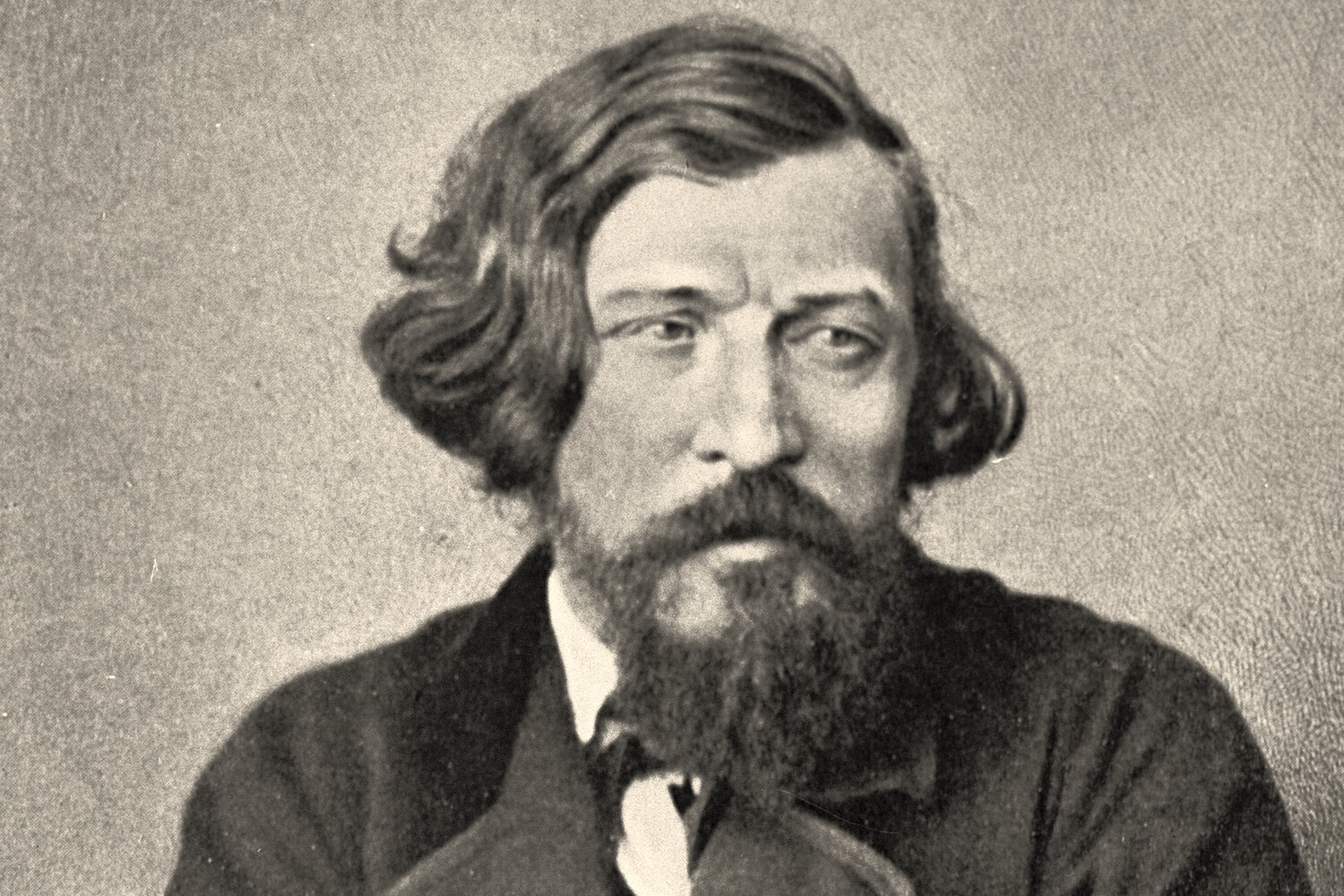
The ‘Father of Narodinism,’ Nikolay Chernyshevsky is remembered by thousands at New York’s Cooper Union on his passing in Siberian exile in 1889. Just two years after the Haymarket martyrs’ execution, among the speakers quoted in this snapshot of a remarkable event is Johann Most
‘Thousands Assemble to Honor Tchernyshewsky’s Memory’ from Workmen’s Advocate (New Haven). Vol. 5 No. 46. November 16, 1889.
Staevitch’s Tribute to the Russian Author and Martyr – “It is the Same Fight on the Banks of the Neva and on those of the Hudson” – Hugh O. Pentecost Tells How He Found His Mistake – Tchernyshewsky His First Teacher.
On Friday evening last the large hall of Cooper Union was filled to overflowing with an enthusiastic audience consisting for the greater part of Russians, men and women, who had come to honor the memory of the dead Russian author Tchernyshewsky, the father of the socialistic movement in the dominion of the Czar. The banners of the Russian Progressive Union of Newark, the Shirt Maker’s Union of New York and the Socialist Labor Party of New York were displayed from the platform. N. Stoleshnikoff and B. Gretch presided. Speeches were made by S. E. Shevitch, Hugh O. Pentecost and John Most.
Shevitch began: “The man whose memory we honor to day was buried in the icy prison of Siberia for nearly a human age. Certainly, he was tried and found guilty. But is every one guilty who is found guilty by a court? (Cries: No!)
“Men are imprisoned, sent to Siberia, even hung, but does this prove their guilt? (No!)
“If a man is hung in Russia, does this prove that he was guilty? (No!)
“If a man, or a number of men, are hung in America, does this show that they were guilty? (No!).
“Was John Brown guilty, when he was executed by the authorities of the State? (Enthusiastic cries: No!)
“Were those five men, whose memory we will honor in this hall on the eleventh of November, and who were hung in Chicago two years ago, were these five men guilty? (Loud and enthusiastic cries: No!)
“Institutions such as those under which Tchernyshewsky was buried alive in the icy prison of Siberia,” the speaker proceeded, “do not exist in Russia alone. Political institutions do not alter circumstances, when exploiter and exploited are placed face to face with each other. The fight is the same on the banks of the Neva and on those of the Hudson. Those who produce and do not possess are the natural enemies of those who possess and do not produce. The latter are always ready to let loose the police and the courts against the former. This country, free and independent by the grace of Silver Dollar Smith, is in this respect in no way superior to the countries of Europe.”
The speaker then went on to tell the audience how Tchernyshewsky was found guilty tor publishing his works, without regard to the fact that the Censors of the government, through whose hands the manuscripts had passed, had approved of them. “Today,” he continued, “his name is honored even by the governing- powers, and still he was a bearer of the red flag!

“Intelligence is no more with the speculators of Wall street, no more with the sickly race of the British lords, no more with the rubbish called politicians in this country, but with the masses! We have no love for the country that allows itself to be ruled by thieves and rascals. Our patriotism is to emancipate the country from those leeches.
“Everywhere, in all countries, we are opposed by brutal force. Be it so! But may the rulers of this world remember that he who raises the knife will fall by the knife! The thinkers show the world that certain changes must come. The changes are not the work of the thinkers. We tell the judges, hangmen, Czars and policemen: Beware!
“What had you thought of a number of men, who at the recent flood in the Conemaugh Valley, had tried to oppose the flood by pressing their bodies against it? You would have considered them fools!
“Well, no more can any body of men, however powerful they may be, oppose the social flood which will overcome them. The manses will march over them without regard to the miserable rubbish at their feet. We know that the future is ours!”
Hugh O. Pentecost followed, and in a very powerful speech declared how he had come to believe that Socialists, Anarchists and. Nihilists drank blood three times a day. “I was a minister of the church.” he began, “about as far from the working people as it is possible for a man to get! I was brought up in the belief that really good people could only be found among the so-called respectable classes, t was brought up to hate the foreigners as people who were always ready to cut our throats, and I was of the opinion that the police forces were instituted by a special decree of God Almighty to keep them in their cages.”
The speaker then related how, little by little, he found that he had been mistaken; but what brought him to think was the trial of the Chicago Anarchists. He followed up the history of their trial and found that he would be proud if he were like one of them. I uttered this, my opinion, in the church, but had I thrown a bomb into the midst of my congregation it could not have created greater consternation,” he continued. “The consequence is, that I am no more among them. Later the book of the author whose memory we honor today a novel, called What is to be done, fell into my hands, and I learned from this foreigner more than I had learned from all my fellow citizens before. Socialists, Anarchists and Nihilists, though differing somewhat in their philosophy, practically want the same thing. The Americans of future generations will be glad to trace their descent to men like Albert Parsons. It seems to me as if the day of emancipation were near. It may be that we shall live to see that day. Let us prepare and let each of us do his duty!”
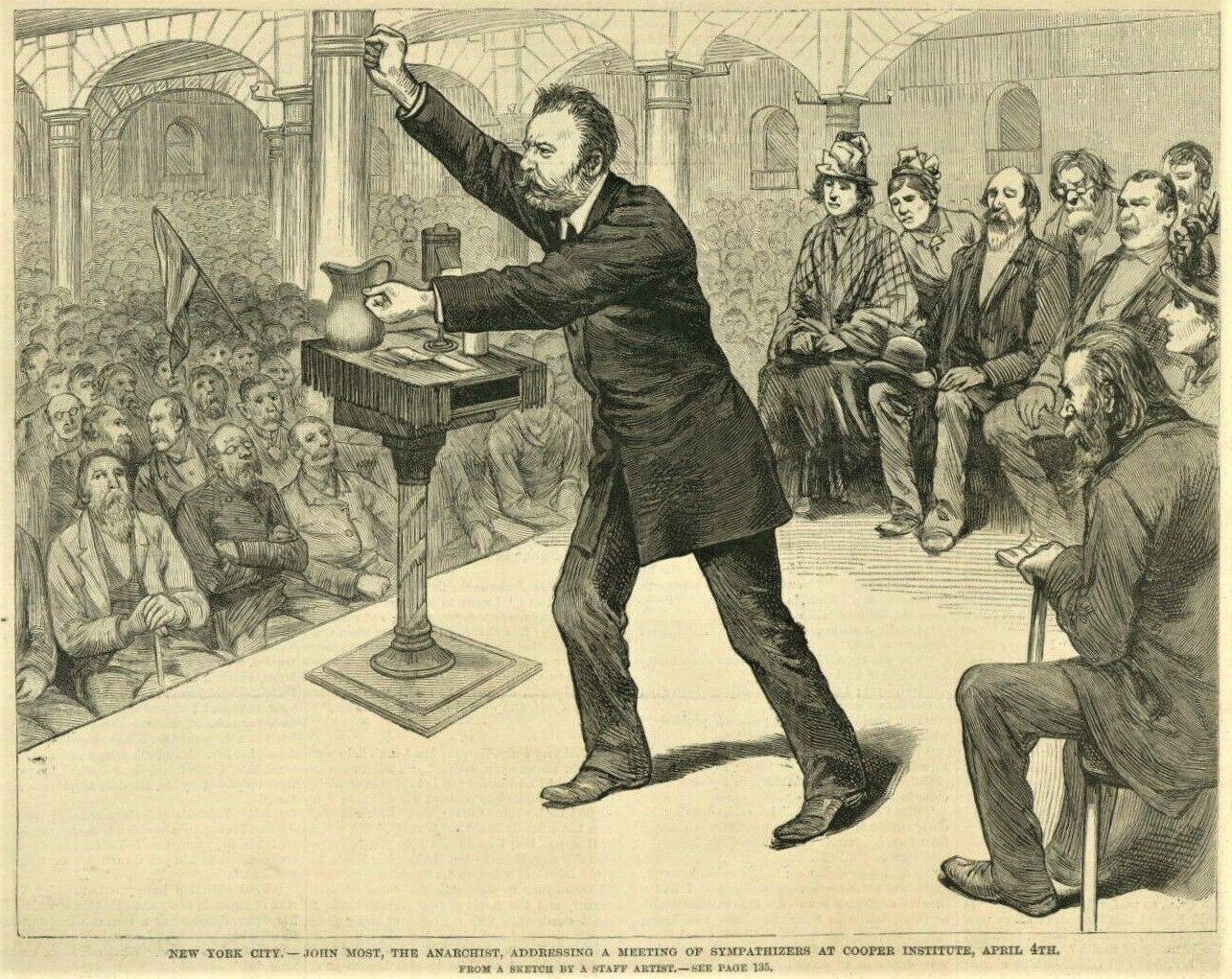
Johann Most, the next speaker, said:
“We to-day honor the memory of a man who, though continually under the threatening cloud of death, can never die; of a man who, whenever he used his pen, made the inmates of palaces tremble, and whose name will still be remembered when the ashes of the mummy of the last king are cast to the winds. Mot every day brings forth Shakespeare, a Goethe, a Darwin, Spencer, or a Tchernyshewsky. It is grand that Russia, the land or bondage, should bring forth the man who first discovered the principles of modern socialism. From Kamtshatka to Warsaw, from Archangel to Odessa, the people may think a star has fallen, but the star Tchernyshewsky still beams on the firmament. A spirit like his cannot die. The powers of Europe have so far looked on the Russian Empire as the stronghold of despotism. Now it has been infested with revolutionary ideas and every revolutionary Socialist looks hopefully to the hast. It is no boast, it is no threat, for the iron law of history decrees it that Czarism will vanish. The third Alexander will follow the second, and then will follow all the emperors, kings, law makers and exploiters. It is not possible that nine-tenths of the people will allow themselves to be exploited by the small tenth much longer. It is not possible, that they will further allow the best of the people to be sent to the scaffold. It is not possible that murders like the crime of Chicago can be repeated. The days of coercion and tyranny are numbered. It cannot go on much further. Long live the Social Revolution”
M. Zametkin, the last speaker, illustrated the noble character of the Russian martyr and his high standing in social science and political economy and this giant of thought.” he said “was buried for nearly a human age in Siberia, without books or any other spiritual nourishment.”
A collection, which was taken up during the meeting, brought $77.07. more than enough to cover the expenses of the meeting.
The Workmen’s Advocate (not to be confused with Chicago’s Workingman’s Advocate) began in 1883 as the irregular voice of workers then on strike at the New Haven Daily Palladium in Connecticut. In October, 1885 the Workmen’s Advocate transformed into as a regular weekly paper covering the local labor movement, including the Knights of Labor and the Greenback Labor Party and was affiliated with the Workingmen’s Party. In 1886, as the Workingmen’s Party changed their name to the Socialistic Labor Party, as a consciously Marxist party making this paper among the first English-language papers of an avowedly Marxist group in the US. The paper covered European socialism and the tours of Wilhlelm Liebknecht, Edward Aveling, and Eleanor Marx. In 1889 the DeLeonist’s took control of the SLP and Lucien Sanial became editor. In March 1891, the SLP replaced the Workmen’s Advocate with The People based in New York.
Access to PDF of full issue: https://chroniclingamerica.loc.gov/lccn/sn90065027/
 Revolution's Newsstand