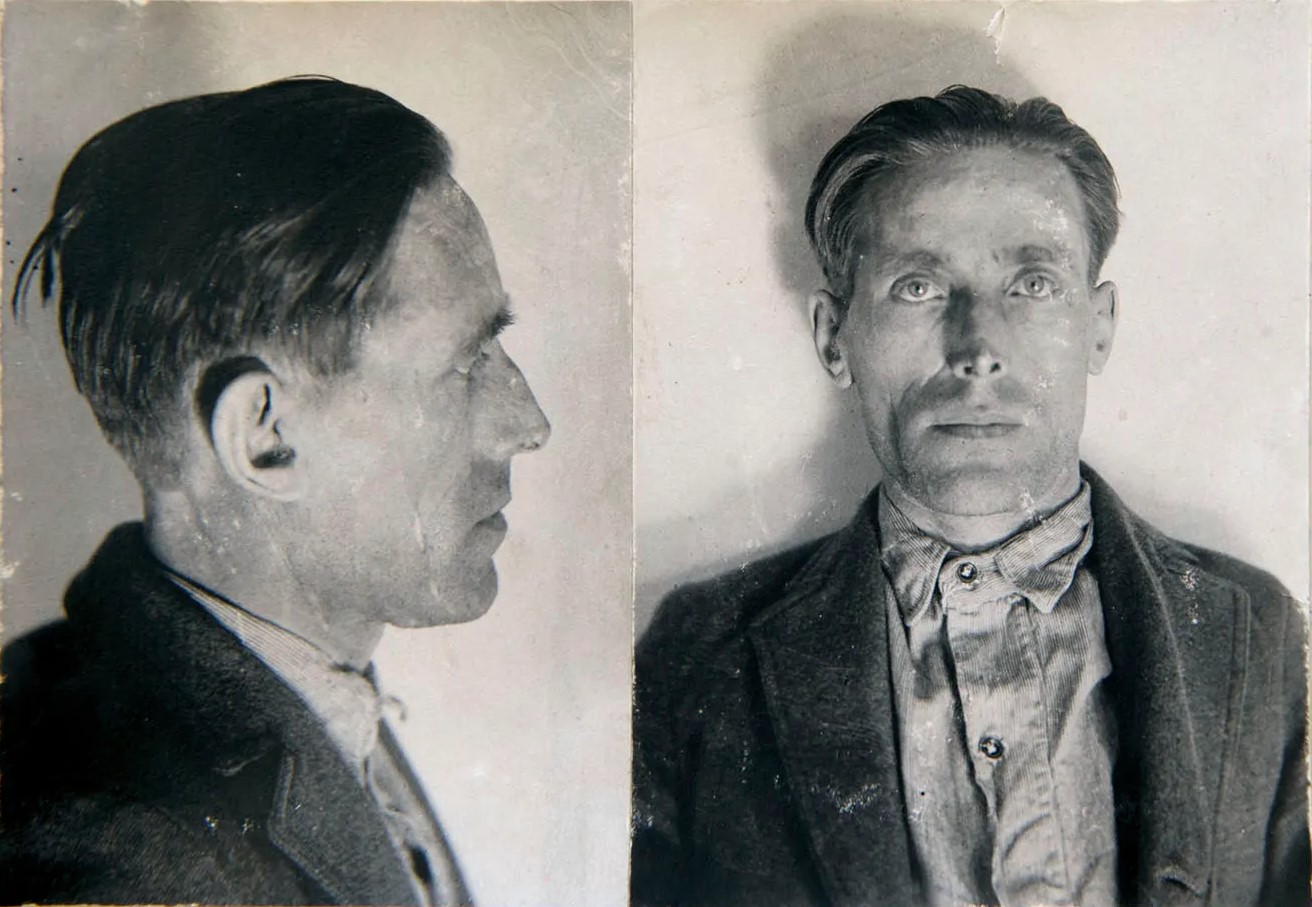
The inspiration for the classic I.W.W. song ‘Rebel Girl’ visits its writer on death row in the months before his execution.
‘A Visit to Joe Hill’ by Elizabeth Gurley Flynn from Solidarity. Vol. 6 No. 280. May 22, 1915.
I.W.W. Song Writer and Rebel Shows Undaunted Spirit in Jail. $300 Needed at Once For Defense.
“Can dungeons, bolts or bars confine thee? Or jails thy noble spirit tame?”
Salt Lake City is a garden city, encircled by great mountains, crowned with eternal snows. In springtime its green shimmer, high altitude, clear, pure air, and leisurely moving people should be ennobling, inspiring to one from whence the Westerner is pleased to term “the effete East.”
But this superficial impression is rapidly dispelled by a visit to that cornerstone of civilization- the county jail. At the doorway of the low-visaged structure, squatted in behind residences, the familiar, fetid jail odor assails the nostrils and the clang of the keys, the surly permission to enter, the damp, tomb-like air within, welcomes us to the compulsory abode of the free spirit under capitalism.
It was indeed a free spirit that drew us there- Joe Hill, the inimitable songster and poet of the I.W.W. Let others write their stately, Whitmanesque verse and lengthy, rhythmic narrative. Joe writes songs that sing, that lilt and laugh and sparkle, that kindle the fires of revolt in the most crushed spirit and quicken the desire for fuller life in the most humble slave. He has put into words the inarticulate craving of “the sailor, and the tailor and the lumberjack” for freedom, nor does he forget “the pretty girl that’s making curls.” He has expressed the manifold phases of our propaganda from the gay of Mr. Block and Casey Jones to the grave of “Should a gun I ever shoulder, ’tis to crush the tyrant’s might.” He has crystalized the organization’s spirit into imperishable form, songs of the people-folk songs.

Never has there been a movement that made an impress on world history, never a conquering movement, sterile of song. Religion and patriotism have been woven in the warp and woof of daily life, have stirred the masses profoundly, flamed the imagination of the young and ensnared the memories of the old, not through the preached dogma, but by melody. And these same elemental passions, which cause people to fight and die-the spirit to do and dare for the labor movement, can be stimulated through the same medium. Employers who judge. their workers as “dumb, driven, cattle,” intuitively sense the menace of strikers who unite, not in sullen apathy, but laughing and singing. “The International” sung in a dozen different languages- together- echoes for us “the wooden shoes, marching up the stairs of time;” to them, the creeping footfalls of revolution. They hate it, they fear it, they would crush it! So they’ve put our brave Joe Hill in prison, AND HE’LL NEVER COME OUT ALIVE IF THEY CAN HELP IT!
They have accused him of an ignoble act, murder for petty theft, and they lied and lied until they’ve hypnotized themselves into believing it. So when he came to us, he was guarded on all sides by deputies, came with a smile and a cheery greeting, with the clear-eyed look of one who cannot be crushed. He is tall, good looking, but naturally thin after sixteen months in a dark, narrow cell, with a corridor and another row of cells between him and daylight, and “nourished” by the soup and bean diet of a prison. Yet he writes constantly and his latest jail product, “The Rebel Girl.” is judged by many as his most beautiful.
This was the first time he was allowed to receive visitors in the office, the first chance he had in six months to shake hands with a fellow worker. It was not as a favor, however, but because they thought he’d talk about his case to a stranger. The head jailor was one of the detectives who framed up the case, and their attitude is identical with that of the average citizen, “Why doesn’t he talk?” -in other words, the legal fiction that the state must prove the accused one guilty, doesn’t apply to an I.W.W. JOE HILL IS CONDEMNED IN UTAH BECAUSE HE DOESN’T UNDERTAKE TO PROVE HIMSELF INNOCENT. Anyone else, not an I.W.W. or foreigner, would have been re- leased at the preliminary hearing, on the grounds of insufficient evidence. People who “identified” him at the trial, couldn’t even describe him at the preliminary. One woman said she saw the scar on his face, although it is very slight, certainly not visible at night, and she was on the wrong side of the man she passed.
Joe had nothing to say about his case, or himself, but wanted to know all about the I.W.W., its growth, outlook, its comtemplated work in the harvests, “Solidarity.” Margaret Sanger’s case, etc. And so the hour was spent in giving him the news of the movement, and a few words of encouragement about his fight for life. I’ve seen men more worried about a six months’ sentence than Joe Hill apparently worries about his life. He only said: “I’M NOT AFRAID OF DEATH, BUT I’D LIKE TO BE IN THE FIGHT A LITTLE LONGER.”
He’s a true soldier in the army of labor, philosophically accepting the status of prisoner of war and the possibility of death. But, shall we, fellow workers, accept it with him so lightly?

When I came out into the blinding sunshine, a cold hand gripped my heart. Was I leaving a tomb? Would he ever “be in the fight a little longer?” Nor is this concern for the individual exclusively, although I see no reason why we shouldn’t exhaust our defensive resources for every individual member, but it’s the realization that Joe Hill typifies to the employers the I.W.W. and if he can be murdered legally, so can every other agitator and organizer out here, in short order.
Can we afford to give up our Joe Hill, without a struggle? While I was in Salt Lake City, I saw a telegram from the attorneys pressing the committee for funds; $600 is still due, half of which the committee has. A stupid, sentimental story was published broadcast that “a woman of unlimited means” is backing the case. There is no truth in this; it is merely the fabrication of a romantic reporter. But I was surprised to know that members throughout the country believe it and are under the delusion that the committee has plenty of money. $300 IS NEEDED QUICKLY and fellow workers should realize that even if the appeal is granted, it will not mean necessarily his release, but a new trial, the expense of which will have to be met.
Joe Hill didn’t ask the I.W.W. to fight for him; he was in jail months before he’d consent to the local’s taking up his case. So this appeal is not from him, but in the spirit:
“He’s in their dungeon, dark and grim;
He stood by us, we’ll stand by him!”
As a matter of fact, he hasn’t been told how low the funds actually are, and it’s up to us to make it unnecessary.
Hold meetings again, fellow workers. Put it up to the workers. Letters and telegrams to Gov. Spry will help, but money is the prime necessity.
I appeal to you- help Joe Hill to fan the flames of discontent, “to fight (and sing) a little longer!”
San Francisco, May 12.
The most widely read of I.W.W. newspapers, Solidarity was published by the Industrial Workers of the World from 1909 until 1917. First produced in New Castle, Pennsylvania, and born during the McKees Rocks strike, Solidarity later moved to Cleveland, Ohio until 1917 then spent its last months in Chicago. With a circulation of around 12,000 and a readership many times that, Solidarity was instrumental in defining the Wobbly world-view at the height of their influence in the working class. It was edited over its life by A.M. Stirton, H.A. Goff, Ben H. Williams, Ralph Chaplin who also provided much of the paper’s color, and others. Like nearly all the left press it fell victim to federal repression in 1917.
PDF of full issue: https://www.marxists.org/history/usa/pubs/solidarity-iww/1915/v06-w280-may-22-1915-solidarity-joe-hill.pdf
 Revolution's Newsstand