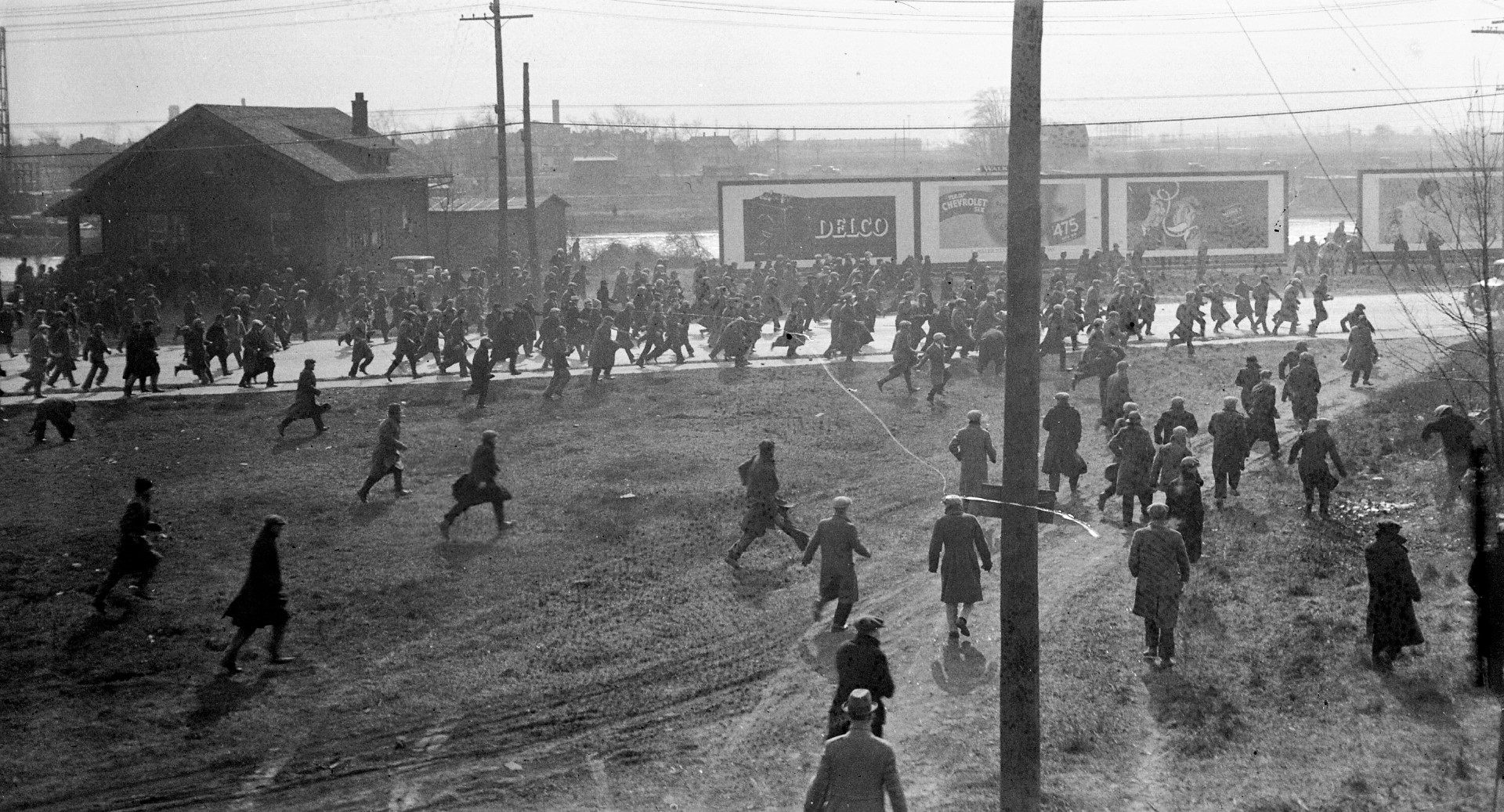
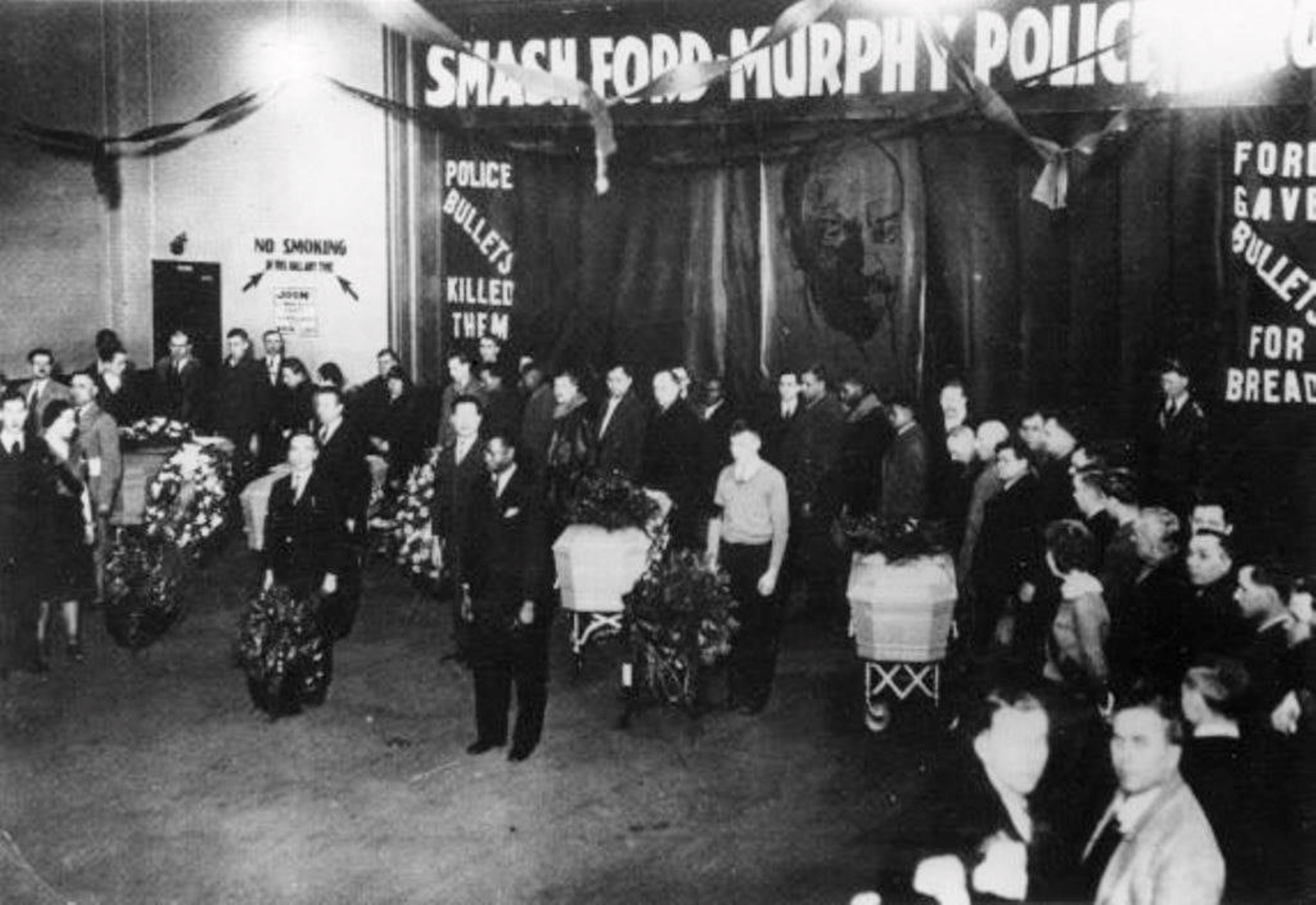
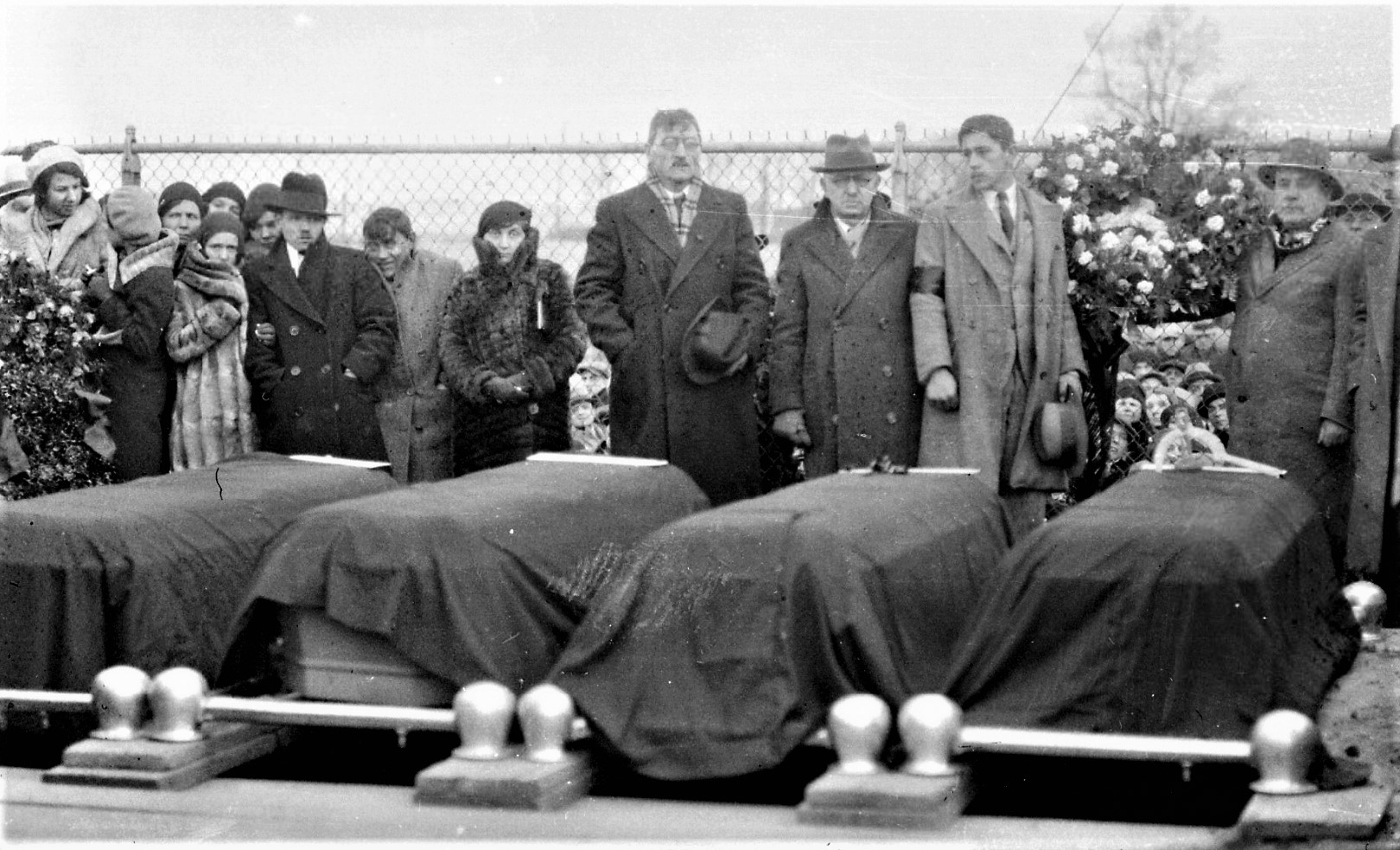
A harrowing account of a defining movement of the Great Depression, the Hunger March Massacre on Henry Ford’s Deaborn, Michigan factories. Demanding relief for the unemployed and destitute, the March 7, 1932 demonstration on a cold Michigan day ended in a massacre of five workers. Joe York, George Bussell, Coleman Leny and Joe Blasio were murdered by the Dearborn police and Henry Ford’s gun thugs led by Harry Bennett. Five months later, Curtis Williams would also die of his injuries. Mary Gossman describes her experiences, including the death of Joe Blasio and her arrest and interrogation.
‘Bloody Monday at Ford’s’ by Mary Gossman from Labor Defender. Vol. Vol. 8 No. 4. April, 1932.
LIKE many others, I saw the strength of the masses pictured on “Bloody Monday.” Even machine guns could not stop the anger of the workers towards Ford.
In an orderly manner we started towards the Ford Factory to ask for bread. There was no violence whatever. At the beginning a leading comrade warned us, “Remember no trouble, we want to ask for bread in a peaceful manner.” There we were met by the Dearborn uniformed thugs-40 of them. They at once shot tear gas pistols at the workers. With eyes covered, the crowd wavered a moment, and someone shouted, ”Let’s go! Let’s give it to them!” Then they started throwing stones and fought so fiercely that the 40 Dearborn police had to retreat-and how they ran!
I never saw such angry militancy. We had 5,000 workers fighting for their very existence. This was not enough. Next time we will go down there with 100,000 workers.
I witnessed the death of Joe York, the District Organizer of the Young Communist League of Detroit. I was about five feet away from him when the machine guns of the thugs spat out the bullet that pierced his lung. I rushed him to the hospital- but it was too late. Comrade Joe York tried to open his mouth on the way, but he could not say anything. Joe York is dead. I took his watch off his right hand and put it on my right hand and pledged over his dead body that I shall never rest until the murderers will pay- and pay dearly. The scandal papers of Detroit tried to play up a story that he was my sweetheart. They do not know what it means to go through such daily struggles and become so clear in the movement that we are willing to give up our lives and make sacrifices for the sake of our comrades.
I took another comrade to the hospital, Joe DiBlasio. He was still conscious and was sitting opposite me in the same car. Joe DiBlasio was shot through his mouth and he was bleeding to death. We tried to stop the blood, but it was impossible. The blood was fresh young, red-blood that will never be forgotten by the working class. DiBlasio said he was all right and made place for Joe in the car, and ten minutes later both were dead. The blood still rushes through my memory. Ford’s River Rouge will never be washed off from the blood and sweat of the workers that he made his millions from.
When they took me to the detective bureau, they question ed me:
Q.: Who was the leader?
A.: The masses.
Q.: But who led the hunger march?
A.: Everyone.
Q. What did you do there?
A.: The same thing everyone did.
Q.: Did you not hear them say that you shall go down there with guns?
A.: What I heard the speakers say was that we shall go out in a peaceful manner.
Q.: Where did you get information about the demonstration?
A.: In the Unemployed Council from the Ford Workers.
Q.: Who told you to go on the demonstration?
A.: The Ford workers.
Then they started to ask personal questions about my private life, and the answers to all of them were, ”I don’t have anything to say.” I told them if they ask me about the demonstration, I will tell them exactly how it happened otherwise I have nothing to say. Then they tried their torture system. One bully grabbed hold of my arm and pinched it and said that they are going to cut Joe York’s body into little pieces. But I told them that doesn’t work. Then one guy roared,
“Lock her up, she won’t talk.” And they took me in the other room and left me for two hours. After this, the prosecuting attorney came into the room and started to talk in sugar-coated words:
“Mary, why don’t you speak? It’s for your own good. We will make it as easy for you as we can if you will only tell us what happened. You were right there and saw everything and you can give us the right information. This would help you out a lot.” I said that I was willing to talk about the demonstration, and only the demonstration.
After that they got sore again and they had the whole police force pass before me to fix my picture in the minds of the uniformed thugs. And all this criminal procedure because I went out to ask for bread! That night I was ill. They treated me rough. But finally one woman gave me some medicine to fix my headache, and at the very same time, she tried to torture me by informing me that four of our men had already died.
They kept me incommunicado for three days, not even letting me with the other arrested comrades; they took us back to the court where they released us on a writ of habeas corpus and subpoenaed us for further appearance in front of the Grand Jury. Four comrades are dead from the bullets of the Ford and Murphy police!
Joe York, age 20, shot in left lung.
George Bussel, age 16, shot in right chest and cheek.
Joe DiBlasio, age 30, shot through mouth.
Coleman J. Leny, age 25, shot.
Comrades, answer the attack of Murphy and Ford: Organize into the International Labor Defense.
Labor Defender was published monthly from 1926 until 1937 by the International Labor Defense (ILD), a Workers Party of America, and later Communist Party-led, non-partisan defense organization founded by James Cannon and William Haywood while in Moscow, 1925 to support prisoners of the class war, victims of racism and imperialism, and the struggle against fascism. It included, poetry, letters from prisoners, and was heavily illustrated with photos, images, and cartoons. Labor Defender was the central organ of the Scottsboro and Sacco and Vanzetti defense campaigns. Editors included T. J. O’ Flaherty, Max Shactman, Karl Reeve, J. Louis Engdahl, William L. Patterson, Sasha Small, and Sender Garlin.
PDF of full issue: https://www.marxists.org/history/usa/pubs/labordefender/1932/v08n04-apr-1932-LD.pdf
 Revolution's Newsstand