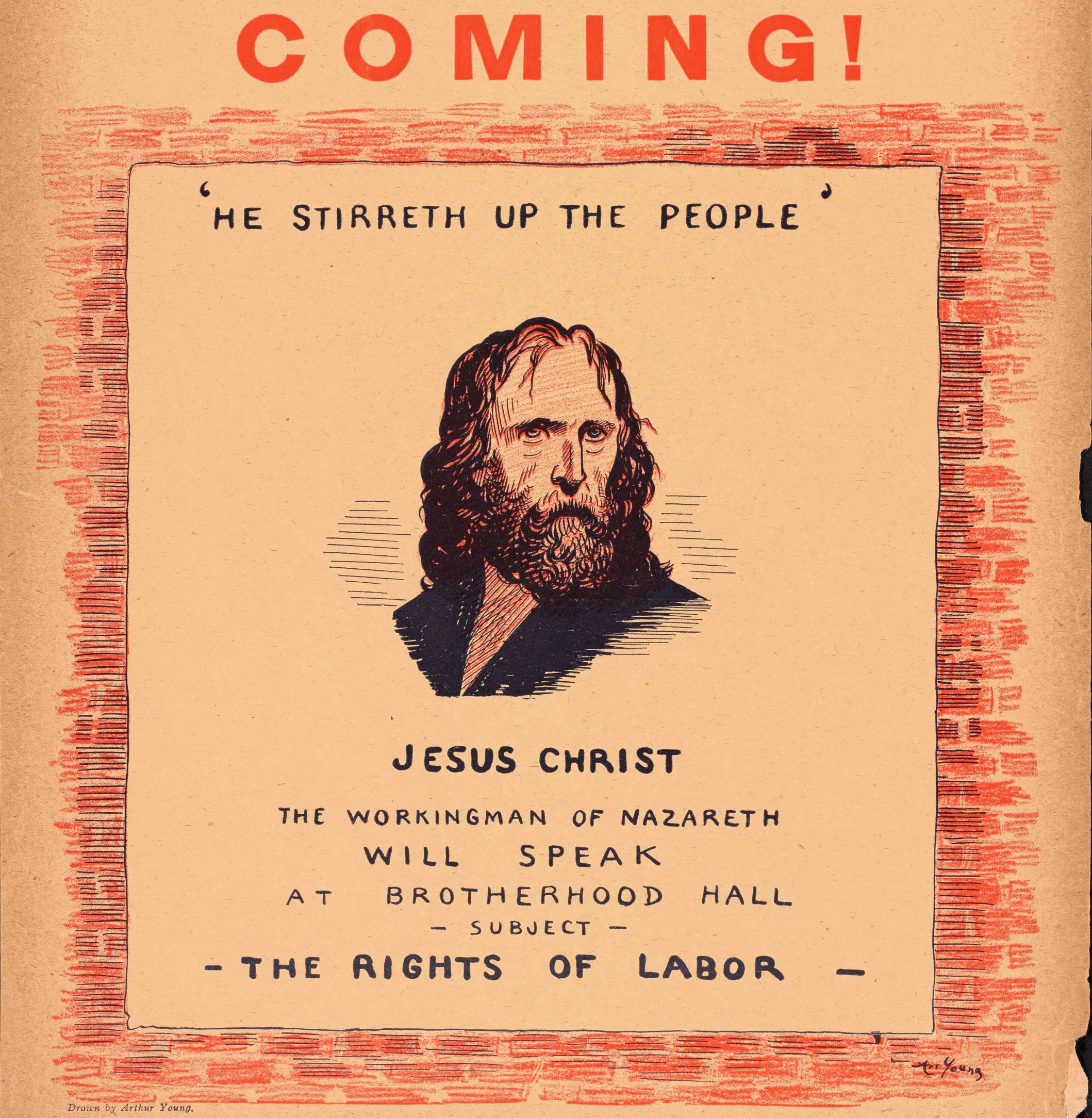
An anonymous wobbly version of the Jesus story and how Roman plutes transformed it into Christmas. Wonderful.
‘The Birth of Christmas’ from Solidarity. Vol. 4 No. 1. December 28, 1912.
Usually Solidarity takes little account of holidays, except that one which the world’s working class has tried to steal from the bosses, and which occurs in some places on May 1. The idea of the slaves STEALING that day from their masters gives us a holy fervor of delight, the very antithesis of our feelings towards those days which the masters have kindly condescended to allow their slaves to observe in common with themselves. But, since this is Tuesday, December 24, and everybody else seems to be thinking about the morrow, we shall depart from our usual custom of indifference, and drop a few remarks about Christmas.
December 25 is supposed to be the birthday of one Jesus who, tradition tells us, was born in a barn on the outskirts of an obscure little hamlet in Palestine about 1912 years ago. The boy Jesus subsequently developed into a social rebel, after having been a workingman and serving a long apprenticeship as a carpenter. He dropped his tools at about 30 years of age (went on strike, in other words), left his father’s house, and started beating his way around the hills and vales of Judea and other divisions of Palestine, agitating against existing conditions. As there were no railways in those days, Jesus had to hike from place to place; and we are told that although “the foxes had holes and the birds of the air nests, the Son of Man had not where to lay his head.”
When, on a Sabbath afternoon, our agitator hero hadn’t eaten for that day, he even had the unparalleled audacity to stalk boldly into a cornfield and swipe enough grain to appease his hunger, thus committing the double crime of “desecrating the Sabbath” and violating Section 7 of the Ten Commandments.
In the course of his agitation tour, which we are told lasted about three years, Jesus came into frequent contact with members of the ruling class and their supporters, consisting of merchants, money changers and high priests of the synagogues, whom he bawled out in picturesque style, calling them “vipers,” “thieves,” “whited sepulchers,” and other choice names, which presently got him into trouble. Finally, these rulers decided that Jesus was a dangerous agitator, guilty of sedition, sabotage, accessory before the fact and other crimes which they called by different names in those days and the rulers decided to put him to death. So they hauled him up before the Roman governor, put up a stall about Jesus’ claiming to be the “King of the Jews,” and other testimony similar to that of a cop’s in a modern police court, and demanded his crucifixion. The governor couldn’t find anything wrong with him, but since Jesus refused to talk, assuming a sort of “to hell with your court,” attitude, Pilate decided to turn him over to the mob of “vipers,” “whited sepulchers,” etc., and they nailed him to a cross.
Before his death, Jesus is supposed to have gathered about him some 12 disciples; but one of them was a Pinkerton who betrayed his whereabouts to the soldiers, who arrested Jesus, and the other eleven failed to show up at the execution. So Jesus died a “failure,” a lone social rebel, true to his purpose even unto death.
But we are told there was a resurrection and there was. Some 50 years or thereabouts after the death of Jesus, Roman governors in Palestine and elsewhere began to be disturbed in their slumbers by a little band of communists, who went by the name of Christians, and who were propagating their ideas of a universal brotherhood in various sections of the Roman empire. Some of these Roman governors, Pliny, for instance, thought they should be ignored for the most part, but the more stupid rulers, like their modern prototypes, decided to use force. So for about three centuries the Christians were persecuted, blacklisted, driven from one place to another, burned in oil, and thrown to the alligators in the arena, for the amusement of the Roman ladies. But, alas! all to no avail! Christianity, with its communistic doctrines, its idea of a universal brotherhood, continued to spread until it became an actual menace to the slave-holding aristocracy of Rome.
Something had to be done. A wise politician named Constantine got on the job at once. He was emperor of Rome and commander-in-chief of the Roman army, so he announced that he had become a Christian, and sent. the soldiers out in all directions to-round up all his subjects, and “convert” them to Christianity at the point of the sword.
But Constantine was wise enough to know that if he left the fundamental doctrines of this Christian heresy intact, they would continue to plague the ruling class of Rome, to the latter’s undoing. So he wisely hit upon the idea of incorporating the old Pagan religious code into the new state religion: Changing a few names was all that was required. The Mother of Jesus took the place of the Goddess of Love in the old Roman mythology; and St. Peter, St. John, St. Luke and other saints replaced the various old bewhiskered residents of Mount Olympus. The former customs, rites and ceremonies of Roman paganism remained practically intact. Thus the politicians won out, and communism took a back seat.
Among these old pagan customs was an annual celebration of the “rebirth of the sun,” which of course had always occurred about the last week in December, when the sun stopped “going south.” The ancients were always afraid it wouldn’t come back; so they were accustomed to use incantations, and other means to induce old Sol not to desert them entirely, but to return and bestow his blessings of light, heat and crops upon a suffering humanity. And great rejoicing occurred annually in those days, when the sun stopped in his southward plunge and started north again. This annual festival must by all means be retained. So the Roman politicians substituted the letter “o” for the letter “u” and we had the “birth of the Son.” Clever trick-since all the basic features of the old pagan festival remain even unto this day: But the “Call of the Carpenter,” stripped of the mystical and mythical veil of Constantine and his successors, and clothed in the original garb of communism and brotherhood, continued to sound intermittently across the ages. Rome went down with the leaden weight of an unspeakably cruel and infamous chattel slave system; the chaos of feudalism held Europe in a cloud for centuries, only to see it emerge at the end of that period into the system of wage slavery known as Capitalism-whose glorious fruitage is the Age of Machinery-without whose advent the abolition of slavery and the Brotherhood of Man were still improbable dreams. In all of these periods, at diverse times, the ideas of brotherhood and communism the original state of barbarian society have played their part; have furnished incentive and stimulus to heroic deeds and to great movements. Jesus did not originate these ideas; but his traditional example inspired others to imitation and contributed to heroic efforts in times of revolutionary crises.
So, on this Christmas eve, the modern militant of the labor movement, may without hypocrisy, pause to do homage to the bumble yet heroic Carpenter of Nazareth. Despised as we are despised; hunted as we are hunted-he Seems like one of our kind, with whom we may clasp fraternal hands across the centuries and bid to be of good cheer, since his ideal of universal brotherhood based upon toil is not forgotten-and is about to be realized.
The most widely read of I.W.W. newspapers, Solidarity was published by the Industrial Workers of the World from 1909 until 1917. First produced in New Castle, Pennsylvania, and born during the McKees Rocks strike, Solidarity later moved to Cleveland, Ohio until 1917 then spent its last months in Chicago. With a circulation of around 12,000 and a readership many times that, Solidarity was instrumental in defining the Wobbly world-view at the height of their influence in the working class. It was edited over its life by A.M. Stirton, H.A. Goff, Ben H. Williams, Ralph Chaplin who also provided much of the paper’s color, and others. Like nearly all the left press it fell victim to federal repression in 1917.
PDF of full issue: https://www.marxists.org/history/usa/pubs/solidarity-iww/1912/v04n01-w157-dec-28-1912-Solidarity.pdf
 Revolution's Newsstand