
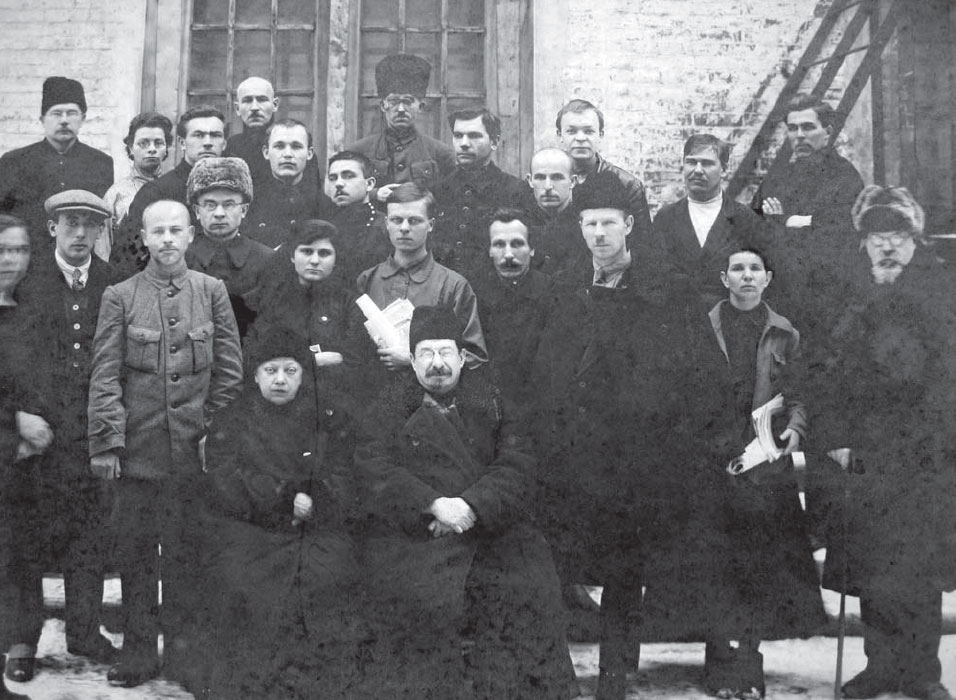
Krupskaya reports on the First All-Union Teachers’ Congress of 1,600 delegates representing 40 Soviet nationalities held Moscow, January, 1925.
‘The Modern Teacher’ by Nadezhda Krupskaya from International Press Correspondence. Vol. 5 No. 17 February 26, 1925.
We knew long ago that the teacher would become a social worker, but only the recent Teachers’ Congress revealed fully the extent to which teachers have advanced. We no longer see the former sentimental village teacher somewhat remote from life; he is now a genuine social worker, moving in the very thick of life, an organiser, an independently thinking human being expressing his thoughts in his own words and pondering over what is going on around him. In conversations with teachers such words as “Marxism”, “historical materialism”, “lumpenproletariat” usw. scintilate.[sic]
At the Congress there were 1,600 delegates, teachers from literally every nationality in Russia, from the South, and the Far North, from the most remote districts, from such places even where not a single person in the village has ever seen a mirror. The elections of the delegates were conducted with quite a ceremony. Positively every teacher took part in the elections, and gathered at the local teachers’ conference. Even the peasantry were extremely interested. The latter gave the teacher delegates instructions like the following: note what kind of communists there are in the centre, are they carrying out the teachings of Lenin? Can they be relied upon? Make inquiries how to conduct collective farming. Secure somewhere in Moscow mechanical spinning machines; this from the peasant women. “Spinning” they said “just wearies us to death. We have to spin day and night, and yet we have to study. We’ve got to liquidate our illiteracy, and we get no time for it”.
Even the children gave instructions. “Link us up with the Moscow pioneers (Red boy scouts), bring us copy of the ‘Pioneers’ Laws”. Go to the Zoological Garden and come back and tell us about the lions and tigers.
The teachers greedily absorbed all the new impressions they obtained in Moscow. Many excursions were arranged to the Museum of the Revolution, to factories, schools and clubs.
There was extensive fraternisation between the workers and the teachers. Delegations of workers came to the Congress to greet the teachers, brought them presents and portraits of Lenin, the working women of the Sokolniki District came on to the plat- form bringing a model semaphore. After switching on the red light one of the women delivered a warm speech of welcome which she concluded with the words: “The line is clear for the ‘smichka’ between the teachers and the working class”. A thunder of applause from the assembled teachers responded to this appeal. In the evenings the teachers broke up and visited the workmen’s clubs where they were met with such marks of comradely affection that, as the teachers themselves, said, they will never in their lives forget.
At the Congress the delegates listened to the speeches of Rykov and Zinoviev in rapt attention. Resolutions of greeting were passed to the scientists, to the Red Army, to the Young Communist League and to the Pioneers. The teachers assembled at this Congress realised that they were members of a common family of toilers.
The political significance of the Congress was enormous. It marked the fact that Lenin’s teaching concerning increasing the moral weight of the teachers, concerning the conversion of the teachers into a reliable bulwark of the Soviet Government in the villages, has been realised to a considerable degree. All the speeches delivered by teachers at the Congress gave proof of this. Conscious of this the teachers paid their visit to Lenin’s mausoleum.

Politics, however, did not entirely absorb the teachers. They eagerly discussed purely pedagogical questions, in connection with new curricula, text books and methods.
Last year and the year before new curricula were issued. These are planned to train the child to take a lively interest in his environment, to connect school closely with everyday life, and to train it to utilise the knowledge it acquires at school in the work of constructing a new society. These new curricula, drawn up by the State Scientific Council and rending asunder the old teaching traditions, were met at first with suspicion on the part of the teachers. At the Congress, however, the vast majority of the teachers warmly welcomed the new methods and pointed out how they facilitated the development of the children and how they were finding favour among the peasantry. The peasants say: “Useful things are being taught in the schools now”. The only complaint made was that it was difficult to carry out the system under present conditions when a teacher sometimes has to instruct a class of from 100 to 250 children in three sections without the necessary text books and school appliances.
Schools are over crowed this year. Every child is attracted to school; even those who for various reasons have not been to school for several years past, now desire to attend. There is not sufficient room to accommodate them all. The peasants are dissatisfied. The desire for knowledge has taken an unprecedented grip of the country.

The discussions in the various sections on questions connected with the building up of the new school revealed an extraordinary improvement in the purely pedagogical skill of the teachers. The curricula are supplemented with local material, many excursions are made, new methods are applied. The teachers are carrying out a great constructive and collective work and are being absorbed by it. The local interest in the schools is increasing and this is fostered and increased by the fact that the school is daily increasing its interest in local life. Not only the teacher but the school as a whole is carrying on social life.
In the villages the school children are informed of the meetings that are to take place. Elder children are asked to visit the homes of illiterate families, where they read the newspapers. The school-children teach comrades, their brothers and sisters and parents to read and write. In many places the school conducts extensive propaganda for hygiene. As a result of the influence of the school the children learn to wash more frequently, to cut and tend their hair and mend their clothes. The peasants’ homes are kept cleaner, the village streets are cleared of filth, gutters for drainage are dug along the streets, trees are planted. The school also conducts agricultural propaganda, and frequently it happens that under the influence of the school the peasants adopt the system of rotations of crops, begin to cultivate kitchen gardens more intensively, exercise greater care for their cattle, acquire machinery, etc. Of course such schools would naturally attract the interest of the peasants, and they are now willingly sending their children to school.
School exhibitions are being organised on an increasingly extensive scale. These exhibitions illustrate the work of the school and particularly of the “examination work”. To these the local population is invited and the children show visitors round and explain to them the nature of the work of the school. These exhibitions serve as a means for popularising the new school.
The delegates eagerly discussed the questions appertaining to the children’s movement. Already we have more than one million Pioneers. The Pioneers introduce a new spirit into the schools. They are well-disciplined, organised and zealously follow their studies. They relieve the teacher of his policeman duties and make it possible to establish comradely relations between the teacher and pupils. The Pioneers enliven and extend the sphere of child self-government in the schools.
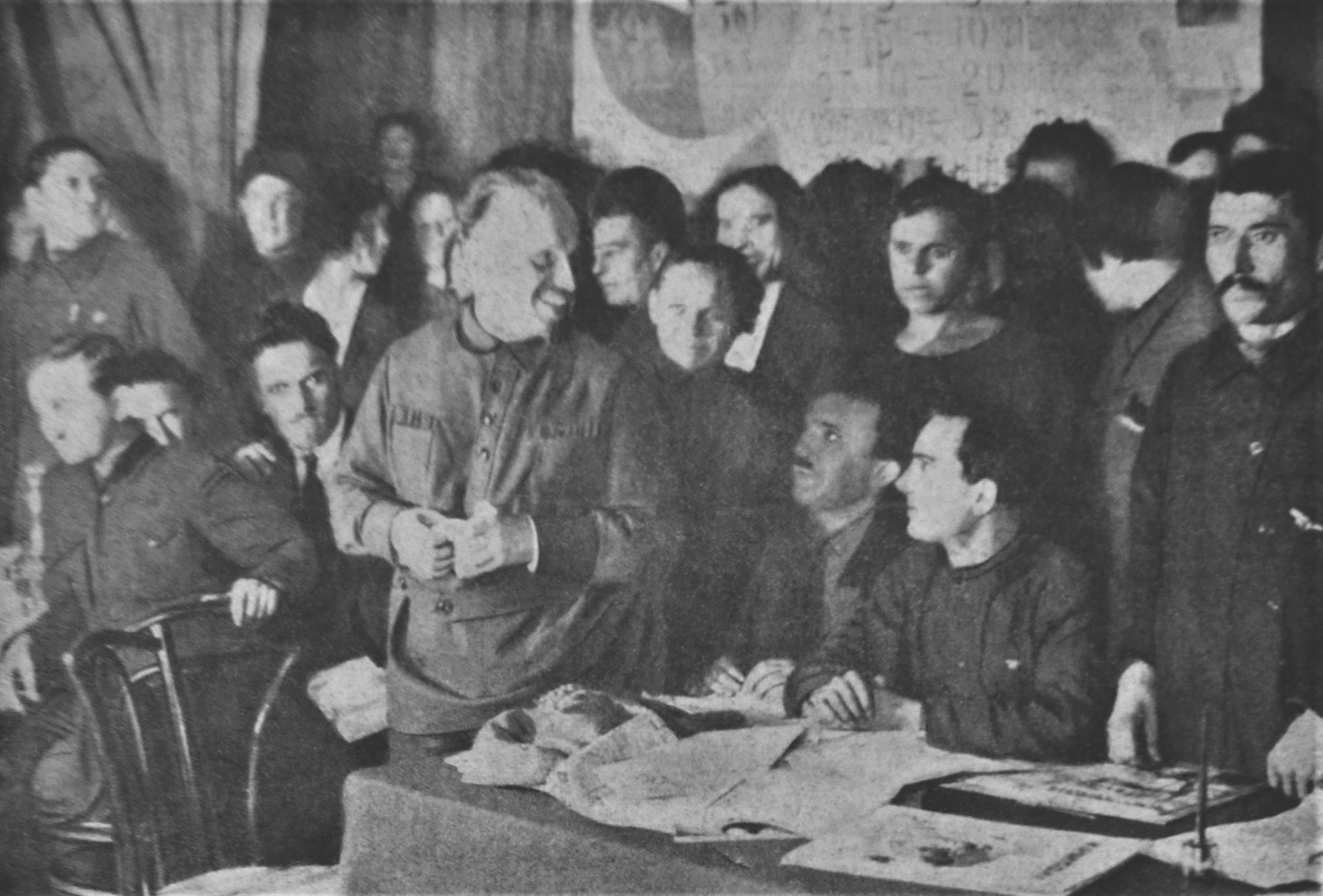
In addition to the plenary meetings of the Congress and meetings of the various sections of the Congress, the teachers attended a number of special meetings convened for them; to discuss such questions as work among the peasantry, the budget of the volost (county) Soviet, etc. The “Teachers’ Journal” and “Pravda” convened special meetings of delegates for the purpose of organising systematic correspondence between teachers and these newspapers. The teachers were supplied with general poli- tical and special pedagogical literature.
The teachers were immensely pleased with the Congress. “We are simply amazed with all we have heard and seen” they said. “Our people at home must be waiting impatiently for our return”, and then they went on eagerly to discuss how best to arrange to deliver their reports, what volost and villages to visit, etc.
The teachers in the localities are eagerly awaiting the return of their delegates; the whole population is filled with expectation. The First All-Russian Teachers’ Congress is undoubtedly of enormous importance; it is a brilliant page in the history of constructing a new life.
International Press Correspondence, widely known as”Inprecorr” was published by the Executive Committee of the Communist International (ECCI) regularly in German and English, occasionally in many other languages, beginning in 1921 and lasting in English until 1938. Inprecorr’s role was to supply translated articles to the English-speaking press of the International from the Comintern’s different sections, as well as news and statements from the ECCI. Many ‘Daily Worker’ and ‘Communist’ articles originated in Inprecorr, and it also published articles by American comrades for use in other countries. It was published at least weekly, and often thrice weekly.
PDF of full issue: https://www.marxists.org/history/international/comintern/inprecor/1925/v05n17-feb-26-1925-inprecor.pdf
 Revolution's Newsstand