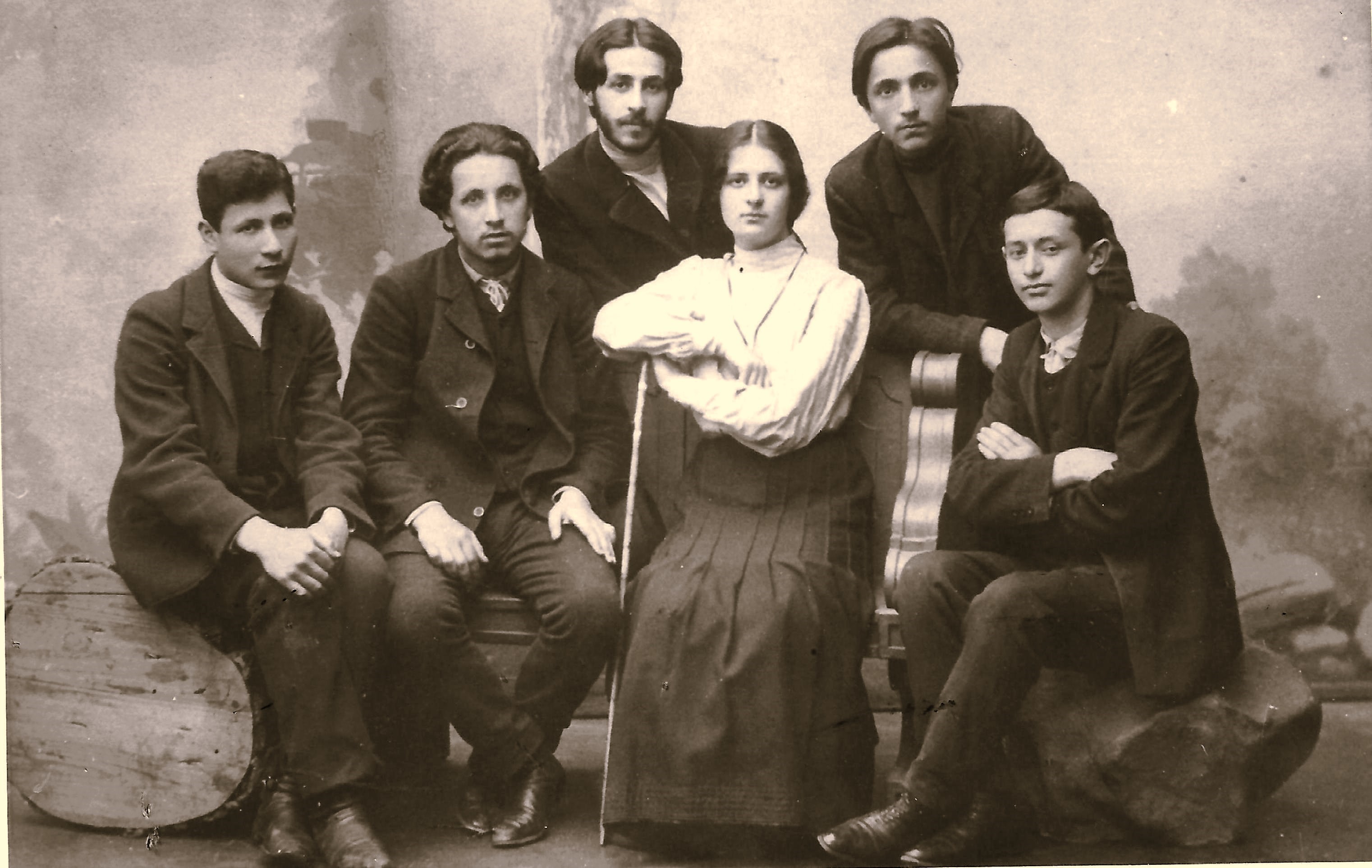
The critique of Zionism began within the Jewish community it claimed to speak for and was largely initiated by left wing Jews. One of the most important centers of that critique developed in the United States and was theoretically indebted to the work of revolutionary Marxist Jacob Milch. Because he largely wrote in Yiddish, the work of Jacob Milch (Yankev Zoyermilkh) is not widely known among English-speaking Marxists. The Polish-born polymath (he produced a Yiddish version of Plato’s ‘Dialogues’) had a profound impact on the Jewish left in the United States from when he joined the Socialist Labor Party in 1891 as an immigrant carpenter and member of the Hebrew Trades Council until his death co-editing the Communist Party’s Morgan Freiheit in 1945, Milch, who had become a well-to-do chocolatier, was a central figure in the Jewish left. In 1906-1907 he penned this important analysis of the development of the Poale Zion, the Socialist Zionist movement, and their territorial solution to the ‘Jewish question.’ Far more than an essay, this deep look at the state of Jewish workers and their possible futures under capitalism was spread over six issues and will be presented here in three parts. Part one here, part two here.
‘New Movements Amongst the Jewish Proletariat, Part Three’ by Jacob Milch from International Socialist Review. Vol. 7 No. 10, April, 1907.
VII.
THERE now remains one more point to: be considered— the point of the proletarization of the Jews: Do the Jews proletarize or not? and if yes, are they then positive or negative proletarians. And this is after all the point at issue. Until now we have endeavored to refute the theory of the Zionist Socialist, first by pointing out the illogical conclusions from their own premises, and then by showing the erroneous conception of the doctrine upon which their conclusions are based. But this would not end the controversy. The Zionist Socialists might now turn the tables by inviting me to explain from my orthodox Marxian standpoint the reasons why Jews in Russia are not permitted to take part in the large industries, why they are not admitted into the large factories, why in America they seek employment mostly in the garment trades, etc. And in corroboration of their own position they might pour down a shower of statistical data collected by the “J. C. A.” (Jewish Colonization Association) and issued in two large, bulky volumes in the Russian language under the title “Materials about the Economic Conditions of the Jews in Russia.” Whether they would do so or not, there is no doubt that this is the paramount question, and my treatise would be incomplete without at least an attempt to answer it. I shall, therefore, herewith deal with that subject. But before proceeding to answer the question a few side remarks seem not out of place. One point of the Marxian doctrine consists of the so-called verelendigung-theorie—the theory of impoverishment, which means that with the growth of capitalism also grows the poverty and misery of the workingmen, as well as the dependence and insecurity of the middle classes. The opponents of Marx made this the target of their attacks. By disproving the theory of impoverishment they believe they can refute the whole of the Marxian system. It is not true, they maintain, that the number of the middle class is being reduced, or that the workingmen are getting poorer; on the contrary, the number of the middle men is constantly increasing; instead of middle class men being reduced to workingmen it very often happens that workingmen rise to the ranks of the middle class, and sometimes even to those of the capitalist; while the workingmen generally live a good deal better nowadays than ever before. This assertion they support with a large number of statistical figures, their contention, in short, being that the middle classes do not proletarize. In Russia a literary battle was raging for a quarter of a century on a similar point. The Marxists claimed that Russia is bound to pass all stages of Capitalism before it would be ready for Socialism, while the opponents vehemently denied it, claiming and “proving” that Russia’s course would not at all be along the lines of capitalistic development, that its path rather lies via the “commune” or the “mir” towards Socialism, their contention having been, in substance: Russia develops neither capitalism nor a proletariat. This battle-cry has, of course, now subsided in view of the glaring facts. But now the Zionist Socialists have raised the same cry with regard to the Jews. The Jews, they say, can become neither capitalists nor proletarians, the curious thing about it all being that while the others have made the assertion, and some keep on making it, in refutation of Marxism, the Zionist Socialists, the new interpreters of Marx, make it in behalf and upon the authority of the doctrine of Marx. Extremes often meet.
I shall touch here upon this subject only in so far as to say that this assertion on the part of these people is due to a misunderstanding of the character of capitalism. “The shadow of the mountain they mistake for the mountain.” They don’t see that the small industries of to-day are not the petty industries of old, that the small and “independent” contractor of to-day is nothing more than the hired agent of a large capitalist, just as dependent on him as the workingman; that he is in a sense nothing else but a “workingman’”—a workingman that has the chance to fleece other workmen.
The characteristic feature of capitalist production consists of the fact that the workman does not possess the tools wherewith to produce, that he stands in no relation with his employer except that he sells him as a free and “independent” man his labor power for a stipulated sum for a certain time, or rather—an uncertain time; that the contract between him and his employer, being an agreement of two “equal” and free men, can be terminated at will by either of the parties. Whoever works under that system, if he be a driver of horses or a driver of men, works under the capitalistic system and is subject to all its consequences.
It is sufficient to consider this one point to be convinced that a so-called small undertaking of to-day is no more than a part of a large capitalistic concern, with two exploiters instead of one. In this country we can best observe it. We have here a great number of small establishments, especially in the clothing industries; but on a closer investigation we discover that such a “factory” is only a small part of a larger factory, that the “owner” thereof is nothing but an agent of a large capitalist, and though such an owner is very often better situated (and sometimes worse) than the man he employs, his economic position is in no wise better: He is just as dependent upon the large capitalist, and very often more so, as the workingman. To begin with, the “loft” where his “factory” is located belongs to the owner of the property, from whom it is hired at a monthly rental. The power used, steam or electricity, is supplied to him “by another large capitalist, or the same, as the case may be. The machinery in most cases is either hired or at best taken on installment, the raw material he gets of the manufacturer he works for. Even the cash to pay wages is supplied by the same manufacturer, and it very often happens that such a “capitalist” disappears with the few dollars without bidding good-by to his employees. And no matter how base and low such action may be, it is surely not the result of too much prosperity. No man escapes with a couple of hundred dollars out of great pleasure.
It must furthermore be borne in mind that capitalism has called into life a number of new “auxiliary” industries which by their nature are small undertakings, such as the repair of machinery, the grinding of scissors and knives, the repair of bicycles, automobiles, etc. The same phenomenon is to be observed in fields other than manufacturing. The wholesale dealers in tobacco, sugar, oil, coal, flour, steel, coffee, patent medicines, and innumerable well advertised articles, are nothing more than agents, unpaid agents of the single concerns controlling the product of the respective articles. For the purpose of statistical showing and for the opponents of Marx, these “capitalists” are in possession of so many independent establishments; for the Zionist Socialists the workingmen employed in such factories belong to the “negative” proletariat; in truth, however, ten or twenty or a hundred of such “establishments” are but one large concern conducted and managed with the capital of one large, real and positive capitalist, and the workingmen therein are real and positive proletarians. Besides, the large cities of to-day, to a great extent the creation of capitalism, give opportunity for the employment of large numbers of workingmen, proletarians to all intents and purposes, who never in their lives came near a steam or electric machine, as the conductors and motormen on surface cars and railroads, dock laborers, etc. Capitalism has also created an intellectual proletariat, such as book-keepers, travelling salesmen, architects, drug clerks, newspaper reporters, etc. Whoever makes the assertion that all these millions of workingmen are not proletarians, that they can therefore take no part in the reconstruction of society, that those who happen to turn the big wheels of the huge machines, are the only, the real, the true proletariat—whoever makes such an assertion has no understanding of the working of capitalism, has no conception of the Marxian doctrine and has no right to make any deductions from it whatsoever. Another point in this connection is the character of the very statistics the Zionist Socialists employ to prove their contention.
M. Oppenheimer, a critic of Marx, and also a critic of some of the critics of Marx, speaks of statistics as a very pliable mass which can be twisted and turned to either side one likes. With some dexterous dialectical jugglery, he says, one can prove with Statistics anything he pleases. This is only half the truth, as my friend, L.B. Boudin in his excellent work on Marxism in the “Review” of last year very properly remarks. With such statistics one can prove nothing. Statistical figures, like facts, prove nothing by themselves. With them something can be proven, when they are brought in a certain relation in a logical sequence. It would, for instance, be easy to “prove” that 99 men who own no dollar to their name are, every one of them, the happy possessors of five million dollars. All we have to do in such case 1s to add to the 99 the multimillionaire Carnegie. We shall then have 100 people with, say five hundred millions, which divided per capita would make five millions per head. The figure is correct, but we have proven nothing. This in fact is the way we in America are repeatedly shown by our official statistics to be the happiest people on earth—to the many millions of poor devils ‘several thousand millionaires are added and the capital “divided” per capita. The poor get the credit and the millionaires are left with the cash.
The Jews, more than any other people, are plagued with that sort of statistics; among the various sufferings and pain the Jews were compelled to undergo in their long history of martyrdom statistics are surely not the least. Friend and foe incessantly harass them with it. From Pogroms they might be spared by the Duma, or by self-defence, or by the revolution, while from statistics the Almighty alone may help them. And what have they not proved against the Jews as well as in their behalf with statistics? “The Jewish people are becoming extinct;” the Jews are multiplying too fast;” “insanity is most prevalent amongst them;” “they yield a large number of great men;” “they are usurers;” “they don’t like to work;” “they work too long hours;” “Jews predominate in all industries;” “Jews are not admitted to the factories;” “Jews control the capital of the world;” “Jews are beggars,” and a thousand and one other things one contradicting the other, one negativing the other.
We shall not here delve into the entangled and futile question whether the Jews are a nation or not; whether they show symptoms of national existence or not. Such questions are usually decided on the battlefield, as was the case in this country in the time of the Civil War. But whether a nation or not, one thing is quite certain: they are neither a social nor a political unit, and if social and political institutions have any influence upon nations or individuals, and no one ever doubted it, the French or the German Jews would then differ from the Polish or Lithuanian Jews in just as much as the social or political surroundings of France or Germany are different from those of Poland or Lithuania, To throw all the Jews of the different countries into one mass and make statistical deductions is obviously false and unscientific, and just as false and as unscientific it is to make a comparison between the Jews of highly cultivated Warsaw and the peasants of that province, or the Jews of cosmopolitan Odessa and the moujiks of the government of Kherson. But this is exactly what our statisticians do: They know of no other but religious distinction; the fact that the Jews mostly inhabit the large cities, which, with their culture and opportunities for education in spite of the government, with their industry and commerce, with their irregularity of employment, with their insecurity of a livelihood; with their opportunities to get rich, with their hustle and bustle, are productive of genius as well as insanity, of usury, idleness, over-work and unemployment, of riches and poverty, while, on the other hand, the majority of non-Jews in Russia consist of peasants who live in the villages, tilling the soil, which with its monotonous, dull, slumbering and drowsy life produce none of these things,—this fact they leave out of consideration, therefore they can “prove” anything they desire, or they prove nothing.
We are now prepared to approach the question of the proletarization of the Jews. The Zionist Socialists proceed the same way as the above characterized statistics, with these differences. In the first place their very statistics are incomplete, as the “Materials about the Economic Conditions of the Jews in Russia,” ‘the source of their wisdom, expressly admits. Secondly, the “Materials,” as far as they can prove anything, speak loudly against them, and thirdly, they take the figures by themselves without -considering all other circumstances, and figures by themselves prove nothing.
According to the “Materials” there really are a number of large factories where Jews find no employment. But there are circumstances explaining it which the “Materials” explicitly point out, and which the Zionist Socialists refuse to take cognizance of. And these are (1) the stubborn refusal of the Jews to work «on Sabbath-day; (2) because of the exclusion of Jews from higher education, the number of trained Jews in mechanical works is very much limited, which circumstance makes it necessary even for Jewish manufacturers to employ non-Jews and are therefore compelled to run their factories on a Sabbath. Thirdly and mainly, the large factories are mostly located in villages and townlets wherefrom Jews are excluded by the “Temporary laws” of 1882. This, once more, bears out our contention that it is the autocracy that is at the bottom of all the trouble. With the autocracy overthrown the chains that fetter the Jews are at once removed; with the “Temporary Laws” repealed, the doors of the higher educational establishments are opened, the barriers of the village removed and with it the barriers to the large factory.
But this is after all not the main point. Of far greater importance is the following: The Zionist Socialists would make us believe that to be employed in a large factory is a “consummation devoutly to be wished.”
This view is the result of their misunderstanding of the Marxian position. They take it for granted that according to the “code Marx” it is a great virtue to be a “positive” proletarian. But there is no such thing. Marxism only declares that capitalistic production irresistibly drives the middle men to become proletarians; that it compels the workman to sell his labor power to the owner of the machine, that it drives him to it against his will, and that his exertions and efforts to escape his fate are of no avail. And the means capitalism employs to drive the workingman to the factory can best be studied from the factory laws in England since the dawn of capitalism. And not only civilized England, “barbarous” Russia, since the time of Peter the Great, knew the trick. There had been times in Russia, just as in England, when people were sent to the factories for all kinds of misdemeanors and crimes invented for that purpose. The manufacturers were given the right to acquire serfs by purchase and compel them to work in their factories, the Russian peasant was thus driven to the factory with the knout of the Cossacks, and with what willingness they stayed there can be gathered from the many failures of manufacturing establishments for lack of hands that followed the manifesto of 1861, the peasants having deserted by the tens of thousands as soon as they were freed. The wages were raised four-fold, but to no purpose, the Russian peasant would not stay. Capitalism in Russia, of course, subsequently found ways and means to get the poor peasant to come begging for work, but this much is certain: out of his own volition he did not go there. And, indeed, it is sufficient to read any account about the condition of the workingmen in Russia to be convinced that the poor devil is not at all to be blamed for it.
The Jews, on the other hand, were never subject to villeinage, they never were serfs, and consequently were never forced into the factory, and of their own good will, or to please the “Marxian” theory of the Zionist Socialists about the positive proletariat they did not flock thereto. The Jews are thus lacking the historical basis of a working class, still less of a factory proletariat. This also is the reason why the existing system is so much in vogue amongst the Jews. This may sound paradoxical. but it is nevertheless the truth.
It is to be remembered that capitalism in Russia is of recent date, its real development having begun only since 1861, after the liberation of the serfs, and until that time only very few Jews pursued industrial employments. In fact, until very lately it was considered a disparagement to have a workingman in the family. It was only dire necessity, and after all the other sources of income had been closed to him that made the Jew take off the “cap of shame” and resolve to become a workingman. But then he had no time to learn any trade thoroughly, it was the necessity for immediate earnings that drove him to seek the shop. The division of labor in the garment and kindred industries helped him. toward this end, and those industries therefore became the most attractive and desired occupations. To the coal mine, where his father never was, he could not and would not go; to the railroads, mostly belonging to the government, he could not and would not go. To this was added, as a consequence of the “Temporary Laws” of 1882, the emigration. Whoever recollects the beginnings of the Jewish emigration from Russia knows that almost every Jew who contemplated emigrating learned to operate a Singer sewing machine. What else could they do? What could people who lived their lives as small traders, agents or brokers—what could they do in a foreign land without capital— in a land whose language, laws, customs and habits were perfectly strange to them? To learn a “trade” was the only way, and the easiest and quickest thing to learn was the ways of the Singer machine. Thus a “Jewish” clothing industry arose in England and America. Is was not their predilection for the garment trade, nor their inability to become “positive” proletarians,—it was, first of all, the economic conditions, growing out of capitalistic production, which prevented a large number of Jews from procuring a livelihood at their old callings, coupled with the persecutions against them and the consequent emigration that drove them to the shop; it was again this very capitalistic mode of production, the division and sub-division of labor, that made it possible for: them to acquire the required skill in those trades in a short time.
This, it seems to me, is the true explanation of why the Jews are employed in certain trades.
Not much better does it stand with the capitalization of the Jews.
It is a most noteworthy fact, a fact which the Zionist Socialists would to well to remember, that the “National Industry” of Russia is to a great extent not owned by the Russian people. It is rather English, French, German and Belgian capitalists who own and control the greatest part of the industrial undertakings. in Russia. This changes the situation altogether. The learned statisticians are only aware of Jewish and non-Jewish capital. The Socialist Territorialist, following their footsteps, have drawn the inference that not only are Jewish workingmen prevented from proletarizing, but even the Jewish capitalist cannot enjoy the full cup of blessed capitalism. Now that we know that the great capitalists of Russia are not the Russians, it becomes clear why the Jews are not counted among the great capitalists of the land, though there are some. It is no longer the Jewish capita? alone that cannot grow, it is Jewish capital together with the Russian, Polish, etc., that are powerless against foreign capital. And then it may well be, and it undoubtedly is, that a good portion of the foreign capital is owned by Jews—foreign Jews. Capital nowadays works in the form of shareholding companies and no one can tell whether it is a Jew or Gentile who draws dividends from those shares. This may also be the reason why the provinces where the Jews are settled are less developed industrially. Foreign capital naturally seeks to exploit first of all the natural products of the country, like naphtha in the Caucasus (which by the way belongs to our “brethren” the Rothschilds); foreign capital threw itself upon the iron and steel industries, the building of railways, surface cars, coal mines, all industries from which Jews are excluded for the above mentioned reasons.
There hardly seems necessary any more reasons in refutation of the theory of the Socialist Territorialist. Still, a superficial glance at the statistics, from which the S. T. draw their wisdom will convince any one that, if anything, there is more reason to deplore the excessive growth of the Jewish proletariat.
Time and space will not allow me to consider here the large amount of statistical figures gathered in the “Materials about the Economic Conditions of the Jews in Russia.” I shall, herefore, only consider a few totals. In the six governments of Wilna, Vitebsk, Grodno, Kovno, Minsk and Mohilev there ‘were in 1897—1,651 factories, with a total of 41,589 workmen of whom 22,279 or 53.57 per cent were Jews.

In the governments of Wholin, Kieff, Podolia, Poltava and Chernigoff the correspondents have counted 1,189 factories with a total of 83,280 workingmen, of which number 9,596 or 11.5, per cent were Jews. In the governments of Bessarabia Ecaterinoslau and Tayrid 396 factories were found with a total number of 33,341 employees, and 2,058 of these, or 6.2 per cent were Jews.
In the first six Provinces enumerated, as can be seen, more than half of the factory hands are Jews, while in the others the percentage is a good deal smaller. This, the “Materials” explain, is because in those Provinces most of the factories are located in the villages, where Jews are not allowed to settle, and also because the cane sugar and metal factories, where Jews cannot work for the given reasons, as Sabbath, etc., are mostly in those Provinces. Nor is this all. The “Materialists” omitted one of ‘the most important reasons—the reason that the percentage of Jewish inhabitants in those Provinces is a good deal smaller. In the first six Provinces the percentage being 14 per cent, while in the others it is only about 9 per cent. The percentage of Jewish workingmen is thus almost doubled.
The proletarian character of the Jewish workingmen is best seen when they are divided by sex. Out of the 20,232 Jewish workingmen in the Provinces of Wilna, Vitebsk, Grodno, Kovno, Minsk and Mohilev, 5,492 were married women, 1,749 girls and 1,389 small boys, i.e., women were 27. per cent, girls 8.6, boys 6.8, altogether 41.14. “This proves,” the “Materials” remark, “how the factory, little by little, wrecks up the patriarchal form of the Jewish family. There are places to-day where the factory whistle drives whole families out of their houses.
Jews, thank Heaven, do proletarize, the Socialist Territorialist may rest easy on that account. They will help construct the new order of society. If we consider all the foregoing we wilt see what an absurdity the whole “theory” of the Zionist Socialists, and especially the Marxian part of it, is.
No! The Socialist Territorialists will not be the redeemers of the Jewish people. Their help must come from elsewhere!
*) The “Materials” caution their readers not to rely too much upon their figures. There are two sets of statistics given: Those issued by the Government and the ones the J. C. A. gathered through its correspondents. These figures differ greatly. According to the Government’s figures the six Provinces show a total of 2,949 factories with 61.65% workingmen. I use the figures of the correspondents because they also give the number of Jewish workingmen in those factories, which the Government statistics fail to do. The statistics go only as far as 1897. “Materials”, 2nd volume, page 217, the Russian Edition.
The International Socialist Review (ISR) was published monthly in Chicago from 1900 until 1918 by Charles H. Kerr and critically loyal to the Socialist Party of America. It is one of the essential publications in U.S. left history. During the editorship of A.M. Simons it was largely theoretical and moderate. In 1908, Charles H. Kerr took over as editor with strong influence from Mary E Marcy. The magazine became the foremost proponent of the SP’s left wing growing to tens of thousands of subscribers. It remained revolutionary in outlook and anti-militarist during World War One. It liberally used photographs and images, with news, theory, arts and organizing in its pages. It articles, reports and essays are an invaluable record of the U.S. class struggle and the development of Marxism in the decades before the Soviet experience. It was closed down in government repression in 1918.
PDF of full issue: https://www.marxists.org/history/usa/pubs/isr/v07n10-apr-1907-ISR-gog-Harv.pdf
 Revolution's Newsstand