
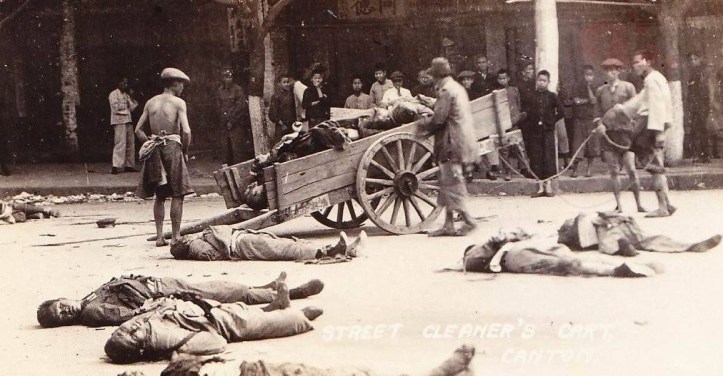
The Left Opposition’s critique of the Comintern’s orientation in China was essential to its larger position on what was happening in the Soviet Union and the Communist International. The massacres of 1927 in Shanghai and Guangzhou were a turning point for the international movement. As the Communist International gathered for its 6th World Congress in the Summer of 1928 Trotsky, recently exiled to Alma Ata, wrote a ‘A Criticism of Fundamentals’ of the Draft Program in which the events in China were central. James P. Cannon, a delegate from the Communist Party, accidentally received a copy of the paper which would serve as the origin document for the International Left Opposition. After the expulsion of U.S. oppositionists, Cannon serialized the document in ‘The Militant.’ The section below, from the July 1, 1929 issue, is part of the larger section on revolutionary policy in China, but serves as a good introduction to the argument.
‘On the Reactionary Idea of “Two-Class Workers’ and Peasants’ Parties” for the Orient’ by Leon Trotsky from The Militant. Vol. 2 No. 11. July 1, 1929.
The lessons of the second Chinese revolution are lessons for the entire Comintern, but primarily for all the countries of the Orient.
All the arguments presented in defense of the Menshevik line in the Chinese revolution must, if we take them seriously, hold trebly good for India. The imperialist yoke assumes in India, the classic colony, infinitely more direct and palpable forms than in China. The survivals of feudal and serf relations in India are immeasurably deeper and greater. Nevertheless, or rather precisely for this reason, the methods which, applied in China, undermined the revolution, must result in India in even more fatal consequences. The overthrow of Hindu feudalism and of the Anglo-Hindu bureaucracy and British militarism can be accomplished only by a gigantic and an indomitable movement of the popular masses which precisely because of its powerful sweep and irresistibility, its international aims and ties, cannot tolerate any halfway and compromising opportunist measures on the part of the leadership.
The Comintern leadership has already committed not a few mistakes in India. The conditions have not yet allowed these errors to reveal themselves on such a scale as in China. One can, therefore, hope that the lessons of the Chinese events will permit of a more timely rectification of the line of the leading policy in India and in other countries of the Orient.
The cardinal question for us here, as everywhere and always, is the question of the communist party, its complete independence, its irreconcilable class character. The greatest danger on this path is the organization of so-called “workers’ and peasants’ parties” in the countries of the Orient.
Beginning with 1924, a year which will go down as the year of open revision of a number of fundamental theses of Marx and Lenin, Stalin advanced the formula of the “two-class workers’ and peasants’ parties for the Eastern countries.” It was based on the self-same national oppression which served in the Orient to camouflage opportunism, as did “stabilization” in the Occident. Cables from India, as well as from Japan, where there is no national oppression, have of late frequently mentioned the activities of provincial “workers’ and peasants’ parties,” referring to them as organizations which are close and friendly to the Comintern, as if they were almost our “own” organizations, without, however, giving any sort of concrete definition of their political physiognomy; in a word, writing and speaking about them in the same way as was done only a short while ago about the Kuomintang.
Back in 1924, Pravda reported that: “There are indications that the movement of national liberation in Korea is gradually taking shape in the form of the creation of a workers’ and peasants’ party.”
And in the meantime Stalin lectured to the communists of the Orient that
“The communists must pass from the policy of a united national front … to the policy of a revolutionary bloc between the workers and petty-bourgeoisie, In such countries this bloc can assume the form of a single party, a workers’ and peasants’ party, akin to the Kuomintang …”
The ensuing tiny “reservations” on the subject of the independence of the communist parties (obviously, “independence” like that of the prophet Jonah inside the whale’s belly) served only for the purpose of camouflage. We are profoundly convinced that the Sixth Congress must state that the slightest equivocation in this sphere is fatal and will be rejected.
It is a question here of an absolutely new, entirely false, and thoroughly anti-Marxian formulation of the fundamental question of the party and of its relation to its own class and other classes.
The necessity for the Communist Party of China to enter the Kuomintang was defended on the ground that in its social composition the Kuomintang is a party of workers and peasants, that nine-tenths of the Kuomintang – this proportion was repeated hundreds of times – belonged to the revolutionary tendency and were ready to march hand in hand with the communist party. However, during and since the coups d’ etat in Shanghai and Wuhan, these revolutionary nine-tenths of the Kuomintang disappeared as if by magic. No one has found a trace of them. And the theoreticians of class collaboration in China, Stalin, Bukharin, and others, did not even take the trouble to explain what has become of the nine-tenths of the members of the Kuomintang the nine-tenths workers and peasants, revolutionists, sympathizers, and entirely our “own.” Yet, an answer to this question is of decisive importance if we are to understand the destiny of all these “two-class” parties preached by Stalin; and if we are to be clarified upon the very conception itself, which throws us far behind not only of the program of the CPSU of 1919, but also of the Communist Manifesto of 1847.
The question of where the celebrated nine-tenths vanished can become clear to us only if we understand, first, the impossibility of a bi-composite, that is a two-class party, expressing simultaneously two mutually exclusive historical lines – the proletarian and petty bourgeois lines; secondly, the impossibility of realizing in capitalist society an independent peasant party, that is, a party expressing the interests of the peasantry, which is at the same time independent of the proletariat and the bourgeoisie.
Marxism has always taught, and Bolshevism, too, accepted, and taught, that the peasantry and proletariat are two different classes, that it is false to identify their interests in capitalist society in any way, and that a peasant can join the communist party only if, from the property viewpoint, he adopts the views of the proletariat. The alliance of the workers and peasants under the dictatorship of the proletariat does not invalidate this thesis, but confirms it, in a different way, under different circumstances. If there were no different classes with different interests, there would be no talk even of an alliance. Such an alliance is compatible with the socialist revolution only to the extent that it enters into the iron framework of the dictatorship of the proletariat. In our country the dictatorship is incompatible with the existence of a so-called Peasants’ League precisely because every “independent” peasant organization aspiring to solve all national political problems would inevitably turn out to be an instrument in the hands of the bourgeoisie.
Those organizations which in capitalist countries label themselves peasant parties are in reality one of the varieties of bourgeois parties. Every peasant who has not adopted the proletarian position, abandoning his proprietor psychology, will inevitably follow the bourgeoisie when it comes to fundamental political issues. Of course, every bourgeois party that relies or seeks to rely on the peasantry and, if possible, on the workers, is compelled to camouflage itself, that is, to assume two or three appropriate colorations. The celebrated idea of “workers’ and peasants’ parties” seems to have been specially created to camouflage bourgeois parties which are compelled to seek support from the peasantry but who are also ready to absorb workers into their ranks. The Kuomintang has entered the annals of history for all time as a classic type of such a party.
Bourgeois society, as is known, is so constructed that the propertyless, discontented, and deceived masses are at the bottom and the contented fakers remain on top. Every bourgeois party, if it is a real party, that is, if it embraces considerable masses, is built on the self-same principle. The exploiters, fakers, and despots compose the minority in class society. Every capitalist party is therefore compelled in its internal relations, in one way or another, to reproduce and reflect the relations in bourgeois society as a whole. In every mass bourgeois party the lower ranks are therefore more democratic and further to the “Left” than the tops. This holds true of the German Center, the French Radicals, and particularly the social democracy. That is why the constant complaints voiced by Stalin, Bukharin, and others that the tops do not reflect the sentiments of the “Left” Kuomintang rank and file, the “overwhelming majority,” the “nine-tenths,” etc., etc., are so naive, so unpardonable. That which they represented in their bizarre complaints to be a temporary, disagreeable misunderstanding which was to be eliminated by means of organizational measures, instructions, and circular letters, is in reality a cardinal and basic feature of a bourgeois party, particularly in a revolutionary epoch.
It is from this angle that the basic arguments of the authors of the draft program in defense of all kinds of opportunist blocs in general – both in England and China must be judged. According to them, fraternization with the tops is done exclusively in the interests of the rank and file. The Opposition, as is known, insisted on the withdrawal of the party from the Kuomintang:
“The question arises,” says Bukharin, “why? Is it because the leaders of the Kuomintang are vacillating? And what about the Kuomintang masses, are they mere ‘cattle’? Since when is the attitude to a mass organization determined by what takes place at the ‘high’ summit!”

The very possibility of such an argument seems impossible in a Revolutionary party. Bukharin asks, “And what about the Kuomintang masses, are they mere cattle?” Of course they are cattle. The masses of any bourgeois party are always cattle, although in different degrees. But for us, the masses are not cattle, are they? No, that is precisely why we are forbidden to drive them into the arms of the bourgeoisie, camouflaging the latter under the label of a workers’ and peasants’ party. That is precisely why we are forbidden to subordinate the proletarian party to a bourgeois party, but on the contrary, must at every step, oppose the former to the latter. The “high” summit of the Kuomintang of whom Bukharin speaks so ironically, as of something secondary, accidental, and temporary is in reality the soul of the Kuomintang, its social essence. Of course, the bourgeoisie constitutes only the “summit” in the party as well as in society. But this summit is powerful in its capital, knowledge, and connections: it can always fall back on the imperialists for support, and what is most important, it can always resort to the actual political and military power which is intimately fused with the leadership in the Kuomintang itself. It is precisely this summit that wrote laws against strikes, throttled the uprisings of the peasants, shoved the communists into a dark corner, and, at best, allowed them to be only one-third of the party, exacted an oath from them that petty-bourgeois Sun Yat-senism takes precedence over Marxism. The rank and file were picked and harnessed by this summit, serving it, like Moscow, as a “Left” support, just as the generals, compradores, and imperialists served it as a Right support. To consider the Kuomintang not as a bourgeois party, but as a neutral arena of struggle for the masses, to play with words about nine-tenths of the Left rank and file in order to mask the question as to who is the real master, meant to add to the strength and power of the summit, to assist the latter to convert ever broader masses into “cattle,” and, under conditions most favorable to it to prepare the Shanghai coup d’etat. Basing themselves on the reactionary idea of the two-class party, Stalin and Bukharin imagined that the communists, together with the “Lefts,” would secure a majority in the Kuomintang and thereby power in the country, for, in China, power is in the hands of the Kuomintang. In other words, they imagined that by means of ordinary elections at Kuomintang Congresses power would pass from the hands of the bourgeoisie to the proletariat. Can one conceive of a more touching and idealistic idolization of “party democracy” … in a bourgeois part? For indeed, the army, the bureaucracy, the press, the capital are all in the hands of the bourgeoisie. Precisely because of this and this alone it stands at the helm of the ruling party. The bourgeois “summit” tolerates or tolerated “nine-tenths” of the Lefts (and Lefts of this sort), only in so far as they did not venture against the army, the bureaucracy, the press, and against capital. By these powerful means the bourgeois summit kept in subjection not only the so-called nine-tenths of the “Left” party members, but also the masses as a whole. In this the theory of the bloc of classes, the theory that the Kuomintang is a workers’ and peasants’ party, provides the best possible assistance for the bourgeoisie. When the bourgeoisie later comes into hostile conflict with the masses and shoots them down, in this clash between the two real forces, the bourgeoisie and the proletariat, not even the bleating of the celebrated nine-tenths is heard. The pitiful democratic fiction evaporates without a trace in face of the bloody reality of the class struggle.
Such is the genuine and only possible political mechanism of the “two-class workers’ and peasants’ parties for the Orient.” There is no other and there will be none.
The Militant was a weekly newspaper begun by supporters of the International Left Opposition recently expelled from the Communist Party in 1928 and published in New York City. Led by James P Cannon, Max Schacthman, Martin Abern, and others, the new organization called itself the Communist League of America (Opposition) and saw itself as an outside faction of both the Communist Party and the Comintern. After 1933, the group dropped ‘Opposition’ and advocated a new party and International. When the CLA fused with AJ Muste’s American Workers Party in late 1934, the paper became the New Militant as the organ of the newly formed Workers Party of the United States.
PDF of full issue: https://www.marxists.org/history/etol/newspape/themilitant/1929/v2n11-mil-1929-gray.pdf
 Revolution's Newsstand