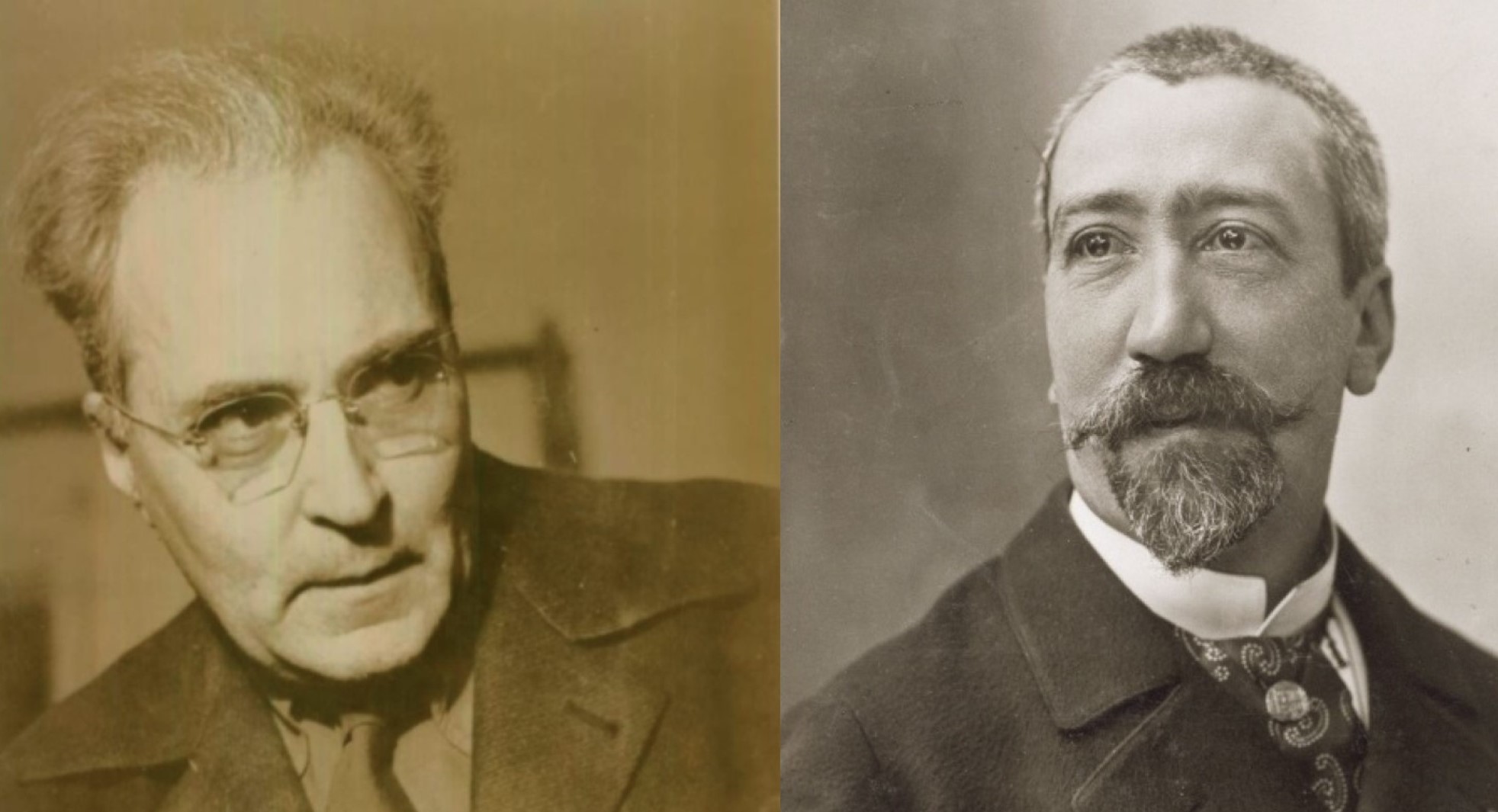
Victor Serge offers some of his own remarkable prose in memory of the writer Anatole France, whose eighty years straddled two epochs, on his passing in 1924.
‘Anatole France’ by Victor Serge from International Press Correspondence. Vol. 4 No. 73. October 16, 1924.
After a long life filled with work, enlightened with brilliant thought and profound joy, after the life of a sage, which was almost as harmonious as his prose, Anatole France has closed his eyes forever. With him there departs one of the greatest bearers of the culture of the XIX. century who has died, having outlived the hopes of his time, on the threshold of an infinitely harsher century.
Anatole Thibault chose that his works should bear the name of his native country, and became one of the most prominent representatives of French pre-war culture, one of the purest upholders of the fame of European culture before Tannenberg, Verdun, the Somune, the Skager Rak. We mourn over a poet and a culture, over a sage and over a magnificent illusion.
Through all his equally clear and over-refined shades of thought, Anatole France was a son of his time and of his society. His language was a model of lucidity, in its technique as precise as scientific thought, penetrated by the clear positivism which was founded by the philosophers of the 18th Century, clothed with faultless elegance, the philosophy of a class which had reached its highest point, and having captured the world also believed it understood it, and as it felt itself to be the victor could afford to be generous.
From 1871 to 1914, between the time of the slaughtering of 30,000 Paris proletarians and the great war, the French bourgeoisie in over forty years of peace reached the summit of prosperity. The catastrophe which marked the end of the second empire had been forgotten: the blood on the wall of the Federals had become faint. The Third Republic built up its colonial empire, grew proud of its social achievements, converted Paris into the most magnificent capital of the capitalist world, where dividends appear to be certain, where the division of the world takes place without any great disturbance, where democracy, the sciences, the arts, literature and socialism promise the poor a slow but peaceful and almost comfortable advance into the future collectivist society. In the meantime, however, behind the screen of radical ministers, the financiers with machiavelian cunning, but at the same time with incredible blindness, are preparing the end of this world. The spirit of this epoch is reflected with all its treasures in the works of Anatole France. The poet perceives behind the hopes of his time the black wall of reality. One reads the tragic closing pages of his “lle des Pinguoins” (Penguin Island): “Million of mortals toil in the gigantic city”.
In order to embody an epoch on this vast scale, one must be very great oneself. What, however, renders the greatness of Anatole France in many respects so valuable to us, what often lifts his work beyond the limits of the era of peaceful capitalism and beyond the present epoch is, that he embodied a phase of modern culture in the most sublime and purest forms. The edifice of a culture always has its gloomy lower regions: the torment of the enslaved, the blood and sweat of wage slaves, of those who are ground down in the factories, the torture of the barracks, the agony of toil. But over this, like the enormous pillars of a vast cathedral, the best men among the ruling class erect the sublime architecture of their thoughts; and if the whole cruelty of the regime is reflected therein, it is nevertheless reflected in magnificent form. With Anatole France, everything is permeated with the expectation and hope of betterment.
Vain expectation, futile hope! It is we who will create the better future- and it will be an arduous task. Every step forward will have to be paid for by our class in suffering and in blood. Since we fully realise this, illuminated by the terrible conflagration of the world war and by the torch of revolution, we understand better what is immortal in the works of Anatole France: lost illusions, never again to be restored, remain therein with all the beauty and the whole force and ideas of a by-gone century.
Other human documents will likewise remain and give testimony to the characteristic features of the thought of our time. The scepticism of Anatole France when he turns to the past has oft-times attained to a height of realism which is pitiless towards all illusions. Pontius Pilate does not know Christ whom he has crucified. The French revolution shattered everything and mowed down heads under its iron law. To understand the past, to cause it to live again and thereby to expose many of the lies of the present, this to-day is peculiar to the socialist thinker.
“The Gods are Athirst”. Upon this world there is no longer any place for the figures created by Anatole France; neither for Crainquebille, nor for M. Bergeret, nor for Jerome Coignard; and should they return they would come too late; they have outlived their time. The great artist who has just passed from our midst, the clever and good man, whose works will in the far off time, be the apologists of the capitalist culture of the 19th century, carries in his frail and aged arms all that is best in democracy in its closing epoch.
International Press Correspondence, widely known as”Inprecorr” was published by the Executive Committee of the Communist International (ECCI) regularly in German and English, occasionally in many other languages, beginning in 1921 and lasting in English until 1938. Inprecorr’s role was to supply translated articles to the English-speaking press of the International from the Comintern’s different sections, as well as news and statements from the ECCI. Many ‘Daily Worker’ and ‘Communist’ articles originated in Inprecorr, and it also published articles by American comrades for use in other countries. It was published at least weekly, and often thrice weekly.
PDF of full issue: https://www.marxists.org/history/international/comintern/inprecor/1924/v04n73-oct-16-1924-Inprecor-loc.pdf
 Revolution's Newsstand