
William D. Haywood makes an appeal to the ‘blanket stiff’ as he describes conditions for migratory harvest workers and what the wobblies have done to organize the ‘jungle camps’ and better conditions.
‘A Word to Migratory Workers’ by William D. Haywood from Solidarity. Vol. 5 No. 255. November 28, 1914.
The Bureau of Migratory Workers has been established by the Industrial Workers of the World to meet the situation in the harvest fields and prevent a repetition of the outrages that prevailed during last season.
An organized effort will be made to circumvent the schemes of the labor bureaus and employment sharks. The lying statements and advertisements of these agencies must be counteracted.
Every year the railroad, steamship companies, labor bureaus, commercial clubs and newspapers send out wonderful stories of the bountiful crops to be harvested in the western parts of the United States and Canada. These notices read: “THOUSANDS OF MEN WANTED-PLEASANT HOMES BIG WAGES.”

The publicity agents flood the country with glowing takes of the golden opportunities throughout the West. Reduced rates are offered to colonizers, homesteaders and harvest hands, inducing the migration from the East that crowd the labor market of the West. Every ticket sold to the unwary adds to the dividends of railroad stockholders. Thousands of persons have come West with hopes of prosperity, only to find themselves stranded, friend- less and homeless. Advertisements have even appeared in the “London Times,” May, 1914, stating that 16,000 to 18,000 men were wanted in the Kansas Wheat Field at wages from $3.00 to $3.50 per day.
The Employment Agencies look upon this influx of humanity as their prey from whom they make profit by selling temporary jobs, the more applicants for work the more money they make. Last season the Labor Bureaus induced the U.S. Secretary of Labor to issue a call for one hundred thousand harvest hands for Kansas. This blunder on the part of Government officials resulted in a terrible competition for jobs. In some localities there were fifty men for every job. This was just what the farmers wanted; to them it meant plenty of hands at the lowest wages and the longest hours. Conditions became so bad in the congested districts it was necessary to establish soup-kitchens and bread lines to keep those who were in search of work from actual starvation.
These harvest workers assemble at various shipping points, coming at great expense, hardship and privations to themselves. No provision whatever is made to assist them in transportation or to provide food and shelter for them after their arrival. When they congregate in numbers greater than the jobs offered, they are met at the station by policemen, deputy sheriffs, constables or mobs of citizens, usually members of the Commercial Club, who refuse to allow them to leave the train, or if they get off they are marched out of town afoot.
The Industrial Workers of the World has helped to organize these migratory workers and has made some success. It is the only organization that has been able to cope with conditions. The opposition that has arisen among the workers is through ignorance and comes largely from the university students who have not intelligence enough to co-operate with the worker for better conditions. Then there is the homesteader, who has made a bet with Uncle Sam that he can stay five years on a piece of ground, build a house of certain dimension and cultivate a given amount of land. The homesteader feels that he has no time to lose; every day must be made to count to the end that he, too, may get into the employing class. The suit-case stiff who has only cut loose from mamma’s apron, is about the same stripe as the student. It is his first job and he is anxious to get to it, no matter what the pay or hours may be.
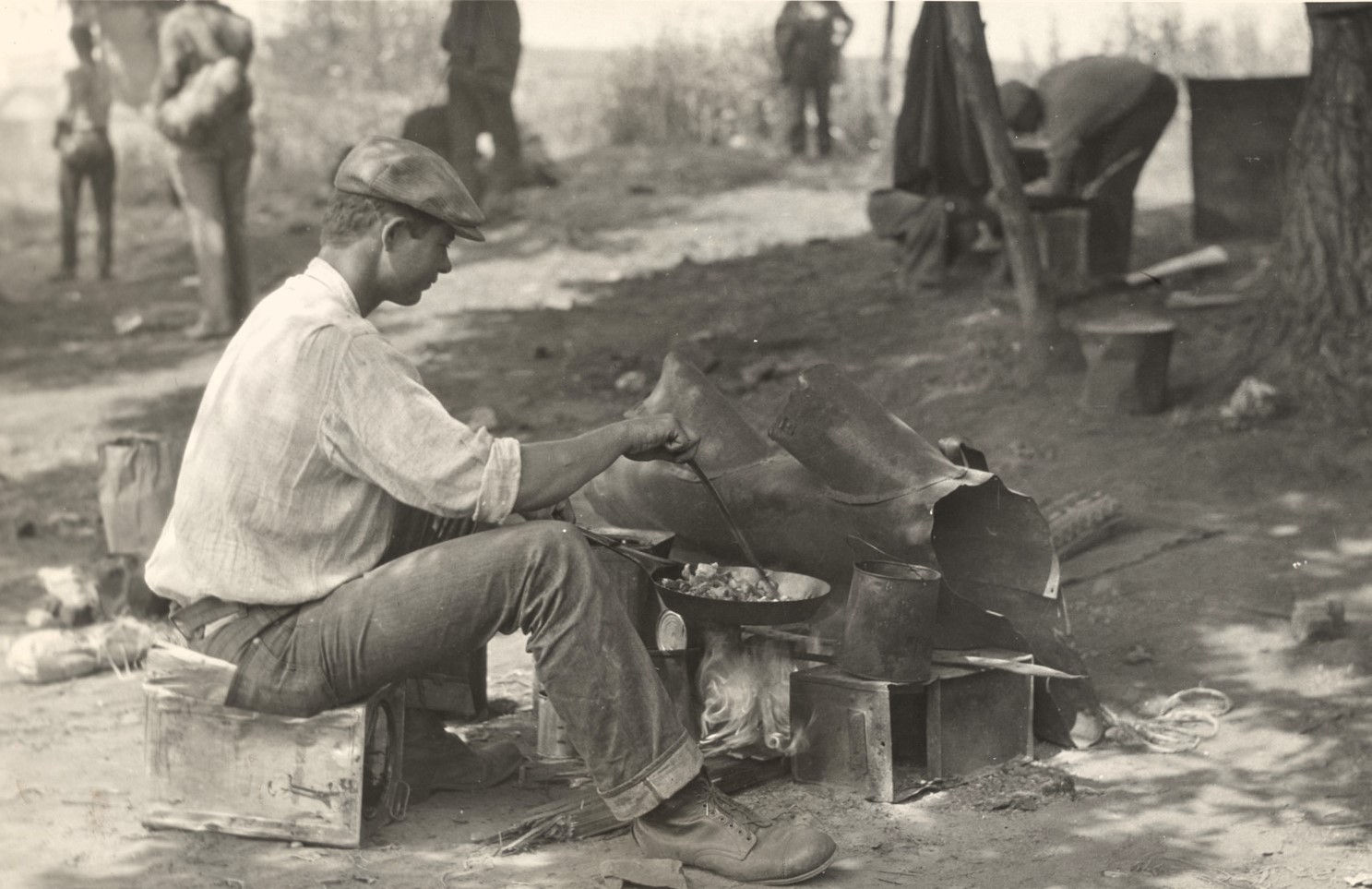
The I.W.W. form in groups and establish what might be called community life in the jungles. When a crowd of members of this organization leave a train near the station, they go to the outskirts of the town, on the bank of a stream if convenient. There a meeting is called, a Camp Committee is elected, the function of which is to see that the camp is kept clean and sanitary; a Job Committee is selected to rustle the town for work. Such pay as is received for work by any member of the group goes into a common fund. A treasurer is elected and an itemized account kept of all receipts and expenses. These accounts are audited every night. A cook and assistants are appointed, who in addition to preparing the food, furnish the cans in which to cook it. Usually empty standard oil cans, vegetable cans, etc. are found and scoured, these being used for cooking utensils, plates and cups. A Spud and Gump Committee forage around the farms for vegetables and other eatables, while the Buying Committee visit the town to purchase such supplies as are necessary and the Camp Treasury can afford. Every man is expected to do some work around the camp, though there are some of parasitic nature who accept service without giving service; these are called “Jungle Buzzards.” But they are not tolerated for long by the I.W.W. Gamblers and “stick ups” infest all harvest gangs, but in the I.W.W. camps the rule, No Gambling, is strictly observed.
In these Jungle Locals discussion has a wide range and plans are laid for organization. The I.W.W. song book is always in evidence. Singing is one of the chief amusements. Sleeping quarters are usually box cars, clumps of bushes, hay stacks or piles of straw. No bedding-the canopy of heaven is their only blanket. If there is no work in sight you will find these men at some time of day at the public library, if the town affords such a thing.
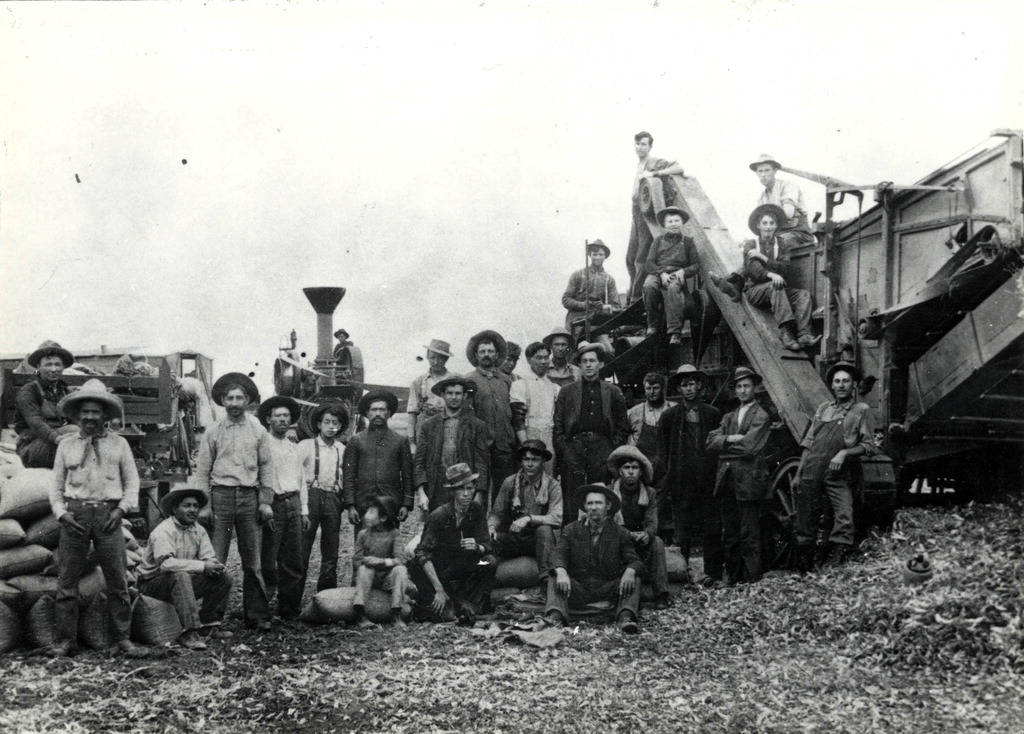
This is the way that most of the harvest hands exist. What a reward for the reapers of the golden harvest-meager food, cooked and eaten out of tin cans; sleeping in filthy box cars, wearing dirty and ragged clothes, denied most of the necessities and all of the comforts and luxuries of life, denied the company of women, denied life itself.
These conditions can and will be changed. It can be accomplished only by the workers themselves through organization. In fact, through the activity of the I.W.W. some improvements have already been made, increase of wages, reduction of hours and better working conditions. To extend this work the Bureau of Migratory Workers has been started, covering the Grain Belts, Fruit Sections, Lumber Districts and Cotton Zone, for the purpose of getting united action among the membership of the local unions in the several districts. This Bureau will gather and compile information as to crop conditions, the time the harvests begin, the probable number of men needed in each locality, the railroad connections. The Job Committee of the Jungle will function to put the employment shark out of business. In addition to keeping the men informed about working conditions a Bulletin will be issued to give facts in connection with the harvest work and refute the lies of the newspapers and Commercial Clubs.
On April 15th a Delegate Conference, representing locals at shipping points will be held in Kansas City. About the middle of May the harvest workers will congregate in Kansas City for a mass meeting. At this conference and mass meeting wages and hours for the harvest work of the coming season will be determined, also arrangements made for camp delegates or district secretaries so that a line of communication can be established between the harvest crews and different districts. Organization and job control will mean better conditions in the harvest fields.

A duty to yourself is to become a member of the Industrial Workers of the World. Look up the local at any shipping point or address Headquarters, 164 W. Washington Street, Chicago, Ill. WM. D. HAYWOOD, General Organizer.
The most widely read of I.W.W. newspapers, Solidarity was published by the Industrial Workers of the World from 1909 until 1917. First produced in New Castle, Pennsylvania, and born during the McKees Rocks strike, Solidarity later moved to Cleveland, Ohio until 1917 then spent its last months in Chicago. With a circulation of around 12,000 and a readership many times that, Solidarity was instrumental in defining the Wobbly world-view at the height of their influence in the working class. It was edited over its life by A.M. Stirton, H.A. Goff, Ben H. Williams, Ralph Chaplin who also provided much of the paper’s color, and others. Like nearly all the left press it fell victim to federal repression in 1917.
PDF of full issue: https://www.marxists.org/history/usa/pubs/solidarity-iww/1914/v05-w255-nov-28-1914-solidarity.pdf
 Revolution's Newsstand