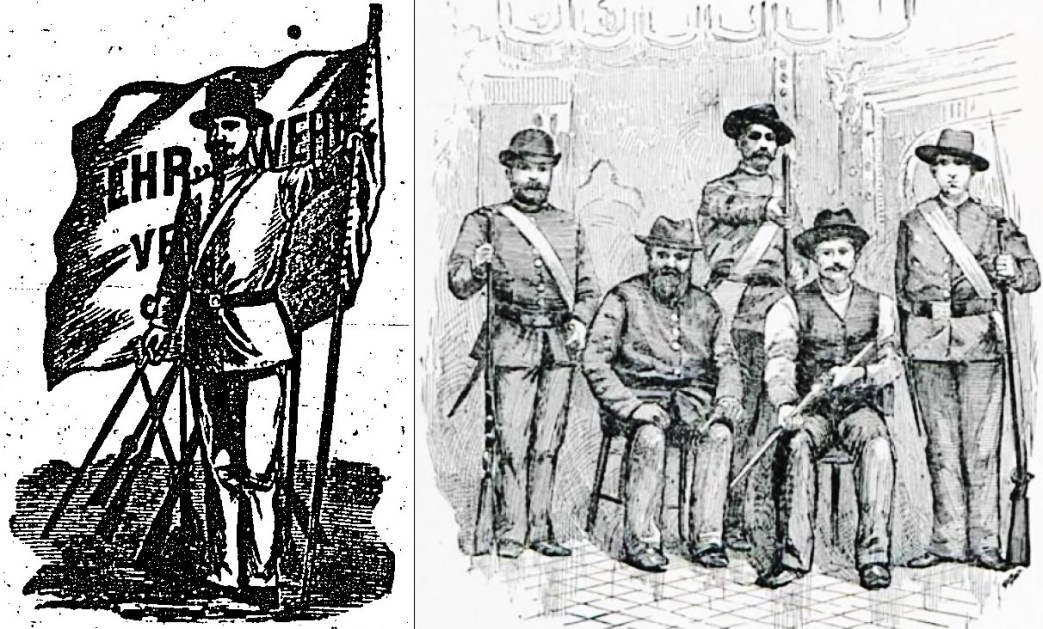
The Lehr und Wehr Verein “Education and Defense Society” was founded in Chicago in 1875 as a workers defense militia, with cities having large German populations like Cincinnati also forming companies.
‘The Cincinnati Workers’ Rifle Union Gives Grand Picnic’ from The Alarm (Chicago). Vol. 2 No. 1. August 22, 1885.
Workingmen’s Military Organizations Give a Grand Picnic at Covington, Ky.
The safe makers gave a picnic at Look out house on Saturday, 8th inst. A German and English speaker addressed them on International principles; plain truths and hard facts as to the necessity of physical force being the only remedy was received with applause, and although at a picnic it is hard to gain the attention of an audience (each being bent on enjoyment), in this instance it was successfully accomplished by the speakers, Zimmermann (German) and Comrade Moore (English.) Again, the Covington Rifle union issued this circular, and in answer to it the Cincinnati Rifle union formed two deep on the evening of the picnic at their hall at Thirteenth and Walnut, and marched to Wirth’s garden, Covington, and there took part in the fulfillment of the programme. The distance from Thirteenth street, Cincinnati, to Wirth’s garden, Seventeenth street, Covington, is from two and one half to three miles, which distance, including Cincinnati and Covington suspension bridge, was covered by the steady tramp of the Cincinnati Rifle union, each member wearing a red ribbon on his breast and headed by two drums or drummers, who only stopped playing when we had to break step crossing the bridge. All along the route the question was asked, Who are they? What are they? The military tramp and nothing but a small red ribbon to be seen, was a mystery to the crowds along the line of march, Comrade Fox, of Covington, addressed the audience, and many heard truths they had never even dreamed of before, put in a most logical, forceible, and undeniable style, after which Comrade W.B. Ogden addressed them in his usual forceible way, and although several wanted to dance, etc., there was calls from the majority to go on speaking, but in respect to all parties he wound up by giving them a nut to crack, after which the usual picnic festivities were proceeded with, all enjoying themselves. Cincinnati, O.
F. M.
The Alarm was an extremely important paper at a momentous moment in the history of the US and international workers’ movement. The Alarm was the paper of the International Working People’s Association produced weekly in Chicago and edited by Albert Parsons. The IWPA was formed by anarchists and social revolutionists who left the Socialist Labor Party in 1883 led by Johann Most who had recently arrived in the States. The SLP was then dominated by German-speaking Lassalleans focused on electoral work, and a smaller group of Marxists largely focused on craft unions. In the immigrant slums of proletarian Chicago, neither were as appealing as the city’s Lehr-und-Wehr Vereine (Education and Defense Societies) which armed and trained themselves for the class war. With 5000 members by the mid-1880s, the IWPA quickly far outgrew the SLP, and signified the larger dominance of anarchism on radical thought in that decade. The Alarm first appeared on October 4, 1884, one of eight IWPA papers that formed, but the only one in English. Parsons was formerly the assistant-editor of the SLP’s ‘People’ newspaper and a pioneer member of the American Typographical Union. By early 1886 Alarm claimed a run of 3000, while the other Chicago IWPA papers, the daily German Arbeiter-Zeitung (Workers’ Newspaper) edited by August Spies and weeklies Der Vorbote (The Harbinger) had between 7-8000 each, while the weekly Der Fackel (The Torch) ran 12000 copies an issue. A Czech-language weekly Budoucnost (The Future) was also produced. Parsons, assisted by Lizzie Holmes and his wife Lucy Parsons, issued a militant working-class paper. The Alarm was incendiary in its language, literally. Along with openly advocating the use of force, The Alarm published bomb-making instructions. Suppressed immediately after May 4, 1886, the last issue edited by Parson was April 24. On November 5, 1887, one week before Parson’s execution, The Alarm was relaunched by Dyer Lum but only lasted half a year. Restarted again in 1888, The Alarm finally ended in February 1889. The Alarm is a crucial resource to understanding the rise of anarchism in the US and the world of Haymarket and one of the most radical eras in US working class history.
PDF of full issue: https://dds.crl.edu/item/54013
 Revolution's Newsstand