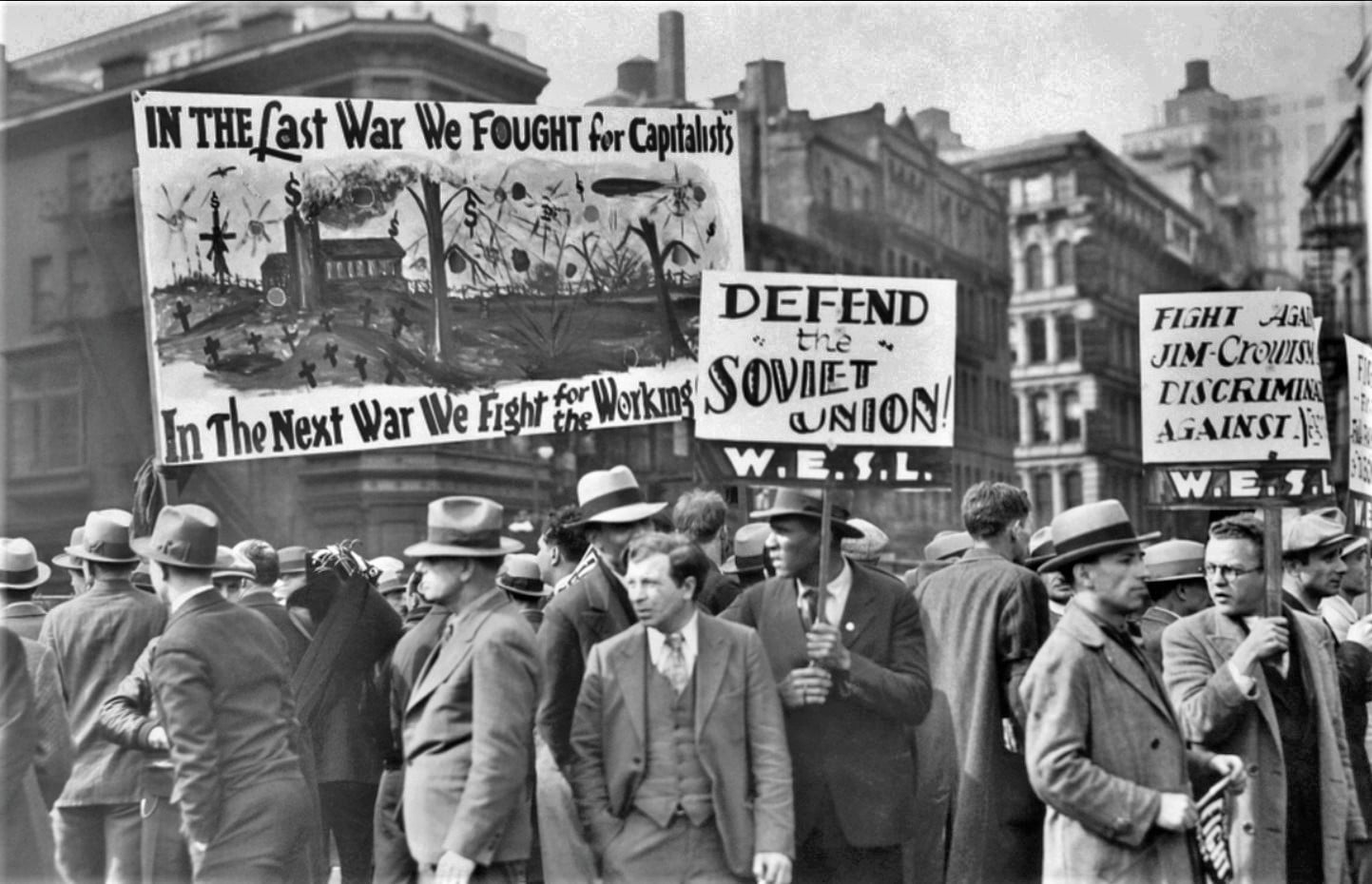
A look at the Communist Party’s attempt to build an organization of left wing veterans to counteract the likes of the reaction American Legion and serve as stewards and defense for working class functions.
‘Experiences of the Workers’ Ex-Servicemen League’ by E. Levi from Party Organizer. Vol. 4 No. 3. April, 1931.
The following experiences of the Workers’ Ex-Servicemen League and the response of individual ex-servicemen should be given particular attention by every comrade in the Party and particularly Party functionaries.
Last March, when the veterans’ bureaus and the American Legion were planning to interfere with our May Day demonstrations in New York City, ex-servicemen in these organizations opposed any interference and partly, as a result of that, the opposition was a complete failure. In our May Day demonstrations there were over 200 workers ex-servicemen as a definite section, with slogans along this line:
“In the last war we fought for the bosses; in the next war we will fight on the side of the workers and for the defense of the Soviet Union.”
In the election campaign in New York City the Workers Ex-servicemen League was one of the united front organizations supporting the Party campaign. In New Brunswick, N.J., where the Party had difficulties in holding meetings, the Ex-servicemen, with the assistance of other workers, finally established the precedent that meetings of the Communist Party would be held. The Ex-servicemen not only participated in physically defending the meetings but their speakers from the platform pointed out the need of supporting the Communist Party as against the capitalist parties.
The hunger marchers in New York City to Albany were given invaluable assistance and the entire march was disciplined and militant due to the fact that a large number of Ex-servicemen and Workers Ex-Servicemen’s League members participated in it. From the very beginning the bosses tried to interfere with the hunger march, refusing permits to hold demonstrations in Yonkers, the first city in the line of the march. After several attempts of the Unemployed Councils and other workers’ organizations to hold preliminary meetings, the Ex-servicemen were finally able to get a permit and held a demonstration with over 5,000 workers at the time the hunger march came through Yonkers.
In Albany the Ex-servicemen showed a real revolutionary resistance and fighting spirit which contributed to keeping the hunger marchers well organized even though they were brutally attacked by the State police.
In the State of Washington, in the logging country, the rank and file members of the American Legion unanimously passed resolutions-supporting the National Unemployment Insurance Bill, over the head of their officers.
These few instances are concrete examples of the possibilities of organizing a mass organization of the Workers Ex-servicemen who will not only fight for their immediate demands, such as the cash payment of the bonus in full and against the last bonus steal, but are willing and ready to unite with the other workers in their every-day struggles.
This condition creates for us the next step in building up mass organizations among the four and one-half million war veterans and other Ex-Servicemen, and to connect it up with the every-day struggles of the workers. The Workers Ex-servicemen’s League is the first step towards building up such a mass organization.
The Party Organizer was the internal bulletin of the Communist Party published by its Central Committee beginning in 1927. First published irregularly, than bi-monthly, and then monthly, the Organizer was primarily meant for the Party’s unit, district, and shop organizers. The Organizer offers a much different view of the CP than the Daily Worker, including a much higher proportion of women writers than almost any other CP publication. Its pages are often full of the mundane problems of Party organizing, complaints about resources, debates over policy and personalities, as well as official numbers and information on Party campaigns, locals, organizations, and periodicals making the Party Organizer an important resource for the study and understanding of the Party in its most important years.
PDF of issue (large file): https://files.libcom.org/files/Party%20Organizer%204.pdf
 Revolution's Newsstand