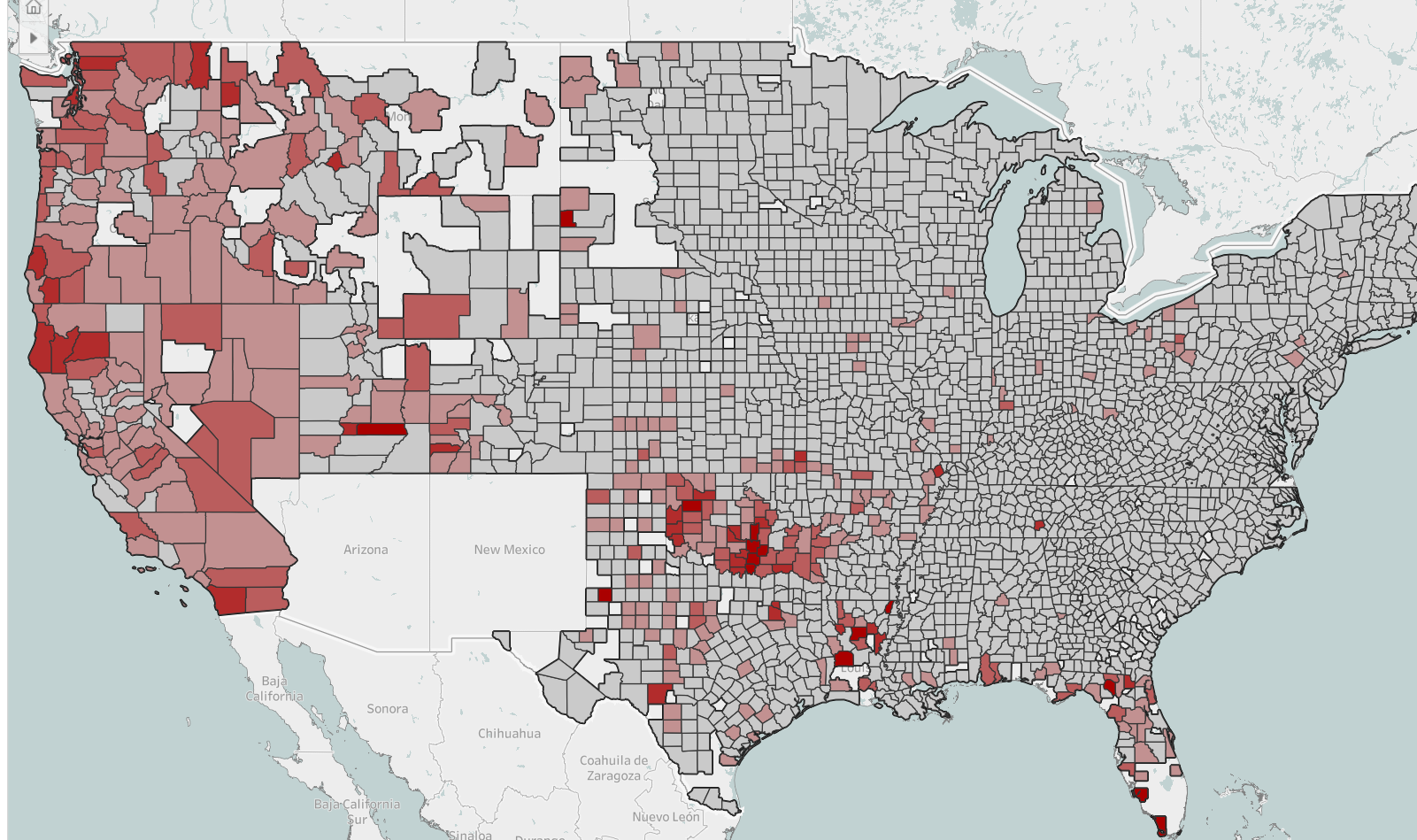
With three times the national average, in 1908 Oklahoma became the state with Socialist Party’s strongest vote by percentage; a position it would hold for the next three elections. Here Frank P. O’Hare describes the breakthrough in the new state.
‘The Oklahoma Vote’ by Frank P. O’Hare from the International Socialist Review. Vol. 9 No. 7. January, 1909.
THE results of the vote in Oklahoma indicate the efficiency of “intensive” agitation work, as opposed to the ordinary methods.
Years ago our Oklahoma agitators went into the “brush” as the most likely place to expound the class struggle. In the towns it will be found that there is as yet no definite movement toward Socialism. In states like Illinois, the small towns are largely dominated by retired farmers, a most conservative and capitalistically minded class. The denizens of — these communities are “established.” In Oklahoma, however, the towns are filled with a pushing, aggressive set of people, on the lookout for the nimble dollar. In the older states the attitude toward Socialism is hatred, but in our little towns tolerance largely prevails.
In the older communities class interests dominate, while in our communities TOWN interests, town loyalty is strong.
This is true because each community is fighting every other community for trade supremacy.
So as yet there is but little foundation for a proletarian movement in our towns. But all classes give Socialism a respectful hearing.
But in the mining districts, and the rural districts, we find a true proletarian class—landless farmers and toilless laborers—and among these workers the socialist thought is making tremendous strides.
In 1900 there were 768 socialist votes in Oklahoma Territory, and probably the same number in Indian Territory, or a total of 1,500. At this election 21,750 votes were cast for Debs, and this, too, in the face of the fact that the Democratic party had met all of organized labor’s demands and placed bona fide labor men in office as Commissioner of Labor and Mine Inspector.
So it is safe to say our vote is a true Socialist vote.
In the mining county of Coal, our vote was 24.3 per cent, and in the cotton county of Marshall, our vote was 24.2 per cent of the total.

Our membership has carried on the most thorough agitation of probably any state. Our state and national dues are 15 cents per month, and in spite of high dues, our comrades contributed about $850 for the Red Special.
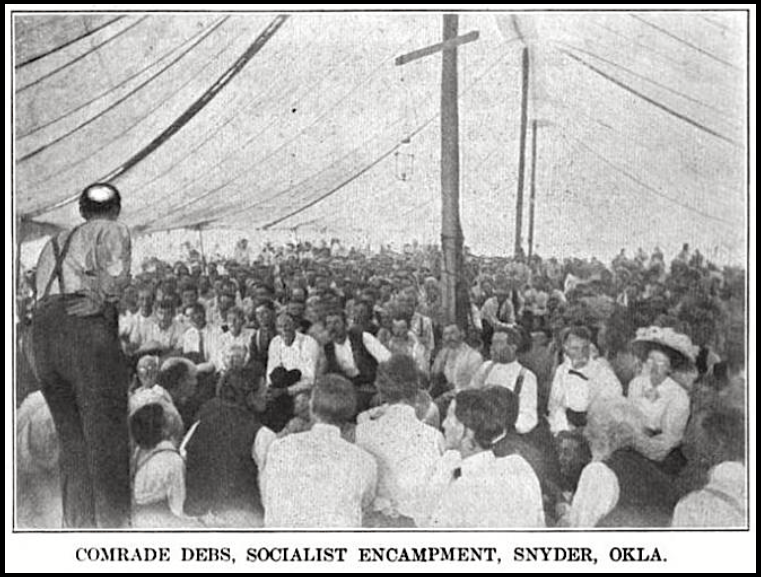
We have had as high as twenty speakers in the field at one time, and many of our counties took speakers for thirty days at a time, covering practically every voting precinct. Only nine of our counties cast less than 100 votes each, and we have seventy-five counties.
A unique step was taken by our force of field workers. At the last meeting of the state executive committee that body recognized the “Oklahoma Field Workers Association,” composed of “all state speakers recognized as such by the Oklahoma Socialist State Committee.” The O. F. W. A. framed a series of recommendations having in view the greater economy of effort and greater efficiency of its membership, and these recommendations were adopted in toto by the State Executive Committee.
From June 15 to June 30, 1909, the field workers will conduct a school in some rural retreat, and each speaker is to be assigned to some department of socialist thought, to investigate and to deliver three lectures on it to the class.
Among the subjects to be assigned are: “The Race Question”; “The Farmer”; “Socialist Activity in Legislation”; “The Land Question”; “Women”; “Trade Unions”; Single Tax”; “Theory of Value”; “Theories of History,” etc
O.F. Branstetter, J.O. Watkins and the writer were made a committee on program and will arrange for the handling of each subject by the twenty or more speakers expected to be present.
From now on our effort will be to develop county secretaries and county organizers, as the routing of the speakers has assumed such proportions that it is necessary to divide the work. The ideal way, of course, is for the state secretary to assign a Speaker to a given county for fifteen or thirty days and have the county secretary make dates in his county.
We have a tremendous undertaking before us, but we have such a big bunch of tireless workers that the prospects look joyful indeed, and we all start in the campaign of 1910 with renewed enthusiasm and great expectations.
The International Socialist Review (ISR) was published monthly in Chicago from 1900 until 1918 by Charles H. Kerr and critically loyal to the Socialist Party of America. It is one of the essential publications in U.S. left history. During the editorship of A.M. Simons it was largely theoretical and moderate. In 1908, Charles H. Kerr took over as editor with strong influence from Mary E Marcy. The magazine became the foremost proponent of the SP’s left wing growing to tens of thousands of subscribers. It remained revolutionary in outlook and anti-militarist during World War One. It liberally used photographs and images, with news, theory, arts and organizing in its pages. It articles, reports and essays are an invaluable record of the U.S. class struggle and the development of Marxism in the decades before the Soviet experience. It was closed down in government repression in 1918.
PDF of full issue: https://www.marxists.org/history/usa/pubs/isr/v09n07-jan-1909-ISR-riaz-gog.pdf
 Revolution's Newsstand