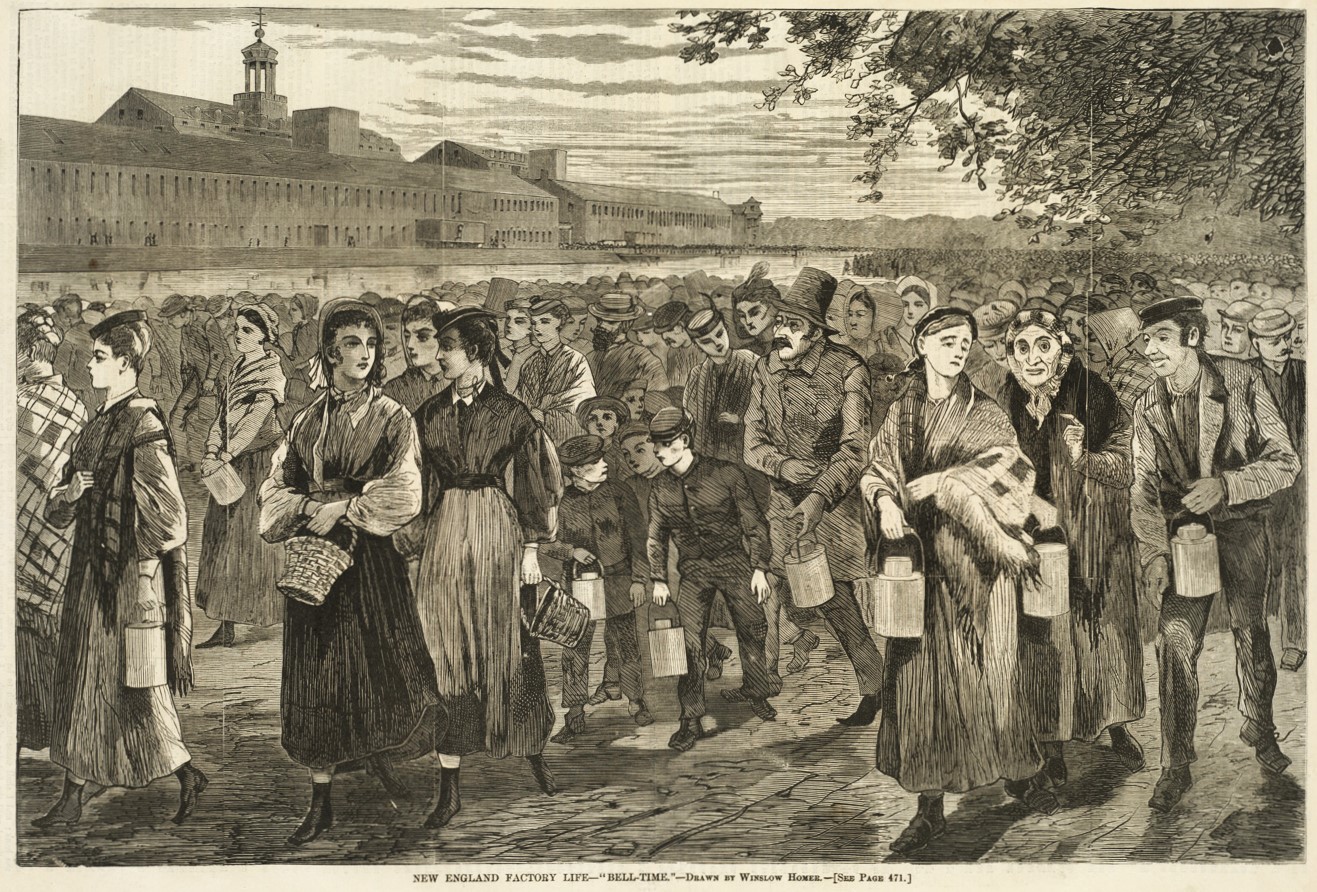
The story of some of the first organizing and strikes among women workers in the United States as New England ‘mill girls’ fight for the ten-hour day in the 1840s.
‘1847- The First Ten-Hour for Women in America’ by Ruth Delzell from Life and Labor (Women’s Trade Union League). Vol. 2 No. 6. June, 1912.
“All Hail New Hampshire! The ‘Ten Hour Bill’ passed the House by one hundred and forty four majority!” This was the joyful news published in the “Voice of Industry” that greeted the working girls of that state on the morning of July 9, 1847.
The struggle which is going on to-day for a shorter work day for women is by no means a new one. In the “History of Women in Trade Unions,” Dr. John B. Andrews tells of the early efforts at legislation, for though this New Hampshire law was the first to be passed, there had already occurred several strikes in the neighborhood of Pittsburg.
In the fall of 1843 the girls in the cotton mills of Pittsburg had been working from five o’clock in the morning till a quarter of seven in the evening, getting off at four o’clock on Saturday. When, however, the time was increased one hour each day without extra pay, these girls rebelled.

In September, 1845, the operatives in five cotton mills in Allegheny near Pittsburg struck, and when they resumed their work a couple of weeks later, it was with the understanding that if the employers in other sections of the country would act together, they would grant the demand for a ten-hour day. The Western girls at once wrote to their New England fellow-workers, The factory girls of Manchester, N.H., in mass meeting resolved to co-operate with their sisters at Pittsburg and Allegheny, and concurred in the proposal to “declare their independence of the op- pressive manufacturing power,” on July 4, 1846, unless the ten-hour system were adopted.
Leading in this fight for the shorter work day was the newly organized Lowell Female Labor Reform Association, which had been organized in 1845, and which in Article IX of its constitution outlined the policy of the union as follows:
“The members of this association disapprove of all hostile measures, strikes, and turn-outs until all pacific measures prove abortive, and then that it is the imperious duty of everyone to assert and maintain that independence which our brave ancestors bequeathed us and sealed with their blood.”
Miss Sarah G. Bagley, who had worked for ten years in the cotton factories at Lowell, was elected the first president, and was a woman of unusual charm and ability. If we accept the statement of the “Voice of Industry”, the preamble adopted at the annual meeting on the first Tuesday in January, 1846, shows the spirit of these working women. It said:
“It now only remains for us to throw off the shackles which are binding us in ignorance and servitude and which prevent us from rising to that scale of being for which God designed us. With the present system of labor it is impossible. There must be reasonable hours for manual labor and a just portion of time allowed for the elevation of the mental and moral faculties, and no other way can the great work be accomplished. It is evident that with the present system of labor the minds of the mass must remain unelevated, their morals unimproved. Shall we, operatives of America, the land where democracy claims to be the principle by which we live and by which we are governed, see the evil daily increasing which separates more widely and more effectually the favored few and the unfortunate many without one exertion to stay the progress? God forbid! Let the daughters of New England kindle the spark of Philanthropy in every heart till its brightness shall fill the whole earth.”
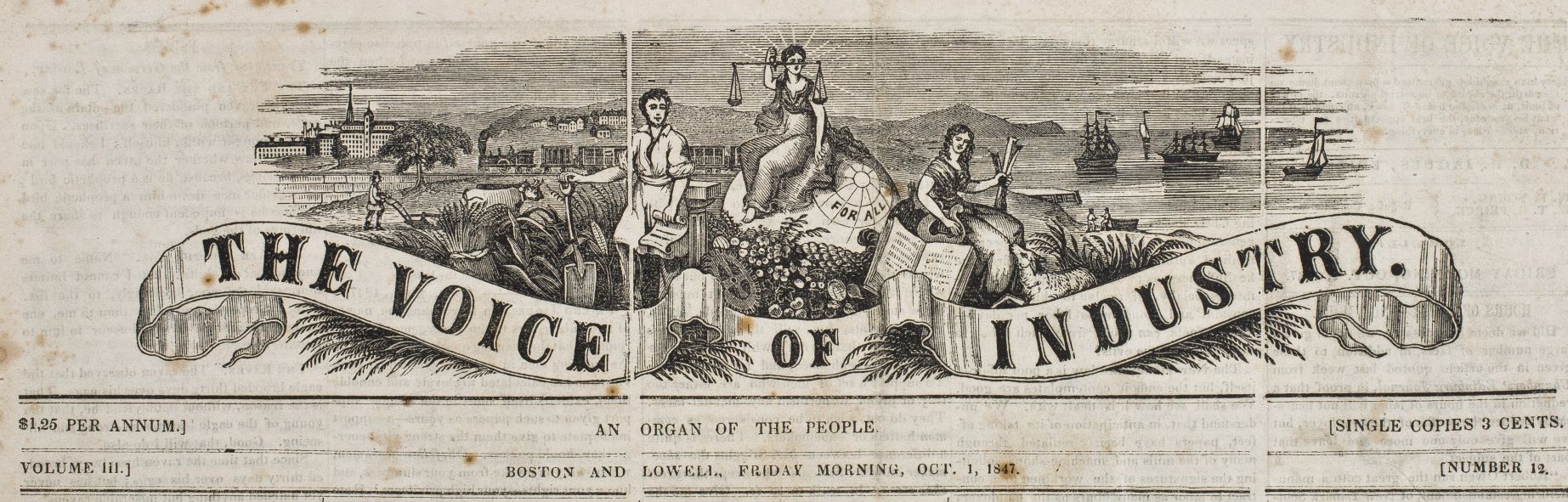
Not satisfied with securing thousands of signatures of factory operatives, who petitioned the legislature for a ten hour day, prominent members of the union, including Miss Bagley, went before the Massachusetts legislative committee early in 1845 and testified as to the conditions in textile mills. This was the first American governmental investigation of labor conditions, and it was due almost solely to the petitions of the working women. About the same time the union appointed a committee to investigate and expose false statements published in newspapers concerning the factory operatives, and they appointed their secretary, Miss Hulda J. Stone, regular correspondent to the “Voice of Industry.” Nor was this all, in their work of publicity they did not hesitate to call public men to account for assailing or ignoring their movement. Resolutions of indignation concerning the action of the committee on hours of labor in the Massachusetts legislature were published, and the fact that they did not labor in vain is apparent in the two following resolutions:
“Resolved, That the Female Labor Reform Labor Association deeply deplore the lack of independence, honesty, and humanity in the committee to whom were referred sundry petitions relative to the hours of labor, especially in the chairman of that committee; and as he is merely a corporation machine, or tool, we will use our best endeavors and influence to keep him in the “City of Spindles,” where he belongs, and not trouble Boston folks with him.
“Resolved, That the members of this association tender their grateful acknowledgments to the voters of Lowell for consigning William Schouler to the obscurity he so justly deserves for treating so ungentlemanly the defense made by the delegates of this association before the special committee of the legislature, to whom was referred petitions for the reduction of the hours of labor, of which he was chairman.”
The spirit of protest against long hours of work, however, expressed itself in other ways than in the demands upon the legislature. In September, 1846, the girls in two rooms of the mills at Nashua, N.H., one day “turned out at lighting-up time and refused to work by candle-light.” The overseer sought to punish them by not letting them out of the yard until the regular time, but while they waited, the machinists and others joined them, and nearly one thousand persons surrounded the factory gate to welcome the girls with a round of cheers. Thereupon the constable appeared, and began to read the riot act to them, but with one accord, both girls and men turned upon the lone officer with a chorus of cheers and hurrahs, until he could say nothing and was forced to retreat. One year later, September 15, 1847, the ten-hour law of New Hampshire went into effect.

Unfortunately this law as well as the Pennsylvania law in 1848, and the New Jersey law which followed in 1851, had drafted into the statute a clause which. permitted employers to hire for more than ten hours by “special contract.” Three days before the law went into effect New Hampshire employers submitted such “special contracts” to their employees, giving them the option of working more than ten hours or not working at all. And in the New York Weekly Tribune, September 15, 1847, we read Horace Greeley’s protest, expressed in no uncertain terms against this practice. Said Mr. Greeley:
“We are told that workingmen can take care of themselves, and that legislation does not afford the proper remedy for the evils complained of. To this we answer that if the laborers have really their free choice to work ten hours only or the twelve or thirteen usually required, there is nothing further to be said if they choose badly. (We may think them serfs or ninnies, but we have no right to interfere.) As to legislation, the friends of labor reform cheerfully admit that if the change they seek can be effected without the aid of the law they would prefer to have it so. But suppose the fact to be that the employers of labor in certain vocations say, “We choose to have our works kept in motion twelve or thirteen hours per day by the same hands, believing our interest will thereby be promoted. If the men who now work for us will not do our bidding in this respect we will discharge them and hire others instead; and there are so many in want of employment that we shall have no difficulty in obtaining as many as we want, even though we see fit to exact fourteen hours’ work per day-what is to be done? Shall private cupidity be permitted to overrule the dictates of public health, the claims of intellectual culture, and of social relaxation and enjoyment- to undermine the constitutions of the laboring class and visit diseases and deformity on generations yet unborn!”
Complaints of legislative intermeddling with private concerns and engagements- vociferations that labor can take care of itself and needs no help from legislation -that the law of supply and demand will adjust this matter, aroused Editor Greeley to protest in this effective fashion.
“To talk of the freedom of labor, when the fact is that a man who has a family to support and a house hired by the year is told “If you work thirteen hours per day, or as many as we think fit, you can stay; if not, you can have your walking papers; and well you know that no one else hereabouts will hire you”-is it not most egregious flummery!”
Life and Labor was the monthly journal of the Women’s Trade Union League (WTUL). The WTUL was founded by the American Federation of Labor, which it had a contentious relationship with, in 1903. Founded to encourage women to join the A.F. of L. and for the A.F. of L. to take organizing women seriously, along with labor and workplace issues, the WTUL was also instrumental in creating whatever alliance existed between the labor and suffrage movements. Begun near the peak of the WTUL’s influence in 1911, Life and Labor’s first editor was Alice Henry (1857-1943), an Australian-born feminist, journalist, and labor activists who emigrated to the United States in 1906 and became office secretary of the Women’s Trade Union League in Chicago. She later served as the WTUL’s field organizer and director of the education. Henry’s editorship was followed by Stella M. Franklin in 1915, Amy W. Fields in in 1916, and Margaret D. Robins until the closing of the journal in 1921. While never abandoning its early strike support and union organizing, the WTUL increasingly focused on regulation of workplaces and reform of labor law. The League’s close relationship with the Amalgamated Clothing Workers of America makes ‘Life and Labor’ the essential publication for students of that union, as well as for those interest in labor legislation, garment workers, suffrage, early 20th century immigrant workers, women workers, and many more topics covered and advocated by ‘Life and Labor.’
PDF of issue: https://books.google.com/books/download/Life_and_Labor.pdf?id=epBZAAAAYAAJ&output=pdf
 Revolution's Newsstand